
Objectives:
Objective 1: To highlight the historical and spiritual significance of the Śrī Narasimha Mandira.
Objective 2: To understand the architectural features of the Śrī Narasimha temple.
Objective 4: To understand the significance of the presiding deities in the Narasimha temple.
Objective 5: To understand the scriptural significance of the Yajna Narasimha Temple.
Introduction
Objective 1: To highlight the historical and spiritual significance of the Śrī Narasimha Mandira.
It is an ancient temple, where Lord Narasimha manifested here before Lord Jagannatha and His temple. The Śrī Narasimha Mandira in Puri, often called Yajna-Narasimha or Narasinha Deuḷa, is an ancient, historically significant temple located west of the Gundicha Temple and east of the Indradyumna Sarovara.
It is considered the guardian deity of the area, with 4-armed Laxmi-Narasimha as the primary deity. This temple is dedicated to Bhagwan Narasimha, the fourth incarnation of Bhagwan Vishnu. The height of the temple is about 60 feet. Local people also call this Nursingha temple.
Key Details About the Temple
● Location: Situated near the Gundicha temple, close to the Indradyumna Tank in Puri, Odisha.
● Significance: It is believed that Lord Narasimha appeared here to help King Indradyumna install the deity of Lord Jagannatha.
● Structure: The temple is a pancharatha rekha deula measuring approximately 55 feet in height.
● Worship: Lord Narasimha is considered the Kshetrapala (guardian deity) of Puri.
Architecture
Objective 2: To understand the architectural features of the Śrī Narasimha temple.
The temple faces towards the west and the height of the temple is about 60 feet. It is a Kalingan order of temple consisting of four structures such as the Vimana, Jagamohana, Natamandapa and Bhogamandapa.
The Vimana and Jagamohana are square on plan and the Natamandapa and Bhogamandapa are rectangular. The temple is built in both sand stones and laterite stones. The temple is a Pancharatha on plan and Panchangabada in elevation.
The three sides central niches of the side of Vimana house the images of Varaha, Trivikrama (Vamana) and Vishnu as the Parsvadevatas of the main presiding deity.
The image of four armed Varaha, standing over a lotus pedestal, is the Parsvadevata of the southern side. He holds Chakra in his uplifted back right upper hand while his lower left hand holds a conch above Goddess Prithvi.
The Parsvadevata on the northern side niche is Trivikrama (Vamana). The four handed image of Trivikrama has been installed on the double petalled lotus pedestal. He holds gada in right upper hand, lotus flower in right lower hand, chakra in left upper hand and conch in left lower hand respectively.
Figures of Sridevi and Bhudevi are flanked on either side of the deity. The right leg of deity is set firmly on the ground and another uplifted left foot touches the image of Brahma. Beneath his uplifted leg is a scene of Bali who is presenting the gift to Vamana while Shukracharya lifts his hands up in dismay.
The image of four armed Vishnu, standing over a lotus pedestal, is the Parsvadevata of the eastern or backside central niche of the main Deity.
The western wall is carved with a miniature rekha angasikhara surmounted by a gajakranta. There are divine figures right above the raha at beki. The doorjambs of the vimana are carved with two vertical bands.
In the lalatabimba, there is a Gajalaxmi image seated over a lotus pedestal in lalitasana. At the base of the doorjambs there are two Khakhara mundis on either side, that house the four armed vaisnavite dwarapala holding attributes of lord Vishnu.
Local people also call this temple as Nrusingha Temple and Nrusimha Temple. The presiding deity is Lord Narasimha. There are two images of Lord Narasimha inside the temple, one behind the other.
The image in front is called Shanta Narasimha. In the local language ‘Shanta’ means ‘Calm’ or ‘Sober’. Anyone who sees this image of Lord Narasimha will have his anger, frustration, and anxiety vanish.
The Deity in the back is called Ugra Narasimha. In the local language ‘Ugra’ means ‘Angry’. He is the internal mood of Narasimha.
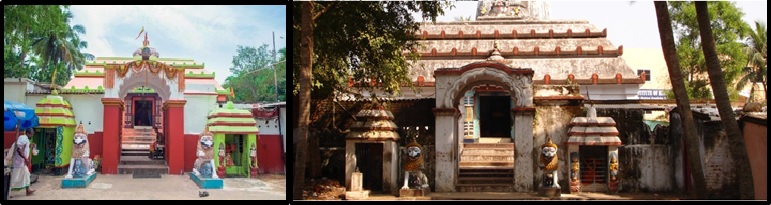
Yajna Narasimha Temple
Leelas/Pastimes associated with the place
Objective 3: To understand the historical pastime associated with the Śrī Narasimha Temple during the attack of Kalapahad.
When Kalapahad attacked Puri and was smashing Deities of various temples, he saw Shaanta Narasimha image and his anger subsided; hence he could not break the Deity as he had planned.
Santa Narasimha’s features are human-like. He has a sharp human nose, a large curly mustache, and an outstretched tongue. Non-Hindus are not permitted in the temple, but the Deities are visible from the door.
Presiding Deities
Objective 4: To understand the significance of the presiding deities in the Narasimha temple.
There are two deities of Lord Narasimha one behind the other, that are worshiped in this temple.
Shantha Narasimha (peaceful) is in the front. Shantha Narasimha has human-like features: a sharp nose, curvy moustache and an outstretched tongue. By seeing Shantha Narasimha one will feel cool and relaxed; all anger, anxiety and frustration will vanish.
Once a marauder named Kalapahad ransacked Puri and broke many Deities. Upon seeing Shantha Narasimha, his anger subsided and he did not touch the Deity. He saw Shanta Narasimha’s image and his anger subsided, hence he could not break the Deity as he had planned.
Deity behind is Ugra Narasimhadeva. He is in the angry mood of Narasimha, which is not usually seen and may be seen only with the help of the pujari’s lamp.
This is the fearful form of Lord Narasimha Deva.
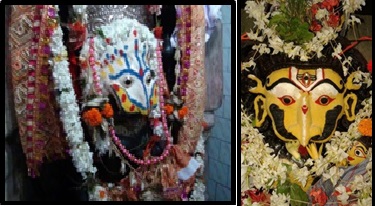
Yagna Narasimha
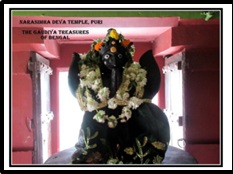
Scriptural Reference
Objective 5: To understand the scriptural significance of the Yajna Narasimha Temple.
The temple’s location, known as Mahavedi, is associated with King Indradyumna, who is said to have performed a thousand Ashavmedha Yagnas (horse sacrifices) here.
As depicted in the Skanda Purana once King Indradyumna stayed near Nilakantheswar temple to make arrangements to perform Ashwamedha Yajna for one thousand years.
On the advice of Sage Narada, King Indradyumna made a Nrusimha image out of black stone and placed the image under black sandal wood tree and worshipped Him.
It is believed that in front of this temple the Ashwamedha Yajna took place and hence He is known as ‘Yajna Narasimha’.
Devotees will earn more punya if they make a darsana of Sri Nilakantheswar, Yajna Narasimha and Panchamukhi Hanuman (Lord Hanuman with five faces) after the sacred bath in Indradyumna Tank.
Festivals like Narasimha Janma, Satapuri Amavasya etc. are observed in Nrusingha temple with great devotion.
How to Reach
The temple of Yagna Narasimha is situated to the north east of Gundicha temple, close to its boundary wall.
When you walk from Gundicha temple towards Indradyumna Sarovara, Yagna Narasimha is a short distance on your right.
It is situated at a distance of just 3 kilometers from the Jagannath temple in Puri. It is located at the end of Badadanda or Grand Road near the north east boundary wall of the famous Gundicha Temple.
The place is quite renowned and one can avail cabs to reach there directly.
Nearest Railway Station
Puri Railway Station
Nearest Airport
Biju Patnaik International Airport, Bhubaneswar
Timings
Open Close Timing
5:30 am – 9:00 pm
Festival
Narasimha Jayanti, Satpuri Amavasya
