
Objective 1: To understand the architectural significance of the Mukhasala (Jagamohana), its role among the four principal structures of the Jagannath Temple, and the importance of its four sacred doorways in temple worship and rituals.
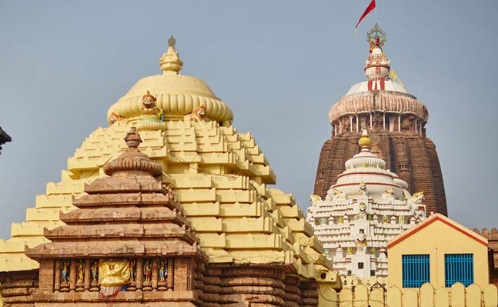
In the architecture of the Jagannath Temple in Puri, the Mukhasala (also known as the Jagamohana) is the main front porch or entrance hall leading directly into the inner sanctum. It is one of the four essential structures that make up the Kalinga style of temple design.
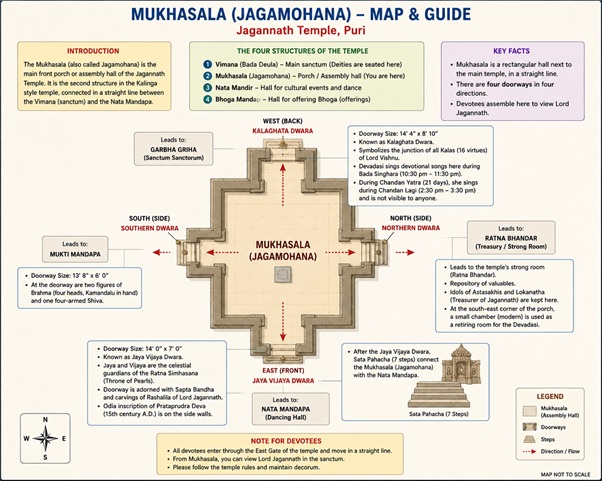
The Puri temple layout is divided into four interconnected halls aligned in a straight line:
1. Vimana (or Bada Deula):The main sanctum sanctorum where the primary deities (Jagannath, Balabhadra, and Subhadra) are seated.
2. Mukha Sala (or Jagamohana): The porch or assembly hall attached to the front of the Vimana. Devotees pass through or assemble here to view the deities.
3. Nata Mandir: The hall used for cultural events, traditional dance performances, and viewing.
4. Bhoga Mandap: The hall where offerings (Bhoga/Prasad) are presented to the deities.
The western doorway opening to the Garbha Griha is known as “Kalaghata Dwara” 14 feet and 4 inches by 8 feet and 10 inches. Vishnu is the emblem of sixteen virtues (Kalas) and the doorway is supposed to be the junction of all these Kalas. The Devadasi sings devotional songs standing near this doorway during the Bada Singhara time (usually between 10.30 pm to 11.30 pm and everybody is allowed to see her while she sings. But during the twenty-one days of Chandan Yatra, she sings during the time of Chandan Lagi, normally between 2.30 pm to 3.30 pm, and nobody is allowed to see her while she sings.
The southern doorway leads to the Mukti Mandapa. At the southern doorway (13 feet and 8 inches by 6 feet) of the porch there are two figures of Brahma with four heads and Kamandalu (Stoup) in hand, and one four-armed Shiva nicely carved.
The northern doorway leads to a chamber which is the strong room of the temple, known as the Ratna Bhandara. It is a repository of valuables. The images of Astasakhis and the image of Lokanatha, the Treasurer of Jagannath, have been mounted here. At the south-east corner of the porch and detached from it, there is a small chamber of modern date which serves as a retiring-room for the Devadasi.
The eastern doorway opening to the Nata Mandapa is known as “Jaya Vijaya Dwara” (14 feet by 7 feet). Jaya and Vijaya are the celestial creatures of heaven who guard the Ratna Simhasana (Throne of Pearls). This doorway is one of the finest specimens of Odishan architecture with Sapta Bandha.
All aspects of Rashalila of Lord Jagannath have been represented here. The Odia inscription of Prataprudra Deva (15th century A.D.) has been inscribed on the side walls of the doorway.
After the Jaya Vijaya Dwara, Sata Pahacha (seven steps) connect the Jagamohana with the Nata Mandapa (the dancing hall).
