
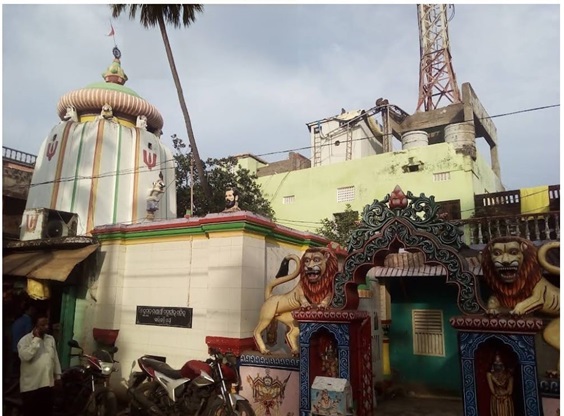
Objective 1: To explain the Ashta Mahavira tradition and detail how eight Hanuman shrines were established to protect Puri’s Jagannatha Temple.
1. The Ashta Mahavira Tradition of PuriAccording to local tradition recounted by priests and scholars of the Jagannatha cult, the Bay of Bengal is said to have damaged the temple precincts on more than one occasion in the past. Lord Jagannatha is accordingly believed to have appointed Hanuman — Rama’s greatest devotee and, in Vaishnava understanding, an eternal (chiranjivi) being — to stand guard over Puri and its temple. Because a single sentinel could not watch every direction and every kind of threat at once, this guardianship came to be distributed across eight Hanuman shrines scattered through the town and its outskirts, collectively called the Ashta Mahavira.
The eight shrines usually listed are Siddha Mahavira, Bedi Mahavira (also called Daria Mahavira), Kanapata Mahavira, Vargi Mahavira, Masani Mahavira, Panchamukhi Mahavira, Phate Mahavira, and Siruli Mahavira. In addition to this set of eight, Hanuman is also worshipped at each of the four gates of the Jagannatha Temple itself — as Phate Hanuman at the eastern Lion’s Gate, Vira Vikrama (or Kanapata) Hanuman at the western gate, Tapasvi Hanuman at the northern gate, and Bada Bhai Hanuman at the southern gate — a separate but related layer of Hanuman guardianship immediately around Srimandira.
Each of the eight Mahavira shrines carries its own local legend explaining what particular danger it guards against: the sea, straying armies, disturbing sounds, or, in less well-documented cases such as Masani Mahavira, simply the general protective presence expected of a Mahavira shrine within the Kshetra.
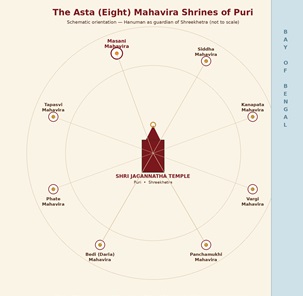
Schematic diagram of the Ashta Mahavira shrines around Sri Jagannatha Temple, Puri (illustrative, not to scale). Masani Mahavira is highlighted.
Objective 2: To outline the identity, history, and modest architectural scale of Masani Mahavira, including its local devotional significance and 17th–18th century origins.
2. Masani Mahavira: Identity and Quick FactsWithin this group, Masani Mahavira is described in available sources as a locally popular Hanuman shrine of modest scale. The presiding image is reported to be a comparatively small standing form of Hanuman, roughly two feet in height — notably smaller than the six-foot deity at Siddha Mahavira or the four-foot image at Bedi Mahavira. This modest scale is consistent with its character as a neighbourhood or locally significant shrine rather than one of the grander pilgrimage temples of Puri.
| Attribute | Detail |
|---|---|
| Deity | Lord Hanuman, worshipped in his Mahavira (“Great Hero”) guardian aspect |
| Position in the group | One of the Ashta (eight) Mahavira / Hanuman shrines guarding Puri Dhama |
| Character of the shrine | A modest, locally venerated neighbourhood shrine rather than a large temple complex |
| Approximate date | Traditionally placed in the 17th–18th century CE |
| Deity image | A comparatively small standing/seated Hanuman image, reported at roughly two feet in height |
| Present condition | Documented as an under-recorded heritage site, in need of conservation attention |
| Function within the group | Shares in the collective duty of the Ashta Mahavira: guarding Shreekhetra and Srimandira from all quarters |
Published sources consulted for this note do not offer a documented explanation of how Masani Mahavira received its name, unlike some of the other Ashta Mahavira shrines whose names are directly tied to a recorded legend (for example, Bedi/Daria Mahavira and the story of the sea, or Vargi Mahavira and the Maratha raiders). In the wider Odia and Hindi linguistic context, terms built on the root ‘masan/shmashan’ are commonly associated with cremation grounds or burial sites, and Hanuman shrines are traditionally placed at the edges of towns or near such boundary sites as protective sentinels.
This is offered here only as a linguistic observation and not as a verified historical claim, since no source reviewed for this note confirms a cremation-ground origin for the name.
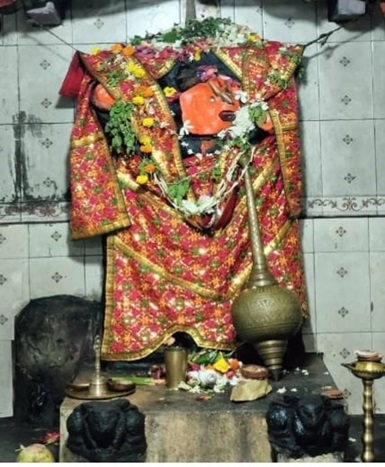
As one of the Ashta Mahavira, Masani Mahavira shares in the collective theological role assigned to all eight shrines: standing guard over Shreekhetra so that Lord Jagannatha’s abode remains undisturbed by external calamity. Devotionally, Hanuman occupies a distinctive place in the Jagannatha tradition of Puri — not simply as a Ramayana figure but as an ever-present, living guardian (chiranjivi) whose worship is folded directly into the ritual calendar of the main temple.
Pana Sankranti (Mahabishuba Sankranti), which marks the Odia New Year in mid-April, is observed at Sri Jagannatha Temple as the birthday of Lord Hanuman, when the Mahavira Hanuman at the Lion’s Gate receives special honours from Lord Jagannatha. Festivals commonly observed at Hanuman shrines across Puri, including the smaller Mahavira shrines, include Hanuman Jayanti, Rama Navami, Makara Sankranti, and Dola Purnima, though the specific festival calendar followed at Masani Mahavira in particular is not separately documented in the sources reviewed.
The Ramananda Vaishnava sect is credited by several accounts with having encouraged and organised the installation of Hanuman images at multiple sites across the Puri Kshetra, contributing to the emergence of this broader pattern of Hanuman worship around the Jagannatha Temple, of which the Ashta Mahavira — and by extension Masani Mahavira — forms a part.
4. Architectural and Historical NotesMasani Mahavira is described in the sources reviewed as dating traditionally to around the seventeenth to eighteenth century CE, a period that saw continued patronage and elaboration of shrines within the Puri Kshetra. Unlike Siddha Mahavira, whose sixteenth-century construction under Gajapati patronage and Konark-linked sculptural fragments are recorded in some detail, no comparable architectural study of Masani Mahavira’s structure, materials, or sculptural programme was located for this note.
More than one source explicitly characterises Masani Mahavira as an under-recorded heritage site in need of conservation attention — a status shared with a number of smaller shrines scattered through the older parts of Puri town, many of which have received far less scholarly and archaeological documentation than the principal Jagannatha Temple complex and its immediate satellite shrines.
Objective 3: To provide practical visiting guidance for pilgrims while highlighting Masani Mahavira’s status as an under-recorded heritage site in need of conservation.
5. Visiting Notes- Masani Mahavira lies within Puri town, in keeping with the other Ashta Mahavira shrines, most of which are located within a few kilometres of the Jagannatha Temple; local enquiry is recommended to confirm the exact lane and current access, as detailed street-level directions were not found in the sources consulted.
- As with the other Mahavira shrines, modest and respectful attire is customary, and visitors are generally expected to remove footwear before entering.
- Because Masani Mahavira is a locally venerated, small-scale shrine rather than a major tourist site, it is best approached as part of a broader circuit of the Ashta Mahavira or the wider heritage lanes of old Puri, ideally with local guidance.
- Pilgrims undertaking a full Ashta Mahavira circuit typically combine visits to Siddha, Bedi, Kanapata, Vargi, Masani, Panchamukhi, and Phate Mahavira within Puri town, with Siruli Mahavira, being farther away, often visited separately.
Masani Mahavira occupies a modest but genuine place within Puri’s layered sacred geography as one of the eight Mahavira forms of Hanuman that traditionally guard Shreekhetra. While it lacks the scale and the well-recorded legend of shrines such as Siddha Mahavira or Bedi Mahavira, its inclusion in every enumeration of the Ashta Mahavira across devotional, journalistic, and heritage sources confirms its recognised place in the tradition. Its relative obscurity in the documentary record is, if anything, a reminder that a number of Puri’s smaller guardian shrines await fuller scholarly and archaeological attention — a gap this note has tried to describe honestly rather than paper over.
