
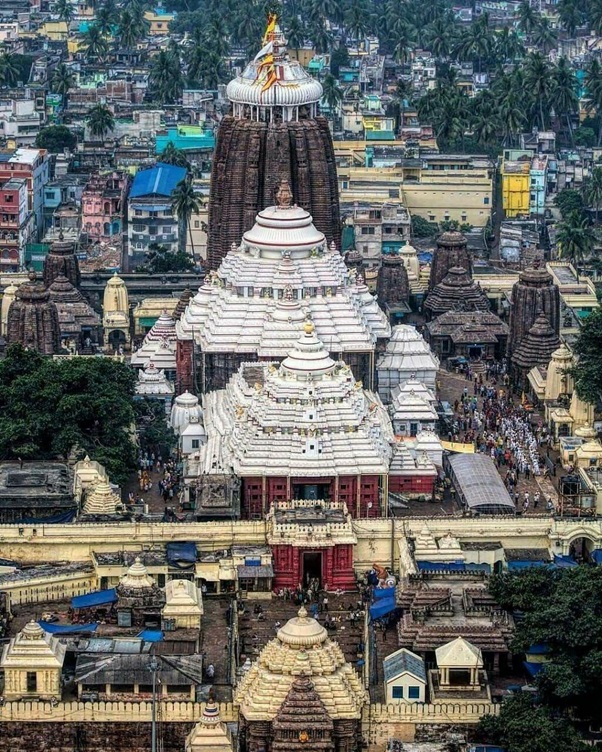
Sri Mandir at Sri Kshethram (Puri)
Objectives
DHAM (Sri Kshethram)
Objective 1: To understand what a Dham is, why it is spiritually significant, and why Śrī Jagannāth Purī holds a special place among the Lord’s holy abodes.
Objective 2: To explore the sacred names of Puri Dham.
Objective 3: To know the glories of Puri Dham.
DEITIES AND TEMPLE (Sri Mandir)
Objective 4: To understand the divine appearance of Lord Jagannāth, Balabhadra, Subhadrā, and Sudarśana, and the role of King Indradyumna’s search for Nīla Mādhava in the manifestation of the Lord’s Dāru Vigraha form.
Objective 5: To understand how Lord Jagannāth’s unique form first manifested in Dwaraka as an expression of Mahābhāva and appreciate its spiritual significance.
Objective 6: To describe the history, architecture, and unique features of the Jagannath Temple, including its construction.
Deities and Rituals at Sri Mandir
Objective 7: To understand the significance of Lord Jagannāth, the unique wooden Deities (Dāru Vigrahas), and the spiritual meaning of the sacred Navakalevara ceremony at Sri Mandir (Lord Jagannath Temple, Puri).
Objective 8: To provide a detailed understanding of the daily worship schedule (nitis), emphasizing discipline, tradition, and the devotional service offered to the Lord.
Objective 9: To understand the traditional system of Jagannātha Sevakas and their indispensable role in the worship of Lord Jagannātha.
Objective 10: To explain the different daily and special decorations (Alankaras) of the Deities and their spiritual meanings.
Objective 11: To highlight the significance of festival-based Veshas (Special Dresses) and how they reflect various divine pastimes of Lord Krishna/Jagannath.
Ratha-yātrā (Festival of Chariots)
Objective 12: To learn about Sri Kshetra’s Jagannath Ratha Yatra.
Objective 13: To examine the origin and the scriptural references to Ratha-yātrā found in the Padma Purāṇa, Skanda Purāṇa, and other Vedic scriptures.
Objective 14: To explain why Lord Jagannāth resides at the Gundicā Temple for seven days during the Ratha-yātrā festival.
Objective 15: To appreciate the traditional process of constructing the three chariots and the hereditary service of the artisans who preserve this sacred tradition.
Objective 16: To explain the historical origin and traditional accounts associated with the name Pāhaṇḍi Vijaya.
Objective 17: To learn the rituals performed before the commencement of the Ratha-yātrā procession.
Objective 18: To learn why Goddess Lakṣmī visits Gundicā Temple and the symbolic meaning of her displeasure and return to the main temple.
Objective 19: To understand the significance of the Bāhudā Ratha-yātrā, the return journey of Lord Jagannāth, Lord Baladeva, and Subhadrā Devī to Śrī Mandira.
Objective 20: To understand the Gaudiya Vaiṣṇava understanding of Ratha-yātrā as Lord Kṛṣṇa’s symbolic return from Dwaraka to Vṛndāvana and the inner mood of Chaitanya Mahaprabhu and Srila Prabhupada.
Objective 21: To locate Jagannath Puri and to understand its importance as one of the holiest pilgrimage places in the world.
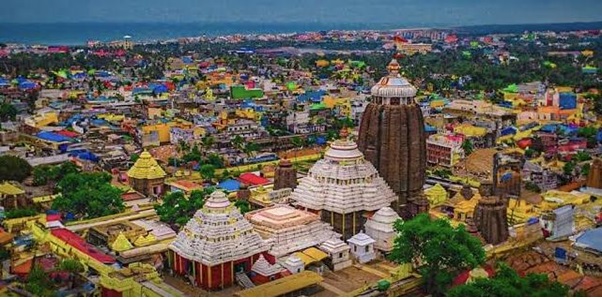
DHAM (Sri Kshethram) – Lord Jagannath Temple, Puri
1. DHAM (Sri Kshethram)
Objective 1: To understand what a Dham is, why it is spiritually significant, and why Śrī Jagannāth Purī holds a special place among the Lord’s holy abodes.
Introduction to Dham
A Dham is the eternal abode of the Supreme Lord. Śrīla Prabhupāda explains in the purport to Śrīmad-Bhāgavatam 4.8.42:
“Dham refers to a place where one can immediately contact the Supreme Lord.”
A Dham is where the glories of the Lord’s holy name, form, qualities, and pastimes are constantly heard and glorified. Vaiṣṇava ācāryas also explain that the heart of a pure devotee is itself a dhāma because Lord Govinda eternally resides there:
tomāra hṛdaye sadā govinda-viśrāma
“Govinda has blissfully and peacefully taken rest in your heart.”
Bhagavān is understood through His holy name, form, qualities, pastimes, and His Dhāma. Therefore, Lord Kṛṣṇa says to Nārada in the Padma Purāṇa:
nāhaṁ tiṣṭhāmi vaikuṇṭhe
yogināṁ hṛdayeṣu vā
yatra gāyanti mad-bhaktāḥ
tatra tiṣṭhāmi nārada
“I do not reside in Vaikuṇṭha nor in the hearts of the yogīs. I reside wherever My devotees glorify My activities.” Thus, wherever the Lord’s devotees sincerely glorify Him, the Lord personally resides.
Jagannāth Purī – The Supreme Dhāma
Among all sacred dhāmas, Jagannātha Purī, also known as Śrī Puruṣottama Kṣetra, occupies a unique position. It is eternally identical with the Supreme Lord.
Its greatest glory is that the Supreme Lord manifests there in His unique Dāru-Brahman form as Lord Jagannāth, Balabhadra, Subhadrā, and Sudarśana, revealing the highest ecstatic mood of divine love and separation.
As stated in Śrīmad-Bhāgavatam,
dharmaṁ tu sākṣād bhagavat-praṇītam
Lord Jagannāth is the original founder of Sanātana Dharma. To give joy to His devotees, He descended to this world and performed innumerable wonderful and mysterious pastimes.
Objective 2: To explore sacred names of Puri Dham.
Jagannāth Purī is glorified by many sacred names, including:
Śrī Kṣetra, Puruṣottama Kṣetra, Nīlācala Dhāma, Jagannātha Dhāma, Samanik Tīrtha, Uḍḍiyāna Pīṭha, Martya Vaikuṇṭha, Nīlagiri, Nīlādri, Śaṅkha Kṣetra, Bhū-svarga and Nṛsiṁha Kṣetra.
Because Śrī (Lakṣmī Devī) is the Svarūpa-śakti of the Lord, the land influenced by her divine energy is known as Śrī Kṣetra. Śrī Kṣetra is revered as Martya Vaikuṇṭha—the spiritual world manifested on Earth.
The Sacred Conch Region
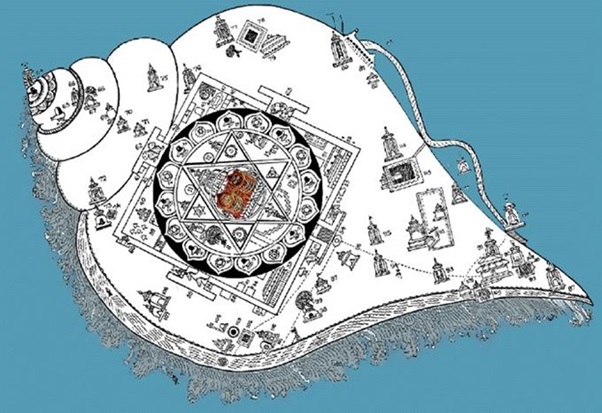
Śaṅkha Kṣetra – The Sacred Conch Region
Jagannāth Purī is also known as Śaṅkha Kṣetra because the entire dhāma is shaped like a conch shell (śaṅkha), one of Lord Viṣṇu’s eternal symbols. At the centre of this sacred conch lies the elevated region known as Nīlagiri (the Blue Hill). Upon its summit stands the magnificent temple of Lord Jagannāth.
Objective 3: To know the glories of Puri Dham.
Glories of Jagannāth Purī Dhāma
Unrestricted Mercy
Anyone who has the darśana of Lord Jagannāth in Purī receives the Lord’s boundless mercy and supreme liberation, regardless of background.
Mahāprasāda
Goddess Lakṣmī personally cooks for Lord Jagannāth. His Mahāprasāda is desired even by the celestial beings, and honoring it frees one from all sins.
Ratha-yātrā
The annual Ratha-yātrā symbolizes the loving attempt of the residents of Vṛndāvana to bring Lord Kṛṣṇa and Balarāma back from Dvārakā.
Lord Brahmā explained that the holy place of Purī (Śrī Kṣetra) is not an ordinary location but is manifested by the Lord’s internal spiritual energy. He also declared that simply seeing the temple flag and offering obeisances grants liberation.
The Sacred Sea
By coming into contact with this holy dhāma, the sea at Jagannāth Purī is glorified as Tīrtharāja, the king of all holy waters. It is said that anyone who bathes in this sacred sea becomes freed from previous sins.
DEITIES AND TEMPLE (Sri Mandir)
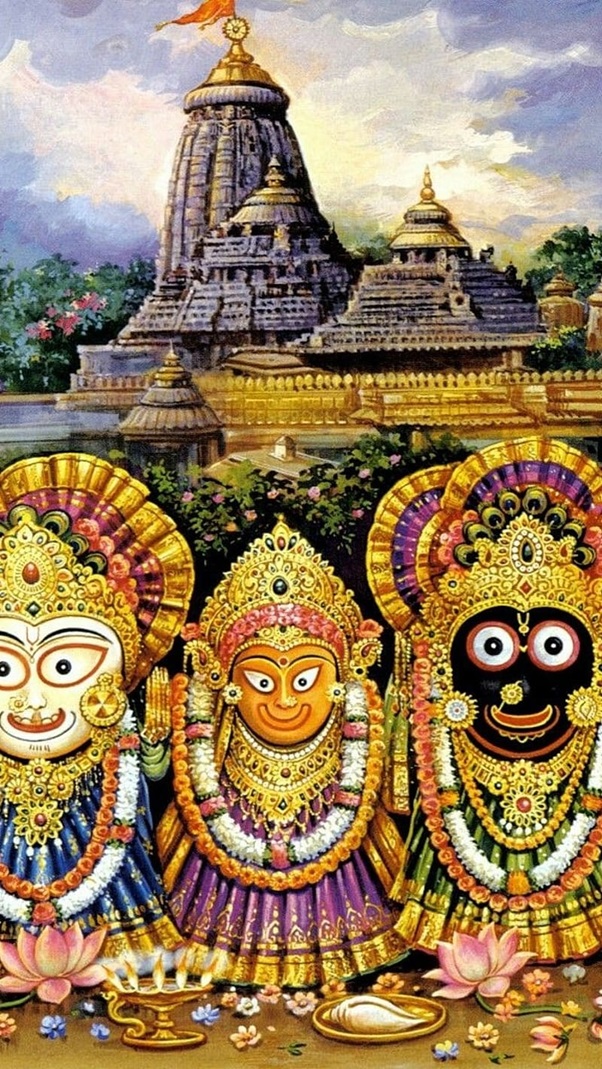
Objective 4: To understand the divine appearance of Lord Jagannāth, Balabhadra, Subhadrā, and Sudarśana, and the role of King Indradyumna’s search for Nīla Mādhava in the manifestation of the Lord’s Dāru Vigraha form.
The Appearance of Lord Jagannāth and Other Deities
The word Jagannāth comes from two Sanskrit words:
● Jagat – the universe
● Nātha – the Lord or Maintainer.
Thus, Jagannāth means “Lord of the Universe.”
Goddess Lakṣmī foretold that during Satya-yuga, the great devotee King Indradyumna, performer of one thousand Aśvamedha Yajñas, would come to Puruṣottama Kṣetra. After the completion of these yajñas, the Supreme Lord would appear before the world in the form of Dāru Vigraha (wooden Deities) to bestow mercy upon innumerable living beings. Due to this Puri is called as Sri kshethram.
King Indradyumna’s Desire to See the Lord
King Indradyumna was a devout follower of Lord Viṣṇu and longed to see Him face to face. One day, by divine arrangement, a travelling devotee visited the King’s court and spoke about a mysterious form of Lord Viṣṇu known as Nīla Mādhava.
Hearing about this form filled the King with deep enthusiasm and eagerness. Determined to find the Lord, he sent many learned brāhmaṇas in different directions to locate Nīla Mādhava.
However, all the brāhmaṇas returned unsuccessful except one named Vidyāpati. His journey would become the turning point in revealing the Lord’s hidden presence.
Discovery of Nīla Mādhava
After searching many regions, Vidyāpati reached the Sabara tribal settlement and stayed with the tribal chief Viśvāvasu, whose daughter Lalitā later became his wife.
Vidyāpati noticed that Viśvāvasu returned each day with a divine fragrance. Lalitā revealed that her father secretly worshipped Lord Nīla Mādhava.
At Vidyāpati’s request, Viśvāvasu agreed to take him to the Deity but blindfolded him to keep the location secret. Lalitā cleverly tied mustard seeds to Vidyāpati’s cloth so he could mark the path.
Upon seeing Lord Nīla Mādhava, Vidyāpati was overwhelmed with ecstasy and offered heartfelt prayers, realizing the Lord mercifully appears in the arca-vigraha (Deity) form to accept the loving service of His devotees.
The Miracle of Liberation
Vidyāpati witnessed a crow fall into a nearby sacred lake, immediately attain a four-armed spiritual form, and ascend to the spiritual world. Inspired, he wished to enter the lake himself, but a divine voice stopped him and instructed him to inform King Indradyumna. This miracle revealed the extraordinary sanctity of the holy place and the Lord’s unlimited power to grant liberation.
The Lord’s Desire for Royal Worship
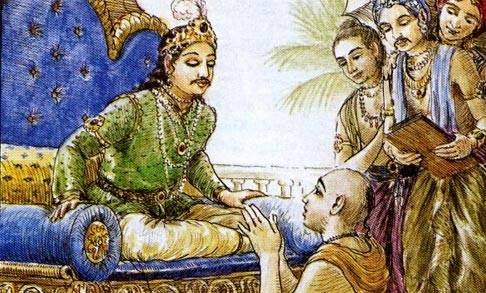
During worship, the Lord spoke to Vishvasu, expressing His desire to receive grand royal worship from King Indradyumna instead of the simple forest offerings. Vishvasu felt distressed at the thought of losing his personal service and temporarily detained Vidyapati. However, he eventually released him.
Vidyapati returned to the King and shared the entire account. Overjoyed, King Indradyumna set out with a large group to bring the Lord back.
Disappearance of Nīla-mādhava and Divine Instruction
Following the mustard plants that had grown from the seeds dropped earlier, the King reached the location. However, the Deity of Neela-madhava had disappeared. In frustration, the King arrested Vishvasu, but a divine voice instructed him to release the tribal devotee.
The voice further directed the King to construct a temple on Neela Hill, where the Lord would appear in a wooden form known as Daaru-brahman (the Absolute Truth manifested in wood). Despite all efforts, King Indradyumna still had not seen the Lord, which caused him great despair. He decided to give up his life through fasting.
Appearance of Daaru-brahman
In a dream, the Lord instructed the King that He would appear as a wooden log floating in the sea at a place called Bankimuhan. The King found this sacred log marked with divine symbols. However, despite using great force and many helpers, it could not be moved.
Again, the Lord appeared in a dream, instructing the King to bring Vishvasu and Vidyapati and place a golden chariot before the log. When this was done with devotion and chanting, the log was easily moved, demonstrating that divine service succeeds through devotion rather than force.
Carving of the Deities
Many skilled artisans attempted to carve the Deities but failed, as their tools broke. Finally, the Lord Himself appeared in disguise as an old sculptor and agreed to carve the Deities under one condition: he must work in seclusion for 21 days without interruption.
The King agreed, but after 14 days, hearing no sound from inside, he became anxious. Against advice, he opened the door prematurely. Inside, he found that the sculptor had disappeared and three Deities—Jagannath, Balarama, and Subhadra, Sudharshana chakra had manifested, but Their limbs were incomplete. The minister explained that the sculptor was the Lord Himself, and due to the King breaking his promise, the forms appeared in this unfinished state.
Significance of the Deity Form
Distressed, the King again decided to give up his life, but the Lord appeared to him in a dream and reassured him. The Lord explained that His form without complete limbs is intentional and represents transcendental reality beyond material limitations.
Though appearing without hands and legs, the Lord accepts offerings, hears prayers, and blesses devotees. This form upholds the Vedic truth that the Supreme Lord operates beyond material senses. The Lord also assured that devotees with pure love will see Him in His original beautiful form.
Physical Appearance of the Deities
In the inner sanctum of the Sri Jagannath Temple in Puri, the deities have distinct, abstract features:
● Lord Jagannath: Has a dark complexion, representing Lord Krishna. He is depicted with huge, perfectly circular black-and-white eyes, a reddish crescent-smile, jutting arms, and a rectangular, legless torso. He stands roughly 6 feet tall.
● Lord Balabhadra: Lord Jagannath’s elder brother, He has a fair complexion, elongated almond eyes, and stands slightly shorter than Jagannath.
● Devi Subhadra: Their sister, positioned between the two brothers, has a golden complexion and large eyes.
These striking, distinct forms are widely considered the epitome of divine beauty and are the centerpiece of the annual Ratha Yatra festival, where the Lord comes out of the temple to ride on massive chariots for the public to witness.
Objective 5: To understand how Lord Jagannāth’s unique form first manifested in Dwaraka as an expression of Mahābhāva and appreciate its spiritual significance.
Appearance of Lord Jagannath in Dwaraka
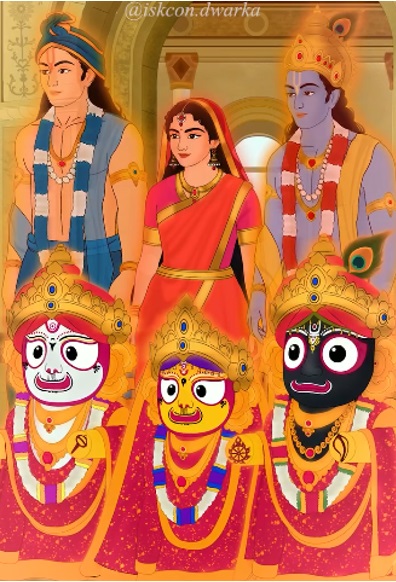
The unique form of Lord Jagannath—with wide, round eyes and a suppressed bodily structure—first manifested in Dwarka, not Puri. It is known as the Mahabhava Prakash form, reflecting the extreme spiritual ecstasy of Lord Krishna, Balarama, and Subhadra.
According to Vaishnava scriptures like the Mahabhava Prakash:
● The Narration: In Dwarka, Mother Rohini was narrating Lord Krishna’s pastimes in Vrindavana to the Lord’s queens.
● The Overwhelming Ecstasy: To ensure the queens and Rohini could speak freely, Krishna and Balarama (along with their sister Subhadra) arrived to listen in secret. Hearing the deep emotions and pastimes of their youth, they were so overcome with divine love that their eyes opened wide, and their limbs retracted into their bodies.
● The Manifestation: Sage Narada Muni witnessed this awe-inspiring, ecstatic form. Moved by the sight, he prayed that the Lord grant the entire world the opportunity to see and worship Him in this exact form. Lord Krishna granted the wish, leading to the appearance of these deities (Lord Jagannath, Baladeva, and Subhadra) in Puri.
The original occurrence of this form in Dwarka is celebrated during events like Snana Yatra, where the deities are bathed and adorned.
Objective 6: To describe the history, architecture, and unique features of the Jagannath Temple (Sri Mandir), including its construction.
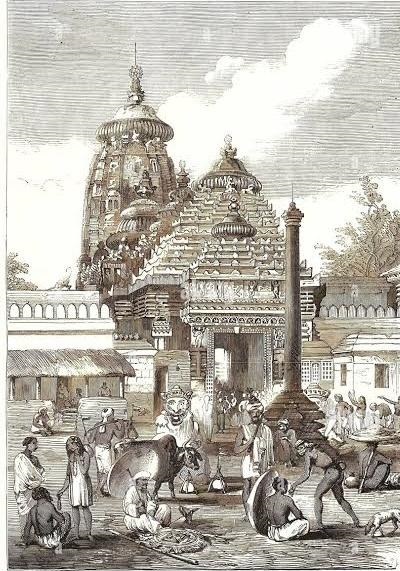
Sri Mandir
Jagannath means The “Lord of The Universe”. It is said that the present temple was built by King Chodaganga Deva (1078-1150 A.D.) and completed by his descendant Anangabhima Deva (A.D. 1170 to 1194), 4th successor to the Ganga dynasty.
The Ganga dynasty ruled Orissa from 1078 to 1434 A.D. and established Vaishnava Culture in Puri. Many saints and seers paid their visit to Puri. In course of time Saint Ramanuja (1056-1136 A.D.), the advocate of Visishta-advaita philosophy, saints like Nimbarka, Vishnu Swami and Madhvacharya paid their visit to Puri and established their monasteries. The great poet Jayadeva Gosvami of Orissa in the 12th century, composed the famous work Gita Govindam, dedicated to Lord Jagannath as Krishna Madhava.
The main temple structure is 65 meters (214 ft.) high and is built on high ground, which makes it look even larger than what it is. The temple complex has 10.7 acres and is surrounded by 2 rectangular walls.
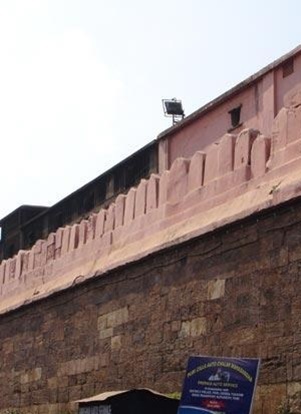
Meghananda Prachira (Compound Wall of Sri Mandir)
The outer surrounding is called Meghananda Prachira (665 × 640 feet). The walls are 6 meters (20 feet) high. The Inner wall is called Kurmabedha (420 × 315 feet). The walls are said to be built during the 15th or 16th century.
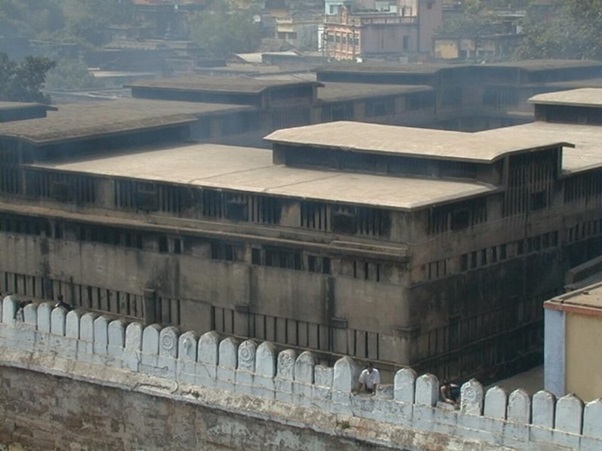
Kitchen-Sri Mandir ( Lord Jagannāth Temple).
Jagannath Temple has the largest kitchen in the world and feeds thousands of Devotees every day. Prasadam for 100,000 people is prepared daily and the kitchen can prepare Prasadam for up to 250,000 people on a festival day. There are 36 traditional communities who render a specific hereditary service to the deities. The temple has as many as 6,000 priests (Pandas).
Deities and Rituals at Sri Mandir Puri
Objective 7: To understand the significance of Lord Jagannāth, the unique wooden Deities (Dāru Vigrahas), and the spiritual meaning of the sacred Navakalevara ceremony at Sri Mandir (Lord Jagannath Temple Puri).
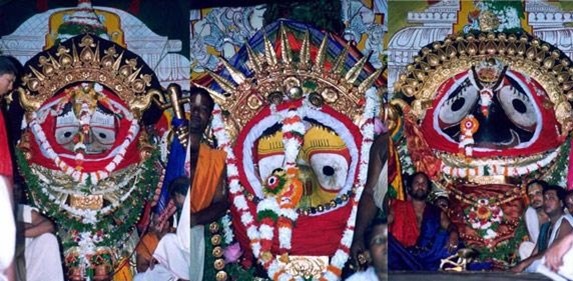
Lord Balabhadra, Goddess Subhadra and Lord Jagannath
Lord Jagannath, the embodiment of universal love and brotherhood, is worshipped in the sanctum of the Jagannath Temple together with His elder brother Lord Balabhadra, His sister Subhadra Devi, Sudarshana, Madhava, Sri Devi, and Bhu Devi. They are seated on the sacred Ratna Simhasana (Ratna Bedi), the jeweled throne of the temple.
The principal Deities of Lord Jagannath, Lord Balabhadra, Subhadra Devi, and Sudarshana are carved from the sacred neem tree (Daru). According to ancient scriptural injunctions, these wooden Deities are ceremonially renewed through the sacred festival of Navakalevara, which is observed whenever an extra lunar month (Adhika Ashadha) occurs before the annual Ratha-yatra (approximately every 12–19 years).
The word Navakalevara means “New Body” (Nava = new, Kalevara = body). During this rare and sacred ceremony, new wooden Deities are carved from specially selected neem trees, and the mysterious transfer of the sacred Brahma Padartha from the old Deities to the new ones is performed according to ancient temple traditions. The entire process lasts for nearly three months and culminates before the Ratha-yatra festival.
Traditionally, the term Navakalevara is understood in two ways:
1. The creation of new wooden Deities and the transfer of the sacred Brahma into Them.
2. The periodic renewal of the existing Deities through fresh protective coatings and repainting when a full Navakalevara is not performed.
Inside the sanctum, Lord Balabhadra, Subhadra Devi, and Lord Jagannath are worshipped in Their distinctive white, yellow, and black forms while seated upon the Ratna Simhasana. Devotees are traditionally permitted to perform pradakshina (circumambulation) of the sanctum during the designated morning period, generally between 8:30 a.m. and 9:30 a.m., subject to the temple’s daily rituals (nitis) and schedule.
Objective 8: To provide a detailed understanding of the daily worship schedule (nitis), emphasizing discipline, tradition, sevakas and the devotional service offered to the Lord.
Daily Rituals of Lord Jagannath Temple (Sri Mandir)
1. Early Morning Rituals (5:00 a.m – 6:30 a.m)
The daily worship (Niti) of Lord Jagannath, along with Balabhadra and Subhadra, follows a well-organized sequence of rituals from early morning till midnight. These rituals reflect deep devotion, discipline, and tradition, performed by different categories of servitors known as sevayats.
The day begins between 5:00 a.m. and 6:30 a.m. with the Dwaraphita, which is the opening of the temple doors in the presence of designated sevayats after verifying the temple seal, followed by the Mangala Aarati auspicious lamp offering. During this time, Pushpalaka sevakas change the Deities’ previous night’s clothes, flowers, and tulasi, offering fresh cotton clothes called Tadapa and Uttariya traditionally washed by the Dhoba sevaka.
By 6:00 a.m., the Mailam ritual involves the removal of decorations, followed by Abakash purification rituals such as brushing and bathing, while the temple astrologer announces the day’s tithi and schedule.
2. Morning Darshan and Decoration (6:45 a.m – 8:30 a.m)
Morning darshan and decoration take place from 6:45 a.m. to 8:30 a.m. A second Mailam occurs at 6:45 a.m. for another change of clothes, and a sacred lamp called Akhanda Baitha is lit to burn throughout the day. From 7:00 to 8:00 a.m., the Sahanamela allows devotees to have close darshan without a fee. At 8:00 a.m., the Beshalagi decoration ritual adorns the Deities with beautiful garments, gold, and ornaments. Simultaneously, several other rituals occur, including the Rosha Homa fire ritual in the kitchen, Surya Puja at the nearby temple, and the worship of gatekeepers Jaya and Vijaya.
3. Food Offerings and Worship (9:00 a.m – 1:30 p.m)
Food offerings and worship dominate the schedule from 9:00 a.m. to 1:30 p.m. The Gopala Ballava Puja at 9:00 a.m. serves as a breakfast offering of fruits, sweets, curd, and coconut. This is followed at 10:00 a.m. by the Sakala Dhupa, the main morning Raja bhoga meal featuring an elaborate 16 Upacharas that includes rice, khichdi, and traditional dishes.
Afterward, the Deities undergo another Mailam clothing change, while large quantities of offerings are made at the Bhoga Mandap for devotees and monasteries. Between 11:00 a.m.
and 1:00 p.m., the Madhyana Dhupa offers even more elaborate food and allows for special darshan near the sanctum. Finally, from 1:00 to 1:30 p.m., the Madhyanha Pahuda allows the Deities to take rest if time permits.
4. Evening Rituals (After 1:30 p.m. – 8:00 p.m.)
Evening rituals commence after 1:30 p.m. with the Sandhya Aarati. On special occasions like Ekadashi, the Deities’ clothes are changed following this lamp offering. The Sandhya Dhupa occurs from 7:00 to 8:00 p.m., providing an evening food offering with fewer items than the morning, followed by the Jaya Mangala Aarati. As the day transitions into night after 8:00 p.m., the Mailam and Chandana Lagi rituals involve another clothing change and the application of sandalwood paste mixed with camphor. The Deities then appear in the Badasinghara Vesha, the day’s most beautiful decoration featuring silk garments and floral ornaments provided by temple mathas. Around 11:00 p.m., the final food offering, Badasinghara Bhoga, consisting of light items like pakhala and sweets, is presented.
5. Night Rituals and Decoration (After 8:00 p.m. – Midnight)
The closing rituals at midnight, known as Khata Seja Lagi and Pahuda, involve preparing beds for the Deities and making final offerings of coconut and betel. Once the Deities are put to rest, the temple doors are sealed by a designated sevayat. These daily rituals highlight that the entire day is a disciplined sequence of dressing, bathing, and meals, where the Deities are treated as living beings. While the timings provide a structured framework for darshan and worship, they may vary due to practical or festival-related reasons.
Objective 9: To understand the traditional system of Jagannātha Sevakas and their indispensable role in the worship of Lord Jagannātha.
Jagannāth’s Servants and Their Services
The worship of Lord Jagannāth at Puri is sustained by a highly organized system of dedicated temple servants known as Jagannāth Sevakas. Every sevaka serves the Lord with complete devotion through mind, body, and speech, considering their service to be a lifelong sacred duty.
The temple’s service system is described in the Madala Panjika, particularly in the Karmāṅgī Prakaraṇa. Traditionally, there are 36 principal categories of temple servants, collectively known as the Chattīsa Niyoga (“Thirty-six Service Groups”). Most of these services are hereditary, with each family responsible for a specific duty that cannot normally be performed by members of another group.
Historically, the number of services has changed over time. During the reign of King Ananga Bhīmadeva, there were 36 principal service groups, while under King Rāmacandra Deva in the 16th century, around 97 types of services existed. Over the centuries, some services were merged or discontinued, although the traditional structure has been largely preserved.
The sevakas come from different social backgrounds—not all are Brahmanas—but all are expected to lead pure Vaiṣṇava lives. Temple records further classify the services into numerous sub-divisions, reflecting the complexity and continuity of Jagannātha’s daily worship.
Broadly, all temple services are grouped into four categories:
1. Rāja Sevā – Services performed on behalf of the King. They are considered principal servants of Jagannatha, they sweep the roads in front of Lord’s Ratha during Ratha Yātrā, apply sandalwood paste to the Lord during Candana Yātrā etc.
2. Other Temple Services – General administrative and ritual duties. There are around 110 types of services offered by the niyogas (servants).
3. Personal Services – Direct services rendered to Lord Jagannātha. There are two types of devadāsis.
1. Those who have taken birth in non-brāhmaṇa family. They sing and dance near Garuda-Stambha for the pleasure of the Lord.
2. Those who have taken birth in brāhmaṇa family. They sing in front of Lord Jagannatha and near His bed in sanctum sanctorum. They also sing on the boat of the Lord during Candana Yātrā.
4. Math Services – Services offered by the various monasteries (Maths) associated with the temple render traditional services such as temple and Gundicā Temple cleaning, Gīta and kīrtana singing, preparation of bhoga, waving the cāmara (yak-tail whisk), dressing the Lord in special veśas, maintaining sacred lamps, reciting hymns, and providing guidance on temple rituals (nitis) and many more. These services continue the centuries-old devotional traditions of Śrī Jagannātha Temple.
This well-preserved tradition demonstrates that the worship of Lord Jagannāth is a collective offering of lifelong devotion, with every sevaka playing a unique and indispensable role in the Lord’s daily service.
Veshas of Jagannath, Baladeva and Subhadra
Objective 10: To explain the different daily and special decorations (Alankaras) of the deities and their spiritual meanings.
Chemedi Vesha
Every morning for Mangala Arati, Lord Jagannath is dressed in a cotton sari. This is called His Chemedi Vesha.
Tadapa Vesha
For taking His morning bath, Lord Jagannath is dressed in a 16’ long by 4’ wide orange and white cotton cloth. This is called Tadapa Vesha.
Utari Vesha
Utari means chadar or wrapper. After His morning Darshana, Lord Jagannath wears a 24’ long silk cloth as a chadar.
Gita Govindham
Origin of the Gīta-Govinda Singing Tradition
Once a devotee named Padma, the daughter of a florist, used to sing Śrīla Jayadeva Goswami’s Gīta-Govinda with deep devotion while working in her fields. Enchanted by her heartfelt singing, Lord Jagannātha left His throne and followed her, becoming so absorbed that His clothes were torn by thorny eggplant bushes, and His upper garment fell in the field.
The next morning, the priests found the Lord’s garments torn. That night, Lord Jagannātha appeared in King Choda Ganga’s dream and revealed that He had gone to hear Padma sing. The King then brought Padma to Jagannātha Temple and arranged for her to sing Gīta-Govinda every night before the Lord’s rest.
This divine pastime established the tradition of daily Gīta-Govinda singing in the Jagannātha Temple, and according to tradition, also marked the beginning of the Devadāsī singing tradition.
King Pratāprudra has written an epigraph which is found on the left side of Jaya-Vijaya gate, declaring that singing of Gita-Govinda should be performed daily in front of Lord Jagannatha. Following message is written on it –
“Dance and singing will continue till ‘Bada Śrīngāra’. No one will sing any other song other than Gita-Govinda. Temple president must see that these instructions are followed strictly. If he fails to execute these instructions as prescribed, he will commit an offense towards Lord Jagannatha.”
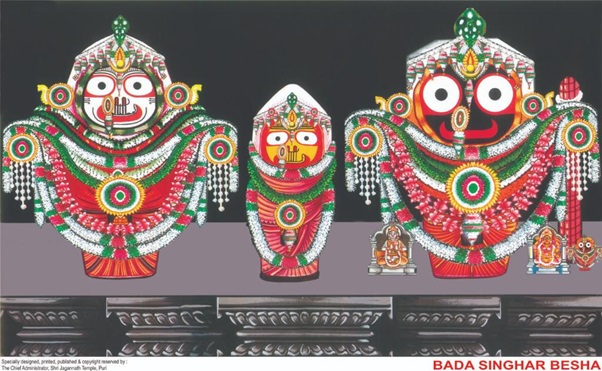
Bada Shringara Vesha
Every evening about 10:00 P.M., before Jagannath, Baladeva and Subhadra are put to rest, they are dressed in their Bada Shringara Vesha. Bada Means great, and Shringara refers to the conjugal love of the Gopis and Radharani for Krishna. The Pandas consider that at this time every evening the Gopis and Radha come to see Jagannath. The Bada Shringara Vesha consists of Gita Govindam Khandua and eight floral ornaments.
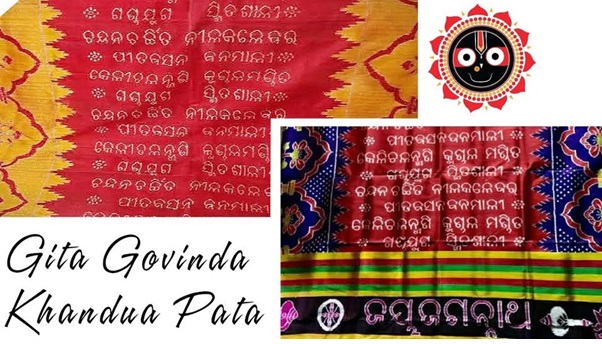
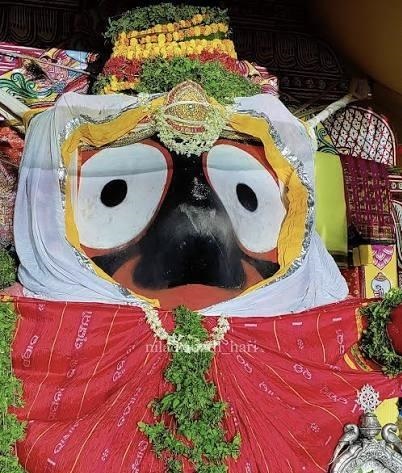
Lord Jagannāth dressed up in
Gita Govindam Khandua
The Gita Govindam Khandua is twelve foot long red silk cloth which is wrapped over each deity’s head. On these clothes are written lines from Jayadeva Goswami’s Gita Govindam.
Gita Govindam is very dear to Jagannath, so every evening it is recited for His pleasure, and He is dressed with the Gita Govindam Khandua. The eight floral ornaments are:
• Candrika with alakapanti – An alaka or forehead decoration made entirely of flowers.
• Puspatilaka – A flower garland tilaka sign on Jagannatha head.
• Karapallaba – Made from fragrant dayana leaves and variety of flowers, these are decorations representing the Lord’s hands and five fingers.
• Makara Kundala – Flower earrings shaped like sharks.
• Padaka – Round or heart shaped, about 18 inches in diameter, this decoration covers Lord Jagannatha’s heart.
• Guna and Jhumpa – Nose decoration made using flowers.
• Puspa Mala – Lord Jagannatha is dressed with many flower garlands each about twelve feet long, stretching from arm to arm.
• Tulasi mala – Lord Jagannath wear a crown of Tulasi garlands which are wrapped on pieces of bamboo and tied together.
As noted in Panchratra Pradipa: “Many temples in Vrindavana dress the deity in the color corresponding to the day of the week.” The same basic system is followed in Jagannath Puri for the different colors of cloth used for the Bada Shringara Vesha.
They are as follows:
Sunday – Ruled by the sun. Lord Jagannath is generally dressed in red garments on this day, the color of the ruby.
Monday – Ruled by the moon. Jagannath wears white on this day, the color of pearl.
Tuesday – Ruled by the planet Mars. Jagannath wears red or pink garments on this day, the color of the coral.
Wednesday – Ruled by Mercury. Lord Jagannath wears green, the color of the emerald.
Thursday – Ruled by Jupiter. Jagannath wears a yellow or golden colour dress, the color of the yellow sapphire.
Friday – Ruled by the planet Venus. Lord Jagannath wears white garments on this day, the color of the diamond.
Saturday – Ruled by the planet Saturn. Jagannath wears the black cloth on this day, corresponding to the color of the blue sapphire.
Makhamala Vesha: After the Bada Shringara Vesha, Lord Jagannath is dressed in a special white cloth for sayanalila, his pastime of taking rest. This is called Makhamala Vesha.
Objective 11: To highlight the significance of festival-based veshas (Special Dresses) and how they reflect various divine pastimes of Lord Krishna/Jagannath.
Special Dresses worn during festivals
Lord Jagannath is adorned with special dresses, or Vesha, throughout the year to celebrate various lunar months and festivals.
During the month of Vaishakha (April–May), the Chandan Vesha lasts for 42 days, starting from Akshaya Tritiya. This period is divided into the Outer Chandan Yatra and the Inner Chandan Yatra, where Deities are anointed with sandalwood paste and oil to provide cooling during the summer. Ceremonial boat rides at Narendra Tank for Lord Madanmohan accompany this festival.
In the month of Jyestha (May–June), the Rukmini Harana Vesha on Shukla Ekadashi commemorates Lord Krishna’s marriage to Rukmini, depicting the Lord as a royal king.
This month also features the Hati Vesha (Elephant Dress) during Snana Yatra, where the Deities are bathed with 108 pots of water and adorned with elephant-head masks symbolizing Lord Ganesha.
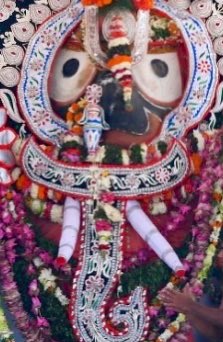
Hati Vesha
The month of Ashadha (June–July) features the famous Suna Vesha (Golden Dress) on Bahuda Ekadashi. During this return of the Ratha Yatra, the Deities are decorated with over a ton of gold ornaments, including golden hands and feet, symbolizing divine majesty.
In Sravana (July–August), the Chita Lagi Vesha involves reinstalling the golden forehead ornament, while the Rahurekha Lagi Vesha restores the Deities’ ear ornaments.
Bhadrapada (August–September) brings several Vesha related to Krishna’s childhood, such as the Vanabhojana Vesha, where the Deities are dressed as cowherd boys in a recreated Vrindavana, and the Kaliya Damana Vesha, which uses a 30-foot snake structure to celebrate the subduing of the serpent Kaliya.
Additionally, the Pralambasura Vesha commemorates Lord Balarama killing the demon Pralambasura. These diverse decorations reflect seasons, festivals, and spiritual teachings, offering rare darshan opportunities and celebrating divine pastimes.
Ratha-yātra—(Festival of Chariots)

Objective 12 : To learn about Sri kshetra’s Jagannath Rath Yatra.
Jagannath Rath Yatra
Jagannath Rath Yatra, also called Puri Rath Yatra, Gundicha Yatra, Navadina Yatra, or simply the “Festival of Chariots”, is an annual Hindu festival celebrated in Puri, Odisha. It marks the symbolic journey of Lord Jagannath (a form of Lord Krishna) along with his elder brother Lord Balabhadra and younger sister Devi Subhadra, from the main Jagannath Temple to the Gundicha Temple, about 3 kilometres away.
During the festival, the deities are taken out of the temple’s inner sanctum. This sacred festival happens only once a year, and is placed on three giant, hand-built wooden chariots. Thousands of devotees then pull these chariots through the streets using thick ropes, an act believed to cleanse the soul and bring divine blessings.
Jagannath Rath Yatra is considered the oldest and largest chariot festival in the world, with historical records going back over a thousand years. It is also one of the few Hindu festivals where the deities literally step outside the temple to meet their devotees. Instead of devotees going to the deity, the Lord comes to the people.

This festival is celebrated approximately 9 or 10 days (Rath Yathra). On Return, Deities will stay in Rath for 3 more days and return to sanctums.
The festival is celebrated every year on Dwitiya Tithi (2nd day) of Shukla Paksha in the Hindu month of Ashadha, which usually falls in June or July in the English calendar. It ends on following Trayodaśī of the same month Niladri Vijaya (Deities return to sanctum).
Objective 13: To examine the origin, the scriptural references to Ratha-yātrā found in the Padma Purāṇa, Skanda Purāṇa, and other Vedic scriptures.
This festival was commenced by King Indradyumna as per the instruction of the Lord Himself. Lord said to him, “O king celebrate our chariot festival in the month of Asādha Sukla dvitiyā. Take Me, Baladeva and Subhadra to our appearance place (Gundicā Temple).” According to this order of the Lord, this festival is being observed till the date.
There are many other names to this festival as follows – Nava-yātrā, Gundicā Yātrā, Mahāvedi Yātrā, Ghosa Yātrā, Patita Pāvana Yātrā, Dakṣiṇābhimukhī Yātrā, Adāpa Yātrā, Nandighoṣa Yātrā, Daśāvatāra Yātrā etc.
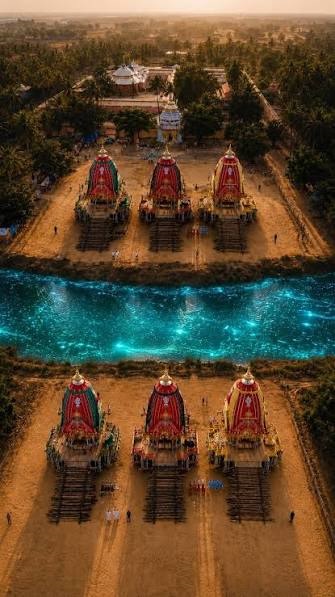
According to the Mādalā Pañjikā, a river called Mālinī once flowed between the present Jagannāth Temple and Gundicā Temple. In those days, six chariots were used during the Ratha-yātrā. The Deities were first taken to the riverbank in three chariots, ferried across the river, and then placed on three other chariots to continue to Gundicā Temple. During the reign of King Vīra Narasiṁha Deva (1238–1264 CE), the river was filled with sand and a direct road was constructed, after which the tradition changed to the three chariots used today.
This festival of chariots is very dear to Lord Jagannath and seems as if non-different from Him. In Bhagavad Gita (6.43), Śrila Prabhupāda quotes the following verse from Kathopanishad (1.3.3-4)-
atmanam rathinam viddhi
Sariram ratham eva ca
buddhim tu särathim viddhi
manah pragraham eva ca
indriyäni hayän ähur
vişayams teșu gocaran
atmendriya-mano-yuktam
bhoktety ahur manīşinah
The individual is the passenger in the car of the material body and intelligence is the driver. Mind is the driving instrument, and the senses are the horses. The self is thus the enjoyer or sufferer in the association of the mind and senses. So it is understood by great thinkers.
Here in this verse, although the terms such as ‘ratha’ (chariot) and ‘sirathi’ are allegorical, one should understand that chariots exist since time immemorial.
Lord Jagannath’s Ratha-yātrā festival is mentioned in Padma Purana as follows –
aṣādhasya dvitiyāyām
ratham kuryad viśeṣataḥ
āsādha śuklaikādaśyām
japa homa mahotsavam
rathasthitam vrajantam tam
mahā vedi mahotsave
ye paśyanti mudā bhaktyā
vasas teṣām hareḥ pade
satyam satyam punaḥ satyam
pratijñātam dvijottamaḥ
nātaḥ śreyaḥ prado viṣṇor
utsavaḥ śāstra-sammataḥ
Ratha-yatra should be celebrated “On the day of Āsādha Śukla Dvitiya, Ratha-yatra of Lord Jagannath festival, perform yajña and chant the holy names of the Lord, One on the ekadasi of bright fortnight. On this day one should observe His Supreme Spiritual abode.
Therefore, O best of Brahmanas, there who happily beholds Lord Jagannath on His chariot, certainly attains is nothing superior in this world than such festivals celebrated for the pleasure of Lord Visnu. This is the conclusion of scriptures.”
In Skanda Purana, while narrating glories of Ratha-yātrā, it is said that, “If one sees Lord Jagannath, Baladeva and Subhadra mounted on Their chariots and moving towards Mahāvedi, one becomes free from sinful reactions of millions of past births.”
Lord Jagannatha is very merciful towards His devotees. In Puranas it is stated that, ‘rathetu vāmanam drṣṭvā, punarjanma na vidyate’ – “One who sees Lord Vāmana seated on His chariot, becomes free from the cycle of birth and death.” Lord delivers all those who take His darśana in His temple, but when He mounts on His chariot He is magnanimously merciful. Thus in order to shower His special mercy, He mounts on the chariot.
tāṅhāra sammati lañā
bhakte sukha dite
rathe cāḍi’ bāhira haila
vihāra karite
(Śrī Caitanya Caritāmṛta, Madhya 13.24)
Having taken permission from the goddess of fortune, the Lord came out to ride on the Ratha car and perform His pastimes for the pleasure of the devotees.
Objective 14: To explain why Lord Jagannāth resides at the Gundicā Temple for seven days during the Ratha-yātrā festival.
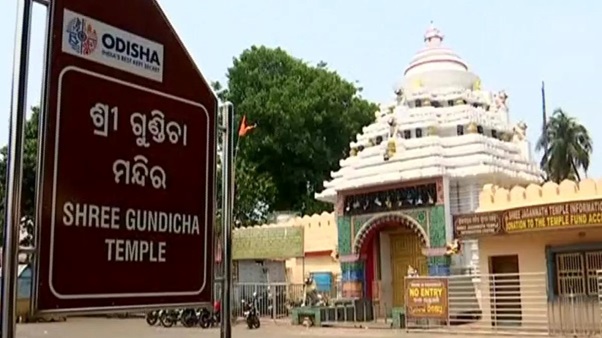
In Skanda Purana, it is mentioned that, after installation of the deities, King Indradyumna asked three boons to the Lord as follows “first. I don’t want any offspring, second You will keep eating whole day, and third, You will take rest only for three hours and rest of the time You should give Your darśana and deliver the conditioned souls.” Upon hearing King Indradyumna’s proposal, Lord Jagannath smiled and said, “So be it!”.
Although, the king was very happy, queen Gundicā became very sad as every woman has a desire to bear a child. Lord Jagannath understood the heart of Queen Gundicā and said to her, “O Gundicā devī, I promise you that I shall live with you for seven days.” Thus Lord Jagannāth resides in Gundicā temple for seven days.
There are many reasons for the Lord coming out of His temple. The temple is considered as Dwarakā which is Aiśvarya pradhāna and followers of Sri Caitanya Mahaprabhu accept that the Lord goes from Dwārakā to Vṛndāvana. Jagannath Lord gets attracted towards Mādhurya, He goes to Vṛndāvana. Thus Gundicā Temple is Vṛndāvana or Sundarācala.
Therefore it is said in Śri Caitanya Caritāmṛta –
“Although Lord Jagannath enjoys His pastimes at Dvārakā dhama and naturally manifests sublime liberality there, still, once a year He becomes unlimitedly eager to see Vṛndāvana.”
Pointing out the neighboring gardens, Śrī Caitanya Mahāprabhu said, “All these gardens exactly resemble Vṛndāvana; therefore Lord Jagannath is very eager to see them again. Externally He gives the excuse that He wants to participate in the Ratha-yātrā festival, but actually He wants to leave Jagannat Puri to go to Sundarācala, the Gundicā temple, a replica of Vṛndāvana.” (Śrī Caitanya Caritāmṛta, Madhya 14.117-120)
Objective 15: To appreciate the traditional process of constructing the three chariots and the hereditary service of the artisans who preserve this sacred tradition.
This festival begins on Vasanta Pañcamī day i.e. four months before Ratha-yātrā. On the day of Vasanta Pañcami, wood is collected from the Ranapūra forest of Dasapallā district of Orissa. Making of chariots begin on the day of Akṣayya Tṛtīya on Grand Road.
Every year, new chariots are constructed. Idols of horses, charioteers are reconstructed only on the year of Navakalevara. Hundreds of carpenters, laborers, painters and artists are engaged in making of the chariots. All these people learn this work from generations to generations.
Each chariot is divided into 34 parts viz. Wheels, Dandiya, Spokes, Ranki, Hansapatā, Kani, Sankha Dwara, Jāli, Gayapatä, Sithhāsana, Kanakapundai, Bhūmi, Solanähäka, Makaradandā, Vasanta, Duar Ghoda, Sarathi Pidh, Kumbhapati, Rahupati, Athnāhākā, Bänka, Pidha, Rsipata, Tandā, Pārābhādi, Khapuri, Päda, Olat kuā, Dadhinuti, Kalaśa, Kantha, Danda, Cakra, Ketana.
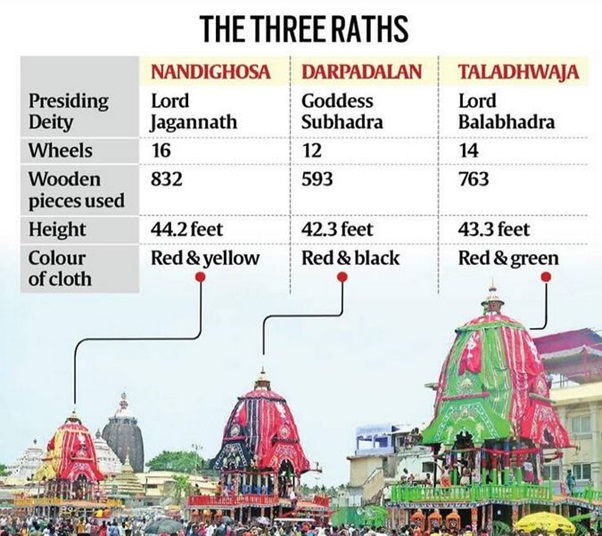
Three Chariots of Ratha-yātrā
| Feature | Lord Jagannāth (Nandighoṣa) | Subhadrā Devī (Devadalana / Darpadalana) | Lord Baladeva (Tāladhvaja) |
|---|---|---|---|
| Principal Deity | Lord Jagannāth | Subhadrā Devī | Lord Baladeva |
| Festival Deity | Rāma Kṛṣṇa | Sudarśana | Madana-mohana |
| Name of Chariot | Nandighoṣa | Devadalana (Darpadalana) | Tāladhvaja |
| Number of Wheels | 16 | 12 | 14 |
| Symbol on the Apex | Disc (Chakra), Garuḍa | Padma (Lotus) | Tāla (Palm Tree) |
| Chariot Colors | Red & Yellow | Red & Black | Red & Green |
| Flag Symbol | Garuḍadhvaja | Padmadhvaja | Lāṅguladhvaja |
| Height | 23 hands | 21 hands | 22 hands |
| Name of the rope used | Shankhachuda | Swarnachuda | Basuki |
| Wheel Circumference | 5 hands | 4 hands | 4 hands |
| Charioteer | Dāruka (or Mātali) | Devadatta (or Arjuna) | Sudyumna |
| Guardian of Charioteer | Nṛsiṁha | Vanadurgā | Ananta |
| Names of Horses | Sukṣmā, Recikā, Mocikā, Amṛtā | Adharma, Ajñāna, Aparājitā, Jyotinī | Sthira, Siddha, Dhṛti, Sthiti |
| Color of Horses | White | Yellow | Black |
| Deities on the Chariot | Varāhadeva, Govardhana, Kṛṣṇa, Gopī Kṛṣṇa, Nṛsiṁha, Rāma, Nārāyaṇa, Trivikrama, Hanumān, Rudra | Caṇḍī, Cāmuṇḍā, Ugratārā, Vanadurgā, Ṣoḍaśa Durgā, Vārāhī | Gaṇeśa, Kārtikeya, Sarvamaṅgalā, Pralambāghna, Halāyudha, Mṛtyuñjaya, Nāṭāmbara, Maheśvara, Śeṣa |
| Deities Near the Door | Indra, Brahmā and the Seven Sages (Sapta Ṛṣis) | Śrīdevī, Bhūdevī and Aṣṭa Bhairavas | Rudra, Sātyaki and Aṣṭa Vasus |
| General Decoration | Entire chariot (except the wheels) is decorated with multicolored cloth. | Entire chariot (except the wheels) is decorated with multicolored cloth. | Entire chariot (except the wheels) is decorated with multicolored cloth. |
| Front Decoration | Wooden horses with the charioteer in front; apex decorated with colorful flags. | Wooden horses with the charioteer in front; apex decorated with colorful flags. | Wooden horses with the charioteer in front; apex decorated with colorful flags. |
Objective 16: To explain the historical origin and traditional accounts associated with the name Pāhaṇḍi Vijaya.
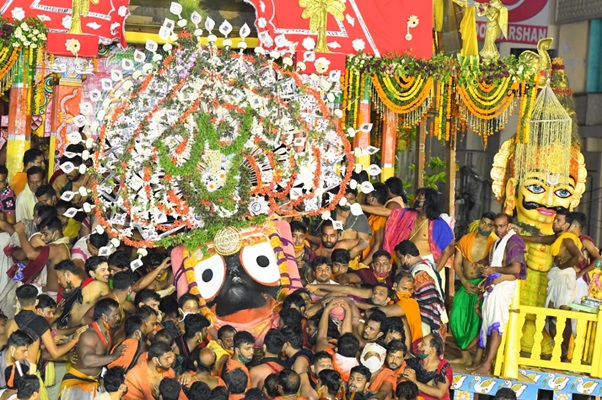
Pāhaṇḍi Vijaya – Bringing the Lord to the Chariots
The ceremonies of Ratha-yātrā begin on the previous night with the offering of Khicadi Bhoga. After this, the sacred procession known as Pāhaṇḍi Vijaya begins, during which Lord Jagannātha, Lord Baladeva, Subhadrā Devī, and Sudarśana are ceremonially brought from the temple to their respective chariots. The Pāhaṇḍi Vijaya (or Pahandi Bije) ritual of Lord Jagannath typically takes about 3 hours to complete.
According to tradition, this festival was originally called Pāṇḍyā Vijaya, named after Malayācala Pāṇḍā Kāñcana Mālā, and over time the name evolved into Pāhaṇḍi Vijaya. The rope used to pull the chariots is also known as Kāñcana Mālā.
Another tradition attributes the name to King Pāṇḍya Vijaya, a powerful South Indian ruler of the third century. Guided by his priest Deveśvara, a great devotee of Lord Viṣṇu, the king upheld Sanātana Dharma and is believed to have revived the ancient tradition of the Ratha-yātrā. Hence, the ceremonial procession of carrying the Deities to the chariots came to be known as Pāhaṇḍi Vijaya.
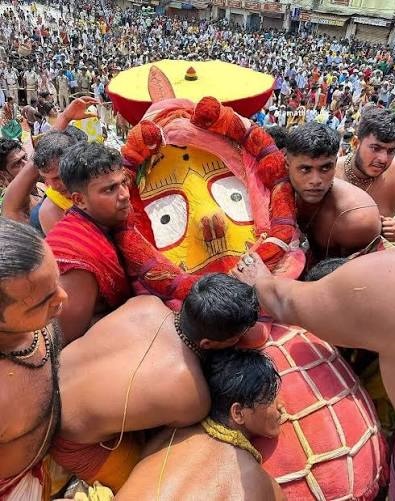
Shubhadra
Order of the Procession
The Deities are brought to the chariots in a fixed order:
1. Sudarśana ( pillar form) is brought out first, circumambulates the chariots, and is placed on Subhadrā Devī’s chariot.
2. Lord Baladeva is then taken to His chariot, Tāladhvaja.
3. Finally, Lord Jagannātha is brought to Nandighoṣa.
It is said that Sudarśana is placed first because Lord Jagannātha is concerned for His younger sister, Subhadrā.
Lord Jagannāth’s Pāhaṇḍi
Thousands of devotees gather to witness this beautiful procession. Lord Jagannāth is carried by His servants in a gentle swaying movement, resembling the gait of a joyful, intoxicated person. Great Vaiṣṇava ācāryas explain that this reflects the Lord’s intense feelings of separation from Vṛndāvana.
After the principal Deities are seated on the chariots, the festival Deities Madana-mohana and Rāma Kṛṣṇa are also placed on Lord Jagannāth’s chariot. A large chest containing the Lord’s clothes and ornaments for His seven-day stay at Gundicā Temple (Sundarācala) is then loaded onto the chariot. Lord Jagannāth is adorned with a golden tilaka.
Objective 17: To learn the rituals performed before the commencement of the Ratha-yātrā procession.
Chhera Pahanra and the Departure of the Chariots
The Gajapati King then arrives in a royal palanquin and performs the sacred ceremony of Chhera Pahanra, sweeping the road before the chariots with a golden broom, symbolizing humility before the Lord.
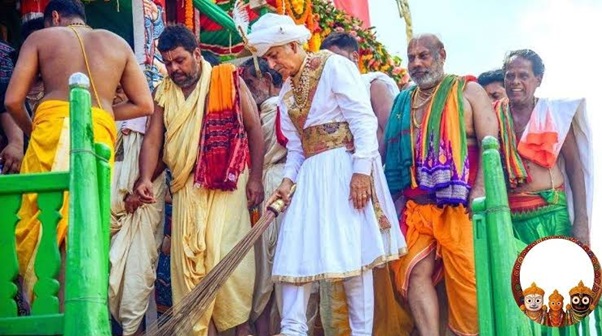
The current Gajapati King performing the Chhera Pahanra ceremony
The three chariots are then offered ārati, sprinkled with sandalwood water, and fanned with yak-tail whisks (cāmaras). The charioteers are mounted, the horses are harnessed, and the chariots are made ready to move.
The chariots begin their journey in the following order:
1. Lord Baladeva’s Tāladhvaja
2. Subhadrā Devī’s Devadalana
3. Lord Jagannātha’s Nandighoṣa
Tradition states that as soon as Lord Jagannāth’s chariot begins to move, Indra showers rain. Amid the joyous sound of musical instruments, thousands of devotees pull the chariots towards Gundicā Temple, chanting the holy names of the Lord.
Journey to Gundicā Temple
As the chariots proceed towards Gundicā Temple (Sundarācala), Lord Jagannāth accepts offerings (bhoga) at various places along the route. By evening, the chariots usually reach Gundicā Temple; if not, they continue the next morning. The Deities remain on the chariots overnight, and the following morning They are ceremonially taken into Gundicā Temple, where They stay for seven days.
The Rathas at Gundicha Temple
After reaching the Gundicha Temple, the three chariots are stationed in front of the temple. On that night, Lord Jagannath, Lord Baladeva, Subhadra Devi, and Sudarshana remain seated on Their respective chariots.
On the following morning, the Deities are ceremonially carried from the chariots into the Gundicha Temple in the Pāhaṇḍi procession. There They remain for seven days, bestowing Their mercy upon all devotees.
During Their stay, special āratis, bhoga offerings, beautiful decorations (alankāra), kīrtana, and other Vaiṣṇava festival services are performed every day.
Thousands of devotees from across India and around the world come to Gundicha Temple to receive the darśana of the Lord and experience the joy of His divine presence.

Rathas at Gundicha Temple
Objective 18: To learn why Goddess Lakṣmī visits Gundicā Temple and the symbolic meaning of her displeasure and return to the main temple.
Herā Pañcamī
On the fourth day of Ratha-yātrā, the festival of Herā Pañcamī is observed. Since Lord Jagannātha had promised Goddess Lakṣmī that He would return within two days, but had not yet returned, Goddess Lakṣmī becomes displeased. She travels to Gundicā Temple in a palanquin, symbolically chastises the Lord’s servants, damages a small part of His chariot, and then returns to the main temple.
Sandhyā Darśana
On the seventh day, devotees celebrate Sandhyā Darśana at Gundicā Temple, receiving the Lord’s special evening darśana.
Objective 19: To understand the significance of the Bāhudā Ratha-yātrā, the return journey of Lord Jagannāth, Lord Baladeva, and Subhadrā Devī to Śrī Mandira.
Bāhudā Ratha-yātrā (Return Journey)
On the ninth day, the Deities begin their return journey to the main temple in the Bāhudā Ratha-yātrā (Return Car Festival). The chariots move in the same order as during the outward journey—Lord Baladeva, Subhadrā Devī, and Lord Jagannāth. As fewer pilgrims attend the return festival, devotees have a better opportunity to come close to the chariots, have darśana of the Lord, and participate in pulling the chariots.
During the Bāhudā Ratha-yātrā (Return Journey), the chariots of Lord Baladeva and Subhadrā Devī proceed directly to the Lion Gate (Siṁha-dvāra) of the Jagannāth Temple. Lord Jagannāth’s chariot, however, stops first at the Ardhaśanī (Mausi Mā) Temple, where He is offered the special Poda Piṭha cake.
On the way, Lord Jagannāth’s chariot halts near the Gajapati King’s Palace. Goddess Lakṣmī is brought in a palanquin to Chahani Maṇḍapa, where She and Lord Jagannāth exchange loving glances in the ceremony known as Lakṣmī–Nārāyaṇa Bheṭa or Chahani Milana. Lord Jagannāth offers His garland to Lakṣmī, who then circumambulates the chariot and returns to the temple.
After this ceremony, Nandighoṣa reaches the Lion Gate, where Lord Jagannāth remains on His chariot from Daśamī to Trayodaśī to give darśana to the devotees.
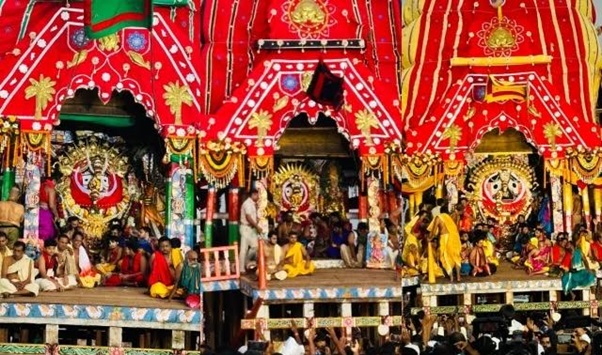
Gold ornaments decorated Deities
Suna Besha
On Ekādaśī, Once back, the deities are adorned in gold ornaments weighing close to 208 kg, in a dazzling ritual called Suna Besha.
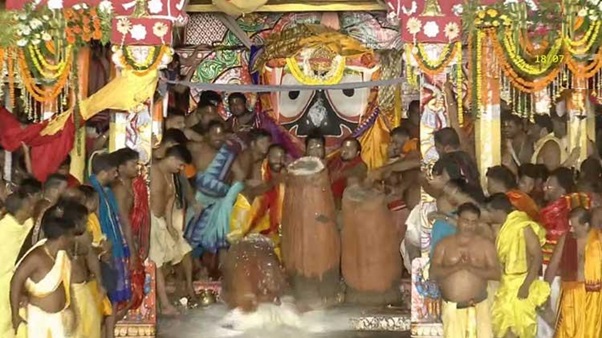
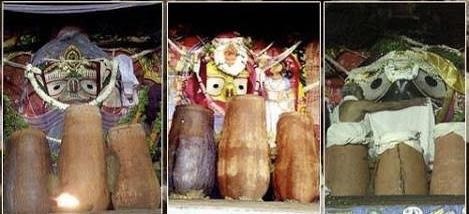
Adharapana
Adharapana is a sacred ritual performed on Dwadashi during Rath Yatra, where nine earthen pots filled with a sweet, spiced drink are offered to Lord Jagannath, Balabhadra, and Subhadra on their chariots. The pots are then broken to signify humility, ego surrender and universal blessings.
Nīlādri Vijaya
On Trayodaśī, the festival of Nīlādri Vijaya (Vijaya Utsava) is celebrated. Sudarśana, Lord Baladeva, and Subhadrā Devī enter the temple first, while Lord Jagannāth enters last. As part of a divine pastime, Goddess Lakṣmī’s attendants initially prevent Him from entering the temple. After playful exchanges between the servants of Lakṣmī and Jagannāth, the Lord offers Rasagullās, flower garlands, and gifts to pacify Lakṣmī. Pleased by His offering, Goddess Lakṣmī allows Lord Jagannāth to re-enter the temple, marking the joyful conclusion of the Ratha-yātrā festival for the year.
Objective 20: To understand the Gaudiya Vaiṣṇava understanding of Ratha-yātrā as Lord Kṛṣṇa’s symbolic return from Dwaraka to Vṛndāvana and inner mood Chaitanya Mahaprabhu and SrilaParbhupatha.
Rath Yatra as per Gaudiya Vaishnava tradition The Vrindavan Connection
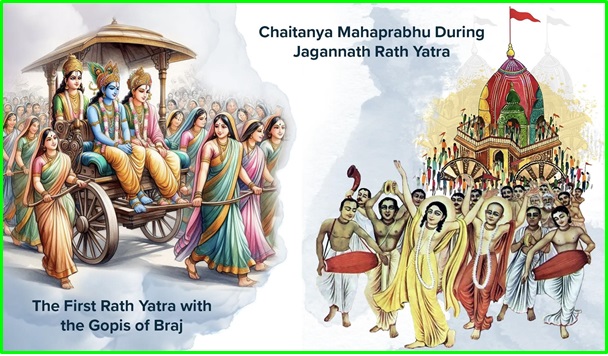
According to this, many years after Lord Krishna left Vrindavan, a solar eclipse brought people from all over India to Kurukshetra. The gopis of Vrindavan also came there and finally met Krishna again after a long separation.
Although they were overjoyed to see Him, their hearts were not fully satisfied. They did not want to meet Krishna as a royal king in Kurukshetra. They longed to be with him in the simple and loving atmosphere of Vrindavan, where they had shared their deepest memories with him.
It is said that, out of their intense love, the gopis wanted to bring Krishna back to Vrindavan. Symbolically, they placed him on a chariot and pulled him with the strength of their devotion.
In this way, Rath Yatra represents the loving desire of the devotees to bring Krishna from Kurukshetra back to Vrindavan.
For Gaudiya Vaishnavas and ISKCON followers, the festival is a celebration of this divine reunion and the pure love that the residents of Vrindavan had for Lord Krishna.
Principle Behind the Ratha-yātrā Festival
1. Krishna’s Return to Vṛndāvana: in Gaudiya samprayadha, The Ratha-yātrā symbolizes the loving desire of the residents of Vṛndāvana, especially Śrīmatī Rādhārāṇī and the gopīs, to bring Lord Kṛṣṇa (Jagannāth) back from Dvārakā to His original home in Vṛndāvana.
2. Mood of Pure Love (Prema): The Vrajavāsīs desire to see Kṛṣṇa only in His original cowherd (gopa) form, not in His royal attire. Their pure, selfless love is the heart of the Ratha-yātrā festival.
3. Śrī Caitanya Mahāprabhu’s Teaching: Śrī Caitanya Mahāprabhu pulled Lord Jagannāth’s chariot in the mood of bringing Kṛṣṇa back to Vṛndāvana. Śrīla Prabhupāda taught that by celebrating Ratha-yātrā, devotees should bring Kṛṣṇa back to Vṛndāvana in their hearts.
Glory of Witnessing Ratha-yātrā
Śrīla Prabhupāda explains that seeing Lord Jagannāth’s Ratha-yātrā destroys one’s sins and opens the path to liberation. To receive its full benefit, one should avoid sinful life and continue in devotional service.
This is the festival of showering mercy. Foreigners and non Hindus are not allowed inside Jagannath temple. Therefore, Lord Jagannath Himself comes out in order to give darśana to all. When Lord Jagannath comes out of the temple, the air touching His divine body, His merciful glance and the dust spread all over the atmosphere due to movement of His chariot makes everyone purified from within and delivers one from sinful reactions of past many.Lord rides on His chariot in order give pleasure to His devotees.
Location
Objective 21: To locate Jagannath Puri and to understand its importance as one of the holiest pilgrimage places in the world.
Jagannātha Purī is situated on the shores of the Bay of Bengal in eastern India, in the tropical state of Odisha (formerly Orissa), about 310 miles south of Kolkata (Calcutta).
Odisha was historically known as Utkala and Udradeśa, and Jagannātha Purī has been revered for centuries as one of the holiest pilgrimage destinations in the world.
