
Objectives:
Objective 1: To understand the location and significance of the term Daan Nivartan Kunda.
Objective 2: To describe the divine pastime associated with Daan Nivartan Kunda.
Location and significance of the term Daan Nivartan Kunda:
Objective 1: To understand the location and significance of the term Daan Nivartan Kunda.
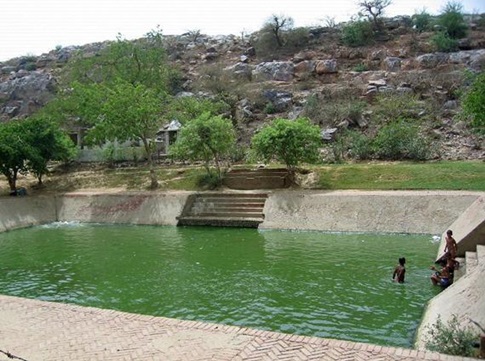
“Daan Nivarṭan Kunda” is a sacred pond near Govardhana Hill, about 1 km outside Govardhan town.This sacred pond, about 15 × 20 meters, lies on the Govardhan Parikrama path, just 250 meters past ISKCON’s Bhaktivedanta Ashram. Pilgrims pause here to remember the sweet Dana-līlā pastime, where the gopīs humbled Śrī Krishna after His playful tax-collecting at Daan-Ghāṭī. With no formal shrine, the kuṇḍa remains a simple yet cherished tīrtha-point on the 38 km circumambulation of Govardhana Hill.
Nivartan means “forgiving” or “excusing”, so this is the “pond of forgiveness”.
Pastime associated with Daan Nivartan Kunda:
Objective 2: To describe the divine pastime associated with Daan Nivartan Kunda.
After Sri Krishna demanded “tax” from the gopīs at Daan Ghāti, the gopīs plotted to teach Him a lesson. When Sri Krishna and His friends returned later, they ambushed Him near this pond, made Him bow before Srimati Radharani, and only then forgave Him. Hence its name.
The detailed narration of the pastime in Rūpa Gosvāmī’s Dana-Keli-Kaumudī:This lyrical drama narrates in vivid poetic and humorous detail the Daan‑līlā (tax episode) at Daan‑Ghāṭī and the later events at Dan Nivartan Kunda. In it: Sri Krishna blocks the gopīs at Daan‑Ghāti, demanding a symbolic “tax” to pass. Later, the gopīs gather at Daan Nivartan Kunda, embarrass Krishna, tie Him up, and insist that He bow down to Srimati Radharani and seek forgiveness. This act of reconciliation gives the pond its name (“place where the tax was excused”).
Daan Nivartan Kunda stands as a tender reminder of the gopīs’ loving victory over Krishna’s playful mischief.It highlights the sweetness of Vraja-līlā, where love, not pride, always triumphs. Pilgrims who pause here connect with the humor, humility, and intimacy of divine pastimes. Thus, this kuṇḍa remains a cherished spot of forgiveness and eternal devotional joy.
