
Objectives
Objective 1: To study the historical and spiritual significance of Maa AlamChandi Temple and its role in the sacred geography of Srikshetra Puri.
Objective 2: To learn about the great devotees, servitors, and saints connected with Alam Chandi.
Objective 3: To understand the connection between AlamChandi Devi and Lord Jagannath’s pastimes, and to study the role of AlamChandi Devi as one of the protective deities (Ashta Chandis) of Srikshetra.
Objective 4: To study the temple’s architecture and cultural heritage, highlighting the unique features of the Kalinga style of temple construction.
Objective 5: To understand the presiding deity, her iconographic features, and the associated parśva-devatās, along with their significance in temple worship and theology.
Objective 6: To identify and compile scriptural references related to AlamChandi Devi from Puranas, ritual practices, local traditions, and Jagannath literature.
Objective 7: To understand the connection between AlamChandi Devi and Lord Jagannath, especially during Navakalebara and other important Jagannath traditions.
Objective 8: To help pilgrims plan their journey to Alam Chandi Temple by understanding the available routes, distances, and modes of transportation.
Objective 9: To provide devotees with accurate darshan timings and festival schedules, ensuring a smooth and spiritually enriching visit to Maa Alam Chandi Temple.
1. Introduction
Objective 1: To study the historical and spiritual significance of Maa AlamChandi Temple and its role in the sacred geography of Srikshetra Puri.
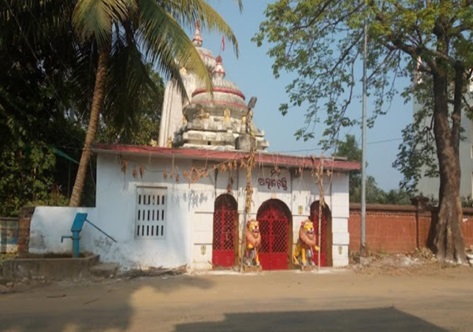
The AlamChandi Temple is an ancient Shakti shrine situated in the Kumbharpada area of Jagannath Puri, Odisha. Located on the left side of the Puri–Bhubaneswar road near the historic Atharanala Bridge, it marks the traditional northern entrance to the holy town of Puri (Srikshetra).
Goddess AlamChandi is revered as one of the Ashta Chandis (Eight Guardian Chandis) who protect the holy realm of Lord Jagannath from various directions. She specifically guards the entrance and plays an irreplaceable structural and ritualistic role in the complex spiritual network of Puri Dhama. Goddess AlamChandi protected the holy Ratnavedi (altar) of Lord Jagannath.
2. Devotees Associated with the Place
Objective 2: To learn about the great devotees, servitors, and saints connected with Alam Chandi.
Devotees and personalities traditionally associated with the AlamChandi Temple are connected mainly through the worship of Lord Jagannath and the sacred traditions of Srikshetra Puri.
Indradyumna Maharaja:
The legendary king who established the worship of Lord Jagannath in Puri is traditionally connected with many guardian deities of Srikshetra, including Goddess AlamChandi.
Gajapati Maharajas:
The Gajapati kings of Puri have historically worshipped Goddess AlamChandi, especially during Jagannath festivals and Nabakalebara ceremonies. They are considered the foremost servants of Lord Jagannath.
Daitapati Sevakas:
The Daitapati servitors are deeply associated with AlamChandi Temple during the Nabakalebara festival. They seek the blessings of the Goddess before bringing the sacred Daru logs into Puri.
Achyutananda Dasa, Balarama Dasa, and Jagannath Das: These devotees are remembered because AlamChandi Temple is not an isolated shrine but an important spiritual part of the larger Jagannath Dham tradition of Puri.
3. Pastime Associated with the Place
Objective 3: To understand the connection between AlamChandi Devi and Lord Jagannath’s pastimes, and to study the role of AlamChandi Devi as one of the protective deities (Ashta Chandis) of Srikshetra.
Origins and Early References:
The origins of the AlamChandi Temple are deeply rooted in ancient Hindu scriptures, particularly the Skanda Purana, which describes Goddess AlamChandi as residing on the northern side of the Jagannath Temple in Puri to safeguard the Ratnavedi, the sacred platform housing the deities. This textual reference establishes the temple’s foundational role as a protective shrine within the sacred geography of Puri, emphasizing its mythological significance in guarding the central Vaishnava complex from malevolent forces.
AlamChandi is recognized as one of the Ashta Chandi, a group of eight protective Chandi temples encircling Puri and serving as sentinels for the Jagannath Temple and the broader Shrikhetra. Traditional listings vary, but commonly include Vimala, Ramachandi, Harachandi, Baseli, Varahi, Dakshina Chandi, and Jadeswari (or Jhadeswari), collectively forming a spiritual perimeter that underscores the temple’s integration into the region’s Shakta–Vaishnava traditions. This attribution highlights AlamChandi’s position among these ancient guardian deities, symbolizing a harmonious blend of Shakti worship with the dominant Jagannath cult.
4. Structure Importance
Objective 4: To study the temple’s architecture and cultural heritage, highlighting the unique features of the Kalinga style of temple construction.
Architecture
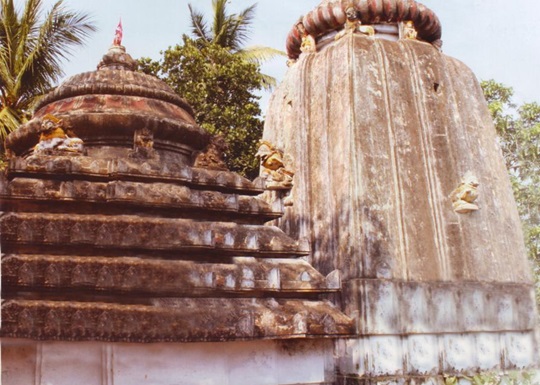
The temple’s physical origins are tied to medieval Odia temple-building traditions, with architectural features indicating construction of the core structures in the 13th century AD during the Eastern Ganga dynasty, a period of significant temple development in Odisha. This timeline aligns with the broader evolution of Kalinga-style architecture, where smaller satellite shrines like AlamChandi were erected to reinforce the protective and ritualistic framework of major pilgrimage sites, exemplifying the Kalingan architectural style with its pancharatha plan and panchangabada elevation built in ashlar dry masonry using gray sandstone.
The temple’s architecture follows the Kalinga style, featuring a pancha-ratha rekha deula vimana (tower) and a pidha deula jagamohana (hall of audience), both constructed from sandstone and dating to the 16th century, while the natamandapa (dance hall) is a modern addition with a flat roof. The temple faces east. Though architecturally modest compared to larger temples in Puri, it is spiritually very significant.
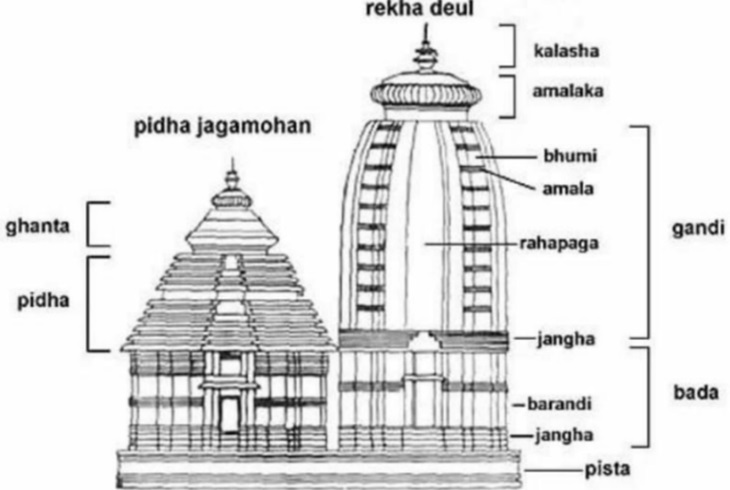
Important structural features include:
- Main Sanctum (Vimana)
- Jagamohana (Assembly Hall)
- Natamandapa added later during the 20th century
- Traditional stone-carved Simhasana (Throne)
- The deity sits upon a decorated pedestal with symbolic Tantric imagery.
Vimana (Sanctum Sanctorum): Reaching a height of about 30 feet, the exterior features classic carvings like Simha Vidalas (lion motifs), Alasa Kanyas (indolent maidens), and dancing female figures.
Jagamohana (Assembly Hall): Standing about 20 feet high, it features two unadorned doorways (East and South). The southern lintel depicts the Navagrahas (nine planetary deities) carved in the Padmasana posture.
Natamandapa (Dancing Hall): A more modern, flat-roofed structure standing roughly 12 feet high. Its inner walls are highly significant because they house depictions of the Dasa Mahavidyas (the ten Tantric manifestations of the Goddess).
5. Presiding Deities
Objective 5: To understand the presiding deity, her iconographic features, and the associated parśva-devatās, along with their significance in temple worship and theology.
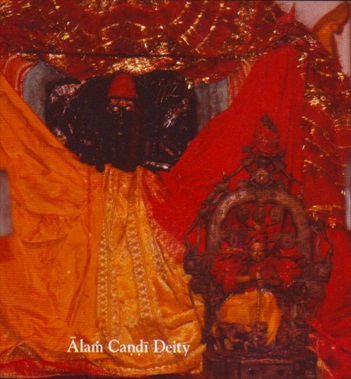
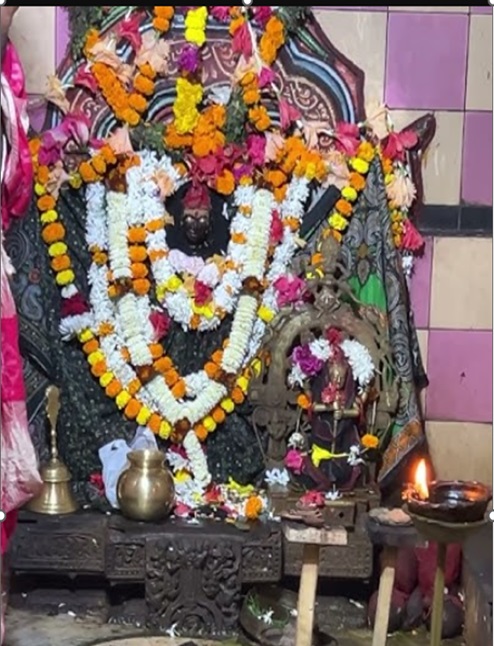
The presiding deity is Goddess AlamChandi, worshipped in a four-armed Durga form. She measures 3 feet in length and 2 feet in width. She stands on a prostrate body of a corpse lying upon a 1-foot-high Simhasana (lion throne), representing transcendence over material existence according to Shakta traditions.
Iconography: In her upper right hand, she holds a knife; her lower right hand displays the Abhaya Mudra (fearlessness); her upper left hand holds a Trishula (trident); and her lower left hand holds a Rosary (Akshamala).
There is a Mahishamardini Durga, the replica of the presiding deity, found from the Simhasana, and it is made of brass.
Parśva-devatās (Side Deities): The three external niches of the Vimana house beautiful granite sculptures of Tantric goddesses:
• South: Six-armed Goddess Sodasi (Tripura Sundari)
• West: Goddess Kalika (Kali)
• North: Goddess Matangi
There is a Shivalinga made of black chlorite found on the left side of Devi AlamChandi. It has been kept on the floor of the sanctum. He is locally worshipped as Krittivasa Mahadeva. The Jagamohana of the temple is a Pidha Deula and its height is about 20 feet from the surface of the temple complex. The Jagamohana has two doorways: one on the eastern side and another on the southern side.
The doorway on the southern side is completely plain. The doorjambs and the doorway lintel are not decorated with any element. Navagrahas are carved on the architrave above the doorway lintel. There is only an image of Mahavira installed on the plain pedestal. His right hand holds a huge rock (Gandha Mardana Parvata), and the left hand possesses a Gada (mace) as the usual attributes.
The Natamandapa of the temple is a modern flat-roofed structure and its height is about 12 feet. Lion, the conventional mount of Devi, is installed on the floor of the Natamandapa. The niches of the inner walls of the Natamandapa are housed with Dasamahavidya figures. The Gaja Simhas are installed on both sides of the main doorway of the Natamandapa hall. They act as the Dvarapalas of the temple.
6. Scriptural References
Objective 6: To identify and compile scriptural references related to AlamChandi Devi from Puranas, ritual practices, local traditions, and Jagannath literature.
The Skanda Purana (particularly in its Utkala Khanda and Purushottama Kshetra Mahatmya sections) mentions the protective energetic layout of Puri. It references the Ashta Shakti or Asta Chandi network that encompasses the town to preserve its spiritual purity. AlamChandi is listed among these core boundary goddesses alongside Vimala, Ramachandi, Harachandi, Baseli, Varahi, Dakshina Chandi, and Jhadeswari. Tantric texts also reference her as a critical energy anchor at the entrance of the Shankha Kshetra (the conch-shaped layout of Puri).
Mentions in Puranic texts link AlamChandi to broader Shakti worship traditions by portraying her as a form associated with the supreme goddess Chandi, who embodies raw power (Shakti) and the cosmic function of destruction of evil to foster preservation and renewal in Vishnu’s divine realm. Interpretations across these texts position AlamChandi as symbolizing the integrated Vaishnava-Shakta theology where the goddess’s fierce attributes complement Vishnu’s preservative aspect, guarding the spiritual equilibrium of sacred sites like Puri.
Ritual Practices
The ritual practices at AlamChandi Temple center on the worship of Goddess AlamChandi as a manifestation of Durga, incorporating elements of Shakta tradition integrated with the broader Jagannath cult in Puri. Daily worship begins with the Mangala Aarti at dawn, followed by offerings of fresh flowers, incense, and lamps to invoke the goddess’s blessings, performed by hereditary priests known as Sevayats. These routines emphasize purity and devotion, with Naivedya consisting of vegetarian preparations like rice, fruits, and sweets offered in the sanctum sanctorum. Special Prasad, prepared within the temple premises using traditional recipes, is occasionally transported by AlamChandi priests to the Jagannath Temple, particularly during auspicious occasions like Saptapuri Amavasya, symbolizing the interconnected sanctity of the sites. This exchange highlights the temple’s auxiliary role in the larger ritual ecosystem of Puri.
Role in Jagannath Temple Traditions
The AlamChandi Temple functions as a key guardian shrine within the traditions of the Jagannath Temple in Puri, positioned at the northern entrance to the town near Atharanala to safeguard the sacred precincts. According to references in the Skanda Purana, Goddess AlamChandi resides on the northern side of the Jagannath Temple specifically to protect the Ratnavedi, the elevated platform housing the deities, ensuring the sanctity of this central ritual space. This protective role extends to overseeing entry into Srikshetra, where historically, kings and distinguished visitors would seek permission at the temple before proceeding to the main Jagannath complex.
Priests from the AlamChandi Temple participate in periodic rituals that link the two sites, notably delivering traditional Prasad to Lord Jagannath on the eve of Makar Sankranti, symbolizing offerings from the guardian deity to the presiding Lord. Similarly, during the Saptapuri Amavasya observance, Prasad is reciprocally sent from the Jagannath Temple to AlamChandi, reinforcing the interconnected devotional practices between the shrines. These exchanges underscore the temple’s ongoing integration into the broader ritual ecosystem of Jagannath worship. As one of the Ashta Chandis of Puri, AlamChandi symbolically represents a protective Shakti in the Jagannath pantheon, granting Agnyamala (permission) for sacred processes such as the transport of Daru logs during the Nabakalebara ritual, where the goddess is invoked to sanctify the wood and avert harm. This role highlights her as a complementary divine force, embodying guardianship and purification essential to the temple’s traditions.
Association with Navakalebara
Objective 7: To understand the connection between AlamChandi Devi and Lord Jagannath, especially during Navakalebara and other important Jagannath traditions.
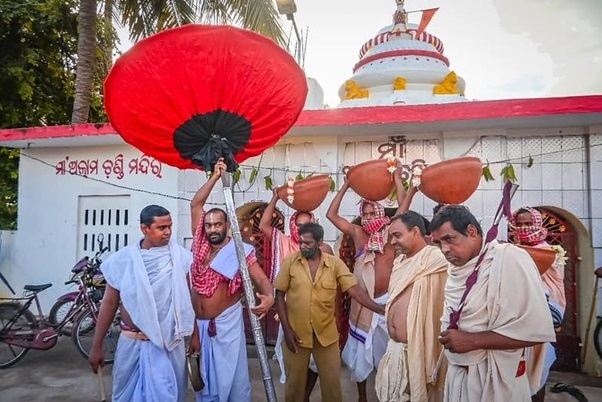
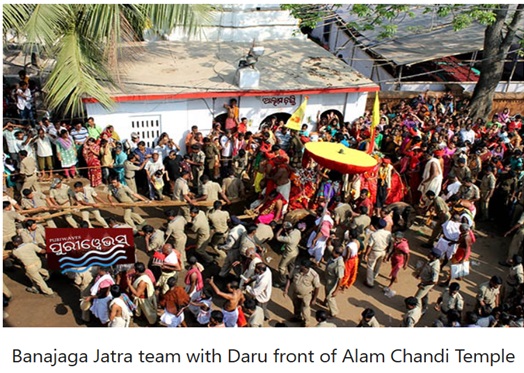
The AlamChandi Temple holds a significant position in the Navakalevara (Nabakalebara) ceremony of the Jagannath Temple in Puri, occurring every 8, 12, or 19 years, where the deities receive new wooden bodies carved from sacred neem trees known as Darus. As the temple is located at the entrance to Puri near Atharanala, it serves as the initial halting point for the Darus upon their arrival in the town, allowing for an overnight stay before they proceed to the Jagannath Temple for carving the new idols. During the procession of the Darus, which are transported on bullock carts in a ritualistic journey, the logs for Lord Balabhadra, Devi Subhadra, and Lord Sudarshana traditionally halt at the AlamChandi Temple, while the Daru for Lord Jagannath may stop at a nearby site like the Narsimha Temple. This stoppage facilitates preparatory rituals and ensures the sanctity of the entry into Puri, with the Darus wrapped in cloth and secured before continuing the next morning through the northern gate of the Jagannath Temple.
Additionally, during Nabakalebara observances, specific rituals such as the recitation of Chandi Patha from the Durga Saptashati are conducted at the AlamChandi Temple, alongside other Shakti shrines in Puri, to invoke divine protection for the renewal process. These practices highlight the temple’s role in the broader spiritual framework of the event, integrating local Shakta traditions with Vaishnava rites.
Historically, the Gajapati Maharaja and Jagannath servitors offer respects here during sacred ceremonial processions related to Nabakalebara.
The Gajapati Maharaja of Puri: As the first servant (Adya Sevaka) of Lord Jagannath, the King of Puri has a deep structural connection to this temple. Historically, kings and distinguished spiritual leaders would halt here to receive formal “permission” before entering the sacred bounds of Srikshetra.
The Banajaga Jatra Team: This specialized group of Daitapati servitors, who go out in search of the sacred neem trees (Darus) for the Lord’s rebirth, are deeply bound to this shrine. They stop here during their return journey to perform critical rituals.
Local Kumbhar (Potter) Community: Located in Kumbharpada, the temple has a deep daily and cultural bond with the local craftsmen who prepare clay pots for the Jagannath Temple’s Mahaprasad.
How to Reach
Objective 8: To help pilgrims plan their journey to Alam Chandi Temple by understanding the available routes, distances, and modes of transportation.
Nearest Airport:
Biju Patnaik International Airport — about 60 km from Puri.
Nearest Railway Station: Puri Railway Station — around 3 km from the temple.
By Road: The temple is situated near Atharanala Bridge on the Puri–Bhubaneswar road. Auto-rickshaws, taxis, and local buses are easily available from Jagannath Temple, Puri Bus Stand, and Puri Railway Station.
7. Darshan Timing
Objective 9: To provide devotees with accurate darshan timings and festival schedules, ensuring a smooth and spiritually enriching visit to Maa Alam Chandi Temple.
Typical darshan timings for Maa Alam Chandi Temple are:
- Morning : 6:00 AM onwards
- Evening Closing : Around 9:00 PM
Timings may vary during: Navaratri, Makar Sankranti, Nabakalebara, and the Rath Yatra season.
Important Festivals
- Durga Ashtami
- Makar Sankranti
- Saptapuri Amavasya
- Nabakalebara Rituals
