
Objectives
Objective 1: To understand the importance of Kanapata Hanuman in Puri and the presiding deity.
Objective 2: To know more about the Architectural and Historical Importance of the temple.
Objective 1: To understand the importance of Kanapata Hanuman in Puri and the presiding deity.
Kanapata Hanuman is located on the western Gate of Jagannatha Temple (Vyaghra dvara) of the main Sri Mandir complex. After marrying the daughter of the ocean Laxmi, the Lord becomes the son-in-law of the ocean, and the ocean becomes the father-in-law of Lord Jagannath.
The boundary wall is referred as Meghanada Pacheri.
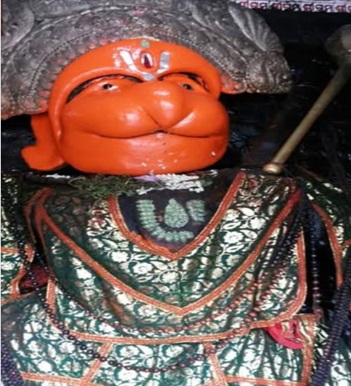
Locally known as Bara Bhai Hanuman, this seven-foot-tall, sindoor-coated deity is a part of the Asta Mahavira (eight protective Hanuman temples) safeguarding Puri.
Historical Significance
Objective 2: To understand the importance of Kanapata Hanuman in Puri and the presiding deity.
During the night the waves of the ocean make a loud sound that is heard all over Puri. One time this sound entered Jagannatha’s temple, thus disturbing the Lord’s sleep. Lord Jagannatha ordered Samudra not to make any sound which might disturb Him. From that time on, the sound of Samudra crashing on the beach never again entered Jagannatha’s Temple. Lord Jagannatha engaged His Devotee Hanuman to stand at the south gate and listen attentively and ensure the sound never entered the Sri Mandira. “Kanapata” means to engage the ears (Kana) for hearing. Thus, Hanuman is known here as Kanapata Hanuman.
Being ordered by his master, Hanuman made the entire boundary wall soundproof and being explicitly loyal always put his ears on the wall to ensure that the sound of the sea has been seized.
It is an astonishing fact that during the night, when one stands before the temple, one can hear the sound of the sea. But most surprisingly, the sound is never heard inside the temple.
That is the wonderful manifestation of God’s power.
Architectural Layout
The deity is housed in a compact, square-plan stone shrine built directly into the eastern flank of the southern gateway (Dakhina Dwara or Horse Gate). It conforms to the broader Kalinga School of Architecture, using a simple Pidha Deula (pyramidal roof structure) common for subordinate guardian.
The architectural focal point is the towering statue of Lord Hanuman, which stands between 7 to 18 feet tall (depending on how the entire stone pedestal base is measured).
The core icon was anciently shaped from soil and khapara (dense coconut shells). Over centuries of ritual worship, it has been continually layered with dense coatings of vermilion (sindoor) paste, giving it a soft, smooth, and heavily rounded silhouette.
Special Occasion
The temple sees heavy footfall on Tuesdays and Saturdays. A highly revered daily tradition involves bringing the Agyana Mala (a garland blessed by Lord Jagannath) to be offered to the Mahavir. During Pana Sankranti (Odia New Year), the deity is dressed in a special Naga Besha (warrior attire).
Timings
The temple is open daily, and the best times to witness local worship are during the early morning or evening ārati.
