
Objectives
Objective 1. To understand the proper relationship between scriptural rules (vaidhi-bhakti) and spontaneous loving devotion (rāgānugā-bhakti) (vatsalya Bhava).
Objective 2. To recognize the importance of glorifying the Supreme Lord above material honor and recognition.
Objective 3. To appreciate the power of sincere repentance and wholehearted surrender in devotional service.
Objective 4. To inspire humility, simplicity, compassion, and loving friendship (sakhya-bhāva) with the Lord by following the example of Raghu Dāsa.
Objective 5. To appreciate Bandhu Mohanty’s complete dependence on Lord Jagannāth as his only true friend and protector.
Objective 6. To recognize Lord Jagannāth as Bhāva-grāhī, the Lord who accepts the loving mood and devotion of His devotees above external qualifications.
Objective 7. To appreciate the importance of humility, repentance, and complete dependence on the Lord during times of difficulty.
Objective 8. To appreciate the importance of complete dependence on the Lord as taught in Bhagavad-gītā 9.22.
Objective 9 .To learn how the Lord mercifully removes the pride of His devotees for their spiritual benefit.
Objective 10. To inspire complete surrender, humility, perseverance, and selfless service by following the devotional example of King Indradyumna.
Objective 11. To recognize that humble service to the Lord is the highest honor, regardless of one’s social position or royal status.
Objective 12. To understand why King Pratāparudra Deva is remembered in the Gauḍīya Vaiṣṇava tradition as the ideal devotee-king who harmonized royal responsibilities with pure devotion to Lord Jagannāth and Śrī Caitanya Mahāprabhu.
Objective 13. To recognize the significance of offering one’s mind, heart, and life in the service of the Lord.
Objective 14. To learn how the simple offering of pān became an established service in the Jagannāth Temple.
Objective 15. To strengthen faith that Lord Jagannāth personally protects and glorifies His sincere devotees.
Objective 16. To recognize that Lord Jagannāth is non-different from Śrī Kṛṣṇa (Gopāla), as revealed through Padmapāda’s divine visions.
Objective 17. To understand the visit of Śrī Rāmānujācārya to Jagannāth Purī and his reverence for Lord Jagannāth.
Objective 18. To appreciate the eternal glory of Lord Jagannāth as the worshipable Lord of the Ikṣvāku dynasty.
Objective 19. To recognize that Lord Jagannāth is the Lord of the Universe who bestows His mercy upon all, and to understand the significance of the French church bell offered to Him as an expression of gratitude.
Objective 20. To recognize that Lord Jagannāth accepts pure devotion regardless of one’s birth, caste, or social background.
Objective 1.To understand the proper relationship between scriptural rules (vaidhi-bhakti) and spontaneous loving devotion (rāgānugā-bhakti)( vatsalya bhava).
1.Kara Mā (Karmābāi)
Kara Mā (also known as Karmābāi or Karāra Devi) was a simple devotee of Lord Jagannāth who worshipped Him with pure motherly love (vātsalya-bhāva). Every morning she lovingly cooked khicari for the Lord without concern for elaborate ritual procedures. Pleased by her sincere devotion, Lord Jagannāth personally visited her humble home each day to accept her offering.
One day, a saint saw her cooking without first bathing or following traditional rules of cleanliness. Wanting to help, he instructed her to strictly observe Vedic regulations before cooking. Obediently, Kara Mā followed his instructions, causing a long delay in preparing the khicari.
Lord Jagannāth came several times to her house, eagerly waiting for His meal, but each time found that she was still cleaning or preparing. When the khicari was finally ready, the Lord quickly ate it and hurried back to the temple before the offering ceremony began. The temple priests noticed traces of khicari on the Lord’s lips and asked Him about it.
Lord Jagannāth revealed that He personally accepted Kara Mā’s offering every day because of her pure love. He explained that the saint had unknowingly interfered with her spontaneous devotion and instructed that she should continue serving Him in her natural mood of love.
The saint humbly admitted his mistake and told Kara Mā to continue worshipping the Lord as she had always done. He also explained that while scriptural rules are essential for ordinary practitioners, the Lord accepts the spontaneous love of His pure devotees in a special way.
When Kara Mā left this world, Lord Jagannāth became overwhelmed with separation and refused all offerings. He told the king that His “mother” was no longer there to feed Him. The king promised that khicari would continue to be offered daily in Kara Mā’s remembrance.
According to tradition, before the famous Chappan Bhoga is offered to Lord Jagannāth, “Kara Mā’s Khicari” is first offered, commemorating her pure, selfless devotion and the Lord’s loving reciprocation with His devotee
Objective 2.To recognize the importance of glorifying the Supreme Lord above material honor and recognition.
2.Dīna Kṛṣṇadāsa
Dīna Kṛṣṇadāsa was a renowned Vaiṣṇava poet and devotee who lived about 300 years ago. Born in Bhimanagara near Khurda to Madhusūdana, he became famous for his elegant Sanskrit and Odia devotional compositions glorifying Lord Jagannāth and the divine pastimes of Śrī Śrī Rādhā-Kṛṣṇa.
One of his best-known hymns, “Jaya Jaya Nīlādripati,” continues to be sung in the Jagannāth Temple at Purī. He composed many of his works while living in the village of Ekagharakiyā on the banks of the Brahmanī River.
King Divyasimha once demanded that Dīna Kṛṣṇadāsa compose poetry praising him. The saint firmly refused, declaring that he would glorify only the Supreme Lord, even at the cost of his life. Angered by this reply, the king imprisoned him.
That night, Lord Jagannāth appeared in the king’s dream and ordered him to release His devotee immediately. When the king reached the prison, he found Dīna Kṛṣṇadāsa’s shackles already broken by the Lord’s divine power. Realizing his mistake, the king begged forgiveness and honored the devotee. Later, out of compassion, Dīna Kṛṣṇadāsa composed the work Jagamohana Candra in the king’s honor.
Dīna Kṛṣṇadāsa was a constant chanter of the Hare Kṛṣṇa Mahāmantra and emphasized the supreme importance of the Holy Name. His works, including Rāsa-Vinoda, Rāsa-Kallola, Nāma Ratnagītā, and Amṛta Sāgara, glorify the Holy Name, Lord Jagannāth, and the transcendental pastimes of Rādhā and Kṛṣṇa. Deeply inspired by Śrī Jayadeva Gosvāmī’s Gīta Govinda, his devotional literature remains highly respected and continues to inspire devotees and scholars throughout Odisha.
Objective 3.To appreciate the power of sincere repentance and wholehearted surrender in devotional service.
3.Bhakta Balarāma Dāsa
Bhakta Balarāma Dāsa was a great devotee of Lord Jagannāth and one of the celebrated saint-poets of Odisha. During one Ratha-yātrā, while thousands of devotees gathered to welcome Lord Jagannāth, Balarāma Dāsa was momentarily distracted by bad association and was in the company of a prostitute.
As the sounds of kīrtana and the Lord’s procession reached him, he immediately came to his senses. Filled with deep remorse and repentance, he left at once, chanting the holy names of Lord Jagannāth, and hurried to the Lord’s chariot for darśana.
Overwhelmed with devotion, he tried to climb the chariot to embrace Lord Jagannāth. However, seeing the marks of vermilion and betel on his body and assuming him to be impure, the temple servants harshly rebuked him, pushed him off the chariot, and cleansed the chariot.
Hurt by the humiliation but without losing his faith, Balarāma Dāsa went to the seashore at Bāṅkimuhān. There he lovingly fashioned three chariots out of sand and prayed to Lord Jagannāth, Lord Baladeva, and Subhadrā Devī to mercifully accept them.
Pleased by His devotee’s sincere repentance and pure devotion, Lord Jagannāth, along with Lord Baladeva and Subhadrā Devī, mystically accepted Balarāma Dāsa’s sand chariots. At the same time, the actual Ratha-yātrā chariots in the city came to a complete halt. Despite the efforts of thousands of devotees and even elephants, the chariots would not move.
Learning what had happened, the Gajapati King personally approached Balarāma Dāsa, begged him to return, honored him by placing his royal turban on his head, and requested him to come before the Lord’s chariots. As soon as Balarāma Dāsa arrived, the chariots immediately began to move again, revealing to everyone that Lord Jagannāth had accepted His devotee’s heartfelt love.
This pastime teaches that the Lord looks at the sincerity of a devotee’s heart rather than external appearances. Genuine repentance, humility, and pure devotion attract the special mercy of Lord Jagannāth.
Objective 4.To inspire humility, simplicity, compassion, and loving friendship (sakhya-bhāva) with the Lord by following the example of Raghu Dāsa.
4.Raghu Dāsa
Raghu Dāsa was a great devotee of Lord Rāmacandra who lived near the Lion Gate (Siṁha-dvāra) of the Jagannāth Temple in Purī. One day, while taking darśana of Lord Jagannāth, he saw Lord Rāma, Sītā, and Lakṣmaṇa seated on the jeweled throne. From that moment, he realized that Lord Jagannāth was none other than Lord Rāmacandra and developed a deep sakhya-bhāva (friendship) with the Lord.
Once, Raghu Dāsa lovingly prepared a flower garland for Lord Jagannāth using a string made from banana bark. The temple priest refused to offer it because such material was not permitted according to temple regulations. Heartbroken, Raghu returned home. That night, Lord Jagannāth appeared in the head priest’s dream and revealed that He had rejected all other flower decorations because He desired only Raghu Dāsa’s garland, which had been made with pure love. The priests immediately apologized and invited Raghu to personally offer his garland to the Lord.
Later in life, Raghu Dāsa became seriously ill and was unable to care for himself. A young boy came daily to clean him, apply sandalwood paste, and serve him with great affection. Raghu eventually realized that the boy was Lord Jagannāth Himself. When he begged the Lord to cure his illness instead of serving him, Lord Jagannāth explained that He wanted Raghu to become free from all his remaining karma and lovingly declared that He also finds joy in serving His devotees.
The friendship between Raghu Dāsa and Lord Jagannāth was so intimate that the Lord would often visit him in the form of a young boy to play. On one occasion, the Lord mischievously persuaded Raghu to steal a jackfruit from the king’s garden, only to disappear at the crucial moment, leaving Raghu caught in the tree. When questioned by the king, Raghu honestly narrated the entire incident, delighting everyone with the Lord’s playful pastime.
During one Ratha-yātrā, Lord Jagannāth’s chariot would not move despite the efforts of thousands of devotees and even elephants. Raghu Dāsa climbed onto the chariot, whispered something into the Lord’s ear, and immediately the chariot began to move, astonishing all who witnessed the event.
Raghu Dāsa was also known for his humility and compassion. He kept a pot of mahāprasāda outside his residence for anyone to take and would himself honor prasāda from the same pot used by people, birds, and animals. His life beautifully demonstrates the intimate friendship, simplicity, humility, and loving reciprocation between Lord Jagannāth and His pure devotee.
Objective 5.To appreciate Bandhu Mohanty’s complete dependence on Lord Jagannāth as his only true friend and protector.
5.Bandhu Mohanty
Bandhu Mohanty was a poor but deeply devoted servant of Lord Jagannāth from Jajpur in Odisha. Though he had a wife, two daughters, and a son, he lived by begging and spent his days chanting the holy names of the Lord, serving others, and remaining content with whatever came by the Lord’s mercy.
When a severe famine struck his village, Bandhu could no longer obtain food for his starving family. Trusting completely in Lord Jagannāth, whom he called his only true friend, he brought his family to Jagannāth Purī, believing the Lord would care for them.
Unable to enter the temple because of the crowds, the family took darśana of Patita Pāvana Jagannāth at the Lion Gate and later rested near the South Gate by the Pejā Nālā. After drinking rice starch (pejā) to ease their hunger, Bandhu prayed earnestly to Lord Jagannāth and fell asleep.
That night, Lord Jagannāth, unable to bear His devotee’s hunger, personally came disguised as an elderly brāhmaṇa carrying a golden plate filled with mahāprasāda. He awakened Bandhu, lovingly fed his entire family, and promised to arrange everything for them the next day.
The following morning, the golden plate was discovered missing from the temple treasury. Seeing the plate with Bandhu, the temple guards falsely accused him of theft, beat him, and imprisoned him despite his truthful explanation.
Unable to tolerate His devotee’s suffering, Lord Jagannāth appeared in the Gajapati King’s dream. The Lord declared that Bandhu was His dear friend and that He Himself had taken the golden plate to feed him. He ordered the king to immediately release Bandhu, honor him, and provide lifelong care for his family.
The king obeyed at once. He personally released Bandhu Mohanty from prison, begged his forgiveness, honored him with fine clothes and a turban, and arranged a home and lifelong maintenance for his family near the South Gate of the Jagannāth Temple.
Bandhu Mohanty spent the rest of his life happily serving Lord Jagannāth near the temple. His life beautifully illustrates that the Lord never abandons those who place complete faith in Him. Lord Jagannāth personally protects, feeds, and honors His sincere devotees, reciprocating with their unwavering devotion.
Objective 6. To recognize Lord Jagannāth as Bhāva-grāhī, the Lord who accepts the loving mood and devotion of His devotees above external qualifications.
6. Dāsia Baurī (Baligram Dāsa)
Dāsia Baurī, also known as Baligram Dāsa, was a humble weaver from Baligram near Puri. Though born in a low-caste tribal family and living in poverty, he gradually kdeveloped deep devotion to Lord Jagannāth through association with devotees, initiation from a spiritual master, and regular hearing of hari-kathā.
During the Ratha-yātrā festival, he had his first darśana of Lord Jagannāth. The Lord’s beautiful lotus eyes deeply touched his heart, and from that day he accepted Lord Jagannāth as the only truth and object of his worship.
After returning home, even a simple meal of rice and spinach reminded him of the Lord’s large eyes. Overwhelmed with ecstatic love, he was unable to eat and constantly remembered Lord Jagannāth. Seeing his devotion, the villagers began calling him Baligram Dāsa.
Pleased by his sincere love, Lord Jagannāth personally appeared before him and assured him that He is attracted not by caste, wealth, or ritual, but by pure devotion. The Lord blessed him, promising to reveal Himself whenever Dāsia looked at the Nīlacakra atop the Jagannāth Temple and to personally accept whatever offerings he made with devotion.
To test this promise, Dāsia obtained a coconut and requested a brāhmaṇa to offer it in the temple only if Lord Jagannāth personally stretched out His hand to receive it. Though initially doubtful, the brāhmaṇa witnessed the Lord miraculously extend His arm from the altar and accept the coconut. The entire temple rejoiced on hearing of Dāsia’s extraordinary devotion.
On another occasion, Dāsia purchased mangoes to offer the Lord. Instead of handing them to the temple priests, he offered them before the Nīlacakra with heartfelt prayer. Before everyone’s eyes, the mangoes mysteriously disappeared. When the priests entered the sanctum, they found mango pulp and seeds near the Deity, confirming that Lord Jagannāth had personally accepted Dāsia’s offering.
The priests honored Dāsia with the Lord’s prasāda garland, while Dāsia humbly bowed to them and accepted their blessings. Later, while praying to see all the Lord’s forms, he was blessed with a divine vision of Lord Jagannāth manifesting His various incarnations from Matsya to Kalki.
The life of Dāsia Baurī teaches that Lord Jagannāth is Bhāva-grāhī—the Lord who accepts the loving devotion of His devotees, regardless of birth, caste, wealth, or social status. Pure devotion alone attracts the Lord’s mercy.
Objective 7. To appreciate the importance of humility, repentance, and complete dependence on the Lord during times of difficulty.
7. Talichā Mahāpātra
Talichā Mahāpātra was a learned brāhmaṇa and one of the principal priests (pūjārīs) of Lord Jagannāth in Purī. He was devoted to strict spiritual discipline, scriptural study, cleanliness, charity, and the personal service of Lord Jagannāth, Baladeva, and Subhadrā Devī.
One day, the Gajapati King arrived unexpectedly for darśana and, as was customary, requested a flower garland that had adorned Lord Jagannāth. Talichā Mahāpātra realized that no garland had been placed on the Lord that day. Not wanting the king to leave without receiving the Lord’s prasāda, he removed the flower garland from his own neck and respectfully placed it on Lord Jagannāth before offering it to the king.
Later, the king noticed a strand of human hair in the garland and became angry, believing that the priest had committed a serious offense by placing his own garland on the Deity. He ordered Talichā Mahāpātra to appear the next morning and prove that Lord Jagannāth actually had hair on His head, threatening severe punishment otherwise.
Deeply repentant for his mistake and fearing the king’s judgment, Talichā Mahāpātra prayed earnestly to Lord Jagannāth. That night, the Lord appeared in his dream and assured him that He would personally protect His devotee, revealing that He indeed possessed beautiful hair.
The next morning, when the temple doors were opened, Talichā Mahāpātra was astonished to see Lord Jagannāth with long, beautiful black hair flowing down to His waist. When the king arrived, he examined the hair and, doubting its authenticity, pulled a few strands. Immediately, blood flowed from the Lord’s head. Overcome with fear and remorse, the king fainted.
After regaining consciousness, the king realized his grave offense. He begged forgiveness from Talichā Mahāpātra and understood that Lord Jagannāth personally protects and identifies with His sincere devotees. When they looked again, the Lord’s hair had disappeared, revealing that the entire miracle had been arranged solely to protect His devotee.
The king honored Talichā Mahāpātra with gifts and offered heartfelt prayers to Lord Jagannāth. Talichā Mahāpātra continued his humble service to the Lord, while this pastime became a lasting testimony to the Lord’s affection for His devotees.
This pastime teaches that Lord Jagannāth lovingly protects those who sincerely serve Him. He accepts responsibility for His devotees and personally safeguards their honor, demonstrating that He is the eternal friend and protector of His faithful servants.
Objective 8. To appreciate the importance of complete dependence on the Lord as taught in Bhagavad-gītā 9.22.
8. Gītā Paṇḍā (Arjuna Miśra)
Arjuna Miśra, affectionately known as Gītā Paṇḍā, was a humble devotee of Lord Jagannāth in Purī who dedicated his life to the daily study and recitation of the Bhagavad-gītā. He lived by begging and accepted every circumstance as the Lord’s arrangement, placing complete faith in Lord Jagannāth’s promise to protect His devotees.
During a period of continuous heavy rain, Gītā Paṇḍā was unable to go out for alms. As the family’s food ran out, his wife became anxious for their starving children. However, Gītā Paṇḍā remained peaceful and repeatedly quoted Bhagavad-gītā 9.22:
“To those who always worship Me with exclusive devotion, I carry what they lack and preserve what they have.”
Frustrated by his unwavering faith, his wife scratched three lines across this verse in the Bhagavad-gītā, doubting the Lord’s promise.
That night, two extraordinarily beautiful boys—one dark-complexioned and the other fair—arrived at their home carrying abundant food supplies. They said the provisions had been sent by a friend of Gītā Paṇḍā. When Gītā Paṇḍā’s wife invited them to stay for prasāda, the dark boy replied that his tongue had been cut in three places, so he could not eat.
Hearing this, Gītā Paṇḍā immediately realized that the two boys were none other than Lord Jagannāth and Lord Baladeva. The Lord’s tongue had been marked because His wife had scratched the Lord’s own words in the Bhagavad-gītā three times. In this miraculous way, Lord Jagannāth demonstrated that His promise in the Gītā is eternally true.
Filled with repentance and gratitude, Gītā Paṇḍā and his wife rushed to the Jagannāth Temple. There they saw three marks on Lord Jagannāth’s lips, confirming that the Lord Himself had come to fulfill His promise and care for His devotee.
This beautiful pastime teaches that Lord Jagannāth always protects and provides for those who place complete faith in His words. The promises of the Bhagavad-gītā are eternal, and the Lord personally upholds them for His sincere devotees.
Objective 9. To learn how the Lord mercifully removes the pride of His devotees for their spiritual benefit.
9. Jagat Seth
Jagat Seth was a wealthy merchant from Hyderabad and a devoted follower of Lord Jagannāth. During a pilgrimage to Jagannāth Purī, he desired to offer bhoga worth one hundred thousand rupees to the Lord and insisted that the entire amount be spent in a single day while he was present.
The temple priests explained that such a large amount could not possibly be spent on one day’s offerings, as the prices of food items were very low. Since they could not decide how to fulfill his request, they prayed to Lord Jagannāth for guidance.
That night, Lord Jagannāth appeared in the chief priest’s dream and instructed that Jagat Seth should offer Him just one betel leaf (pān), but prepared not with ordinary lime—instead, it should contain powder made from a rare elephant pearl (gaja-moti).
When the priest conveyed the Lord’s instruction, Jagat Seth realized that obtaining a genuine elephant pearl was virtually impossible. He understood that despite all his wealth, he could not fulfill even the Lord’s simple request.
Recognizing that pride had entered his heart, Jagat Seth removed his royal garments, dressed as an ordinary pilgrim, and humbly approached Lord Jagannāth. Placing his wealth before the Lord, he prayed for forgiveness, acknowledging that the Lord had mercifully destroyed his false pride.
This pastime teaches that Lord Jagannāth is not impressed by wealth or opulent offerings. He desires humility, sincerity, and loving devotion. The Lord often removes the pride of His devotees so they may develop genuine surrender and pure bhakti.
Objective 10. To inspire complete surrender, humility, perseverance, and selfless service by following the devotional example of King Indradyumna.
10. King Indradyumna – The Devotee King of Lord Jagannāth
King Indradyumna was a great devotee of Lord Viṣṇu whose life’s only desire was to have the direct darśana of the Lord. When he heard about the mysterious Deity of Nīla-mādhava, he eagerly sent learned brāhmaṇas in all directions to find Him. By the Lord’s arrangement, Vidyāpati alone discovered the hidden Deity worshipped by the tribal devotee Viśvāvasu and informed the King.
When King Indradyumna reached the sacred place, Nīla-mādhava had disappeared. Though deeply disappointed, he obeyed the Lord’s divine instruction to construct a magnificent temple on Nīlācala, where the Lord promised to appear as Dāru-brahman, the Supreme Lord manifested in a sacred wooden form.
Following the Lord’s guidance, the King found the divine log (Dāru), which could not be moved by physical strength. Only when Viśvāvasu and Vidyāpati joined together in devotional service and the log was placed on a golden chariot did it move effortlessly, teaching that the Lord is pleased by devotion rather than power.
The Lord Himself then appeared as an aged carpenter and agreed to carve the Deities of Lord Jagannāth, Lord Baladeva, Subhadrā Devī, and Sudarśana. When the anxious King opened the workshop before the agreed time, the Lord disappeared, leaving the Deities with incomplete limbs. Saddened, the King prayed for forgiveness, and the Lord reassured him that this unique form was His eternal transcendental manifestation, beyond material limitations, through which He would accept the love and service of all devotees.
By the Lord’s own instruction, King Indradyumna inaugurated the Ratha-yātrā Festival, taking Lord Jagannāth, Lord Baladeva, and Subhadrā Devī from the main temple to the Gundicā Temple, Their place of appearance. This sacred festival continues to this day under many names, including Gundicā Yātrā, Nava-yātrā, Ghoṣa Yātrā, and Patita Pāvana Yātrā.
After the installation of the Deities, King Indradyumna requested three unique boons from the Lord: that he would leave no descendants, that the Lord would continually accept offerings throughout the day, and that the Lord would rest for only three hours daily while granting darśana to the conditioned souls for the remainder of the day. Lord Jagannāth happily granted these requests. Seeing Queen Gundicā’s sadness at having no children, the Lord compassionately promised to stay with her for seven days every year, giving rise to His annual stay at the Gundicā Temple during Ratha-yātrā.
King Indradyumna’s life exemplifies complete surrender, unwavering perseverance, and selfless devotion. Rather than seeking personal glory or royal prosperity, he dedicated his entire kingdom to establishing Lord Jagannāth’s lworship for the benefit of all humanity. Through his devotion, Lord Jagannāth’s worship and the Ratha-yātrā festival became eternal gifts for the whole world.
Objective 11. To recognize that humble service to the Lord is the highest honor, regardless of one’s social position or royal status.
11. King Puruṣottama Deva
King Puruṣottama Deva, the Gajapati King of Odisha, was a great devotee of Lord Jagannāth. Every year during the Ratha-yātrā, he personally performed the sacred Chhera Pahanra ceremony by sweeping the road before the Lord’s chariot with a golden broom, considering himself the humble servant of Lord Jagannāth.
When the minister of the King of Kāñcī witnessed this, he misunderstood the service as the work of a common street sweeper and advised his king to reject the proposed marriage between Princess Padmāvatī and King Puruṣottama Deva. Deeply insulted by this misunderstanding of devotional service, King Puruṣottama Deva declared war on Kāñcī.
Before the battle, Lord Jagannāth and Lord Baladeva personally went ahead of the king’s army disguised as two heroic soldiers riding black and white horses. On their journey, They accepted buttermilk from an elderly woman named Māṇikā and gave her Lord Jagannāth’s diamond ring as payment, promising that the king would compensate her.
When King Puruṣottama Deva later received the Lord’s ring from Māṇikā, he realized that Lord Jagannāth and Lord Baladeva had personally gone before him to fulfill Their promise and assure his victory. Out of gratitude, he rewarded Māṇikā generously and established the village of Māṇikā Patna in her honor.
With the Lord’s direct assistance, King Puruṣottama Deva defeated the King of Kāñcī and brought Princess Padmāvatī to Purī. Still hurt by the earlier insult, he ordered that she be married to a street sweeper (caṇḍāla). However, his wise minister delayed the marriage.
The following year, during Ratha-yātrā, while King Puruṣottama Deva was once again sweeping the road before Lord Jagannāth’s chariot, the minister presented Princess Padmāvatī and declared that the king himself was the street sweeper chosen as her husband. Realizing the minister’s wisdom, King Puruṣottama Deva gladly accepted Princess Padmāvatī as his queen.
According to the conditions of the battle, the Deity of Gaṇeśa from Kāñcī was brought to Purī and installed behind the Jagannāth Temple. Even today, the Gajapati King continues the tradition of performing Chhera Pahanra, demonstrating that the highest honor is to become the humble servant of Lord Jagannāth. This pastime beautifully teaches that the Lord personally protects, assists, and glorifies those who render humble and selfless service to Him.
Objective 12. To understand why King Pratāparudra Deva is remembered in the Gauḍīya Vaiṣṇava tradition as the ideal devotee-king who harmonized royal responsibilities with pure devotion to Lord Jagannāth and Śrī Caitanya Mahāprabhu.
12. King Pratāparudra Deva
King Pratāparudra Deva was the famous Gajapati king of Odisha during the time of Śrī Caitanya Mahāprabhu. In the Gauḍīya Vaiṣṇava tradition, he is revered not merely as a powerful ruler but as an exalted devotee who received the special mercy of Mahāprabhu. According to the Gaura-gaṇoddeśa-dīpikā, King Indradyumna, who originally established the worship of Lord Jagannāth, later appeared as King Pratāparudra.
Family and Background
· Son of King Puruṣottama Deva and Queen Padmāvatī (Rūpāmbikā).
· Belonged to the Gajapati dynasty of Odisha.
· Ruled from Cuttack (Kataka).
· Accepted Kāśī Miśra as his spiritual master and regularly served him by personally massaging his feet and inquiring about Lord Jagannāth’s daily worship.
A Powerful but Humble King
Although Pratāparudra was a mighty emperor and successful military leader, he remained deeply humble and devoted to Lord Jagannāth. He supported Vaiṣṇava culture, protected religious traditions, encouraged learning, and was greatly respected by devotees such as Rāmānanda Rāya, Sārvabhauma Bhaṭṭācārya, and Kāśī Miśra.
King Pratāparudra’s Relationship with Lord Jagannāth
King Pratāparudra Deva regarded himself not as the owner of the kingdom but as the first servant of Lord Jagannāth. He believed that the kingdom of Odisha belonged to Lord Jagannāth and that he ruled only as the Lord’s representative. Every important decision of the kingdom was taken with the understanding that it was meant for the pleasure and service of Lord Jagannāth.
The King faithfully upheld the daily worship, festivals, and ancient traditions of the Jagannāth Temple. He ensured that the temple services were performed according to established scriptures and generously supported the maintenance of the temple.
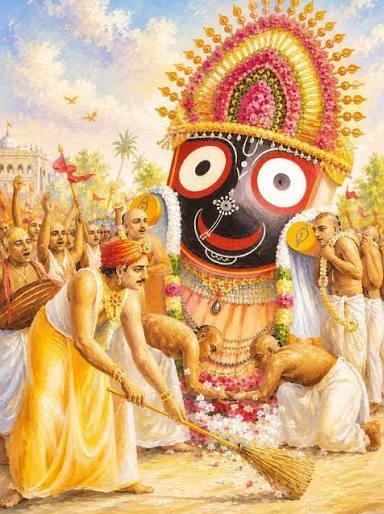
Chhera Pahara by the king
His devotion was especially evident during the annual Ratha-yātrā, when he performed the sacred service of Chhera Pahara. Setting aside all royal prestige, he swept the road before Lord Jagannāth’s chariot with a golden broom while sprinkling sandalwood-scented water. This act symbolized that even the greatest emperor is only a humble servant of the Supreme Lord. His humility deeply pleased both Lord Jagannāth and Śrī Caitanya Mahāprabhu.
Pratāparudra eagerly awaited every opportunity to have the darśana of Lord Jagannāth. He regularly consulted with Kāśī Miśra regarding the Lord’s worship and took personal interest in ensuring that all temple rituals and festivals were conducted with the highest devotion and dignity.
His Desire to Meet Śrī Caitanya Mahāprabhu
King Pratāparudra developed an intense longing to receive Mahāprabhu’s darśana. However, Mahāprabhu initially refused because He wished to uphold the ideal that a sannyāsī should avoid close association with worldly rulers. Despite repeated refusals, the King never lost faith or devotion and even declared that life and kingdom were meaningless without Mahāprabhu’s mercy.
Receiving Mahāprabhu’s Mercy
Nityānanda Prabhu arranged for the King to receive one of Mahāprabhu’s used garments (bahirvāsa), which Pratāparudra worshipped with great devotion.
During the Ratha-yātrā festival, the King performed the humble service of Chhera Pahara, sweeping the road before Lord Jagannāth’s chariot with a golden broom and sprinkling sandalwood-scented water. Mahāprabhu was deeply pleased by this act of humility.
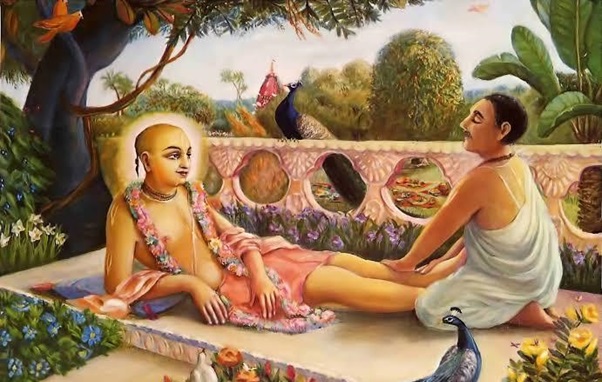
Mahaprabhu and king at flower garden
Later, while Mahāprabhu rested in a flower garden during Ratha-yātrā, the King approached Him in the simple dress of an ordinary Vaiṣṇava, gently massaged the Lord’s feet, and recited verses from the Gopī-gīta of the Śrīmad-Bhāgavatam. Overwhelmed by the King’s devotion, Mahāprabhu embraced him, bestowing His full mercy without initially revealing his royal identity.
Witness to Mahāprabhu’s Pastimes
King Pratāparudra witnessed many extraordinary pastimes of Mahāprabhu, including:
· The Lord’s ecstatic dancing during Ratha-yātrā.
· The miraculous movement of Lord Jagannāth’s chariot when Mahāprabhu pushed it with His head.
· Nandotsava celebrations and other devotional festivals in Puri.
· Mahāprabhu’s loving dealings with His devotees.
His Devotional Character
Pratāparudra valued Mahāprabhu’s association above his kingdom, wealth, or even his own life. When Mahāprabhu considered leaving Puri, the King declared that he would gladly sacrifice everything just to keep the Lord in Jagannāth Purī. His humility, service attitude, and unwavering devotion made him one of the foremost royal devotees in Gauḍīya Vaiṣṇava history.
Significance
King Pratāparudra Deva stands as an ideal example of how great worldly power can be harmonized with genuine humility and pure devotion. His life teaches that sincere service to Lord Jagannāth and His devotees attracts the causeless mercy of Śrī Caitanya Mahāprabhu, regardless of one’s social position.
Objective 13. To recognize the significance of offering one’s mind, heart, and life in the service of the Lord.
13. Princess Viṣṇupriyā
Princess Viṣṇupriyā, the daughter of King Jayasimha Deva and Queen Candrāvatī of Jaipur, is remembered for her extraordinary devotion to Lord Jagannāth.
During a pilgrimage to Jagannāth Purī, her parents learned the glories of Jagannāth Mahā-prasāda, which is first offered to Lord Jagannāth and then to Goddess Vimala. Deeply inspired, Queen Candrāvatī prayed for a daughter whom she could dedicate to the Lord’s service. By Lord Jagannāth’s mercy, Princess Viṣṇupriyā was born.
When Queen Candrāvatī later became seriously ill, all medical treatments failed. A saint from Purī arrived carrying Jagannāth Mahā-prasāda and instructed that it be given to the Queen while praying sincerely to Lord Jagannāth. With great faith, the Queen honored the Mahā-prasāda and gradually recovered completely. This miracle greatly strengthened the devotion of the royal family, who thereafter showed special respect to all pilgrims and servants of Lord Jagannāth.
As Viṣṇupriyā grew older, her love for Lord Jagannāth deepened. When a Panda from Purī visited the palace to receive offerings for the Lord, the King and Queen presented valuable gifts. Viṣṇupriyā, however, reflected that Lord Jagannāth, the husband of Lakṣmī, already possessed unlimited wealth and opulence. She concluded that the only meaningful gift she could offer was herself.
She wrote a heartfelt Sanskrit prayer on a bhūrja-patra (birch bark leaf) with musk ink, placed it in a jeweled box, and requested the Panda to deliver it personally to Lord Jagannāth. Expecting precious jewels, the Panda opened the box during his journey. Seeing only a leaf with a written prayer, he foolishly discarded it.
That night, Lord Jagannāth appeared to the Panda in a dream and asked, “Where is My gift from Princess Viṣṇupriyā?” The Lord explained that her loving letter was more valuable than all material treasures and revealed that He Himself had picked it up and placed it upon His own chest.
The next morning, when the temple doors opened, everyone saw the leaf resting on Lord Jagannāth’s chest. The head priest read the Sanskrit verse, in which Viṣṇupriyā expressed that since the Lord already possessed all riches, she had nothing material to offer. Remembering that the gopīs of Vṛndāvana had stolen Kṛṣṇa’s mind with their pure love, she humbly offered her own mind and heart at His lotus feet, praying that He would kindly accept them.
This beautiful pastime teaches that Lord Jagannāth is not pleased by material wealth but by pure love and complete surrender. Princess Viṣṇupriyā’s offering of her heart remains an enduring example of selfless devotion, demonstrating that the greatest gift one can offer the Lord is one’s mind, heart, and loving service.
Objective 14. To learn how the simple offering of pān became an established service in the Jagannāth Temple.
14.Prabhu Dāsa
Prabhu Dāsa was a humble pān (betel leaf) seller and a great devotee of Lord Jagannāth in Jagannāth Purī. Though he earned only a simple living by selling pān, he spent most of his time serving the Lord and taking His darśana. His devotion was so deep that he would often become overwhelmed with ecstasy and shed tears before Lord Jagannāth.
Prabhu Dāsa lovingly desired that, after accepting the elaborate offerings of fifty-six preparations (Chappan Bhoga), Lord Jagannāth should also be offered pān as a token of loving service. At that time, however, there was no tradition of offering pān to the Lord.
One night, the great poet-devotee Balarāma Dāsa witnessed two extraordinarily beautiful boys coming out of the Jagannāth Temple after it had closed. They regularly visited the humble hut of Prabhu Dāsa and returned chewing pān. Curious, Balarāma Dāsa later discovered that these boys were none other than Lord Jagannāth and Lord Balabhadra, who personally came every night to accept Prabhu Dāsa’s loving offering.
On one occasion, Prabhu Dāsa had no money to prepare fresh pān. When the two boys asked for pān, he requested Them to leave Their chādars (shawls) as security until They paid the next day. The Lords happily agreed and left Their chādars with him.
The following morning, the temple priests were astonished to find that the sacred chādars adorning Lord Jagannāth and Lord Balabhadra were missing from the altar. Thinking they had been stolen, the matter was reported to King Pratāparudra, who ordered an investigation.
At that time, Balarāma Dāsa explained everything he had witnessed, revealing that the Lords had personally gone to Prabhu Dāsa’s house and had left Their chādars in exchange for pān. The King visited Prabhu Dāsa, who joyfully returned the chādars and humbly confirmed the incident.
Realizing the Lord’s desire to accept this loving service, King Pratāparudra immediately established the tradition of offering pān to Lord Jagannāth and Lord Balabhadra after Their meals.
Prabhu Dāsa was officially entrusted with this service and received the title Pahāda Nāyaka (Bidiyā Yogāniya), the servant responsible for supplying pān to the Lord. This sacred service has continued through his descendants to the present day.
This pastime beautifully demonstrates that Lord Jagannāth is conquered not by wealth or grandeur but by the sincere love of His devotees. The Lord personally accepted the simple offering of Prabhu Dāsa and established it as an eternal service in His temple, showing that even the smallest offering made with pure devotion is most dear to Him.
Objective 15.To strengthen faith that Lord Jagannāth personally protects and glorifies His sincere devotees.
15. Lāndi Mātā
Lāndi Mātā was an elderly devotee of Lord Jagannāth in Jagannāth Purī who worshipped the Lord in the mood of vātsalya-rasa (motherly affection). She considered Lord Jagannāth to be her own beloved son and lovingly cared for Him as a mother would care for her child.
Every day, she prepared a simple neem-leaf paste and brought it to the Jagannāth Temple. Thinking that the Lord accepted many rich food offerings every day, she lovingly worried that He might suffer from stomach discomfort. Out of motherly concern, she wished to feed Him the bitter neem paste, believing it would help His digestion.
One day, the temple gatekeeper stopped her at the entrance and mocked her, refusing to believe that Lord Jagannāth was her son or that He would accept such a simple offering. Heartbroken, Lāndi Mātā returned home weeping, distressed that she could not feed her beloved son.
That night, Lord Jagannāth personally appeared before Lāndi Mātā in her humble hut. He affectionately addressed her as “Mother” and said that after eating many sweets He was suffering from stomach pain and desired the neem paste she had prepared. After requesting the offering, the Lord disappeared.
On the same night, Lord Jagannāth appeared in a dream to the King of Purī and instructed him to seek Lāndi Mātā’s forgiveness. The Lord revealed that He accepted her as His mother and greatly desired the neem paste she lovingly prepared. He ordered the King to ensure that she was allowed to offer it to Him every day.
The following morning, the King, accompanied by his ministers, visited Lāndi Mātā’s humble hut. He apologized on behalf of the temple authorities, glorified her pure devotion, and declared her residence to be known as Lāndi Mātā Matha, a sacred place of pilgrimage. He also ordered that she should personally offer the neem preparation to Lord Jagannāth every day for the rest of her life. Furthermore, even after her departure from this world, a daily bitter offering would continue to be made in her remembrance.
To this day, instead of the original neem-leaf paste, Lord Jagannāth is offered a preparation known as Tīta Bhoga (the bitter offering) after the main food offerings, commemorating the loving devotion of Lāndi Mātā.
This beautiful pastime demonstrates that Lord Jagannāth accepts the love and affection of His devotees above all else. He reciprocated with Lāndi Mātā’s pure motherly affection by personally accepting her offering and establishing it as an eternal part of His daily worship, showing that sincere devotion is more valuable than even the grandest offerings.
Objective 16.To recognize that Lord Jagannāth is non-different from Śrī Kṛṣṇa (Gopāla), as revealed through Padmapāda’s divine visions.
16. Ācārya Padmapāda
Ācārya Padmapāda, originally known as Sadānanda, was the most intimate and beloved disciple of Śrī Śaṅkarācārya. He was renowned for his unwavering faith and devotion to his spiritual master. Once, when Śaṅkarācārya called him from across a flooded river, Sadānanda confidently stepped onto the water, believing that if his guru’s mercy could help him cross the ocean of material existence, it could also help him cross the river. Miraculously, lotus flowers appeared beneath each of his footsteps, enabling him to walk safely across the river. From that day, he became known as Padmapāda (“one whose feet rest on lotuses”).
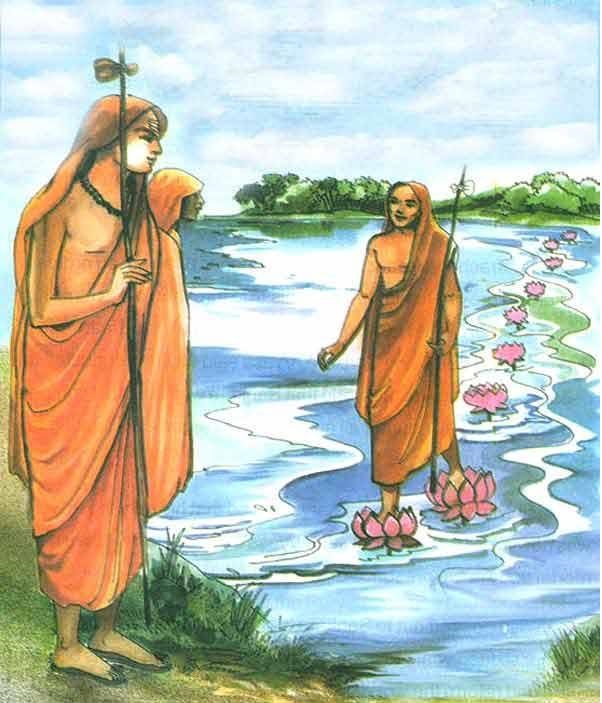
Ācārya Padmapāda
Śaṅkarācārya later appointed Padmapāda as the head of Govardhana Math in Jagannāth Purī, one of the four principal monasteries established by him. As a strict follower of the Vedic (Nigama) tradition, Padmapāda carefully followed orthodox methods of worship.
During a visit to the Jagannāth Temple, Padmapāda learned that after food was first offered to Lord Jagannāth according to the Vedic process, it was then offered to Goddess Vimala through the Āgama (Tantric) tradition, thereby becoming Jagannāth Mahā-prasāda. This created doubt in his mind, and he hesitated to honor the Mahā-prasāda.
Seeking guidance, Padmapāda meditated upon his guru, Śaṅkarācārya. During meditation, he saw the divine form of Lord Jagannāth, within whose eyes he beheld the entire universe. There he saw Śaṅkarācārya, who instructed him not to doubt Jagannāth Mahā-prasāda. He explained that Lord Jagannāth is the Supreme Lord, beyond all religious systems, and that the offering to Goddess Vimala does not diminish the sanctity of the Mahā-prasāda.
Although reassured, Padmapāda still wondered whether the vision was merely his imagination. That night, Lord Kṛṣṇa appeared to him in a dream as a beautiful cowherd boy carrying a pot of yogurt. The Lord revealed that He was the same Gopāla described in the Vedas and that He was non-different from Lord Jagannāth, the Dāru-Brahma (wooden Deity). He instructed Padmapāda to give up all doubts, take darśana of Lord Jagannāth, and honor His Mahā-prasāda.
The next day, while witnessing the noon offering in the Jagannāth Temple, Padmapāda saw a mountain of food offerings before the Lord. Standing atop the offering was the same beautiful cowherd boy from his dream, who joyfully accepted the bhoga. He then witnessed the boy merge into the Deity of Lord Jagannāth, revealing that Lord Jagannāth and Lord Kṛṣṇa are one and the same.
All of Padmapāda’s doubts disappeared. Realizing the supreme glory of Jagannāth Mahā-prasāda, he offered heartfelt prayers of repentance for doubting its sanctity. He then went to Ānanda Bāzār, joyfully honored the Mahā-prasāda, and glorified the unlimited mercy of Lord Jagannāth.
This pastime teaches that Jagannāth Mahā-prasāda is transcendental and supremely sacred. It also demonstrates that Lord Jagannāth is the Supreme Lord described in the Vedas, beyond all sectarian distinctions, and that sincere faith and humility lead to spiritual realization.
Objective 17.To understand the visit of Śrī Rāmānujācārya to Jagannāth Purī and his reverence for Lord Jagannāth.
17. Śrī Rāmānujācārya in Jagannāth Purī
Śrī Rāmānujācārya
Śrī Rāmānujācārya, the great 12th-century Vaiṣṇava ācārya of the Śrī Vaiṣṇava Sampradāya, visited Jagannāth Purī during the reign of King Choda Ganga Deva. A renowned teacher of Viśiṣṭādvaita Vedānta, he recognized Lord Jagannāth as Mahā-Viṣṇu and desired that the Lord’s worship be performed strictly according to the Vedic (Nigama) tradition.
At that time, the worship of Lord Jagannāth included a unique combination of Vedic, Āgamic, and traditional temple practices. Rāmānujācārya was especially concerned that devotees from communities such as the Dayitā-patis participated in the Lord’s service. Believing that temple worship should follow only the Vedic system, he proposed several reforms and sought the support of King Choda Ganga Deva, who greatly respected him.
Although the temple servitors strongly objected to these changes, the King agreed to Rāmānujācārya’s proposals and fixed a day for the new system of worship to begin.
On the appointed morning, the King, priests, and learned brāhmaṇas assembled in the Jagannāth Temple, expecting Rāmānujācārya to inaugurate the new system. However, he did not appear. After waiting for some time, the King instructed the temple priests to continue the traditional worship and sent his ministers to search for the ācārya.
It was then discovered that during the previous night, Lord Jagannāth had personally appeared to Rāmānujācārya in a dream. The Lord instructed him not to alter the established system of worship, explaining that He accepted the loving service of His devotees exactly as it had been offered for generations. Lord Jagannāth told him that His relationship with His devotees was unique and should not be disturbed.
To prevent the changes from taking place, Lord Jagannāth arranged for Garuḍa, His divine carrier, to transport Rāmānujācārya out of Odisha during the night. The next morning, Rāmānujācārya was found at Kūrma Kṣetra in South India.
This pastime illustrates that Lord Jagannāth personally protects the ancient traditions of His temple and lovingly accepts the sincere service of all His devotees according to His own divine will. It also demonstrates Rāmānujācārya’s humility, as he accepted the Lord’s instruction and did not attempt to impose his own understanding upon the Lord’s established worship.
Objective 18.To appreciate the eternal glory of Lord Jagannāth as the worshipable Lord of the Ikṣvāku dynasty.
18.Vibhīṣaṇa
After Lord Rāmacandra defeated Rāvaṇa and returned victorious from Laṅkā, He rewarded all those who had faithfully assisted Him. Before returning to His eternal abode, Lord Rāma gave special instructions to His eternal associates, including Jāmbavān, Hanumān, and Vibhīṣaṇa.
When Vibhīṣaṇa humbly prayed to remain with the Lord instead of ruling Laṅkā, Lord Rāma instructed him to worship Lord Jagannāth, the worshipable Deity of the Ikṣvāku dynasty. The Lord declared that even great demigods such as Indra worship Lord Jagannāth and advised Vibhīṣaṇa to dedicate himself to His service. Vibhīṣaṇa gladly accepted the Lord’s instruction.
Following Lord Rāma’s order, Vibhīṣaṇa became a devoted worshipper of Lord Jagannāth and is traditionally believed to visit the Jagannāth Temple regularly to offer his worship. His connection with Jagannāth Purī continues to be honored through several long-standing temple traditions.
Every year, a special Vibhīṣaṇa Arcana (ceremonial worship) is performed near the Garuḍa Stambha inside the Jagannāth Temple. The temple also preserves a Vibhīṣaṇa Window, which commemorates his association with Lord Jagannāth.
A well-known tradition recounts that a poor brāhmaṇa once prayed to Lord Jagannāth for financial help to perform his son’s sacred thread ceremony. By the Lord’s arrangement, the brāhmaṇa met Vibhīṣaṇa, who compassionately gifted him his gold bracelet. It is traditionally believed that a portion of this bracelet is still preserved among the sacred ornaments of Lord Jagannāth in the temple treasury.
This pastime highlights Vibhīṣaṇa’s complete obedience to Lord Rāmacandra, his deep devotion to Lord Jagannāth, and his compassion toward devotees. It also emphasizes that worship of Lord Jagannāth has been honored since ancient times by great devotees and even by the demigods.
Objective 19. To recognize that Lord Jagannāth is the Lord of the Universe who bestows His mercy upon all, and to understand the significance of the French church bell offered to Him as an expression of gratitude.
19. Captain and Lord Jagannāth
During the seventeenth century, a French trading ship carrying passengers, valuable cargo, and a large church bell was sailing through the Bay of Bengal on its way to Pondicherry. As the ship approached the coast of Odisha, it was caught in a violent storm while heading directly toward what appeared to be a gigantic whale. Faced with certain disaster, Captain Beatle, an experienced sailor, realized there was no human way to save the ship. Panic spread among the passengers as they prepared for death.
Amid the fear and confusion, one elderly Indian passenger remained perfectly calm. Holding a hand-painted picture of Lord Jagannāth, Lord Balabhadra, and Subhadrā Devī, he continuously prayed for the Lord’s protection.
Curious about the old man’s composure, the Captain questioned him. The devotee explained that Lord Jagannāth is the Lord of the Universe, who protects anyone who sincerely prays to Him. Though doubtful, the Captain promised that if Lord Jagannāth saved the ship, he would offer all the treasures on board—and even himself—in gratitude.
Soon afterward, the Captain witnessed a miracle. The enormous whale suddenly changed its course and disappeared into the deep sea. Although the immediate danger had passed, the violent storm still threatened to destroy the ship. Remembering the old devotee’s faith, the Captain himself prayed earnestly to Lord Jagannāth for protection.
Immediately, the storm subsided, the sea became calm, and the ship was completely saved. Overwhelmed with gratitude, Captain Beatle publicly declared that Lord Jagannāth had rescued everyone on board.
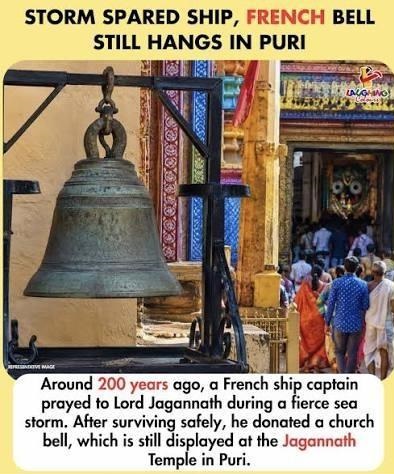
True to his promise, the Captain offered the valuable treasures from the ship, including the large French church bell, to Lord Jagannāth’s Temple in Purī. When the ship neared the coast, he saw the majestic Jagannāth Temple rising above the horizon. Bowing his head in reverence, he glorified Lord Jagannāth and acknowledged Him as the Lord who had mercifully saved their lives.
According to tradition, the French church bell offered by Captain Beatle is still preserved and displayed within the Nilādri Vihāra complex inside the Jagannāth Temple precincts.
This pastime beautifully illustrates that Lord Jagannāth responds to sincere prayers regardless of nationality, culture, or religion. His mercy extends to all who seek His shelter with faith, demonstrating that He is truly the Lord of the Universe (Jagannāth), who lovingly protects all living beings.
Objective 20. To recognize that Lord Jagannāth accepts pure devotion regardless of one’s birth, caste, or social background.
20. Salabega
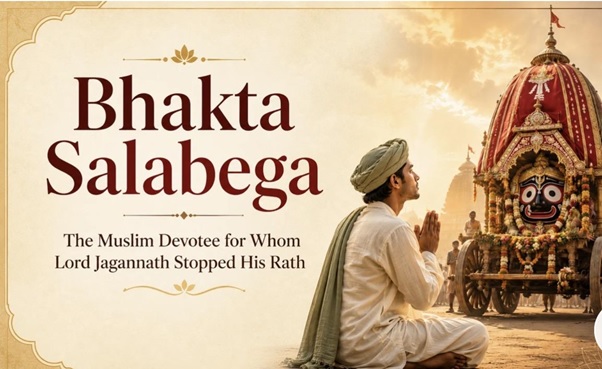
Bhakta Salabega was a 17th-century saint-poet of Odisha and one of the greatest devotees of Lord Jagannath. Salabega was born to the Mughal officer Lalbeg (Muhammad Quli Khan) and a Hindu Brahmana widow. Although born in a Muslim family, he became one of the greatest devotees of Lord Jagannāth.
As a young warrior, Salabega was severely wounded in battle. Seeing his suffering, his mother instructed him to sincerely pray to Lord Krishna. After days of heartfelt prayer, Lord Hari appeared to him in a dream, gave him a medicinal herb, and miraculously healed all his wounds. Filled with gratitude, Salabega dedicated his life to the Lord.
He travelled to Jagannāth Purī, but because of his birth he was not allowed to enter the Jagannāth Temple. But his devotion earned the special mercy of Lord Jagannath.
Accepting this with humility, he left for Vṛndāvana, where he spent a year immersed in devotion, composing beautiful songs glorifying Śrī Śrī Rādhā-Kṛṣṇa.
Later, longing to see Lord Jagannāth during the Ratha-yātrā, Salabega hurried back to Purī. Realizing he would arrive late, he sang heartfelt prayers begging the Lord to wait for him. During the Bahudā Ratha-yātrā (the return journey), Lord Jagannāth’s chariot unexpectedly stopped and would not move, despite thousands of devotees pulling it.
When Salabega finally arrived and had darśana of the Lord, the chariot immediately began moving again. Everyone understood that Lord Jagannāth had lovingly waited for His devotee. Even the Gajapati King came to witness this extraordinary event.
Salabega’s Bhajans
Salabega composed many devotional songs dedicated to Lord Jagannath. His bhajans express humility, surrender, separation from the Lord, and intense devotion.The bhajan “Ahe Nila Saila” remains one of the most famous Jagannath bhajans in Odisha.Salabega composed numerous devotional bhajans glorifying Lord Jagannath, Sri Krishna, Radha-Krishna pastimes, and devotional surrender.
Salabega spent the rest of his life in Purī, and after his passing, a samādhi was established at the place where the Lord’s chariot had waited for him. His devotional poems and bhajans remain among the most cherished devotional songs in Odisha and continue to be sung in praise of Lord Jagannāth.
Salabega’s life demonstrates that the Lord accepts sincere devotion, not one’s birth or social status. Pure love and unwavering faith alone attract the mercy of Lord Jagannāth.
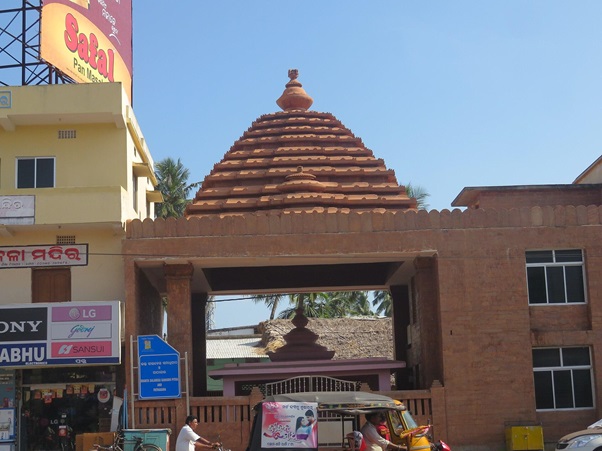
SalabegaSamadhi, Puri
Objectives
Objective 1: To know the sacred significance of Salabega Samadhi in Jagannath culture and Odia bhakti tradition.
Objective 2: To learn about the devotional life of Bhakta Salabega and his deep devotion to Lord Jagannath.
Objective 3: To highlight how Salabega’s compositions made Lord Jagannath devotion accessible to common people.
Objective 4: To know the location of Salabega Samadhi on Grand Road (Bada Danda), Puri, Odisha.
Objective 5: To learn about the accessibility and nearby transport facilities such as Puri Railway Station, Bhubaneswar Airport, and local transport options.
1. Introduction
Objective 1: To know the sacred significance of Salabega Samadhi in Jagannath culture and Odia bhakti tradition.
Salabega Samadhi is one of the most revered devotional memorials associated with the Jagannath tradition in Odisha. The Samadhi commemorates Bhakta Salabega, the celebrated saint-poet and ardent devotee of Lord Jagannath.
The Samadhi is located on the Grand Road (Bada Danda) in Puri, along the sacred route of the annual Rath Yatra of Lord Jagannath. The site holds a unique place in Jagannath culture because the chariot of Lord Jagannath pauses near the Samadhi during the Rath Yatra every year in honor of Salabega’s devotion.
Salabega’s devotional songs and bhajans remain deeply rooted in Odia spiritual culture. His famous composition “Ahe Nila Saila” continues to be sung by devotees across Odisha.
2. Devotees Associated with the Place
Objective 2: To learn about the devotional life of Bhakta Salabega and his deep devotion to Lord Jagannath.
Bhakta Salabega
Bhakta Salabega was a 17th-century saint-poet of Odisha and one of the greatest devotees of Lord Jagannath. He was born to Lalbeg, a Mughal military officer, and Lalita, a Hindu Brahmin lady.
After recovering from severe battle injuries through constant chanting of Lord Vishnu’s holy names, Salabega dedicated his life to the worship of Lord Jagannath.
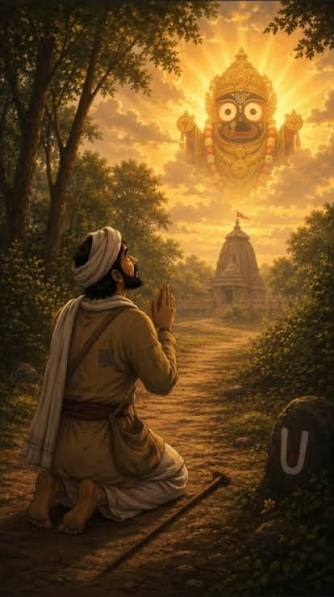
Salabega glorifying Lord Jagganath from
far distance from (Sri Mandir ) main temple at puri
Although he was not permitted to enter the Jagannath Temple due to prevailing social customs, his devotion earned the special mercy of Lord Jagannath.
Salabega composed numerous devotional bhajans glorifying Lord Jagannath, Sri Krishna, Radha-Krishna pastimes, and devotional surrender. His compositions became an integral part of Odia devotional literature and Jagannath culture.
3. Leelas / Pastimes Associated with the Place
The Chariot of Lord Jagannath Stopped for Salabega
One of the most celebrated pastimes connected with Salabega occurred during the Rath Yatra festival.
While returning from Vrindavan to Puri for the Rath Yatra, Salabega became seriously ill and was unable to reach Puri on time. He prayed intensely to Lord Jagannath for darshan.
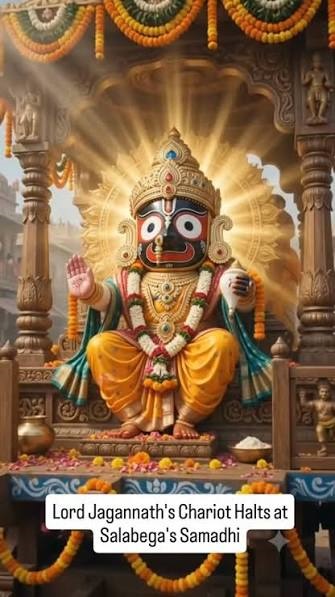
During the return chariot festival (Bahuda Yatra), the chariot of Lord Jagannath stopped on the Grand Road and did not move forward until Salabega arrived and offered prayers.This divine pastime demonstrated Lord Jagannath’s affection for His devotee.
To commemorate this event, the chariot of Lord Jagannath still pauses near Salabega Samadhi during the annual Rath Yatra.
Objective 3: To highlight how Salabega’s compositions made Lord Jagannath devotion accessible to common people.
Salabega’s Bhajans
Salabega composed many devotional songs dedicated to Lord Jagannath. His bhajans express humility, surrender, separation from the Lord, and intense devotion.
The bhajan “Ahe Nila Saila” remains one of the most famous Jagannath bhajans in Odisha.
4. Place / Structure / Importance
Objective 4: To know the location of Salabega Samadhi on Grand Road (Bada Danda), Puri, Odisha.
Salabega Samadhi is situated on Bada Danda (Grand Road) in Puri, Odisha.
The Samadhi marks the sacred memorial site of Bhakta Salabega. The structure is simple yet spiritually significant and attracts devotees throughout the year.
The location is especially important during Rath Yatra because the chariot of Lord Jagannath pauses near the Samadhi as a mark of divine respect toward Salabega’s devotion.
The Samadhi symbolizes:
- Devotion beyond social barriers
- The mercy of Lord Jagannath upon sincere devotees
- The inclusiveness of Jagannath culture
- The importance of bhakti over external identity
The site is also associated with devotional singing, kirtan gatherings, and remembrance of Salabega’s bhajans.
Presiding Deities
The Samadhi primarily commemorates Bhakta Salabega and his devotion to Lord Jagannath.
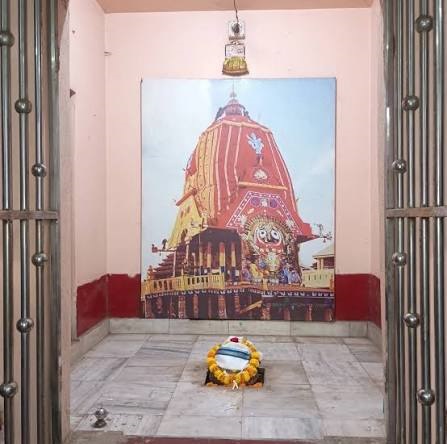
Salabega samadhi
Associated Deities
- Lord Jagannath
- Lord Balabhadra
- Devi Subhadr
- Sri Krishna
Scriptural / Historical References
Historical References
- Salabega’s devotional compositions form an important part of Odia bhakti literature.
- His bhajans are regularly sung in Jagannath devotional traditions.
- Jagannath culture recognizes Salabega as one of the foremost devotees of Lord Jagannath.
Literary Contributions
Salabega composed numerous bhajans in Odia language, making Jagannath devotion accessible to common people.
His compositions prominently include
- Ahe Nila Saila
- Bhajans glorifying Lord Jagannath
- Radha-Krishna devotional songs
7. How to Reach and Around
Objective 5: To learn about the accessibility and nearby transport facilities such as Puri Railway Station, Bhubaneswar Airport, and local transport options
Darshan Timing: The Samadhi area is generally accessible throughout the day.
Recommended visiting time:
- Morning: 6:00 AM – 11:00 AM
- Evening: 4:00 PM – 8:00 PM
Address: Salabega Samadhi, Grand Road (Bada Danda), Balagandi, Puri, Odisha.
Local Transport: Auto-rickshaws, Cycle-rickshaws, Taxis, Walking from Jagannath Temple area
Rath Yatra period is the most significant time to visit.
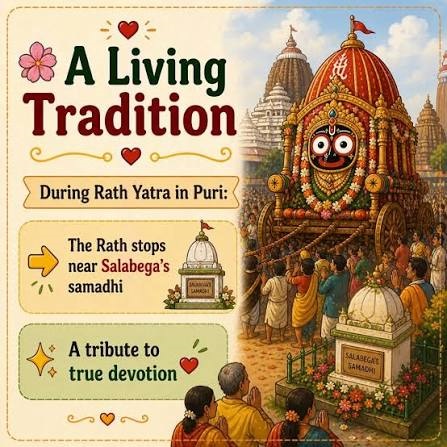
As a summary,
Salabega Samadhi stands as a timeless symbol of pure devotion, humility, and the universal message of Lord Jagannath. The life of Bhakta Salabega demonstrates that sincere love for God transcends all barriers of caste, creed, birth, and social status.
His devotional compositions continue to inspire millions of devotees and remain an integral part of Odisha’s spiritual heritage. The annual tradition of Lord Jagannath’s chariot pausing near his Samadhi during the Rath Yatra is a unique testimony to the Lord’s boundless compassion and affection for His devotees.
Visiting Salabega Samadhi offers not only a glimpse into the rich Jagannath tradition but also a profound lesson that true bhakti is measured by the purity of one’s heart rather than external identity.
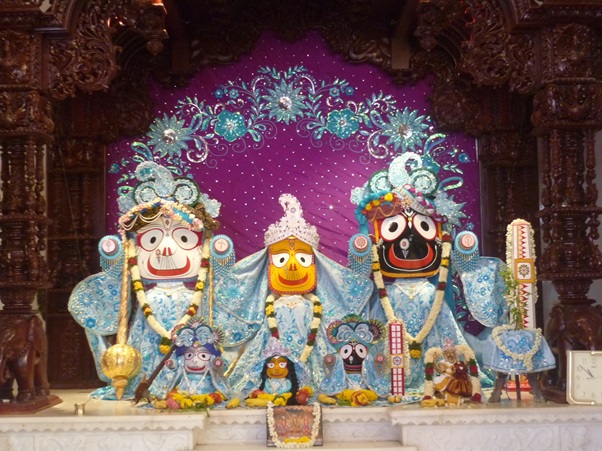
Lord Jagganath, Lord Baladev and Goddesses Subhadhra.
