
Nila Chakra
Objectives
Objective 1.To identify the Neelachakra as the sacred blue wheel crowning the Jagannath Temple and understand its architectural and spiritual significance.
Objective 2.To explore the scientific role of the Neelachakra and the historical development of the Neelachakra through the records of the Madala Panji and other traditional sources.
Objective 3.To identify the location and dimensions of the Neelachakra atop the Jagannath Temple.
Objective 4.To understand the spiritual significance of the Neelachakra as the symbolic representation of Lord Vishnu’s Sri Sudarshana Chakra.
Objective 5.To explore the remarkable engineering features and enduring mysteries of the Neelachakra atop the Jagannath Temple.
Objective 6.To identify the features and significance of the Patitapabana Bana, the sacred flag that flies above the Neelachakra.
Objective 7.To identify the role and responsibilities of the Chunnara Nijogi (Garuda Sevaks) in the daily service of the Neelachakra and Patitapabana Bana.
Objective 8.To recognize the Neelachakra as a symbol of divine protection (Raksha Kavacha) for humanity.
Objective 9.To explore the unique worship of Lord Sudarshana in the Jagannath tradition, where He is worshipped in the form of a wooden pillar on the Ratna Simhasana.
Introduction
Objective 1.To identify the Neelachakra as the sacred blue wheel crowning the Jagannath Temple and understand its architectural and spiritual significance.
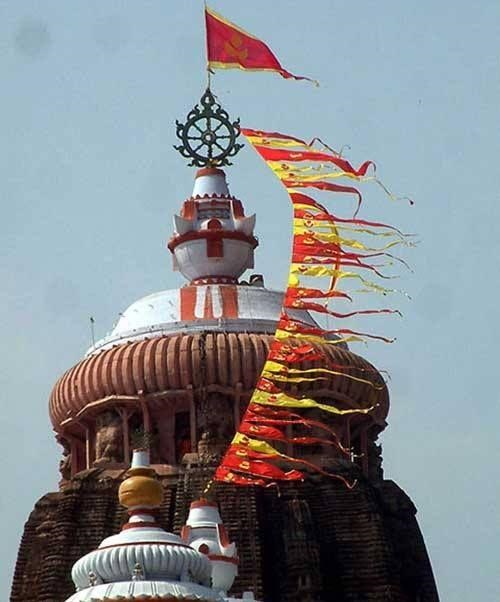
As known from the name Neelachakra the chakra or the sacred wheel is blue. The amalak sila (fluted final) that crowns the top of Sri Jagannath temple at Puri is intended to serve as a balance to keep the heavy structure properly centred over which the dadhinauti (Kalasa) and one with Pataka (flag) are seen from a distance. This wheel is called Neelachakra (Blue wheel) and the flag on it is called Patitapaban baana. As per the custom, every day a different flag is waved on the Neelachakra.
In Srikhetra there is a Parampara (legacy) of three types of Chakra Upasana. One is Nila Chakra on the top of the temple. Second is Sudharshan Chakra on the left side of Mahaprabhu. Another Chakra is Sunaar Chakra (golden round disk), Mahaprabhu holding in the right hand when he is adorned with Suna Besha.
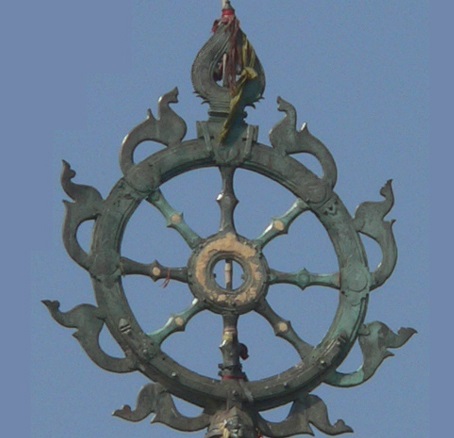
Nila Chakra on the top of the temple
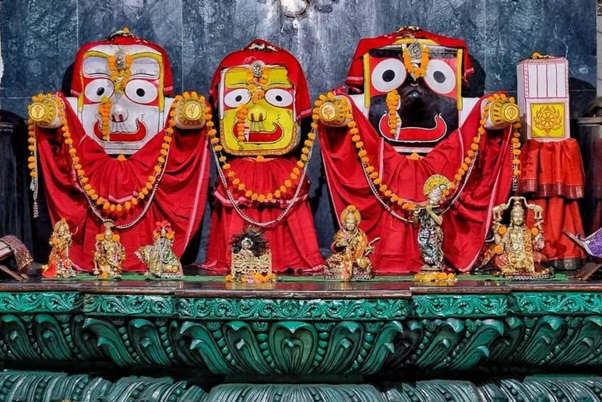
Bhagavan BalaRam,Devi Subhadra ,Bhagavan Jagganath
and Sri Sudharsanar( wooden pillar).
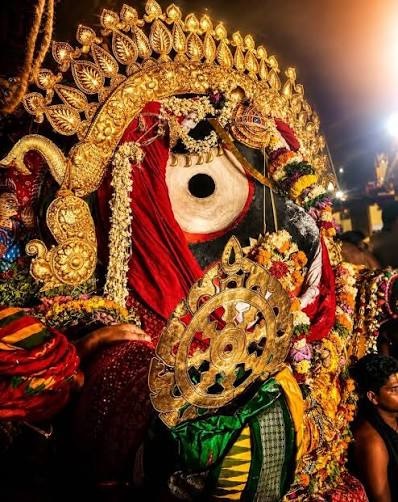
Sunaar Chakra
Importance and History
Objective 2.To explore the scientific role of the Neelachakra and the historical development of the Neelachakra through the records of the Madala Panji and other traditional sources.
The Neelachakra also serves as earthing from a practical and scientific point of view to protect the temple from thunderstorms. A metallic alloy of Neelachakra has the capacity of earthing as a good conductor. It is a metal plate of ninety meters in length and one hundred mm in width that leads to the bottom soil of the well situated on the southern side of the main temple and in front of the Vimala temple.
According to Madalapanji (Palm leaf chronicle) and other sources:
The original Neelachakra was welded during the reign of Anangabhima Dev III (1211–1238 AD). It was replaced twice, once by Ramachandra Dev I (1568–1605 AD) of the Bhoi dynasty in 1595 AD after the invasion of Kalapahad and for the second time in 1703 AD by Divya Singha Dev I (1688–1716 AD) after it was broken by the onslaught of a great cyclone in 1694 AD. This mighty cyclone threw the Neelachakra near the Vata Ganesh on the southern side of the temple.
The Neelachakra was also bent by a heavy cyclone during the reign of Bhanu Dev IV (1414–1435 AD), and it was made straight.
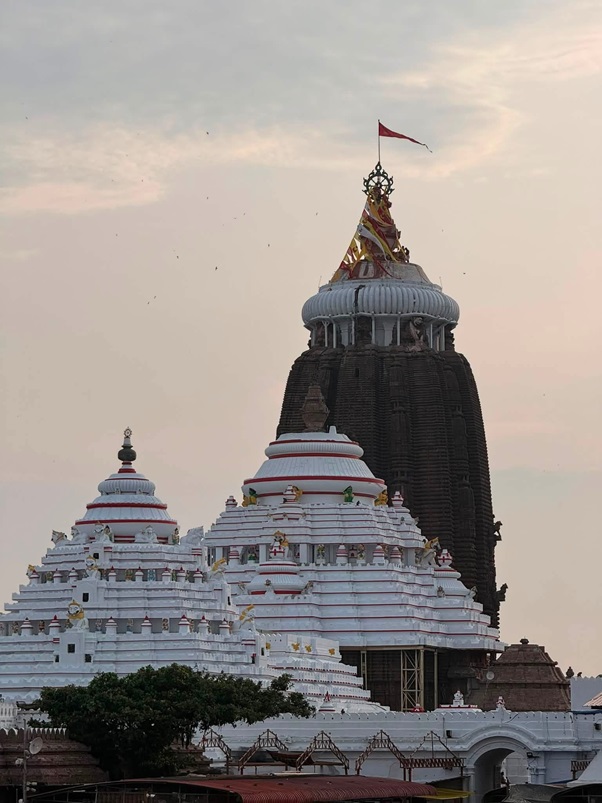
Neelachakra is fixed on the top of the main temple
Location and Structural Details
Objective 3.To identify the location and dimensions of the Neelachakra atop the Jagannath Temple.
The Neelachakra is fixed on the top of the main temple at a height of sixty-five metres and ninety centimetres from Bada Dānda (Grand Road Level) with a staff of four and a half metres long to hold the Patitapāban Bānā (flag). The Neelachakra is made of eight metals comprising fifty per cent iron, twenty-five per cent copper and the remaining twenty-five percent zinc, mercury, lead, brass, silver and gold.
The dimension of the Neelachakra is circular with an outer diameter of three metres and fifty centimetres, and an outer perimeter of eleven metres. The inner perimeter is about 7.92 metres. Eight ribs of 56 cm each relates to the centre. The thickness of the Neelachakra is fifty mm with designs on the outer circumference. The weight of the Chakra is above one hundred and fifty kilograms.
Significance Of Chakra
Objective 4.To understand the spiritual significance of the Neelachakra as the symbolic representation of Lord Vishnu’s Sri Sudarshana Chakra.
The wheel is the symbol of motion. It is nothing but the replica of Lord Vishnu’s powerful weapon Sri Sudarsan Chakra with which all the divine powers are attributed. Though a wheel is fixed atop the Jagannāth Temple, this is the ayudha (weapon) of Lord Vishnu, Lord Vāsudeva and Lord Jagannāth.
This ayudha known as Sudarsan Chakra is a pillar carved out of wood and is worshipped in the sanctum sanctorum of the temple along with the trinity – Balabhadra, Jagannāth and Subhadrā, and the pillar-shaped Lord Sudarshan is seated on the left side of Lord Jagannāth on the Ratna Singhasan (Jewel Throne) inside the main temple.
Neelachakra is the ayudha of Nilambaradhara Vishnu. It is also a symbolic representation of Sri Jagannāth’s wheel of administration of Visva Brahmānda (Universe). If any ruler moves the wheel of administration during his reign (Sasanakāla) properly, good governance is ensured. Sri Jagannāth operates the divine wheel for bestowing peace and blessings on mankind.
So it is said – “Chakra Sevyam Nrupasevyam Na Sevayam Nrupa Kevalam.”
Mistery of Neela Chakra
Objective 5.To explore the remarkable engineering features and enduring mysteries of the Neelachakra atop the Jagannath Temple.
The engineering skill of Neelachakra is a mystery. The devotee always sees the Neelachakra from the front side in every direction. The Neelachakra has no shadow from any direction at any time and is also dust and rust-free.
The flag (Patitapabana Bana) at the top of the Neela Chakra of the Jagannath Temple always floats in the opposite direction of the wind.
Patitapabana bana in Neela Chakra:
Objective 6.To identify the features and significance of the Patitapabana Bana, the sacred flag that flies above the Neelachakra.
Above the Neelachakra there flies a triangular flag (7.6 meters) called Patitapābana Bānā fastened on a fixed bamboo mast 4.5 metres high over the Neelachakra. The flag is either deep red or yellow. Over the middle part of the flag, there is a symbol of a crescent moon and the sun painted in white.
Besides the main Patitapābana Bānā, there are other similar small triangular flags fastened which the devotees donate. Devotees must pay the concerned Sevayat some amount of their labour according to the length of the flag they donate.
If on any occasion Patitapābana Bānā is slipped out of the mast of the Neelachakra, Prasada (sanctified food) is not offered to the Lords until the flag is restored.
In busy hours when dry Prasad (Bhoga) cannot be offered to Sri Jagannatha inside the temple, the Sevaks offer it from the inner courtyard of the temple by exalting to the Neelachakra. This Bhoga (Prasad) is called Chakra Monohi and is considered as Prasad given to devotees.
Chunnara Nijogi or Garuda Sevaks
Objective 7.To identify the role and responsibilities of the Chunnara Nijogi (Garuda Sevaks) in the daily service of the Neelachakra and Patitapabana Bana.
There are some special traditional Sevaks known as Chunnara Nijogi or Garuda Sevaks to perform the seva of fastening Patitapabana Bana on the mast of the Neelachakra. They also render service to Garudastambha in the Natamandir.
Garuda Sevakas are very expert in climbing the steep temple wall within a few minutes up to the Neelachakra because they climb daily at sunset to change the Patitapābana Bānā and other adjoining flags.
On each Ekadashi (eleventh day of the lunar month), the Garuda Sevakas lift the Mahadeepa (the great lamp filled with ghee and lighted wick) to the Neelachakra and place it on the side of it.
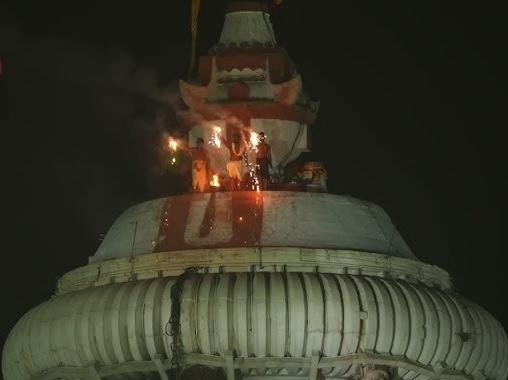
Eakadasi Mahadeepam
Before climbing the temple, the concerned Sevayat wears Patabastra (silk cloth) and ties flags on his waist for easy climbing. They climb from the side of Jagamohan up to the Neelachakra. They first unfasten all flags and tie new flags and then climb down slowly.
Many devotees lay prostrate before the Garuda Sevaka with reverence. If they desire to have a token of the old flags, they get it from him in case the Sevak so pleases.
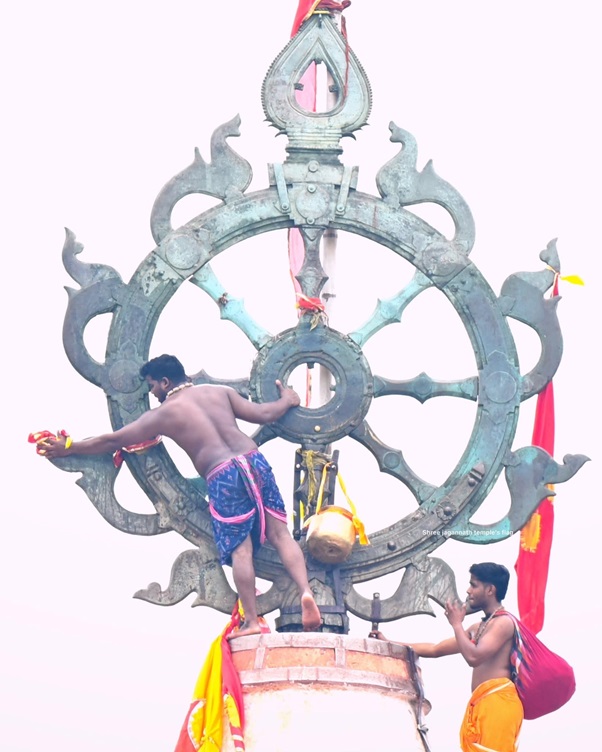
Garuda Sevakas
Objective 8.To recognize the Neelachakra as a symbol of divine protection (Raksha Kavacha) for humanity.
The devotees disclose their heartfelt grief and anguish to the Neelachakra if they could not reach the Lord residing in the temple. This represents that the Neelachakra is as sacred as the Lord. Thus, Neelachakra is the most revered iconic symbol in the Jagannath cult.
It is the only physical object whose markings are used as a sacrament and considered sacred in Jagannath worship. It symbolises protection by Lord Jagannāth. So, devotees should bow down before the Neelachakra so that Lord Sudarshan will protect them from all danger.
The Neelachakra is also called Uhada or Raksha Kavacha (shield) for mankind.
The Neela Chakra is the symbol of Lord Jagannath.
Other Notable Points:
Objective 9.To explore the unique worship of Lord Sudarshana in the Jagannath tradition, where He is worshipped in the form of a wooden pillar on the Ratna Simhasana.
In the Jagannath tradition, Lord Sudarshana is not worshipped in the form of a wheel inside the temple. Instead, He is worshipped in the form of a wooden pillar and is enshrined on the Ratna Simhasana along with Lord Jagannath, Lord Balabhadra, and Devi Subhadra. This unique pillar form of Lord Sudarshana is a distinctive feature of Jagannath worship.
During the Ratha Yatra, Lord Sudarshana is the first deity to emerge from the temple in the Pahandi procession. He is then ceremonially installed on Devadalana, the chariot of Devi Subhadra.
Lord Sudarshana also comes out for Nagara Parikrama (procession around the holy city) three times a year: Radhashtami, Grahma Purnima (Balarama Jayanti), and Kumara Purnima.
