
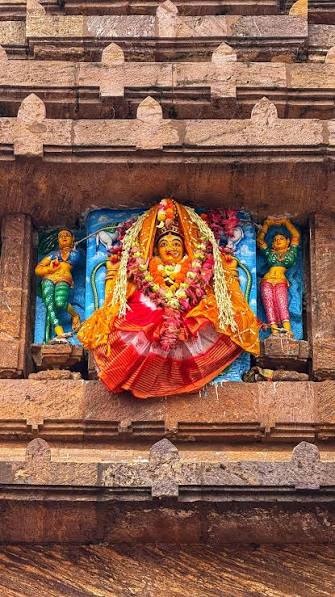
Sri Mahalaksmi at the top of the Simha Dvara
of Sri Mandira, Puri.
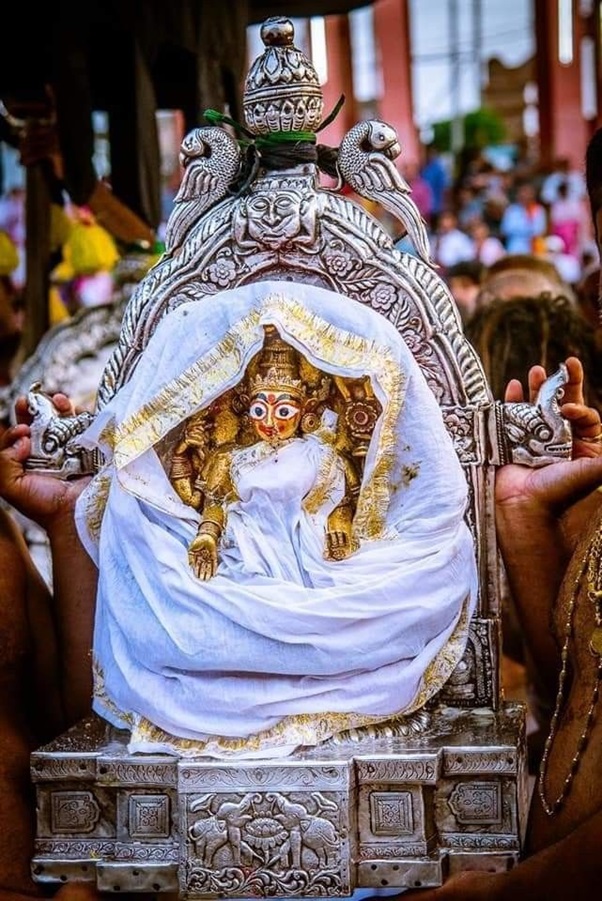
Mahalakshmi Urchavar
Objectives
Objective 1: -To know the location and position of the Sri Mahalaksmi Temple within the Sri Jagannatha Temple complex.
Objective 2: To explore the history, architecture, and presiding deity of the Sri Mahalaksmi Temple.
Objective 3: To understand Mahalaksmi’s role as the Queen of Sri Mandira and Her role in Lord Jagannatha’s bhoga preparation.
Objective 4: To learn about the Laksmi-Nrsimha deity and the daily worship and chanting traditions of the Mahalaksmi Temple.
Objective 5: To learn about the important festivals of Mahalaksmi and Her special role in Hera Pancami and the Ratha Yatra.
Objective 6: To explore the significance of Niladri Bije and the loving relationship between Lord Jagannatha and Goddess Mahalaksmi.
Objective 7: To learn how Mahalaksmi’s pastime with Sriya Candalini shows that Lord Jagannatha’s mercy is for everyone.
Objective 8: To learn about the importance of the Mahalaksmi Temple in the Gaudiya Vaisnava tradition and its connection with Srila Bhaktivinoda Thakura.
Objective 1: -To know the location and position of the Sri Mahalaksmi Temple within the Sri Jagannatha Temple complex.
Introduction
Sri Mahalaksmi Temple is an ancient and important shrine situated in the north-western corner of the inner enclosure (Kurma Pracira/Kurma Bedha) of the Sri Jagannatha Temple complex at Puri, Odisha. The presiding deity faces east.
The main lord Jagganath temple in Puri is called SRIMANDIR. ‘Sri’ signifies Goddess Lakshmi and is believed to be the ‘Maya Shakti’ (power of delusion) of Lord Jagannath , who always serves him. They are inseparable.
Goddess Mahalaksmi is the eternal consort of Lord Jagannatha and the predominating goddess of the Jagannatha Temple. She is revered as the supreme Grhalaksmi and is affectionately known as Sri Mandira Rani, the Queen of Sri Mandira, who governs the prosperity and ritual order of the temple.
Objective 2: To explore the history, architecture, and presiding deity of the Sri Mahalaksmi Temple.
History and Architecture
The temple is traditionally said to have been built by King Coda Ganga of the Ganga dynasty of Orissa. According to the Madala Panjika, its Jagamohana was constructed by Vidyadhara Mahapatra during the reign of King Mukundadeva (1555–93). Built in the traditional Kalinga architectural style, the temple consists of four main sections:
- Vimana – sanctum containing the presiding deity
- Jagamohana – assembly hall
- Natyamandira – dancing hall
- Bhogamandapa – offering hall
The principal deity is a beautiful four-armed form of Mahalaksmi, traditionally described as being carved from black stone and seated in Padmasana.
Objective 3: To understand Mahalaksmi’s role as the Queen of Sri Mandira and Her role in Lord Jagannatha’s bhoga preparation.
Mahalaksmi as the Queen of Sri Mandira
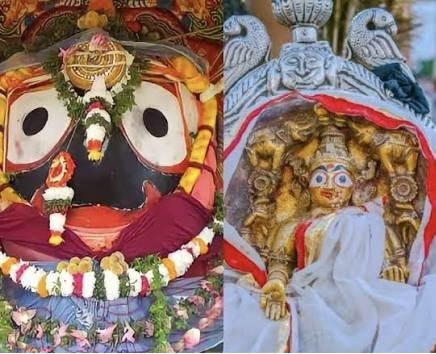
Lord Jagannath and Goddess Mahalakshmi
Mahalaksmi occupies a unique position in the Jagannatha tradition. She is not regarded merely as Lord Jagannatha’s divine consort but as the Queen and divine administrator of Sri Mandira.
She represents the Lord’s divine energy or Sakti, and Sridevi, present with the principal deities on the Ratna Simhasana, represents Her presence in the main sanctum. Devotees especially worship Mahalaksmi for prosperity, well-being and harmony in family life.
Mahalaksmi and Lord Jagannatha’s Bhoga
Mahalaksmi has an intimate connection with the preparation of Lord Jagannatha’s food offerings. According to temple tradition, the preparation of the Lord’s bhoga takes place under Her divine supervision.
The Mahalaksmi Temple has its own kitchen and storeroom, and ingredients required for preparing Lord Jagannatha’s bhoga are traditionally taken from this storeroom. Thus, Mahalaksmi is regarded as the divine mistress of the household who oversees the Lord’s kitchen and ensures that His offerings are properly prepared.
Objective 4: To learn about the Laksmi-Nrsimha deity and the daily worship and chanting traditions of the Mahalaksmi Temple.
Laksmi-Nrsimha
A deity of Laksmi-Nrsimha is situated in the Jagamohana of the Mahalaksmi Temple.According to tradition, Sripada Sankaracarya worshipped this deity and composed the beautiful Laksmi Nrsimha Stotra here.
Devotees also sit within the temple and recite sacred prayers such as the Visnu Sahasra Nama and chant the holy names of the Lord.
Daily Worship and Sacred Traditions
Arati and regular worship of Sri Mahalaksmi are performed daily. A special bathing ceremony of Mahalaksmi is observed every Thursday. There is also an ancient tradition in which devotees sit for some time and chant the holy names before leaving the temple after having darsana of Mahalaksmi.
Objective 5: To learn about the important festivals of Mahalaksmi and Her special role in Hera Pancami and the Ratha Yatra.
Important Festivals
Several important festivals are separately celebrated in the Mahalaksmi Temple, including Prathamastami, Odhana Sasthi, Vasanta Pancami, Aksaya Trtiya and Rukmini Vivaha. Mahalaksmi also plays a prominent role in the annual Ratha Yatra celebrations.Specially in Hera Panchami and Niladri Bije.
Hera Pancami
“Hera” means to seek or look for, and “Panchami” means the fifth day. On the fifth day of Ratha Yatra, Mahalaksmi ceremonially goes to Gundica Temple in a palanquin because Lord Jagannatha has left Sri Mandira without taking Her with Him.
In the evening, Goddess Lakshmi enters the Gundicha temple after Sandhya Dhupa. But she is unable to see Lord Jagannath. She was offered by an ‘Agyan Mala’ (a consent garland) on behalf of Lord Jagannath to Goddess Mahalaxmi assuring her that the Lord will return to the main temple in three days.
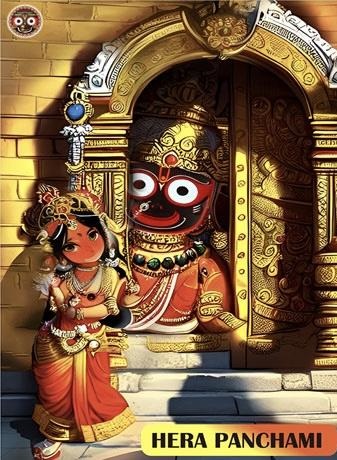
In a celebrated pastime expressing Her loving displeasure, a portion of Lord Jagannatha’s Nandighosa chariot is symbolically damaged before Mahalaksmi returns to the main temple. This event signals that the Bahuda Yatra (the return chariot journey) is fast approaching.Following the ritual, the massive chariots outside the Gundicha Temple are turned around to face south in preparation for the trip back home.
Objective 6: To explore the significance of Niladri Bije and the loving relationship between Lord Jagannatha and Goddess Mahalaksmi.
Niladri Bije
Niladri Bije is the final grand ritual of the annual Ratha Yatra festival in Puri, Odisha. It marks the homecoming of Lord Jagannatha, Lord Balabhadra, Devi Subhadra and Lord Sudarsana, when They descend from Their chariots and re-enter the Sri Jagannatha Temple to take Their respective places on the Ratna Simhasana. Celebrated on Asadha Trayodasi, Niladri Bije brings the deities’ Ratha Yatra journey, including Their stay at Gundica Temple, to a joyful conclusion.
An important feature of Niladri Bije is the loving pastime between Lord Jagannatha and Goddess Mahalaksmi. Mahalaksmi is displeased because Lord Jagannatha went on Ratha Yatra without taking Her with Him. Therefore, when Jagannatha returns to Sri Mandira, She playfully prevents Him from entering by closing the temple doors. This affectionate exchange between the divine couple is traditionally associated with Laksmi-Narayana Bacanika and Mana Bhanjana, the appeasement of Mahalaksmi’s loving anger.
To pacify Mahalaksmi, Lord Jagannatha offers Her Rasagola, the famous sweet preparation. Pleased by His loving offering, Mahalaksmi finally forgives Him and permits Him to enter the temple. Lord Jagannatha then returns to the Ratna Simhasana, completing the Ratha Yatra festivities.
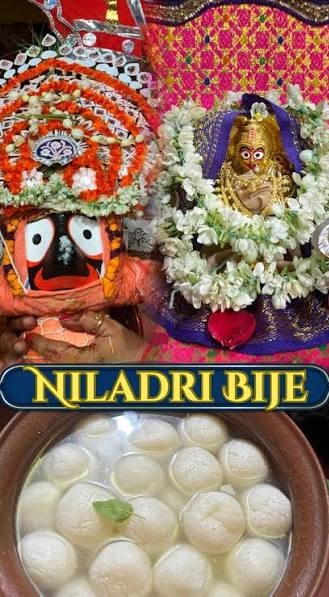
Niladri Bije and Rasagola
Because of this special tradition of offering Rasagola to Mahalaksmi, the day of Niladri Bije is also popularly celebrated in Odisha as Rasagola Dibasa (Rasagola Day). Thus, Niladri Bije beautifully represents the homecoming of Lord Jagannatha and the affectionate divine relationship between Jagannatha and Mahalaksmi.
As the doors of the Srimandir welcome Mahaprabhu once again, millions of hearts whisper the same prayer:
“Come back again next year, Prabhu. Until then, stay in our hearts.”.
This is not just a homecoming; it is the reunion of the Lord with His eternal abode and devotees. Niladri Bije reminds us that no matter how far we travel, the greatest peace is always found when we return home to faith, to love, and to Mahaprabhu.
Objective 7: To learn how Mahalaksmi’s pastime with Sriya Candalini shows that Lord Jagannatha’s mercy is for everyone.
Mahalaksmi and Sriya Candalini Pastime
A famous tradition associated with Mahalaksmi describes Her visit to Sriya Candalini, a woman of a socially marginalized community who worshipped Her with great devotion, cleanliness and fasting.
Pleased with Sriya’s sincere devotion, Mahalaksmi blessed her with prosperity. When Baladeva objected to Mahalaksmi’s visit because of prevailing caste restrictions, She left the temple. Immediately the temple’s prosperity disappeared, the storehouses became empty, and Jagannatha and Baladeva suffered from hunger.
Eventually, the two brothers received wonderful food at the house where Mahalaksmi was staying (SriMahalakshmi’s devotee —Sriya Candalini’s house ) and realized Her greatness. Jagannatha sought Her forgiveness and requested Her to return.
Mahalaksmi agreed on the condition that Jagannatha’s prasada should be available without discrimination between higher and lower social classes. The pastime therefore emphasizes that sincere devotion transcends social distinctions and the mercy of Lord Jagannatha is meant for everyone.
Objective 8: To learn about the importance of the Mahalaksmi Temple in the Gaudiya Vaisnava tradition and its connection with Srila Bhaktivinoda Thakura.
Srila Bhaktivinoda Thakura
The Mahalaksmi Temple also has significance in the Gaudiya Vaisnava tradition. Srila Bhaktivinoda Thakura, during his stay in Puri, is traditionally remembered as having discussed topics from devotional scriptures at this sacred place.
Thus, Sri Mahalaksmi Temple is important not only as the shrine of Lord Jagannatha’s eternal consort but also for its connection with Jagannatha’s bhoga, Mahaprasada, Ratha Yatra traditions, Vaisnava devotional practices and the principle of equal spiritual mercy for all.
