
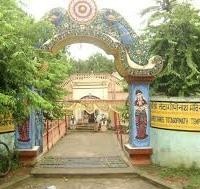
Haridas Thakur Samadhi Temple –
Swargadwar, Jagannath Puri, Odisha
Objectives
Objective 1: To introduce the importance of Srila Haridas Thakur Samadhi.
Objective 2: To learn about the devotees associated with this holy place.
Objective 3: To know the important pastimes connected with the Samadhi.
Objective 4: To appreciate the spiritual significance of the place.
Objective 5: To understand the significance of Srila Haridas Thakur as the Namacharya (Teacher of the Holy Name).
Objective 6: To strengthen faith in the Holy Name and the Hare Krishna Mahamantra.
Objective 7: To refer to the scriptural sources related to Srila Haridas Thakur.
Objective 8: To provide practical information for pilgrims visiting the Samadhi.
Introduction
Objective 1: To introduce the importance of Srila Haridas Thakur Samadhi.
The samadhi of Srila Haridas Thakur at Swargadwar, Jagannath Puri, is a prominent place of pilgrimage for Vaishnavas all over the world. A beautiful temple has been constructed on the site to house and protect the samadhi, making it a sacred destination for devotees who come to honor the great Namacharya.
Objective 2: To learn about the devotees associated with this holy place.
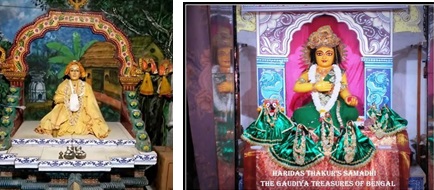
Srila Haridas Thakur – Namacharya of the
Brahma-Madhva-Gaudiya Sampradaya
Devotees Associated with the Place
Srila Haridas Thakur — The Namacharya
Lord Brahma, Prahlada Maharaja, and Richika Muni’s son Mahatapa had combinedly incarnated as Haridas Thakur. He is the Namacharya of the Brahma-Madhva-Gaudiya Sampradaya — the foremost teacher and exemplar of the practice of chanting the Holy Name. He is an eternal associate of Sri Chaitanya Mahaprabhu and accompanied the Lord in most of His magnanimous pastimes.
He was an empowered incarnation of the Supreme Lord who appeared to set an example for all. Though born in a Muslim family, he widely propagated the chanting of Krishna’s Holy Name as the ultimate spiritual practice, teaching that the Lord and His Holy Names are non-different. He chanted 300,000 Holy Names of Krishna every single day — a practice he maintained till the very end of his life.
Srila Haridas Thakur was born in the village of Buron, in the district of Khulna, present-day Bangladesh. According to Advaita Vilasa, he was about 35 years older than Sri Chaitanya Mahaprabhu. His father’s name was Khan Ullah Kazi.
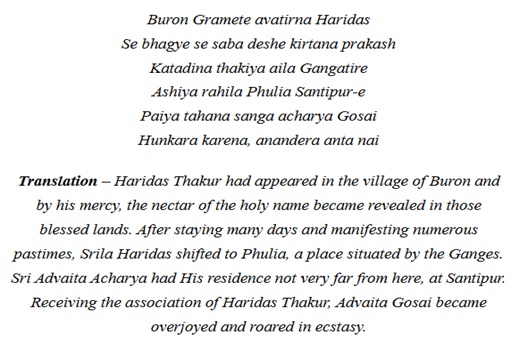
In the Navadvipa Dham Mahatmya, Srila Bhaktivinoda Thakur reveals that in Dvapara Yuga, Lord Brahma had stolen the cows, cowherd boys, and calves of Vrindavana to test Lord Krishna. On realising his mistake, Brahma meditated upon the form of Lord Chaitanya at Mayapur and received the boon to become His intimate associate in the Lord’s future appearance. To prevent Brahma from becoming proud of his position, Lord Chaitanya arranged for him to incarnate as Haridas Thakur in a Muslim family.
Sri Chaitanya Mahaprabhu
Sri Chaitanya Mahaprabhu was the supreme Lord and the most intimate well-wisher of Haridas Thakur. He personally visited Haridas’s residence (Siddha Bakul) every day during His 24-year stay at Puri, bringing prasadam and conversing on the glories of the Holy Name. When Haridas became too weak to take darshan of Lord Jagannath, Mahaprabhu Himself came to Haridas — saying that the Lord comes to wherever His pure devotee is. Upon Haridas’s passing, Mahaprabhu personally carried his body, bathed it in the ocean, and placed it in samadhi at this very spot in Swargadwar.
Sri Advaita Acharya
Sri Advaita Acharya was one of Haridas Thakur’s closest associates from his early days at Phulia and Santipur. Advaita Acharya honoured Haridas Thakur above all caste considerations — offering him the first prasadam plate even when high-born brahmanas were present. Their mutual association at Phulia produced some of the most celebrated pastimes of the Gaudiya Vaishnava tradition.
Srila Bhaktivinoda Thakura
Srila Bhaktivinoda Thakura, the great 19th century Vaishnava acharya who resided in Puri at his Bhakti Kuti cottage (directly opposite this samadhi), highly glorified Haridas Thakur’s samadhi and the sacred Swargadwar area in his writings. His residence, now the ISKCON Bhakti Kuti, is located just across the road from this samadhi, further sanctifying this entire area.
Objective 3: To know the important pastimes connected with the Samadhi.
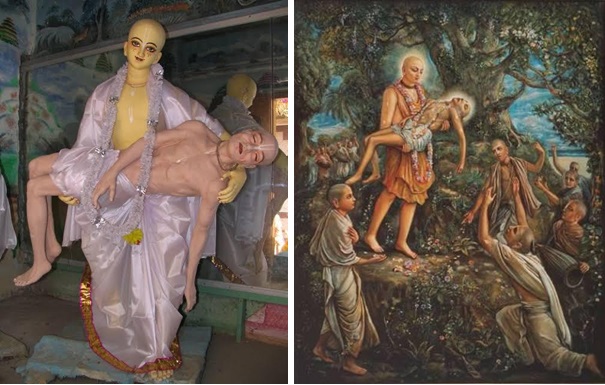
Sri Chaitanya Mahaprabhu carrying Haridas Thakur’s transcendental body
to the ocean shore at Swargadwar
Pastimes Associated with the Place
About 500 years ago, Namacharya Srila Haridas Thakur concluded his earthly pastimes at Siddha Bakul in Jagannath Puri. He desired to leave his body while gazing upon the moonlike face of Lord Gauranga (Sri Chaitanya Mahaprabhu), and the Lord mercifully fulfilled this wish.
Holding the lotus feet of Lord Chaitanya upon his heart and chanting “Sri Krishna Chaitanya” in ecstasy, Haridas Thakur departed for the eternal abode. Witnesses compared his passing to that of Bhishma on the battlefield of Kurukshetra, who also left his body at will.
Lord Chaitanya personally carried Haridas Thakur’s body, dancing in divine ecstasy, while devotees joined in tumultuous Harinama sankirtana. A grand procession led by the Lord brought the body to the sea, where it was bathed. Devotees drank the seawater and touched Haridas Thakur’s lotus feet.
haridase samudra jale snana karaila
prabhu kahe – “samudra ei ‘maha-tirtha’ haila”
(Chaitanya Charitamrita, Antya, 11.64)
A samadhi was prepared in the sand, and amidst loud sankirtana, offerings of silken robes, sandalwood pulp, food, and cloth were placed upon the transcendental body. Lord Chaitanya Himself covered the body with sand, and devotees constructed a raised platform with a protective fence — sanctifying the site forever.
Mahaprabhu’s Proclamation of Haridas Thakur’s Glories
After the samadhi ceremony, Lord Chaitanya made a profound declaration about the greatness of Haridas Thakur:
Haridasa achila prithibira shiromani
taha bina ratna sunya haila medini
(Caitanya-caritamrita, Antya 11.97)
Thakur and the Prostitute at Benapole
One of the most celebrated pastimes demonstrating the power of Haridas Thakur’s chanting took place at Benapole (in present-day Bangladesh). An envious landlord named Ramachandra Khan, unable to tolerate Haridas’s rising fame, sent a beautiful young prostitute named Hira Bai to tempt him. For three consecutive nights, Hira Bai visited Haridas’s cottage. Each night, Haridas gently asked her to wait while he completed his daily chanting of 300,000 holy names. As dawn approached each night, she left without success. By the third night, the purifying power of the Holy Name had transformed her completely. She fell at Haridas’s feet, confessed the conspiracy, and begged him to be her spiritual master.
Haridas instructed her to distribute all her possessions to brahmanas, return to his cottage, plant Tulasi, and chant the Holy Name for the rest of her life. She followed these instructions and became a great Vaishnavi, known as Laksha-Hira, chanting lakhs of holy names daily. Stalwart Vaishnavas came from far to seek her darshan and blessings.
Whipped at Twenty-Two Market Places
At Phulia, the local Kazi complained to the Mulukpati that Haridas, though born a Muslim, was chanting the names of Hindu gods. Haridas was arrested, tried, and ordered to abandon Harinama. He fearlessly proclaimed:
Khanda khanda hoi deha, yaya yadi prana /
Tabu ami badane na chhari harinaam (Sri Chaitanya Bhagavata) –
Translation
“Even if my body is cut into several pieces and I lose my life, yet I shall not give up the chanting of the Holy Names of Krishna.”
Sentenced to be whipped at twenty-two market places (a punishment normally fatal after just two or three), Haridas was dragged through the streets and beaten by royal guards. Yet he kept smiling and chanting throughout, completely unaffected by pain. After twenty-two market places, the guards realised he was no ordinary person. Haridas, feeling compassion for the guards who feared for their lives, entered samadhi — appearing dead. The guards brought his ‘body’ before the Mulukpati. Haridas was thrown into the Ganges, and he swam to shore, fully conscious, chanting Krishna’s names. The Mulukpati and Kazi begged forgiveness at his feet, and Haridas forgave them all.
The Snake at Phulia
When Haridas Thakur resided in a small grotto at Phulia, a venomous snake also lived there. Devotees were unable to sit with Haridas due to the snake’s presence. Hearing their distress, Haridas humbly requested the snake to leave, saying that if it did not, he himself would vacate the place. The snake immediately came out of its hole and departed. All who witnessed this were left wonderstruck and developed deep devotion for Haridas Thakur.
Place
Objective 4: To appreciate the spiritual significance of the place.
Spiritual Importance
The spiritual significance of this site is extraordinary for several reasons. Firstly, this samadhi was personally established by Sri Chaitanya Mahaprabhu Himself — making it among the most sacred spots in Gaudiya Vaishnava history. Secondly, it is the resting place of the Namacharya — the greatest teacher of the Holy Name in the Kali Yuga — whose very samadhi radiates the purifying power of the Hare Krishna Mahamantra. Thirdly, Mahaprabhu declared that the ocean itself became a great pilgrimage site (maha-tirtha) upon touching the transcendental body of Haridas Thakur, making this entire beachfront area supremely sacred.
The Swargadwar area — meaning ‘Gateway to Heaven’ — is widely regarded as one of the most sacred zones of Puri Dham, permeated by the presence of Mahaprabhu and His eternal associates. Visiting this samadhi and offering prayers here is considered highly auspicious for all Vaishnava pilgrims.
Structure and Setting
Five hundred years ago, during the time of Sri Chaitanya Mahaprabhu, this spot was just a sandy beach on the ocean front at Swargadwar (‘Gateway to Heaven’). Today, a beautiful and well-maintained temple has been constructed to house and protect the samadhi of Haridas Thakur. The samadhi is situated on Haridas Math Lane, on the oceanfront, directly opposite the ISKCON Bhakti Kutir (Bhaktivinoda Thakura’s bhajan cottage). The sound of ocean waves and the spiritual atmosphere make this one of the most moving pilgrimage sites in all of Puri Dham.
Presiding Deity
Objective 5: To understand the significance of Srila Haridas Thakur as the Namacharya (Teacher of the Holy Name).
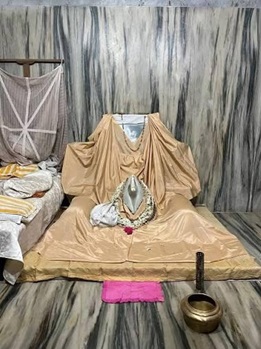
Deity of Srila Haridas Thakur at the Samadhi Temple,
Swargadwar, Puri
Deity of Srila Haridas Thakur
The presiding Deity at the Haridas Thakur Samadhi Temple is a beautiful murti (deity form) of Srila Haridas Thakur himself. He is depicted in a serene, devotional posture — absorbed in the chanting of the Hare Krishna Mahamantra, with japa mala (chanting beads) in hand, his eyes downcast in the mood of deep bhajan. The murti captures the eternal mood of Haridas Thakur: humble, completely surrendered to the Holy Name, and radiating divine peace.
Objective 6: To strengthen faith in the Holy Name and the Hare Krishna Mahamantra.
The Hare Krishna Mahamantra — The Teaching of Haridas Thakur
Haridas Thakur teaches by his very presence that the chanting of the Holy Name of Krishna is the supreme spiritual practice for this age of Kali, that God is one and His names are non-sectarian, and that anyone — regardless of birth, caste, or religion — can achieve the highest spiritual destination simply by sincerely chanting the Hare Krishna Mahamantra.
The Padma Purana glorifies the Holy Name as follows:
The Holy Name of Krishna is transcendentally blissful. It bestows all spiritual benedictions for it is Krishna Himself, the reservoir of all pleasure. Krishna’s name is complete, and it is the form of all transcendental mellows. The Holy Name of Krishna is not a material name under any condition, and it is no less powerful than Krishna Himself. Since Krishna’s name is not contaminated by the material qualities, there is no question of its being involved with maya. Krishna’s name is always liberated and spiritual. It is never conditioned by the laws of material nature. This is because the name of Krishna and Krishna Himself are identical. (Padma Purana)
Objective 7: To refer to the scriptural sources related to Srila Haridas Thakur.
Scriptural References
Sri Chaitanya Charitamrita, Antya-lila, Chapter 11: The primary source describing the passing away of Haridas Thakur, Mahaprabhu’s grief and ecstasy, the samadhi ceremony at the ocean shore, and the grand feast in Haridas’s honour. Verse 64: Mahaprabhu declares the ocean a maha-tirtha. Verse 97: “Haridas was the crest jewel of this world.”
Sri Chaitanya Charitamrita, Antya-lila, Chapter 3: Describes the pastimes of Haridas Thakur at Benapole (the Hira Bai pastime and the whipping at twenty-two market places).
Sri Chaitanya Bhagavata (by Vrindavana Dasa Thakura): Describes Haridas Thakur’s birth at Buron, his early pastimes, his association with Advaita Acharya at Phulia, and his fearless proclamation: “Even if my body is cut into pieces, I shall not give up the chanting of Harinaam.”
Navadvipa Dham Mahatmya (by Srila Bhaktivinoda Thakura): Reveals the divine origin of Haridas Thakur as a combined incarnation of Lord Brahma, Prahlada Maharaja, and Mahatapa, who appeared to become Mahaprabhu’s intimate associate and propagate the Holy Name.
Padma Purana: Glorifies the absolute transcendental nature of the Holy Name of Krishna: “The name of Krishna and Krishna Himself are identical.” This teaching was the life and soul of Haridas Thakur’s mission.
Srimad Bhagavatam (7.5.23–24): Lists the nine processes of devotional service, of which Shravanam (hearing) and Kirtanam (chanting) of the Holy Name are supreme — the very practices embodied by Haridas Thakur throughout his life.
Objective 8: To provide practical information for pilgrims visiting the Samadhi.
How to Reach In and Around
The Samadhi Temple of Srila Haridas Thakur is located on Haridas Math Lane, Swargadwar, Puri, Odisha – 752001. Situated along the oceanfront near Swargadwar, it is a prominent pilgrimage site and is easily identified by its location opposite ISKCON Bhakti Kuti (ISKCON Puri). The temple is approximately 2 kilometers from the Jagannath Temple.
