
Objectives
Objective 1: To introduce the main deities in the Temple and explain their forms.
The Deities in the Temple
Objective 1: To introduce the main deities in the Temple and explain their forms.
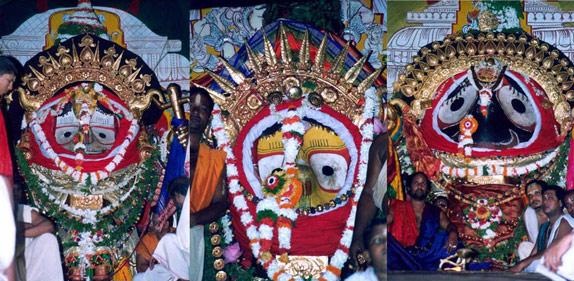
Lord Jagannatha, the symbol of universal love and brotherhood is worshiped in the Temple along with brother Balabhadra, sister Subhadra, Sudarshan, Madhava, Sridevi and Bhudevi on the Ratnabedi or the bejewelled platform.
Main Temple: In the main temple are Their Lordships Balabhadra,Subhadra and Jagannatha who are white, yellow and black respectively. They are seated on the Ratna Singhasan. Between 8:30 am and 9:30 am devotees can circumambulate the Deities.
Daily Rituals at Jagannatha Temple
Objective 2: To provide a detailed understanding of the daily worship schedule (nitis), emphasizing discipline, tradition, and the devotional service offered to the Lord.
Daily Rituals of Lord Jagannatha Temple
1. Early Morning Rituals (5:00 a.m – 6:30 a.m)
The daily worship (Niti) of Lord Jagannatha, along with Balabhadra and Subhadra, follows a well-organized sequence of rituals from early morning till midnight. These rituals reflect deep devotion, discipline, and tradition, performed by different categories of servitors known as sevayats.
The day begins between 5:00 a.m. and 6:30 a.m. with the Dwaraphita, which is the opening of the temple doors in the presence of designated sevayats after verifying the temple seal, followed by the Mangala Aarati auspicious lamp offering. During this time, Pushpalaka sevakas change the Deities’ previous night’s clothes, flowers, and tulasi, offering fresh cotton clothes called Tadapa and Uttariya traditionally washed by the Dhoba sevaka.
By 6:00 a.m., the Mailam ritual involves the removal of decorations, followed by Abakash purification rituals such as brushing and bathing, while the temple astrologer announces the day’s tithi and schedule.
2. Morning Darshan and Decoration (6:45 a.m – 8:30 a.m)
Morning darshan and decoration take place from 6:45 a.m. to 8:30 a.m. A second Mailam occurs at 6:45 a.m. for another change of clothes, and a sacred lamp called Akhanda Baitha is lit to burn throughout the day. From 7:00 to 8:00 a.m., the Sahanamela allows devotees to have close darshan without a fee. At 8:00 a.m., the Beshalagi decoration ritual adorns the Deities with beautiful garments, gold, and ornaments. Simultaneously, several other rituals occur, including the Rosha Homa fire ritual in the kitchen, Surya Puja at the nearby temple, and the worship of gatekeepers Jaya and Vijaya.
3. Food Offerings and Worship (9:00 a.m – 1:30 p.m)
Food offerings and worship dominate the schedule from 9:00 a.m. to 1:30 p.m. The Gopala Ballava Puja at 9:00 a.m. serves as a breakfast offering of fruits, sweets, curd, and coconut. This is followed at 10:00 a.m. by the Sakala Dhupa, the main morning Raja bhoga meal featuring an elaborate 16 Upacharas that includes rice, khichdi, and traditional dishes.
Afterward, the Deities undergo another Mailam clothing change, while large quantities of offerings are made at the Bhoga Mandap for devotees and monasteries. Between 11:00 a.m. and 1:00 p.m., the Madhyana Dhupa offers even more elaborate food and allows for special darshan near the sanctum. Finally, from 1:00 to 1:30 p.m., the Madhyanha Pahuda allows the Deities to take rest if time permits.
4. Evening Rituals (After 1:30 p.m. – 8:00 p.m.)
Evening rituals commence after 1:30 p.m. with the Sandhya Aarati. On special occasions like Ekadashi, the Deities’ clothes are changed following this lamp offering. The Sandhya Dhupa occurs from 7:00 to 8:00 p.m., providing an evening food offering with fewer items than the morning, followed by the Jaya Mangala Aarati. As the day transitions into night after 8:00 p.m., the Mailam and Chandana Lagi rituals involve another clothing change and the application of sandalwood paste mixed with camphor. The Deities then appear in the Badasinghara Vesha, the day’s most beautiful decoration featuring silk garments and floral ornaments provided by temple mathas. Around 11:00 p.m., the final food offering, Badasinghara Bhoga, consisting of light items like pakhala and sweets, is presented.
5. Night Rituals and Decoration (After 8:00 p.m. – Midnight)
The closing rituals at midnight, known as Khata Seja Lagi and Pahuda, involve preparing beds for the Deities and making final offerings of coconut and betel. Once the Deities are put to rest, the temple doors are sealed by a designated sevayat. These daily rituals highlight that the entire day is a disciplined sequence of dressing, bathing, and meals, where the Deities are treated as living beings. While the timings provide a structured framework for darshan and worship, they may vary due to practical or festival-related reasons.
Veshas of Jagannatha Baladeva Subhadra.
Objective 3: To explain the different daily and special decorations (Alankaras) of the deities and their spiritual meanings.
Chemedi Vesha:
Every morning for Mangala Arati, Lord Jagannatha is dressed in a cotton sari. This is called His Chemedi Vesha.
Tadapa Vesha:
For taking His morning bath, Lord Jagannatha is dressed in a 16’ long by 4’ wide orange and white cotton cloth. This is called Tadapa Vesha.
Utari Vesha:
Utari means chadar or wrapper. After His morning Darshana, Lord Jagannatha wears a 24’ long silk cloth as a chadar.
Bada Shringara Vesha:
Every evening about 10:00 P.M., before Jagannatha, Baladeva and Subhadra are put to rest, they are dressed in their Bada Shringara Vesha. Bada Means great, and Shringara refers to the conjugal love of the Gopis and Radharani for Krishna. The Pandas consider that at this time every evening the Gopis and Radha come to see Jagannatha. The Bada Shringara Vesha consists of Gita Govindam Khandua and eight floral ornaments.
The Gita Govindam Khandua is twelve foot long red silk cloth which is wrapped over each deity’s head. On these clothes are written lines from Jayadeva Goswami’s Gita Govindam. Gita Govindam is very dear to Jagannatha, so every evening it is recited for His pleasure, and He is dressed with the Gita Govindam Khandua. The eight floral ornaments are:
• Candrika with alakapanti – An alaka or forehead decoration made entirely of flowers.
• Puspatilaka – A flower garland tilaka sign on Jagannatha head.
• Karapallaba – Made from fragrant dayana leaves and variety of flowers, these are decorations representing the Lord’s hands and five fingers.
• Makara Kundala – Flower earrings shaped like sharks.
• Padaka – Round or heart shaped, about 18 inches in diameter, this decoration covers Lord Jagannatha’s heart.
• Guna and Jhumpa – Nose decoration made using flowers.
• Puspa Mala -Lord Jagannatha is dressed with many flower garlands each about twelve feet long, stretching from arm to arm.
• Tulasi mala – Lord Jagannatha wear a crown of Tulasi garlands which are wrapped on pieces of bamboo and tied together.
As noted in Panchratra Pradipa: “Many temples in Vrindavana dress the deity in the color corresponding to the day of the week.” The same basic system is followed in Jagannatha Puri for the different colors of cloth used for the Bada Shringara Vesha. They are as follows:
Sunday – Ruled by the sun. Lord Jagannatha is generally dressed in red garments on this day, the color of the ruby.
Monday – Ruled by the moon. Jagannatha wears white on this day, the color of pearl.
Tuesday -Ruled by the planet Mars. Jagannatha wears red or pink garments on this day, the color of the coral.
Wednesday – Ruled by Mercury. Lord Jagannatha wears green, the color of the emerald.
Thursday – Ruled by Jupiter. Jagannatha wears a yellow or golden colour dress, the color of the yellow sapphire.
Friday – Ruled by the planet Venus. Lord Jagannatha wears white garments on this day, the color of the diamond.
Saturday – Ruled by the planet Saturn. Jagannatha wears the black cloth on this day, corresponding to the color of the blue sapphire.
Makhamala Vesha: After the Bada Shringara Vesha, Lord Jagannatha is dressed in a special white cloth for sayanalila, his pastime of taking rest. This is called Makhamala Vesha.
Special Dresses worn during festivals
Objective 4: To highlight the significance of festival-based veshas (Special Dresses)and how they reflect various divine pastimes of Lord Krishna/Jagannath.
Lord Jagannatha is adorned with special dresses, or Vesha, throughout the year to celebrate various lunar months and festivals.
During the month of Vaishakha (April–May), the Chandan Vesha lasts for 42 days, starting from Akshaya Tritiya. This period is divided into the Outer Chandan Yatra and the Inner Chandan Yatra, where Deities are anointed with sandalwood paste and oil to provide cooling during the summer. Ceremonial boat rides at Narendra Tank for Lord Madanmohan accompany this festival.
In the month of Jyestha (May–June), the Rukmini Harana Vesha on Shukla Ekadashi commemorates Lord Krishna’s marriage to Rukmini, depicting the Lord as a royal king. This month also features the Hati Vesha (Elephant Dress) during Snana Yatra, where the Deities are bathed with 108 pots of water and adorned with elephant-head masks symbolizing Lord Ganesha.
The month of Ashadha (June–July) features the famous Suna Vesha (Golden Dress) on Bahuda Ekadashi. During this return of the Ratha Yatra, the Deities are decorated with over a ton of gold ornaments, including golden hands and feet, symbolizing divine majesty.
In Sravana (July–August), the Chita Lagi Vesha involves reinstalling the golden forehead ornament, while the Rahurekha Lagi Vesha restores the Deities’ ear ornaments.
Bhadrapada (August–September) brings several Vesha related to Krishna’s childhood, such as the Vanabhojana Vesha, where the Deities are dressed as cowherd boys in a recreated Vrindavana, and the Kaliya Damana Vesha, which uses a 30-foot snake structure to celebrate the subduing of the serpent Kaliya.
Additionally, the Pralambasura Vesha commemorates Lord Balarama killing the demon Pralambasura. These diverse decorations reflect seasons, festivals, and spiritual teachings, offering rare darshan opportunities and celebrating divine pastimes.
