
Objectives
Objective 1: To understand the historical origin of Konark Sun Temple (Arka Kṣetra).
Objective 2: To appreciate the spiritual significance of Konark in the scriptures and its connection with Śrī Caitanya Mahāprabhu.
Objective 3: To know the architectural grandeur of the Sun Temple.
Objective 4: To understand the glories of Lord Sūrya as described in the Vedic scriptures.
Objective 5: To learn about the sacred places surrounding Konark.
Objective 6: To understand the present condition of sun temple Konark.
Introduction
Objective 1: To understand the historical origin of Konark Sun Temple (Arka Kṣetra).
Konark, traditionally known as Arka Kṣetra, is one of the ancient sacred places of Odisha. The present Sun Temple was constructed in the 13th century CE (around 1250 CE) by King Narasimhadeva I of the Eastern Ganga dynasty. Historical records state that nearly 1,200 artisans worked for approximately twelve years to complete this magnificent temple.
The word Konark comes from two Sanskrit words:
● Kona – Corner
● Arka – Sun
Thus, Konark means “the corner where the Sun-god is worshipped.”
The temple is located approximately 35 km northeast of Jagannath Puri and 65 kms from Bhubaneshwar, the capital city of Odisha. The temple is designed in the shape of a huge chariot drawn by seven horses with 12 wheels, carrying Surya, the sun god, across the heavens. The temple is a UNESCO World Heritage site and is one of the architectural wonders of India.
Objective 2: To appreciate the spiritual significance of Konark in the scriptures and its connection with Śrī Caitanya Mahāprabhu.
According to the Skanda Purāṇ, Konark is known as Arka Kṣetra, one of Odisha’s sacred kṣetras.
Śrī Caitanya Mahāprabhu visited Konark while travelling through Odisha. During His pilgrimage He offered respects to Lord Sūrya, recognizing all devas as exalted servants of the Supreme Lord Śrī Kṛṣṇa.
Konark reminds us that:
● All demigods receive their power from the Supreme Lord.
● Respect may be offered to every deva while understanding that Śrī Kṛṣṇa is the Supreme Personality of Godhead (Bhagavad-gītā 10.21, 10.41).
The Legend of Samba
According to the Samba Purāṇa and local tradition:
Lord Kṛṣṇa’s son Samba was cursed with leprosy.
On the advice of sages, he performed severe austerities for twelve years at the confluence of the Chandrabhaga River and the sea near Konark.
Pleased with his devotion, Lord Sūrya, the healer of all skin ailments, cured Samba of his disease.
After bathing in the Chandrabhaga River, Samba discovered a deity of Surya said to have been fashioned by Viśvakarma. In gratitude he established worship of Lord Surya at this sacred place.
Objective 3: To know the architectural grandeur of the Sun Temple.
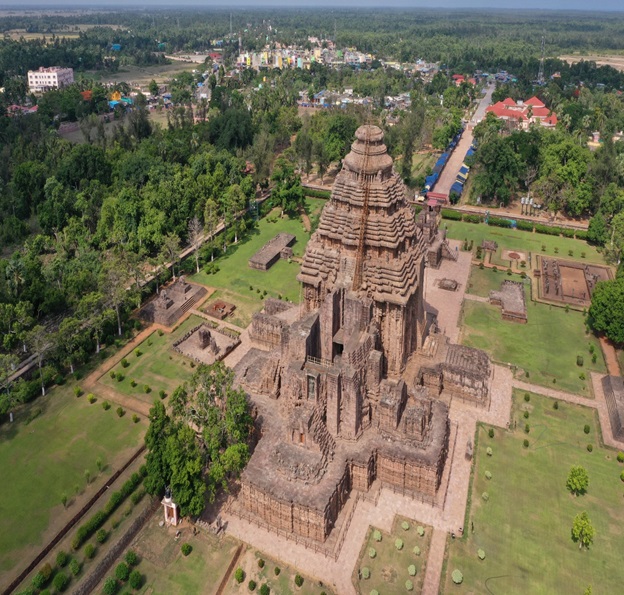
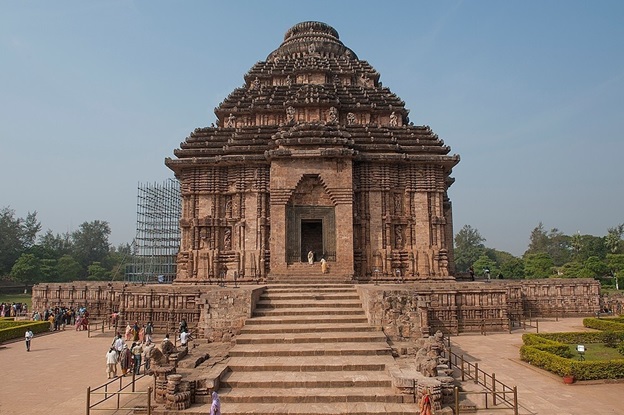
The Konark Sun Temple is one of India’s greatest architectural achievements.
Important features include:
● Built in the form of Lord Surya’s celestial chariot.
● Seven horses symbolize the seven days of the week.
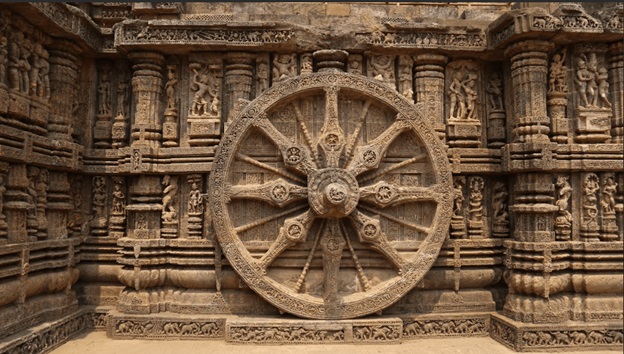
● Twenty-four stone wheels that are three meters wide, symbolize the twenty-four hours of the day (and are also interpreted as the twelve months divided into day and night).
● Each wheel functions as an ancient sundial, capable of indicating time with remarkable accuracy.
● Magnificent carvings depict scenes from Vedic life, musicians, dancers, animals, celestial beings and devotional themes.
Although much of the original temple has collapsed, the surviving structures continue to display extraordinary craftsmanship.
Objective 4: To understand the glories of Lord Sūrya as described in the Vedic scriptures.
In the Vedic tradition, Lord Surya is honored as the visible representative of the Lord’s brilliance.
In Bhagavad-gītā (10.21) Lord Kṛṣṇa says:
ādityānām ahaṁ viṣṇur jyotiṣāṁ ravir aṁśumān
marīcir marutām asmi nakṣatrāṇām ahaṁ śaśī
Translation:
“Of the Ādityas I am Viṣṇu, of lights I am the radiant sun, of the Maruts I am Marīci, and among the stars I am the moon.”
Thus, Vaiṣṇavas honor Lord Surya while understanding that his power comes from Śrī Kṛṣṇa.
Objective 5: To learn about the sacred places surrounding Konark.
Several ancient shrines surround Konark, including:
● Tribenishwara Mahadeva
● Rameshwara Mahadeva
● Chitreshwara Mahadeva
● Utpaleshwara Mahadeva
● Ramachandi Temple
● Chandrabhaga Beach
● Chitreshwari Devi
● Khileshwari Devi
These temples make Konark an important pilgrimage region in Odisha.
Objective 6: To understand the present condition of sun temple Konark.
Today, no regular deity worship is performed inside the original Sun Temple because the original deity is no longer present.
However, the monument remains one of India’s greatest sacred and historical landmarks.
Every year, the famous Konark Dance Festival is held in December, where classical dancers from across India perform before the magnificent temple.
Pilgrimage Information
Location: V4Q2+337, Konark-Puri Rd, Konark, Odisha 752111
Distance from Jagannath Temple: Approximately 35 km
Nearest Beach: Chandrabhaga Beach
UNESCO Status: World Heritage Site
Darshan / Visitor Timings: 6:00 AM to 6:00 PM
