
Objectives:
Introduction:
Objective 1: To learn the spiritual and historical significance of Chakaleshwar Mahadev Temple and Chakra Tirtha in Govardhan.
In the sacred land of Govardhan, on the northern banks of the divine lake Mānasi Ganga, lies the spiritually significant Chakaleshwar Mahadev Temple. This temple is intimately connected to Chakra Tirtha, a holy spot sanctified by the presence of Vishnu’s Sudarsana Chakra.
Govardhan is a place of innumerable pastimes of Sri Krishna and His devotees, and Chakaleshwar Mahadev stands as one of the eternal guardians of this holy place. Vaishnavas and especially followers of Sri Chaitanya Mahaprabhu show special reverence to this temple, recognizing its role in the spiritual landscape of Braja Mandala.
Chakra Tirtha – The Origin:
Objective 2: To understand the origin of Chakra Tirtha and role of Sudarshana Chakra in protecting the Vrajavāsīs during Sri Krishna’s Govardhana-līlā.
The origin of Chakra Tirtha traces back to the most celebrated pastime of Sri Krishna lifting Govardhana Hill. When torrents of rain poured down by Indra’s fury, Sri Krishna held Govardhan for seven days and nights to protect the Vrajavasis.
To ensure the safety of the devotees and animals beneath the hill, Sri Krishna invoked His eternal associate—the Sudarshana Chakra. Hovering above Govardhan, the Sudarsana Chakra emitted heat like countless suns, evaporating the torrential rains. Ananta Sesa, in His serpent form, also drank up the excess water, ensuring that not a drop of rain water disturbed the devotees sheltered under Govardhan. When the pastime concluded and Sri Krishna placed the hill back in its place, the Sudarsana Chakra manifested itself in the northern bank of Mānasi Ganga, creating what is now known as Chakra Tirtha.
The word “Sudarshana” means “auspicious vision”. From the effulgence of Sudarshana emanate all sources of light—the sun, the moon, and fire. It also represents the light of spiritual knowledge, enabling devotees to discern the spiritual from the material, and the higher from the lower.
Tradition also narrates that at Chakra Tirtha, Srimati Radharani and Sri Krishna first enjoyed their swing pastimes, adding yet another layer of transcendental sweetness to this sacred site.
Scriptural Reference:
Objective 3: To highlight scriptural connections to Govardhana and Chakra Tirtha through Śrīmad-Bhāgavatam.
Śrīmad-Bhāgavatam 10.24.35:
kṛṣṇas tv anyatamaṁ rūpaṁ gopa-viśrambhaṇaṁ gataḥ
śailo ’smīti bruvan bhūri balim ādad bṛhad-vapuḥ
Translation: “To convince the cowherd men that Govardhana Hill is non-different from Himself, Sri Krishna assumed a great, unprecedented form and declared, ‘I am Govardhana Hill.’ In that form He accepted all the offerings made to the hill.”
Explanation:
This verse demonstrates that Govardhana Hill is non-different from Sri Krishna, as the Lord expanded Himself as the hill to accept the offerings of the Vrajavāsīs. Thus, worship of Govardhana is direct worship of the Supreme Lord, a principle that also underscores the spiritual importance of related sacred places like Chakra Tīrtha, where His divine pastimes manifested.
Śrīmad-Bhāgavatam 10.25.2:
gaṇaṁ sāṁvartakaṁ nāma meghānāṁ cānta-kārīṇām
indraḥ pracodayat kruddho vākyaṁ cāheśa-māny uta
Translation:
Indra, angry and falsely thinking himself the supreme controller, sent forth the clouds of universal destruction, known as Sāṁvartaka.”
Explanation:
This verse sets the stage for the Govardhana-līlā. Angered by the Vrajavāsīs’ worship of Govardhana instead of him, Indra summoned the Sāṁvartaka clouds, which are usually reserved for universal devastation. In the Braja oral tradition and later texts such as the Govardhana Mahātmya, it is described that while Sri Krishna held up the hill, the Sudarśana Chakra hovered above, dissipating the torrential rains. This adds a theological link to the sacredness of Chakra Tīrtha, commemorating this divine protection.
Chakaleshwar Mahadev – Protector of the Dham:
Objective 4: To describe the role of Chakaleshwar Mahadev as the eternal protector of Govardhan and greatest Vaiṣṇava.
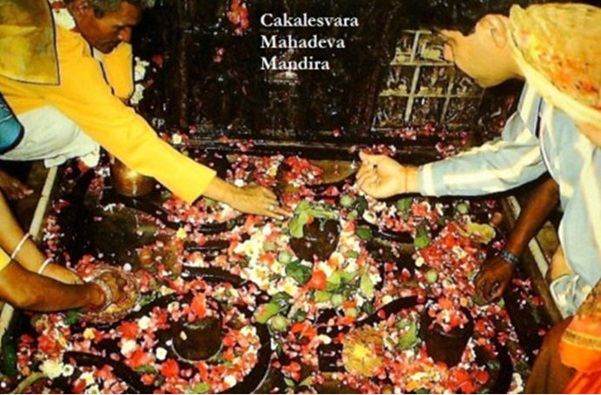
Adjacent to Chakra Tirtha is the temple of Chakaleshwar Mahadev, a presiding Siva-linga who serves as the protector of this portion of the dham. Siva, in his form as Chakaleshwar, guards the northern side of Govardhan and is one of the five prominent Mahadevs of Braja Mandala.
According to Gaudiya Vaishnava understanding, Siva is not merely a demigod but the greatest Vaishnava, “Vaiṣṇavānām yathā Śambhuḥ”. He performs the service of protecting the dham and assisting devotees in their spiritual journey. By visiting Chakaleshwar Mahadev, devotees seek his blessings to progress in their bhakti and to complete Govardhana Parikrama peacefully.
Visiting Chakra Tirtha and Chakaleshwar Mahadev Today:
Objective 5: To highlight the importance of visiting Chakra Tirtha and Chakaleshwar Mahadev for spiritual advancement during Govardhana Parikrama.
Both Chakra Tirtha and Chakaleshwar Mahadev temple are located on the northern side of Mānasi Ganga, Govardhan. They are easily accessible during Govardhana Parikrama.
Pilgrims visiting these sacred sites often bathe in Chakra Tirtha, offer prayers to Chakaleshwar Mahadev, and pay respects at the bhajana kutir of Sanatana Gosvami. These acts are considered to grant spiritual strength, humility, and devotion for progress on the path of Krishna bhakti.
The temple of Chakaleshwar Mahadev and the nearby Chakra Tirtha are not mere historical relics; they are vibrant centers of spiritual energy in Govardhana dham. For Gaudiya Vaishnavas, they represent the harmonious cooperation of the devotees— Siva, Sanatana Gosvami, and Sudarsana Chakra—in preserving, protecting, and glorifying Sri Krishna’s pastimes.
By visiting these sacred places with faith and devotion, the pilgrims receive blessings for bhakti, knowledge, and protection from material obstacles, drawing them closer to the ultimate goal of pure love for Sri Radha-Krishna.
