
Objectives:
Objective 1: To know the sacred significance of Narendra Sarovara
Objective 2: To learn about the sacred history, location and Chandana Yatra of Narendra Sarovara
Objective 1: To know the sacred significance of Narendra Sarovara
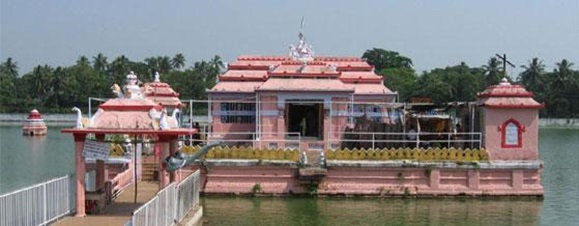
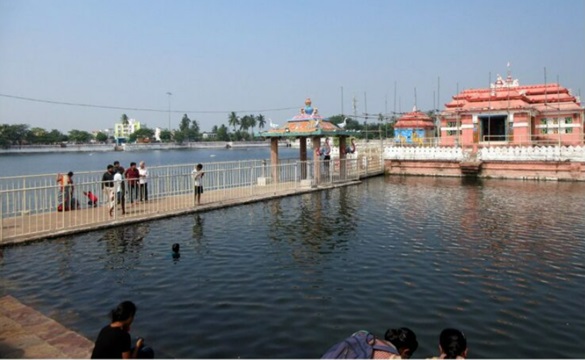
Narendra Sarovara is situated to the north east of Jagannatha temple next to Jagannatha Vallabha Garden; walking along Grand road towards Gundicha Temple, it is on your left side.
This pond is also known as Sri Chandana Puku, because Chandana Yatra of Lord Jagannatha takes place here.
The tank covers a vast area, making it one of the largest water bodies within Puri, surrounded by a series of small and picturesque temples.
Objective 2: To learn about the sacred history, location and Chandana Yatra of Narendra Sarovara
Narendra Sarovara is 873 feet long and 743 feet wide. This pond was created during thirteenth century by Narendra Mahapatra. He was the minister to Kavi Narasimha Deva. Some say that great personality (Narendra) King Indradyumna made this pond for the pleasure of Lord Jagannatha during His Chandana Yatra. Chandana Yatra is also known as Gandhalepan Yatra (Gandha means fragrances, and lepana means to smear the body with oils or pastes).
Some say that great personality (Narendra) King Indradyumna made this pond for the pleasure of Lord Jagannatha during His Chandana Yatra.
Sandalwood paste (chandan lepana), camphor, rose water, and herbs are blended to soothe the deities, expressing the devotees’ affection and service (seva). The rites coincide with Odisha’s hottest period, symbolising both physical and spiritual coolness. Daily observances include devotional music, floral decorations, and the preparation of light summer foods such as pakhala bhata. The festival also initiates chariot construction for the forthcoming Rath Yatra, linking the cycle of Jagannath’s major annual observances.
Sandalwood paste (chandan lepana), camphor, rose water, and herbs are blended to soothe the deities, expressing the devotees’ affection and service (seva).
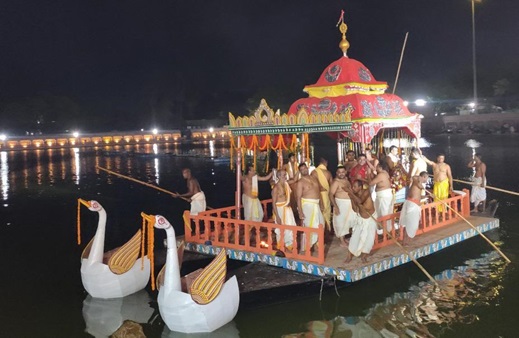
Narendra Sarovara covers a region of 3.25 hectares and arranged north-east of the acclaimed Jagannath Temple. There is a small Temple on an island inside this tank devoted to Lord Jagannath, Balaram and Subhadra. The name is Chandan Pokhari in light of the fact that Lord Jagannath comes here each night for 21 ceaseless days amid Chandan Yatra, from Akshay-tritaya (in month of April/May) up to Suklastami Tithi in the long stretch of Jyesta (May/June) to enjay his Nauka Lila (floating pastime).
Daily observances include devotional music, floral decorations, and the preparation of light summer foods such as pakhala bhata.
Presently this Sarovara is remodeled with wellsprings by the tourism office. It is situated 60km from Bhubaneswar, the capital city of Odisha. The Vijaya Vigraha of Lord Jagannatha, Sri Madana mohana, along with Lokanatha Mahadeva And other Deities, all enjoy a daily procession and boat ride during Chandana Yatra.
In the middle of the pond there are three temples on a small island structure which is reached by a bridge. During Chandana Yatra the Vijaya Vigraha deities from Jagannatha temple and Pancha Mahadeva sit here and receive Puja.

Objective 3: To immerse in the divine connection (past times) of Lord Chaitanya Mahaprabhu with Narendra Sarovara
Narendra Sarovar is deeply connected with the pastimes of Chaitanya Mahaprabhu.
In the book Gaudiya Treasures of Bengal, it is glorified as a divine site where Lord Chaitanya performed ecstatic water pastimes (jal-keli).
Chaitanya Mahaprabhu would come here with His intimate associates like Nityananda Prabhu, Advaita Acharya, and Svarupa Damodara.
They engaged in joyful water sports (jal-keli), splashing each other while chanting the holy names of Krishna.
These pastimes are compared to the playful water pastimes of Lord Krishna in Vrindavan with the gopis.
Devotees would sing kirtan, and Mahaprabhu would enter deep spiritual ecstasy (bhava), sometimes losing external consciousness, relishing the mood of Lord Krishna’s pastimes in Vrindavan.
Objective 4: To understand the Spiritual significance of Narendra Sarovar and its connection with Vrindavan
Narendra Sarovar is considered non-different from the transcendental waters of Vrindavan.
Bathing or even remembering this place is said to purify the heart and awaken devotion (bhakti).
Narendra Sarovar is described as:
● A place filled with laughter, splashing water, and divine love
● Where the Lord forgets His identity and relishes the mood of Krishna’s Vrindavan pastimes
● A confidential spiritual playground for His closest devotees
● Continuous chanting of Hari-nama filling the air
● Nityananda Prabhu and Advaita Acharya playfully engaging with Mahaprabhu
● Svarupa Damodara singing sweet kirtans
