
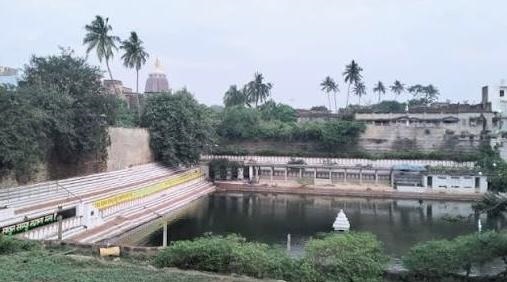
Sweta Ganga Tank with Sri Mandir at back Puri Dham
Objectives
Objective 1. To explore the spiritual importance of Sweta Ganga in the pilgrimage culture of Jagannath Puri Dham.
Objective 2. To learn about the five sacred tirthas associated with pilgrimage in Puri.
Objective 3. To explore about the distinguished devotees and personalities associated with the sacred site of Sweta Ganga.
Objective 4. To understand the traditional origins of Sweta Ganga as described in the Purushottama Kshetra Mahatmya and Skanda Purana.
Objective 5. To develop reverence for Sweta Ganga as a holy tirtha that combines devotion, purification, remembrance, and spiritual upliftment.
Objective 6. To understand the unique sacred nature of Sweta Ganga as a holy tirtha associated with nearby shrines rather than presiding Deities within the tank itself.
Objective 7. To identify the scriptural sources that describe the origin and significance of Sweta Ganga.
Objective 8. To identify the location of Sweta Ganga within the sacred landscape of Sri Jagannath Dham.
Introduction
Objective 1.To explore the spiritual importance of Sweta Ganga in the pilgrimage culture of Jagannath Puri Dham.
Sweta Ganga is one of the five sacred Pilgrimage water tanks, i.e., the Pancha Mukti Tirthas (Five Sacred Waters) in Sri Kshetra, the Jagannath Puri Dham and is closely associated with the worship of Jagannath Temple. It is also believed that Gangamata Matha is located adjacent to the tank/pond. It is also spelled as Shewta Ganga or Shweta Ganga.In Puranas it is described as Akrishna, meaning not “not black.” Sweta means white. People here say that once a year, for a brief moment, the water of this pond turns as white as milk.
Objective 2.To learn about the five sacred tirthas associated with pilgrimage in Puri.
Pancha Mukti Tirthas
The remaining pancha tirthas are Sweta Ganga, Indradyumna Sarovara, Markandeya Sarovara, Rohini Kunda(a well located inside the primary temple complex) and Mahodadhi, the mighty Bay of Bengal at Swargadwar, considered the sum total of all holy rivers.
Bathing in Sweta Ganga leads to
Purifiy one from sins.
Grant spiritual merit (punya).
Help devotees attain liberation (mukti).
Prepare pilgrims for the darshan of Lord Jagannath
Because of this significance, Sweta Ganga is counted among the Pancha Mukti Tirthas of Puri.
Devotees associated with the Place
Objective 3.To explore about the distinguished devotees and personalities associated with the sacred site of Sweta Ganga.
Sarvabhauma Bhattacharya : This pond is located just opposite the house of Sarvabhauma Bhattacarya, in a small lane off Bali Sahi Road.
About Sarvabhauma Bhattacharya:
Sarvabhauma Bhattacarya was formerly Brihaspati, the guru of the gods. (As per Gaura-ganoddesha-dipika 119). He was a Great scholar of Vedanta and logic. He lived and taught in Puri. When Chaitanya Mahaprabhu arrived in Puri as a young sannyasi, Sarvabhauma initially tried to instruct him in Vedanta. After several discussions, he became deeply impressed by Chaitanya’s spiritual insight and later became one of his prominent followers. This event is considered an important turning point in the spread of Gaudiya Vaishnavism in Puri.
King Sweta a devotee of the Lord.As mentioned in the Purushottama Kṣetra Māhātmya and Skanda Purana, Ganga appeared after the King Sweta worshipped Lord Jagannath here and pleased Bhagavan .
Objective 4.To understand the traditional origins of Sweta Ganga as described in the Purushottama Kshetra Mahatmya and Skanda Purana.
Origin of Sweta Ganga
By Purushottama Kṣetra Māhātmya: The story of Śweta Gaṅgā is preserved mainly in the Purushottama Kṣetra Māhātmya sections of the Puranas and in local Jagannath traditions. King Śweta and Śweta Gaṅgā
According to the tradition:
There was a pious king named Śweta who was a great devotee of Lord Vishnu.He performed severe austerities and worship in Purushottama Kṣetra (Puri).Pleased with his devotion, Lord Vishnu granted him darśana and offered him a boon. King Śveta did not ask for personal prosperity or liberation; instead, he prayed that the sacred River Gaṅgā would eternally remain in Purushottama Kshetra so that future generations of pilgrims could obtain spiritual purification and blessings. By the Lord’s grace, the sanctity of Gaṅgā manifested in a sacred tank, which became known as Śweta Gaṅgā (“the Gaṅgā of King Śveta”).
Traditional Verse
A verse traditionally cited in Odisha’s Jagannath Māhātmyas glorifies Śweta Gaṅgā:
śweta-gaṅgāṁ samāsādya snātvā bhakti-samanvitaḥ
sarva-pāpa-vinirmukto viṣṇu-lokaṁ sa gacchati
Meaning
“One who reaches Śweta Gaṅgā and bathes there with devotion becomes freed from all sins and attains the abode of Lord Vishnu.” This verse is frequently quoted in local tirtha-māhātmya literature and pilgrimage guides associated with Puri.
Matsya Temple at Śweta Gaṅgā
A distinctive feature of Śveta Gaṅgā is the presence of a shrine of Matsya. The Matsya deity is worshipped on the bank of the tank, reinforcing the Vaishnava character of the tirtha.
By Skanda Purana : There is also a reference of King Sweta legend in the Skanda Purana – As per the Skanda Purana, King Sweta, a devoted follower of the Lord Mahaprabhu, conducted a significant Yajna, during which Devi Ganga emerged from the Yajna Kunda upon its conclusion. This event led to the site being named Sweta Ganga. The king constructed a boundary wall and stairs leading to the tank. Temples dedicated to the Matsya Avatar of Vishnu and King Sweta are located on the banks of the tank.
According to local Mahabharata and Puranic lore, this tank, sweta Ganga, was created by the piercing of the earth with the nail of Lord Vishnu’s big toe.
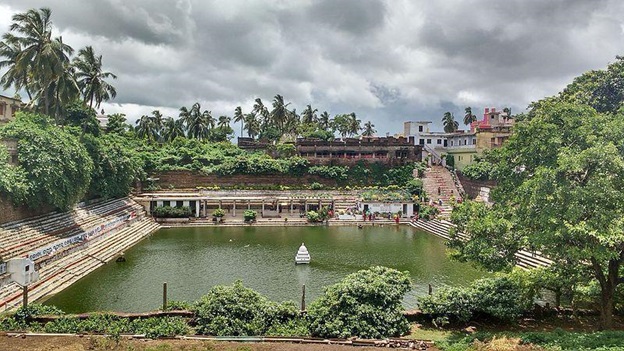
Sweta Ganga Tank. Puri
Objective 5.To develop reverence for Sweta Ganga as a holy tirtha that combines devotion, purification, remembrance, and spiritual upliftment.
Importance of the Sweta Ganga :
A place connected with Lord Vishnu’s Matsya form and King Śveta’s devotion.
A sacred tirtha that grants purification: Bathing or even touching the water brings spiritual merit. The tank helps purify devotees before entering the Jagannath Temple, so the pilgrims after bathed in Sea again takes a bath on Swetaganga before taking darshan of Lord Jagannath.
A sacred tirtha to remove sins : The sin incurred or offence of inadvertently stepping on Jagannatha Prasadam also known as the “Mahaprasad” can be absolved by taking bath in Sweta Ganga and taking darshan of Sveta Madhava (devoted King) and Matsya Madhava, who are located in her banks.
A manifestation of Mother Gaṅgā within Purushottama Kṣetra :The tank’s water as sacred as the River Ganga and local belief holds that Goddess Ganga herself resides here, which is why the tank is said never to run dry. The taking bath in Sveta Ganga is same as taking bath in Ganga River, because many incidents prove that the Sweta Ganga is non different from the Ganga River in Kashi.
Apart from spiritual bathing, it is a key ritual site where residents and pilgrims perform post-cremation shraddha (funeral)
Objective 6.To understand the unique sacred nature of Sweta Ganga as a holy tirtha associated with nearby shrines rather than presiding Deities within the tank itself.
Presiding Deities
As it is a sacred tank, there are no Deities, but on the banks of Sweta Ganga are shrines dedicated to:
Sweta Madhava Temple-Lord Sri Krishna is worshipped as Sweta Madhav -The name given by the Lord to the King Sweta, he was great devotee of Bhagavan.
Matsya Madhava Temple-The Matsya deity is worshipped on the bank of the tank, reinforcing the Vaishnava character of the tirtha.
Objective 7.To identify the scriptural sources that describe the origin and significance of Sweta Ganga.
Scriptural References
In Skanda Purāṇa – Purushottama Kṣetra Māhātmya,Nīlādri Mahodaya,Kapila Saṁhitā and Brahma Purana relates the background of the holy tank called Sweta Ganga in Puri, justifies its importance and thereby highlights the sanctity of Purusottama Kshetra
Objective 8. To identify the location of Sweta Ganga within the sacred landscape of Sri Jagannath Dham.
Location
Sweta Ganga is located in the area between the Singhadwara (Lion Gate) of Sri Dham and Swargadwar. It is towards the south/southwest of the Jagannath Temple area. It is situated near Gangamata Math.
It is located around 10-12 minutes walking distance from Sri Dham, Jagannath Puri temple.
