
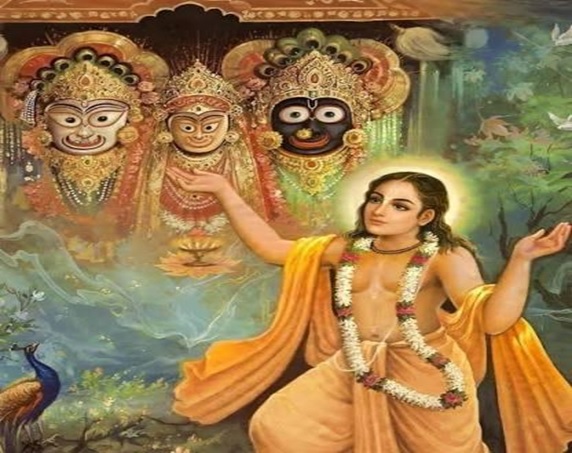
Śrī Caitanya Mahāprabhu
Objectives
Objective 1.To appreciate that Śrī Caitanya Mahāprabhu is Śrī Kṛṣṇa appearing with the mood and golden complexion of Śrīmatī Rādhārāṇī.
Objective 2.To learn the three distinct phases of Śrī Caitanya Mahāprabhu’s twenty-four years in Jagannātha Purī.
Objective 3.To understand the daily devotional practices of Śrī Caitanya Mahāprabhu during His residence at Jagannātha Purī.
Objective 4.To appreciate the loving relationship between Śrī Caitanya Mahāprabhu and Lord Nityānanda as revealed through the Daṇḍa-bhaṅga pastime.
Objective 5.To learn the historical and devotional importance of Āṭhāranālā as the gateway to Jagannātha Purī and a sacred place associated with Śrī Caitanya Mahāprabhu.
Objective 6.To recognize Ahulā Maṭha and Gambhīrā as important pilgrimage sites associated with the life and teachings of Śrī Caitanya Mahāprabhu.
Objective 7.To appreciate how the pastimes of Śrī Caitanya Mahāprabhu during Ratha-yātrā reveal the highest teachings of prema-bhakti and the confidential mood of Gauḍīya Vaiṣṇavism.
Objective 8.To understand the significance of Indradyumna Sarovara in the pastimes of Śrī Caitanya Mahāprabhu during the Guṇḍicā festival.
Objective 9.To appreciate how these sacred sites collectively reveal the core principles of Gauḍīya Vaiṣṇavism—guru-bhakti, Vaiṣṇava-sevā, nāma-saṅkīrtana, Śrīmad-Bhāgavatam, Deity worship, and Kṛṣṇa-prema.
Objective 1.To appreciate that Śrī Caitanya Mahāprabhu is Śrī Kṛṣṇa appearing with the mood and golden complexion of Śrīmatī Rādhārāṇī.
Introduction
Sri Chaitanya Mahaprabhu is none other than Supreme Lord Sri Krishna, who appeared in this Kali-yuga to inaugurate the yuga dharma for this age – Sankirtana, the congregational chanting of the Holy Names of the Lord. Sri Chaitanya Mahaprabhu appeared at Sridhama Mayapura, in the city of Navadvipa in Bengal, on the Phalguni Purnima evening in the year 1486 AD. He is considered as the most merciful manifestation of Krishna. Krishna with the mood and complexion of His source of inspiration Radha.
“kṛṣṇa-varṇaṁ tviṣākṛṣṇaṁ
sāṅgopāṅgāstra-pārṣadam
yajñaiḥ saṅkīrtana-prāyair
yajanti hi su-medhasaḥ”
Śrīmad-Bhāgavatam 11.5.32
Chaitanya is sometimes referred to by the names Gauranga or Gaura due to his fair complexion, and Nimai due to his being born underneath a Neem tree.
His Mother’s Wish: After taking the vows of sannyasa in 1510 at Katwa, his mother, Sachi Devi, requested that he make Jagannath Puri his base. Because Puri is a major coastal pilgrimage site, she knew it would be easier for her to receive news and updates about his well-being from traveling devotees.
Objective 2.To learn the three distinct phases of Śrī Caitanya Mahāprabhu’s twenty-four years in Jagannātha Purī.
Life In Puri
Sri Chaitanya Mahaprabhu spent first 24 years in Navadvipa and the latter twenty-four years in Puri. His residence in this dhama is traditionally categorized into three chronological phases:
● The First Six Years (c. 1510–1516): Following His acceptance of sannyasa , the Lord traveled extensively to South India, Bengal, and Vrindavan. Although Puri was His headquarters, He remained in a state of continuous movement, distributing prema (divine love) and performing miracles such as the intellectual and spiritual liberation of the renowned scholar Sarvabhauma Bhattacarya.
● The Middle Six Years (c. 1516–1522): Upon returning from His pilgrimage to Vrindavan, the Lord fixed His residence permanently in Puri for the remaining eighteen years of His life. During this middle phase, He focused on the public congregational chanting ( sankirtan ) and dancing, instructing all souls through His exemplary conduct in the path of bhakti .
The Final Twelve Years (c. 1522–1534): This period, the Antya-lila , represents the peak of His internal absorption. Sheltered within the Gambhira, the Lord descended into the profound depths of Vipralambha-seva (service in separation) and Mahabhava . He spent His days and nights relishing the confidential moods of the gopis of Vrindavan, experiencing the “transcendental madness” of divine love.
Objective 3.To understand the daily devotional practices of Śrī Caitanya Mahāprabhu during His residence at Jagannātha Purī.
Lord Chaitanya’s Daily Activities in Puri:
In the daytime Shri Chaitanya engaged in dancing and chanting and seeing the temple deity of Jagannatha. At night in the company of His most confidential devotees, such as Ramananda Raya and Swarupa Damodara, He tasted the nectar of the transcendental mellow of Lord Krishna’s pastimes.
He very happily passed His days in this way at Nilacala, Jagannatha Puri. Feeling separation from Krishna, He exhibited many transcendental symptoms all over His body. Day after day these symptoms, such as transcebndental anxiety, agitation, and talking like a madman, were present just as they are described in the sastras.
MORNING:
Every morning Shri Chaitanya Mahaprabhu saw the Deity of Lord Jagannatba. Standing near the Garuda Stambha, He offered obeisances, prayers, danced, and sang before Lord Jagannatha. He waited to see the Upala bhoga (morning refreshments) offered at noon. Upala Bhoga is a particular type of offering performed just behind the Garuda Stambha on a stone slab. That stone slab is called the upala. All food is offered within the temple room just below the altar of Lord Jagannatha. This bhoga, however, was offered on the stone slab within the vision of the public. Krishna das Kaviraj also says Lord Chaitanya would wait outside the temple during the Upala bhoga offering. (Ml/64, M15/6,Ant4/16)
Sometimes when coming from the temple, absorbed in ecstatic love of Krishna, Shri Chaitanya would sit on the ground and mark it with His nails. At such times He would be greatly morose, and would cry, “Alas, where is Vmdavan? Where is Krishna, the son of the king of the cowherd men? Where is that person who plays the flute?”
After visiting the temple, the Lord would visit Siddha Bakula, where Haridas lived along with Sanatana and Rupa Goswamis. If one of these three was not present, He would meet with the others. That was His regular practice. He would talk with them for sometime, then go to the seaside to perform His noontime duties.
AFTERNOON:
Returning to the Gambhira room, Shri Chaitanya would sit in His room and chant on His beads, and Advaita Prabhu would come there to worship Him. Advaita Acarya would smear very fragrant sandalwood pulp all over Lord Chaitanya’s body- After being worshiped; Lord Chaitanya worshiped Advaita Acarva in return
Then Lord Chaitanya would take prasadam by accepting invitations at different devotee’s homes everyday. After taking prasadam, Lord Chaitanya would return to His room. It was a long standing rule that Shri Chaitanya Mahaprabhu would lie down to rest after lunch and Govinda would come to massage His legs.
EVENING:
When the Bengali Vaishnavas were visiting Puri, they would meet Lord Chaitanya in the evening after resting, following their noon prasadam. Lord Chaitanya took them all to the temple and began congregational chanting. As long as the devotees remained at Jagannatha Puri with Lord Chaitanya, this pastime of Sankirkan was performed with great jubilation every day.
After the Bengali Vaishnavas returned home, Lord Chaitanya spent the nights in the company of His most confidential devotees, Ramanananda Raya, and Svarupa Damodara. With them Lord Chaitanya tasted the nectar of the transcendental mellows of Krishna’s pastimes. He recited from Shrimad-Bhagavatam, Gita-Govinda, Jagannatha-vallabha-Nataka, and Krishnakarnamrta. He would also recite His own verses, expressing their emotions, and thus enjoy tasting them with these two friends. Sometimes the Lord would be absorbed in a particular emotion and would stay awake all night reciting verses and relishing their taste.
If Ananta, with His 1,000 heads, tried to describe even one day’s pastimes of Shri Chaitanya Mahaprabhu, He would find them impossible to describe fully. If Ganesh, Lord Siva’s son and the expert scribe of the demigods, tried for millions of milleniums to fully describe one day of the Lord’s pastimes, he would be unable to find their limit.
LEELAS IN PURI
Objective 4.To appreciate the loving relationship between Śrī Caitanya Mahāprabhu and Lord Nityānanda as revealed through the Daṇḍa-bhaṅga pastime.
Danda-bhanga Leela
At Chandanpur, near the end of the journey, the Danda-bhanga leela occurred. While the Lord was visiting a temple, Nityananda Prabhu took the Lord’s sannyasa stuff ( danda ) and broke it into three pieces, casting it into the river. This pastime signaled the Lord’s transition into a mood of total dependence on Krishna, performed in the presence of His intimate associates Gadadhara Pandita, Mukunda, Govinda, Jagadananda, and Brahmananda.
Objective 5.To learn the historical and devotional importance of Āṭhāranālā as the gateway to Jagannātha Purī and a sacred place associated with Śrī Caitanya Mahāprabhu.
Atharanala
“Athara” means eighteen; this is a bridge of eighteen arches at the entrance to Jagannatha Puri. It has been said that Maharaja Indradyumna built this bridge. When he first commenced construction, he was unsuccessful again and again. Finally by the order of the Lord he offered the heads of his eighteen sons into the water of the river; only then was he successful in building the bridge.
Sri Caitanya Mahaprabhu first came to Puri via Atharanala Bridge, and there is a small temple marking the place where Sri Caitanya Mahaprabhu rested before he crossed. We also find the lotus foot print of Lord Gauranga Mahaprabhu.
“Every year when the devotees from Bengal would come to associate with Lord Chaitanya here in Jagannath Puri during the four months of Chaturmasya, They would first come to Athranala. Very often Shri Chaitanya Mahaprabhu would personally come to meet them here and there was a wonderful celebration of ecstatic reciprocation between the vaishnavas. The essence of Goudiya Vaishnav sidhanta is very much understood through the loving exchanges between devotees.
In the humble spirit of servitude and through the sincere chanting of the Holy name, the philosophy of Krishna Consciousness reveals the awakening of devotion within our hearts that is our purpose of life. So Athara Nala represents the place of the unity for the reunion of Vaishnavas.
Shripad Advait Acharya, Nityanand Prabhu, Srivas Pandit, Shivanand Sen, Pundarik Vidyanidhi, Shriman Pandit, Shri Ram Pandit, Shrinidhi, Kholavecha Shridhar, Budhimant Khan, Murari Gupta, Acharya Ratna Chandra Shekhar. After Kartik, all the great souls along with their wives would leave Jagannath Puri. It would take one month practically to walk to Bengal and just in time for Rath yatra they would walk back. So over half year they would separate from each other specially Lords who loved his devotees more than his own life how much he longed to be reunited with his devotees.
Ramananda Raya said the only suffering I know is to be bereft of the association of Vaishnavas. So here at AtharNala Shri Chaitanya Mahaprabhu would meet his beloved devotees. Lord Chaitanya wants as saying good bye to his devotees he began to cry in great love for them how much kindness you have toward me.
All of you go through so much terrible trouble just to come here to see me. I am remained enjoying in Jagannath Puri. But you are leaving your homes, you are leaving everything to travel a very very difficult and austere path across the whole country of Orissa and Bengal with so much trouble and difficulty you come here just to see me and then so much trouble again to come back. How much I am indebted to you. My life is your property. This was the mood of Lord Chaitanya’s love for his devotees. It is described in Shri Chaitanya Charitamrita and Shri Chaitanya Bhagavat how Lord Gourang Mahaprabhu would serve his devotees with so much care and attention.
Here at AtharaNala He would offer garland on each devotee with his hands as well as offer them sandalwood pulp. He would also offer his obesences to the devotees. When all the devotees would meet at Narendra Sarovar. The Bengali devotees and the Puri devotees and all of them offering obeisances to each other not considering who is big or who is small, who is learned or who is not learned. Everyone was just offering the dandavat obeisances to each other Shri Chaitanya Mahaprabhu was offering obeisances to every devotee with loud loud chanting of the holy names and ecstatic dancing. In fact the chanting was so loud it filled the entire fourteen planetary systems.
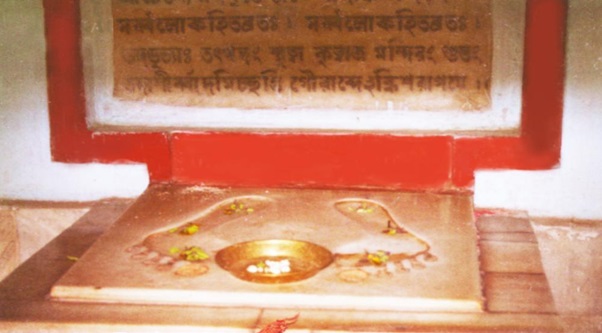
Footprints of Chaithanya Mahaprabhu
Srila Bhaktisidhanta Sarsvati Thakur had installed these footprints of Lord Shri Chaitanya Mahaprabhu here at Atharanala to commemorate the holiness of this place. As we have explained in Dand Bhanga Nadi, it was at Atharanala that Lord Chaitanya asked Lord Nityanand Prabhu, “Please give me my sanyasadanda. It was here that Lord Nityanand Prabhu devised this story.
He said my Lord when you were at Kamalapur when you saw the temple of Jagannath you were in so much ecstasy you started dancing and chanting and you fell down and I tried to catch you we fell on the danda and it broke into three pieces and I do not know where it is. Lord Nityananda Prabhu spoke those words in Atharanala. Lord Chaitanya said, “I will go to Puri alone. I will not go with you. You can either walk in front of me or behind me.
Lord Nityanand Prabhu he said, “you can punish me in anyway you want I am an offender” and Mukunda Datt said “Please my Lord! you go in front and we will follow behind you. So it was here that Shri Chaitanya Mahaprabhu, with his ecstasy of love for Jagannath, began his famous journey to Shri Jagannath Darshan.”
Objective 6.To recognize Ahulā Maṭha and Gambhīrā as important pilgrimage sites associated with the life and teachings of Śrī Caitanya Mahāprabhu.
Ahula Matha
This Matha is located in Heragohiri Sahi (near police line). It is a very old temple in a bad condition. Sri Advaita Acharya stayed here. Sri Caitanya Mahaprabhu came here to take prasadam when he was invited by Advaita Acharya. There is also a Gambhira room, where the deities worshipped by Advaita Acharya reside: Sri Caitanya Mahaprabhu, Lord Nityananda, Advaita Acharya and his wife, Sita devi.
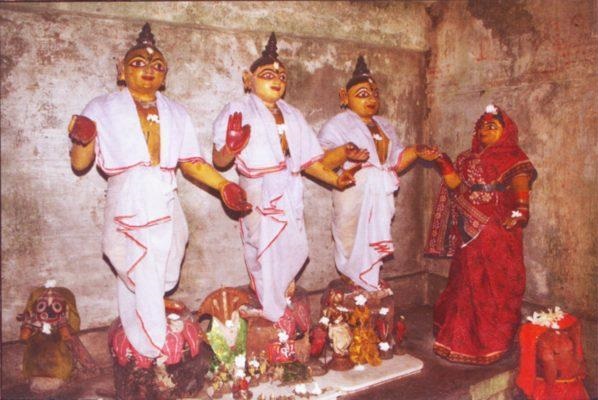
Deities of Ahula math
Gambhira
Gambhira is situated south east of the Jagannatha temple in Bali Sahi, on the way to Svargadvara. This place is also known as Kashi Mishra’s house, also known as Radha Kanta Matha.
When Mahaprabhu came to Jagannatha Puri after taking sannyasa, He stayed at Sarvabhauma Bhattacharya’s House. After His return to Puri from South India he then stayed at Kashi Mishra’s House. Kashi Mishra was Rajguru of King Prataparudra, and King had gifted him a house with a large garden near the temple. King Prataparudra was a great devotee of Sri Caitanya Mahaprabhu; He suggested to Sarvabhauma that Mahaprabhu can stay in Kashi Mishra’s house.
Sri Caitanya Mahaprabhu stayed in Kashi Mishra’s house in a very small room called Gambhira. He stayed in Gambhira constantly for the last twelve year of His manifested pastime.
Inside the room there is a box which holds the Kamandalu, Paduka and quilt of Mahaprabhu.
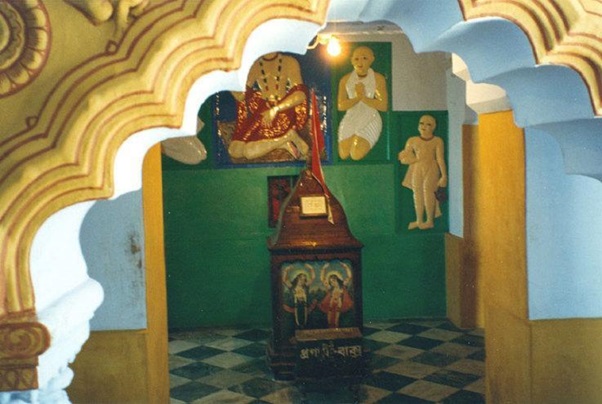
Gambira
Objective 7.To appreciate how the pastimes of Śrī Caitanya Mahāprabhu during Ratha-yātrā reveal the highest teachings of prema-bhakti and the confidential mood of Gauḍīya Vaiṣṇavism.
Lord Chaitanya at Ratha-yatra
As the day of the festival drew near, Sri Chaitanya personally took part in the preparations.
Two miles up the coast from the great temple of Jagannatha stands a modest but very attractive temple with milk-white walls and a russet roof, nestled among tropical gardens. A steady ocean breeze playing through the gardens surrounds the temple with a soothing sururrus and bathes it in cool and refreshing currents of air. The temple’s name is Gundica.
Here the chariot parade ends, and in the restful atmosphere of this still country place, Jagannatha, Balarama, and Subhadra remain for a week of leisure. The rest of the time the temple stands empty.
All year long the vacant temple collects dirt, sand, and straw; cleaners are sent just before the festival. It is considered a menial’s job, so Lord Chaitanya surprised everybody when He set out with hundreds of devotees, brooms, and waterpots to clean Gundica temple for the arrival of Jagannatha.
In great jubilation, the Lord swept every surface of the temple—floors, walls, ceilings—chanting Hare Krishna all the time, and His followers swept and chanted with Him. He swept so energetically His entire body became coated with dirt and dust. Sometimes the Lord shed tears of devotional ecstasy, and with those tears He washed the temple. Finally, He gathered all His sweepings into a single pile, throwing it outside. The others did the same. Sri Chaitanya’s pile was by far the largest.
Again they swept the whole temple, meticulously removing the tiniest bits of dust, grit, and straw. Then a hundred devotees came in with brimming water-pots, and Sri Chaitanya began vigorously throwing water on all the floors, walls, and ceilings. Devotees crowded about a lake and a well nearby filling pots; others rushed back and forth in lines with full or emptied pots. In the temple, water flew in great arcs and every surface was washed and scrubbed again and again. Everyone in the temple, in the water lines, in the filling places, ecstatically chanted the names of Krishna. Lord Chaitanya got down on His hands and knees and mopped the floor of the temple and polished the throne of Jagannatha with His own robes.
Then it was finished. The temple shone. It was cool, radiant, immaculate—as cool and bright, Krishnadasa Kaviraja says, as Sri Chaitanya’s own heart. It was fit to receive Lord Jagannatha.
Gundica was prepared, and two days later the three huge chariots stood in the morning sun before the gates of the Puri temple, awaiting their transcendental passengers. A vast crowd packed the streets. Inside the gates, Sri Chaitanya watched Lord Jagannatha, surrounded by powerfully built bearers, proceed from His throne to His chariot. Stout cushions led across the courtyard like steppingstones, and the bearers, muscles and veins bulging, lifted the large and heavy form of Jagannatha from cushion to cushion. Sometimes a cushion would split open with a heavy cracking report, and clouds of cotton wadding would fill the air. As Lord Jagannatha moved toward His chariot, Lord Chaitanya loudly called out to Him, “Manima! Manima!”—“My Lord! My Lord!” But the tumultuous din of musical instruments drowned out His words.
As Lord Jagannatha drew near His cart, Sri Chaitanya saw Maharaja Prataparudra, the King of Orissa. The King was bending over with a gold-handled broom, carefully sweeping the road in front of Lord Jagannatha. The King had long desired to have an audience with Sri Chaitanya, and the Lord had steadfastly refused. As a member of the renounced order, Sri Chaitanya was forbidden to have any connection with worldly men. But when Lord Chaitanya saw the crowned head of state personally performing this menial service for Lord Jagannatha, He became very pleased and resolved to show the king all mercy.
As Lord Jagannatha prepared to depart for Gundica temple, Lord Chaitanya organized His close followers into seven groups for sankirtana, congregational chanting. Each group had two drummers, a dancer, a lead chanter and five others to respond. Sri Chaitanya placed four chanting parties in front of the chariot, one on each side, and one in the rear.
The thick ropes that draw the chariots stretched tight, and as the crowd shouted in joy, the ponderous wheels began to turn. As the three huge chariots started to inch forward, the hundreds of mirrors that decorated the chariots flashed in the sun. Festoons of bright silken cloth billowed and shimmered. Scores of white yak-tail whisks hanging in rows swayed back and forth in unison, and bells and gongs of all shapes and sizes clanged, chimed, and tinkled. The chariots’ cloth canopies, shaped just like the great stone dome of the Puri temple, moved stately and majestically; each vehicle was a temple in motion.
As the wheels of Jagannatha’s car started to turn, fourteen drums began pounding together. Nearby, the king stood with his confidant Sarvabhauma Bhattacarya, and together they watched as Sri Chaitanya began to dance before Lord Jagannatha in ecstasy, chanting the names of Krishna. Sometimes He flung His long arms high over His head and chanted, “Jaya Jagannatha! Jaya Jagannatha!” (“All glories to Lord Jagannatha!”).
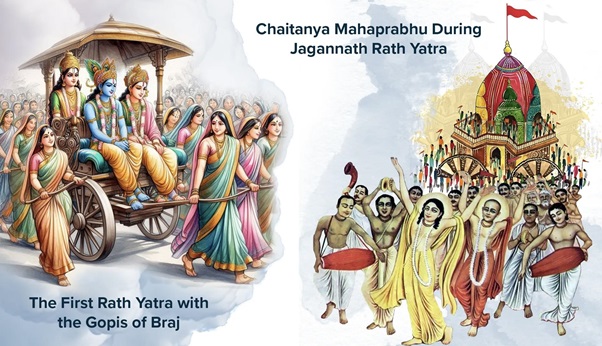
As Lord Chaitanya danced. He remained facing the steadily advancing chariot and kept His eyes fixed upon the large-eyed, smiling countenance of Lord Jagannatha, riding above and always moving toward Him. And Sri Chaitanya began to sink deeper and deeper into a specific emotional ecstasy elicited by this Ratha-yatra journey of the Lord.
Lord Chaitanya danced before Lord Jagannatha’s chariot on the way to Gundica, He merged deeper and. deeper into the feelings of Radharani. He lived through all Her feelings for Krishna, and expressed all of them in His ecstatic dancing.
As Sri Chaitanya danced, Lord Jagannatha watched with great pleasure. King Prataparudra, together with Sarvabhauma Bhattacarya, was also intently watching, and the king became stunned with ecstatic love. Then it happened by the mercy of Lord Chaitanya that the king could clearly see the mystery of the Lord’s activities. He saw that Lord Chaitanya, the dancer, and Lord Jagannatha, who watched the dancer, were the same Personality of Godhead. The king directly beheld the mystery of the Lord: how the one Lord manifests Himself in transcendental variegatedness for the enjoyment of His pastimes.
As the procession moved forward, Lord Chaitanya moved from one sankirtana group to another, now dancing in the midst of one, now the other. And then the king and Sarvabhauma Bhattacarya saw another mystery, witnessed only by the confidential associates of Sri Chaitanya: They saw Lord Chaitanya dancing in the center of all seven groups at once. The chanters in each group, not realizing that the Lord had expanded Himself by His spiritual potency to be in all seven groups, thought that the Lord had come to favor them. Sometimes as seven, sometimes as one, the Lord danced before the chariot. And sometimes all the groups would come together in front of the chariot to form a circle around Lord Chaitanya.
Then Lord Chaitanya would dance with greater and greater energy. Roaring like thunder, leaping higher and higher, He hurled Himself in a circle so swiftly that He looked like the single incandescent ring formed by a whirling firebrand. Everyone became astonished, even Lord Jagannatha. The chariot came to a complete standstill and remained immobile while Lord Jagannatha watched with unblinking eyes the dancing of Sri Chaitanya Mahaprabhu.
As the Lord danced before the motionless chariot, physical transformations induced by ecstasy appeared on His body. His skin erupted with goose pimples, and the hairs of His body stood on end: His body resembled a silk cotton tree, all covered with thorns. His teeth chattered so violently that people became afraid they would fall out. His body flowed with perspiration and sometimes oozed blood. His voice became so choked with ecstasy that when he tried to shout “Jagannatha!” He could utter only “jaja gaga, jaja gaga.” Tears sprang from His eyes as though expressed from a syringe, and people all around Him became wet. Sometimes He became stunned, crashing suddenly to the ground and lying immobile, scarcely breathing. His limbs hard as wood. Then He would suddenly leap up again, and tears, perspiration, and foam would fly from His golden body.
Then His ecstatic mood changed. Svarupa Damodara, the Lord’s secretary, could instantly read the feelings of Sri Chaitanya, and he began to sing a particular verse repeatedly. In this verse, Srimati Radharani expresses Her feelings at meeting Krishna at Kurukshetra. Srimati Radharani says, “That very person who stole away My heart during My youth is now again My master. These are the same moonlit nights in the month of Caitra. The same fragrance of malati flowers is there. In Our intimate relationship, I am also the same lover, yet still My mind is not happy here. I am eager to go back to that place on the bank of the Reva, under the Vetasi tree. That is My desire.”
Now Sri Chaitanya, fully merged into the highest ecstasy of Srimati Radharani at Kurukshetra, began to dance rhythmically. Gradually He moved further and further out in front of Lord Jagannatha’s chariot, and then, in response, the chariot also began moving slowly forward. As Lord Chaitanya danced. He mimed in gesture the drama of the meeting at Kurukshetra, with all its tragic and exalted emotions. Lord Jagannatha and Lord Chaitanya again enacted that sublime pastime of transcendental love on the road to Gundica. Sometimes Lord Chaitanya danced out in front of the chariot, and so, in the role of Radharani, tried to lead Krishna back to Vrindavana. Out of her love for Radha, Jagannatha moved forward.
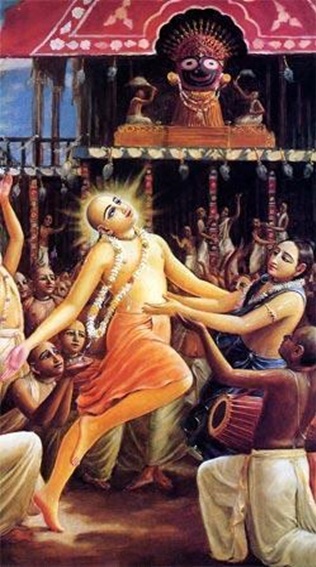
Chaithanya Mahaprabhu at Ratha yatra
Sometimes Lord Chaitanya would fall behind the chariot, thereby indicating that Krishna had forgotten the residents of Vrindavana, had put away the love of His youth, forsaking Her and all the others. Whenever Lord Chaitanya dropped in back of the chariot, the chariot would come to a stop. In this way Krishna—Lord Jagannatha—responded that He had not forgotten. Srimati Radharani—all of Vrindavana—remained dear to Him above all else. The chariot would stand immobile until Lord Chaitanya again came in front to dance, moving further and further ahead of the car. Then Lord Jagannatha again began to move slowly forward. In this way, Krishna admitted that He could not live without Radharani, that He could never be satisfied outside of Vrindavana. And in this way, Lord Chaitanya led Lord Jagannatha to Gundica, and satisfied Him fully.
By His extraordinary pastimes with Lord Jagannatha during the Ratha-yatra festival, Lord Chaitanya manifested the most confidential ecstasies of divinity. People are wasting away in this material world, trying vainly to squeeze a few drops of happiness out of dead, dry matter. Lord Chaitanya disclosed these innermost pastimes of Krishna, opening this incalculable treasure of spiritual feelings, to show that nothing in this world can compare to Krishna.
Objective 8.To understand the significance of Indradyumna Sarovara in the pastimes of Śrī Caitanya Mahāprabhu during the Guṇḍicā festival.
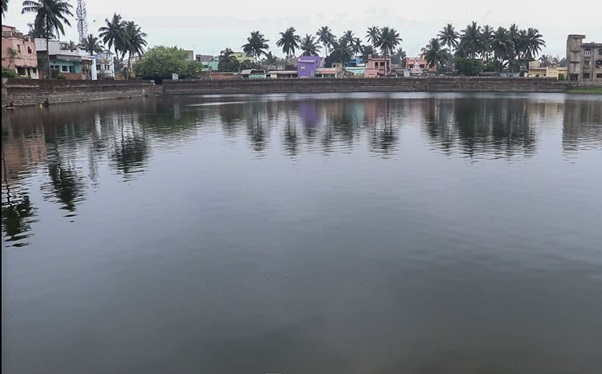
INDRADYUMNA LAKE
Located about 1/4 mile from Gundica Temple. During the annual cleansing of the Gundica Temple, The devotees would fetch water and bathe here. Since hundreds of men were engaged in bringing water from this lake, there was no place to stand on the banks. Hundreds of devotees brought water in the pots, and hundreds took the empty pots away to fill them up again. Many water pots were broken when people collided with one another.
Water Sports: Lord Chaitanya and the devotees splashed water on each other.They formed circles, played cymbals and croaked like frogs while in the water. Lord Chaitanya enjoyed watching as couples (Svarupa Damodara & Vidyanidhi: Murari Gupta & Vasudeva Datta) would duel in water lights. Advaita Acarya, being defeated by Lord Nityananda, called Him bad names. Shri Chaitanya Mahaprabhu was surprised to see the duelers, Sarvabhauma Bhattacarya and Ramananda Raya, lose their gravity and become like children. Lord Chaitanya jokingly told Gopinatha Acarya, “Tell them to stop their childish play because they are both learned scholars and very grave personalities.”
Lord Chaitanya amazed all the devotees by floating on the water lying on Advaita Acarya and showing His pastime of Sesasayi Vishnu.
Sheshsayi means Krishna lying on Shesha. Lord Chaitanya was laying on Advaita Acharya and they floated all around the entire Indradyumna sarovar. All devotees were ecstatically celebrating this beautiful darshan of Sheshshayi Vishnu. Lord Chaitanya was lying on the body of Adwait Acharya who was floating throughout the lake. Shri Indradyumna Sarovar Ki Jay.
After spending many wonderful wonderful moments performing their loving pastimes in Indradyumna sarovar then Lord Chaitanya would go to ‘Ayi Tota’ the garden next to Gundicha Mandir. There He and His devotees took prasad. Shri Gourang Mahaprabhu Ki- Jay.
Objective 9.To appreciate how these sacred sites collectively reveal the core principles of Gauḍīya Vaiṣṇavism—guru-bhakti, Vaiṣṇava-sevā, nāma-saṅkīrtana, Śrīmad-Bhāgavatam, Deity worship, and Kṛṣṇa-prema.
Mahaprabhu Vishrama Sthana
Leaving Nrsimhadeva temple and proceeding towards Indradyumna Sarovara, Mahaprabhu Vishrama Sthana is a few meter along on your right side. After Gundicha Mandir Marjana (cleaning the Gundicha temple), Lord Gauranga Mahaprabhu took rest at this place.
Paramananda Puri Kua
Srila Paramananda Puri was a disciple of Srila Madhavendra Puri and thus He was the godbrother of Srila Isvra Puri, the spiritual master of Sri Lord Gauranga.Lord Gauranga always paid respect to Srila Paramananda Puri as His Guru Varga. “Thus Lord Gauranga exchanged respectful obeisances with Paramananda Puri, who was very dear to Him”. Paramananda Puri established a small monastery behind the western side of the Jagannatha temple, where he had a well dug to supply water. The water, however, was bitter, and therefore Lord Gauranga prayed to Lord Jagannatha to allow Ganges water to come into the well to make it sweet.
When Lord Jagannatha granted the request, Lord Gauranga told all the devotees that from that day, hence, the water of Paramananda Puri ‘s well should be celebrated as Ganges water, for any devotee who would drink it or bathe in it would certainly get the same benefit as that derived from drinking or bathing in the waters of the Ganges. Such a person would certainly develop pure love of Godhead.
Sarvabhauma Bhattacarya’s House
When Lord Chaitanya first came to Puri, He fainted in front of Deity of Lord Jagannatha and Sarvabhauma took Him to his home. Sarvabhauma Bhattacharya spoke to Lord Chaitanya in his house about the impersonal doctrine for several days and finally Lord Chaitanya defeated all his impersonalist conclusions and bestowed his causeless mercy upon him by showing His Shad-bhuja rupa, or six-armed form, a combined form of Lord Krishna, Lord Rama and Lord Chaitanya. There is a hidden tunnel in the house that is said to lead in two directions – to the sea and to the Jagannatha Temple. It is said that this tunnel was used by Sri Chaitanya.
Siddha Bakula
Siddha Bakula is located behind Kashi Mishra house. Sri Caitanya Mahaprabhu personally arranged for Srila Haridasa Thakura to reside at this place. Siddha Bakula is the bhajana kutir of Haridasa Thakur, the place where he chanted 3,00,000 names of Krishna daily.
Sri Chaitanya requested Haridasa, “Remain here and chant the Hare Krishna maha-mantra. I shall personally come here to meet you daily. Remain here peacefully, and look at the cakra on top of Lord Jagannath’s temple and offer obeisances. As far as your prasadam, I shall arrange to have that sent here.”
In order to provide shade for Thakur Haridasa, Sri Chaitanya planted a used tooth stick of Lord Jagannath. All of a sudden it grew up and appeared as a great shade tree. Rupa Gosvami recited Lalitha Madhava and Vidagdha Madhava under this tree to Sri Gauranga and his followers. During his stay, Sanatana Gosvami lived with Haridasa Thukur here. Haridasa Thakur left his body here and Lord Chaitanya danced in ecstasy here.
In course of time, the King of Orissa ordered his officers to cut down the tree here in order to construct Lord Jagannatha’s Ratha-yatra cart. Big amount of wood is needed, since the carts are about 13 m high and each year new ones are constructed. They come to cut this tree but Srila Jagannatha Gosvami objected, informing them that the tree had been planted by Sri Caitanya Mahaprabhu for giving shade to Haridasa Thakura. But they refused and decided to cut this tree in the next day. Overnight, the tree becomes hollow. The trunk remained standing, but its insides were empty. The next morning when the royal officers came they found the tree hollow and returned without cutting it.
The tree was not ordinary tree, having been used as a toothbrush for Lord Jagannatha, and then planted in the ground by Mahaprabhu’s own hand, and acting as shelter for Nama Acharya Srila Haridasa Thakura.
Tota Gopinatha
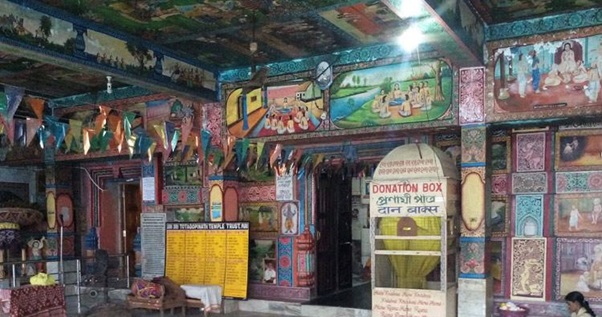
Tota Gopinatha Temple.
Gadadhara Pandita would read Bhagavatam every day to Caitanya Mahaprabhu. Once Mahaprabhu came here after taking darshana of Lord Jagannatha, where He saw Lord in his Syamasundara form. By seeing, he experienced the mood of separation from Krishna; He experienced the same feelings as he would in Vrindavana. He saw Cataka parvata as Govardhana, the ocean as Yamuna, and VataVrksha as Vamshi vata where Krishna played his flute to attract Gopi’s.
One day in same separation mood Mahaprabhu was digging the soil; He suddenly saw the top portion of a deity. He said to Gadadhara, “I have found a most precious thing here. Would you like to accept it?” And then together they removed from the sand a very beautiful deity of Lord Sri Krishna.
Mahaprabhu named the deity Gopinatha. As deity found in garden, which is called Tota in Oriya language, devotee started to address this deity as Tota Gopinatha. Mahaprabhu gave the responsibility of Tota Gopinatha’s service to His most dear Gadadhara Pandita.
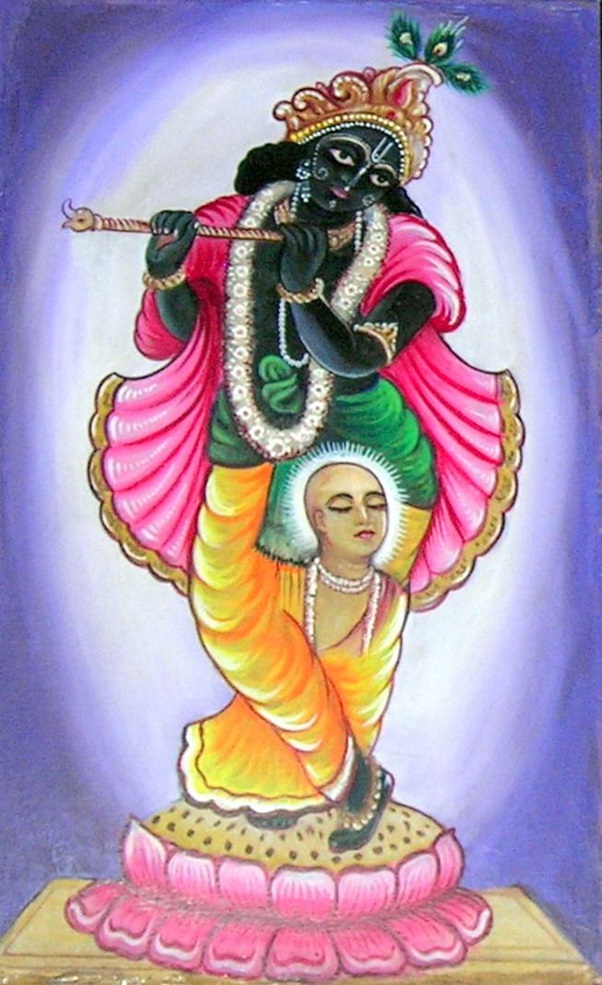
Tota Gopinatha and Chaithanya Maha Prabhu.
Gaudiya Vaisnavas accept that Sri Chaitanya Mahaprabhu ended His manifested pastimes in Jagannatha Puri by entering into the knee of the Tota Gopinatha DeityThere is a crack in His knee where Lord Chaitanya entered the Deity and left this world and went to Golok brindavan.
