
Objectives
Objective 1: To identify the location and architectural featuresof the Nata Mandira in the Jagannath Temple.
Objective 2.To learn the history and spiritual significance of the Nata Mandira.
Introduction
Objective 1: To identify the location and architectural featuresof the Nata Mandira in the Jagannath Temple.
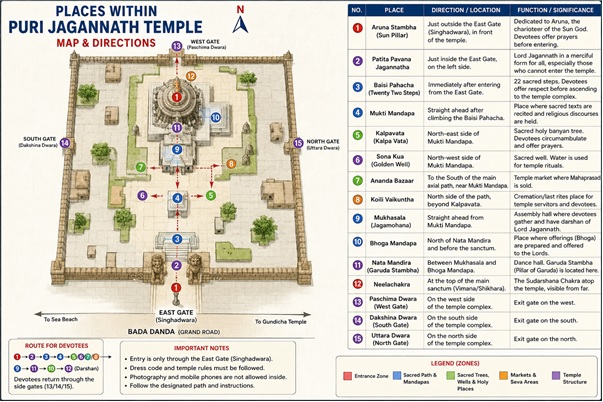
The Nata Mandira (also called Natamandapa or the Dancing Hall) is the third of the four principal structures of the Jagannath Temple. It is situated between the Bhoga Mandapa and the Mukhasala (Jagamohana).
Historically, this hall served as the place where Devadasis (Maharis) offered devotional dance and music before Lord Jagannath as part of the daily temple worship. Today, although these performances are no longer conducted, the Nata Mandira continues to be an important part of the temple’s sacred architecture.
Location
The four principal structures of the Jagannath Temple are arranged in a straight east-west line:
- Bhoga Mandapa (Hall of Offerings)
- Nata Mandira (Dancing Hall)
- Mukhasala (Jagamohana or Assembly Hall)
- Vimana (Sanctum Sanctorum)
After entering through the eastern side of the temple and passing the Bhoga Mandapa, devotees reach the Nata Mandira before entering the Mukhasala and finally obtaining the darshan of Lord Jagannath.
Architecture
The Nata Mandira is built in the traditional Kalinga architectural style. Important architectural features include:
- Built on a raised platform.
- Supported by beautifully carved stone pillars.
- Richly decorated ceilings and walls.
- Sculptures depicting dancers, musicians, celestial beings, floral motifs, and devotional themes.
- Connected to the Mukhasala through the Jaya Vijaya Dwara, followed by the Sata Pahacha (Seven Steps).
Objective 2.To learn the history and spiritual significance of the Nata Mandira
Historical Background
The Nata Mandira was added after the construction of the main sanctum and Jagamohana. It is generally attributed to the Eastern Ganga rulers, particularly during the expansion of the temple under King Anangabhima Deva III and his successors during the 13th century.
For many centuries, Mahari dancers performed sacred dances here before Lord Jagannath. These devotional performances later became one of the foundations of today’s classical Odissi dance tradition.
Spiritual Significance
The Nata Mandira teaches that all forms of art should ultimately be offered in the service of the Lord. Music, dance, poetry, and every talent become perfect when used for the pleasure of Sri Jagannath.
