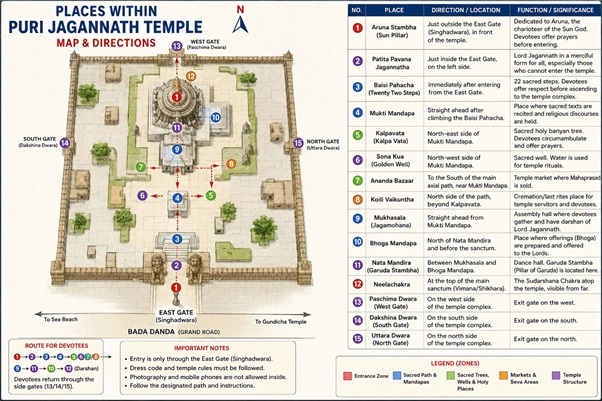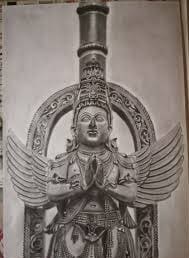
Garuda Stambham at Puri Jagannath Temple
Objectives
Objective 1.To understand the location, importance, and unique features of the Garuda Stambha in the Jagannath Temple.
Objective 2.To recognize Garuda as the divine carrier of Lord Narayana and His posture of offering prayers to Lord Jagannath.
Objective 3.To appreciate the Garuda Stambha as a symbol of closeness to Lord Jagannath through devotion and surrender.
Objective 4.To appreciate the humility, surrender, and deep devotion of Sri Chaitanya Mahaprabhu before Lord Jagannath.
Objective 5.To appreciate that true darśana is receiving the Lord’s merciful glance rather than merely seeing Him with our eyes.
Objective 6.To distinguish between the Garuda Stambha and the Aruna Stambha based on their location and purpose.
Introduction
Objective 1.To understand the location, importance, and unique features of the Garuda Stambha in the Jagannath Temple.
Lord Jagannatha is considered identical with Lord Vishnu and Lord Krishna. Hence His Vahana-Stambha (Garuda Stambha) is placed in front of Lord Jagannath, on the eastern side of the Nata Mandira of the Jagannath Temple.
Garuda Stambha is a unique feature of Agama-based temples. Usually, such features are not seen in the temples of North India. This tradition reflects the influence of Acharya Ramanujar.
A visit to the Jagannath Temple is considered incomplete without touching and embracing the Garuda Stambha. The Garuda Pillar is regarded as very holy and holds great religious significance for devotees. It also has its own daily rituals performed by the temple servitors.
Location
Objective 2.To recognize Garuda as the divine carrier of Lord Narayana and His posture of offering prayers to Lord Jagannath.
There are four sections of the temple, namely, the Bhoga Mandapa (Refectory), the Nata Mandira (Hall for Dance), Jagamohana (the Porch), and the Deula (Main Temple). In the Nata Mandira (the place for dance and music) there is a pillar known as “Garuda Stambha”, on the top of which Garuda, the carrier of Narayana, is seated with folded hands.
This pillar is placed just at the level of Ratna Vedi (Ratna Simhasana) so that Garuda can point his eyes to the feet of Lord Jagannatha. From this place one can get a view of Lord Jagannatha, Balabhadra and Subhadra.
Devotional Importance of Embracing the Garuda Stambha
Objective 3.To appreciate the Garuda Stambha as a symbol of closeness to Lord Jagannath through devotion and surrender.
Devotees embrace the pillar (Garuda Stambha) and offer their prayers to the Lord. Only on the eve of Ratha Yatra one can embrace the Lord. On other days devotees are debarred from doing so. They embrace the pillar of His carrier and feel they embrace the Lord.
Moreover, the importance of Puri lies in embracing the Lord, not only saluting and offering prayer to the Lord from a far.
People also embrace the pillar from a hygienic point of view. It is said that one can get relief from incurable diseases if he can touch this pillar. Moreover, devotees sit beneath this pillar while Garuda takes bath. It is also believed that one can be free from the sins of many ages if a drop of the bathing water of Garuda falls on him.
Because of these reasons devotees embrace the pillar, touch their shoulders on this pillar to get rid of sins and diseases, and they also feel that they embrace the Lord Himself.
The Garuda Stambha and Sri Chaitanya Mahaprabhu
Objective 4.To appreciate the humility, surrender, and deep devotion of Sri Chaitanya Mahaprabhu before Lord Jagannath.
For the first time, when Sri Chaitanya Mahaprabhu came to Jagannath Temple for a darshan of Lord Jagannath, He rushed inside in an ecstasy of devotion and became unconscious. The temple attendants did not know about His greatness and sent Him out. Later, they realized their mistake and welcomed Him with garlands from the deity.
Sri Chaitanya thought He was a great devotee of Lord Jagannath and still the Lord did this to Him, so He was very upset with this incident and decided not to go inside the temple but to view His Lord from behind the Garuda Stambha. Thereafter, Sri Chaitanya always refrained from going inside the Garbha Griha and used to view the Trinity from behind the Garuda Stambha.
Every time He came to get a darshan of Lord Jagannath, tears would flow from His eyes due to His great devotion. Behind the Garuda Pillar, there is a small depression which encircles the pillar. It is said and believed that Sri Chaitanya’s tears would often fill this depression.
It is at this place that Sri Chaitanya usually offered His prayers to Lord Jagannatha. The fingerprints of Sri Chaitanya are seen in the gate of Bhoga Mandapa. It is believed that the stone wall of the Bhoga Mandapa became soft because of the devotion of Sri Chaitanya, due to which His fingerprints became imprinted on the wall.
Garuda Stambha and Srila Prabhupada
Objective 5.To appreciate that true darśana is receiving the Lord’s merciful glance rather than merely seeing Him with our eyes.
Teachings by Srila Prabhupada while taking darshan from behind the Garuḍa Stambha
Śrīla Prabhupāda taught that devotees should take darśana of Lord Jagannātha from behind the Garuḍa Stambha in a mood of humility. He explained that Lord Jagannātha is not an object to be seen by us; rather, He is the Supreme Seer who mercifully sees His devotees.
When one gives up the ego of being the enjoyer and approaches the Lord with a spirit of loving service (sevonmukha), Lord Jagannātha reveals Himself. Thus, the Garuḍa Stambha reminds devotees to seek the Lord’s merciful glance rather than trying to “see” Him with material vision.
Garuda Stambha vs. Aruna Stambha
Objective 6.To distinguish between the Garuda Stambha and the Aruna Stambha based on their location and purpose.
Visitors often confuse the Garuda Stambha with the Aruna Stambha.
● The Garuda Stambha is located inside the temple complex (Nata Mandapa) and is a dedicated Vishnu Vahana (carrier). It was built as part of the original temple structure.
● The Aruna Stambha is located outside the temple premises, right in front of the eastern Lion’s Gate (Singhadwara). This 25-foot monolithic pillar was originally built at the Sun Temple in Konark and was relocated to Puri in the 18th century. It is associated with Aruna, the charioteer of the Sun God.
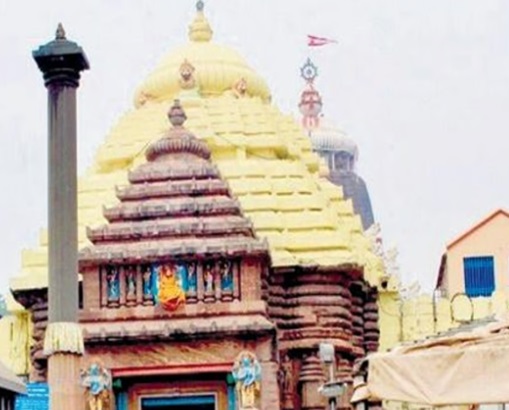
Aruna Stambha