
Objectives:
1. To know the identity, significance, and location of Carcikā Devī in the Jagannath tradition of Puri.
2. To understand the historical importance of Carcikā Devī and her relationship with the Gajapati kings and Jagannath traditions.
3. To describe the role of Carcikā Devī in Rathakhala, Nandighoṣa Ratha construction, and the Ratha-yātrā festival.
4. To explain the iconography, associated deities, and Tantric significance of Carcikā Devī.
5. To identify the major temples dedicated to Carcikā Devī and recognize her unique features.
6. To appreciate the teachings and spiritual significance of Carcikā Devī in the Jagannath tradition.
1. Introduction
Objective 1: To know the identity, significance, and location of Carcikā Devī in the Jagannath tradition of Puri.
Carcikā Devī is one of the important guardian deities associated with the sacred Jagannath tradition of Puri. She is worshipped as a powerful manifestation of Divine Mother Śakti and plays a significant role in the construction of Lord Jagannath’s chariots and the annual Ratha-yātrā festival.
Her temple stands on the Grand Road (Bada Danda) of Puri. It is located opposite the Jagannath Temple administrative office, near the Rathakhala, where Lord Jagannath’s chariots are constructed every year, and opposite the royal palace of the Gajapati Maharaja.
2. Devotees Associated with the Place
Objective 2: To understand the historical importance of Carcikā Devī and her relationship with the Gajapati kings and Jagannath traditions.
Carcikā Devī has been worshipped in Puri for centuries as a guardian deity. The Gajapati kings of Odisha traditionally sought her blessings before undertaking important activities. In earlier times, the kings would visit and worship Carcikā Devī before entering the Jagannath Temple. Her worship reflects the harmonious integration of Śākta and Jagannath traditions in Odisha.
Objective 3: To describe the role of Carcikā Devī in Rathakhala, Nandighoṣa Ratha construction, and the Ratha-yātrā festival.
Carcikā Devī has a very special relationship with Lord Jagannath. She is regarded as the protector and superintendent of the construction of Nandighoṣa Ratha, the chariot of Lord Jagannath. She serves as the guardian deity of the Rathakhala, where the three sacred chariots are built annually.
Before the commencement of chariot construction (Anukula), special worship is offered to her. Her blessings are considered essential for the successful completion of the chariots.
During the return Ratha-yātrā (Bahuda Yatra), Goddess Lakṣmī comes to this temple and meets Lord Jagannath. This sacred meeting symbolizes the reunion of Lakṣmī and Nārāyaṇa and is known as Lakṣmī–Nārāyaṇa Bhet.
3. Presiding Deities
Objective 4: To explain the iconography, associated deities, and Tantric significance of Carcikā Devī.
The Goddess is depicted in a powerful form with eight arms. She carries divine weapons including Conch (Śaṅkha), Discus (Cakra), Mace (Gadā), Sword, Spear, and other protective weapons. She is represented as a victorious and protective mother goddess and is traditionally shown seated upon a corpse, symbolizing victory over material existence and death.
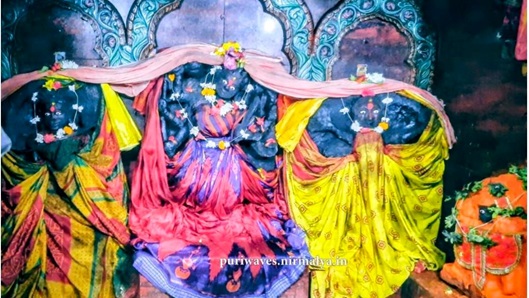
Within the shrine, Carcikā Devī is worshipped together with Marchikā Devī and Ugratārā Devī. These deities are installed on a common pedestal, and their combined worship represents different manifestations of divine feminine power.
In Tantric worship, Carcikā Devī is worshipped as Kumārī, Tripura Sundarī, Bhairavī, Bhagavatī, Vidyākālī, and Trinetrā. She is described as the three-eyed goddess whose eyes symbolize the Sun, Moon, and Fire. In Tantric traditions, Lord Jagannath is worshipped as Mahābhairava, while Carcikā Devī is worshipped as the supreme divine feminine energy.
Objective 5: To identify the major temples dedicated to Carcikā Devī and recognize her unique features.
Temples dedicated to Carcikā Devī can be found in Banki (Odisha), Mathura, Prachi Valley, Jajpur, Jagatsinghpur, Kanas, Chilika region, Gurubai, and Nihalprasad. Among these, the Carcikā Temple at Banki is particularly famous.
The unique features of Carcikā Devī include:
- Guardian deity of Rathakhala.
- Superintendent of Nandighoṣa chariot construction.
- Worshipped before chariot construction begins.
- Visited by Gajapati kings before major undertakings.
- Associated with Lakṣmī–Nārāyaṇa Bhet during Bahuda Yatra.
- Represents both Jagannath and Śākta traditions.
4. Place and Significance
Objective 6: To appreciate the teachings and spiritual significance of Carcikā Devī in the Jagannath tradition.
Carcikā Devī teaches devotees the importance of seeking divine blessings before beginning any sacred work, the protective role of the Divine Mother, the harmony between devotion, service, and divine energy, and that all successful service to Lord Jagannath proceeds under divine guidance and protection.
Carcikā Devī is not merely a local goddess of Puri but an integral part of the Jagannath tradition. As the guardian of Rathakhala, protector of Nandighoṣa Ratha, and participant in the sacred Ratha-yātrā rituals, she occupies a unique and honored position in the spiritual life of Puri. Her temple stands as a symbol of divine protection, sacred service, and the inseparable connection between Lord Jagannath and the Divine Mother.
5. Travel Guide
By Road: Puri has excellent road connectivity with major cities of Odisha and neighboring states.
Distances
Bhubaneswar → Puri: ~60 km
Konark → Puri: ~35 km
Cuttack → Puri: ~85 km
By Train
Nearest Railway Station is Puri Railway Station.
Distance from Puri Railway Station to Carcikā Devī Temple: approximately 2–3 km. Puri is well connected to major Indian cities such as Chennai, Kolkata, Hyderabad, New Delhi, Mumbai, and Bhubaneswar.
By Air
Nearest Airport is Biju Patnaik International Airport.
Distance to Puri: approximately 60 km.
Location
The shrine of Carcikā Devī is situated on Bada Danda (Grand Road), Puri, opposite the Jagannath Temple administrative office.
