
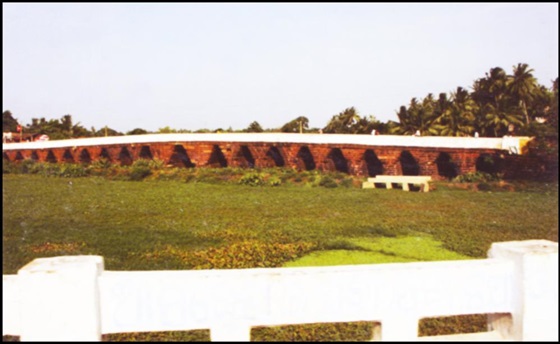
ATHARANALA – Bridge The Sacred Eighteen-Arched Gateway to Sri Jagannath Puri
ObjectivesObjective 1: To describe in detail about Atharanala’s history and architecture.
Objective 2: To describe the spiritual significance, role of the bridge and local folklore connected to it.
Objective 3: To highlight the rich pilgrimage heritage and Atharanala’s connection to Sri Chaitanya Mahaprabhu and Astachandi Temple.
Objective 4: To document the current status of Atharanala.
Objective 1: To describe in detail about Atharanala’s history and architecture.
1. Introduction and Meaning of the NameAtharanala is a historic stone bridge that stands at the northern entrance to the sacred city of Puri, Odisha, on the road from Bhubaneswar. Far more than an engineering monument, it has for centuries been regarded as the traditional threshold through which pilgrims enter Sri Kshetra, the holy abode of Lord Jagannath.
The name itself carries meaning. In Odia, “Athara” means eighteen, and “Nala” refers to channels, passages, or arches. Atharanala therefore means “eighteen passages,” describing the eighteen arches through which the waters of the Musa (also called Madhupur or Mangala) river once flowed beneath the bridge. Later reconstruction added an additional culvert, so the structure now technically encompasses nineteen channels, though the original name of eighteen has endured in devotional memory and popular usage.
2. Historical Background and ArchitectureHistorians trace the origins of the bridge to the Eastern Ganga dynasty of the thirteenth century, with construction associated with Bhanu Deva I and continued under Narasimha Deva II, who is said to have rebuilt it to allow the surplus waters of the Sara rivulet to drain properly. The present structure, resting atop these earlier foundations, has been dated on architectural grounds to the Maratha period in the latter half of the eighteenth century.
The bridge is built of laterite stone and lime mortar using the ashlar masonry technique typical of medieval Odishan architecture, oriented north to south. It measures approximately 85 metres in length and 11 to 12 metres in width, its eighteen arches ranging from seven to sixteen feet across. The facade is adorned with carved reliefs of Lord Shiva, Goddess Durga (Mahishasuramardini), Ardhanarisvara, Gajabhisheka Lakshmi, Kartikeya, the Navagrahas, musicians, dancers, animals, and hunting scenes — a rich visual record of medieval devotional art.
The bridge has withstood the region’s floods and monsoons for seven to eight centuries, its arches specifically engineered to allow floodwaters to pass freely while protecting the structure itself. Today, Atharanala is recognised by the Archaeological Survey of India as Monument of National Importance N-OR-64, and heavy vehicles are restricted from crossing it in order to preserve the ancient structure.
Objective 2: To describe the spiritual significance, role of the bridge and local folklore connected to it.
3. The Legend of Maharaja IndradyumnaLocal tradition and devotional lore closely associate Atharanala with Maharaja Indradyumna, the legendary king credited with establishing the worship of Lord Jagannath at Puri. It is said that when he first undertook the construction of this bridge, his efforts failed again and again despite his best endeavours. Only when he offered the heads of his eighteen sons into the waters of the river, by the order of the Lord, did the construction finally succeed.
“This story is part of local folklore and devotional tradition rather than established historical evidence, yet it remains deeply woven into the sacred memory of the place.”
The number eighteen recurs throughout this narrative and throughout Jagannath Sanskruti more broadly — the eighteen chapters of the Bhagavad Gita, the eighteen Puranas, the eighteen chapters of the Mahabharata, and the eighteen-syllable Bija Mantra of Sri Jagannath are all cited by local tradition as resonant with the eighteen arches of this bridge, lending the site an auspicious numerological character in the eyes of pilgrims.
4. Spiritual and Traditional Significancea. Gateway to Sri Kshetra For centuries, every pilgrim travelling to Jagannath Puri entered the holy city by crossing Atharanala. Crossing the bridge traditionally marked one’s entry into Sri Kshetra, the sacred abode of Lord Jagannath, and many pilgrims would pause here to offer prayers or chant the holy names before proceeding onward for darshan. It is considered the first sacred landmark encountered on the approach to the Lord, and many devotees regard the crossing itself as the symbolic beginning of their pilgrimage.
b. A Glimpse of the Neelachakra From the bridge, pilgrims can traditionally catch a distant view of the Neelachakra, the sacred wheel atop the spire of the Jagannath Temple, on a clear day. For pilgrims arriving after a long journey, this first sight of the temple’s crowning emblem from Atharanala has long been treasured as an early darshan in itself — a moment when the destination first becomes visible and the heart of the pilgrim quickens.
c. Vastu and Numerological Significance The bridge stands on the northern side of Puri, a direction which, according to Vastu Shastra, is ruled by Kubera, the lord of wealth. Local tradition therefore regards Atharanala as an auspicious place to pray to Lord Jagannath for the fulfilment of one’s wishes. It is also said within Jagannath Sanskruti that circumambulation (parikrama) of the bridge yields merit equal to that of reading the sacred texts associated with the number eighteen.
d. Connection with Temple Custom Atharanala’s association with the Jagannath Temple extends into matters of ritual purity as well. According to long-standing temple custom, if a non-Hindu is found to have trespassed inside the Jagannath Temple, the entire stock of prasad prepared that day must be discarded from the Atharanala bridge into the river below. This custom underscores the bridge’s standing as a boundary point of Sri Kshetra — the line at which the sanctified precincts of the Lord’s temple are considered to begin.
Objective 3: To highlight the rich pilgrimage heritage and Atharanala’s connection to Sri Chaitanya Mahaprabhu and Astachandi Temple.
5. Sri Chaitanya Mahaprabhu’s Association with AtharanalaAtharanala holds special significance for Gaudiya Vaishnavas as the very place through which Sri Chaitanya Mahaprabhu first entered Puri. The Caitanya Bhagavata records that Mahaprabhu crossed into the holy city by this bridge, and a small temple still marks the spot where He rested before proceeding onward. At this site devotees also find the imprint of the Lord’s lotus feet, preserved as a tangible trace of His arrival.
For pilgrims within the Gaudiya Vaishnava tradition, this transforms Atharanala from a purely historical monument into a site of direct devotional memory — a place where the Lord Himself is understood to have paused on His way to Srimandir, just as generations of ordinary pilgrims have paused there since.
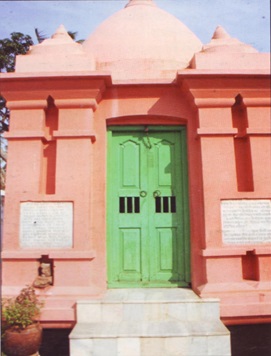
Sri Chaitanya Mahaprabhu, whose entry into Puri via Atharanala is recorded in the Caitanya Bhagavata.
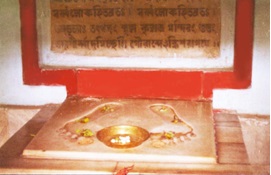
The small shrine marking the place where Sri Chaitanya Mahaprabhu rested before crossing into Puri.
6. Nearby Sacred SitesJust beside Atharanala, on the Bhubaneswar–Puri road, stands the Ashtachandi Temple, dedicated to the eight forms of Chandi collectively worshipped as Ashtachandi. Its proximity to the bridge means that pilgrims passing through Atharanala often pay their respects here as well, making the immediate vicinity of the bridge a small but meaningful cluster of sacred stops on the approach to Sri Mandir.
A second bridge of the same name and period exists near Jajpur, built in the same style and, according to local belief, connecting the Viraja Kshetra of Jajpur with the Jagannatha Kshetra of Puri — two of Odisha’s Pancha Kshetras. While architecturally and thematically related, this Jajpur bridge is distinct from the Atharanala at Puri and should not be confused with it.
Objective 4: To document the current status of Atharanala.
7. Present Status and ConservationAtharanala remains a protected monument under the Archaeological Survey of India, and conservation efforts continue to safeguard it against the pressures of a modern city built up around an ancient sacred landscape. Despite periods of neglect, the bridge continues to draw pilgrims and visitors who pause here, as travellers have done for centuries, before continuing on to the darshan of Lord Jagannath.
ConclusionAtharanala is at once a marvel of medieval Odishan engineering and a living thread of devotional memory. It is the point where the historical and the sacred meet — where a king’s legendary sacrifice, a saint’s footsteps, and centuries of ordinary pilgrims’ prayers converge at the very threshold of Sri Kshetra. To cross Atharanala, in the understanding of the pilgrims who have done so for generations, is to begin, in a very real sense, one’s approach to Lord Jagannath Himself.a
