

The entrance facade of Jhanja Pita Matha, Puri
Objectives
Objective 1: To outline the identity, historical role, and sampradaya affiliation of Jhanja Pita Matha within Puri’s wider network of temple-supporting monasteries.
Objective 2: To document the unique musical awakening service—involving jhanja cymbals and scripture recitation—performed during the temple’s daily Mangala Arati.
Objective 3: To highlight the Matha’s spiritual heritage, leadership lineage, and ongoing contributions to living Jagannath culture.
Objective 4: To provide practical details regarding the site’s location, accessibility, presiding deities, and relevance for modern pilgrims.
Introduction and Historical Role
Objective 1: To outline the identity, historical role, and sampradaya affiliation of Jhanja Pita Matha within Puri’s wider network of temple-supporting monasteries.
Jhanja Pita Matha is one of the traditional monasteries (Mathas) of Sri Kshetra Puri. It belongs to the Madhva-Gaudiya sampradaya, the spiritual tradition followed by the devotees of Sri Chaitanya Mahaprabhu, who spent the last eighteen years of His manifested pastimes in Puri, spreading devotion to Sri Krishna through the chanting of the holy names.
For centuries, Puri has been home to hundreds of Mathas established by great Vaishnava acharyas and spiritual teachers. These Mathas served as centres for devotional practice, scriptural learning, and the training of disciples. Many of them were also entrusted with specific services (sevas) for Lord Jagannath. Along with the main Jhanja Pita Matha, there is also a smaller branch known as Sana Jhanja Pita Matha, continuing the long-standing tradition of parent and branch Mathas in Puri.
Like many other historic Mathas, Jhanja Pita Matha is situated close to the Jagannath Temple, allowing its resident devotees to easily perform their assigned temple services. Over the centuries, renowned acharyas such as Adi Shankaracharya, Ramanujacharya, Nimbarkacharya, and the followers of Sri Chaitanya Mahaprabhu established important Mathas in Puri. Each Matha contributes to Lord Jagannath’s worship through a unique seva.
Jhanja Pita Matha is especially known for its traditional devotional music offered with the jhanja (large hand cymbals), a service that is explained in the following section.
The continued existence of Jhanja Pita Matha reflects its respected place among the historic institutions that have preserved the devotional traditions and temple worship of Sri Jagannath Dham for generations.
The Musical Awakening Service
Objective 2: To document the unique musical awakening service—involving jhanja cymbals and scripture recitation—performed during the temple’s daily Mangala Arati.
Jhanja Pita Matha derives its very name from the sacred musical service it renders. The word “Jhanja” refers to large brass cymbals, an instrument central to devotional kirtan in the Gaudiya Vaishnava tradition, while “Pita” (Pitha) denotes the seat or institution associated with that service.

The seat of the presiding Acharya
at Jhanja Pita Matha, adorned for worship
According to accounts of the Jagannath Temple’s daily ritual calendar, sevakas connected with this tradition—referred to as the Jhanjapita Loka or Jhanja Pitaman—play the jhanja and recite scriptural verses (sastra) as part of the early-morning rituals leading up to the Mangala Arati, the ceremony that formally awakens the Deities. This musical offering, performed together with instruments such as the mardala (drum), pakhaja (large drum), and jhumuka, forms part of the distinctive sound-world with which Lord Jagannath is greeted at the start of each day.
This service reflects the broader devotional principle, central to Jagannath worship, that the Lord is served exactly as a living, conscious personality would be served—woken gently, bathed, dressed, fed, entertained, and put to rest each day according to a fixed and elaborate ritual calendar. The offering of devotional music at dawn is regarded as an act of loving service to that living, conscious Lord: it is understood not merely as ceremonial accompaniment but as an expression of intimate devotion—the awakening of divine consciousness through sound—and it sets the spiritual tone for the rest of the day’s worship in the temple.
The continuing performance of this musical awakening service remains one of the distinguishing features of the Matha’s contribution to Jagannath worship, linking its resident Vaishnavas directly, if modestly, to the inner ritual life of the temple.
Spiritual Heritage and Cultural Preservation
Objective 3: To highlight the Matha’s spiritual heritage, leadership lineage, and ongoing contributions to living Jagannath culture.
Jhanja Pita Matha has preserved the devotional traditions of Sri Kshetra Puri for generations. Like the other historic Mathas of Puri, it continues its daily worship, festival celebrations, and musical seva, helping to keep the living traditions of Lord Jagannath’s worship alive.
The Matha is led by a succession of Mahantas (heads of the Matha), who guide disciples and local devotees in spiritual life. Portraits of the previous Acharyas and Mahantas are respectfully worshipped within the Matha, symbolizing the unbroken guru-parampara (disciplic succession) through which devotional knowledge and practices have been passed down from one generation to the next.
Through its devotional music, worship, and dedicated service, Jhanja Pita Matha continues to uphold the Gaudiya Vaishnava ideals of humility, discipline, and loving devotion to Lord Jagannath.
Highlights
● Preserves the living devotional traditions of Sri Kshetra Puri.
● Maintains an unbroken guru-parampara through successive Mahantas.
● Continues daily worship, festivals, and musical seva.
● Upholds the Gaudiya Vaishnava values of humility, discipline, and devotion.

Portraits of past Acharyas and Mahantas
preserved within the Matha
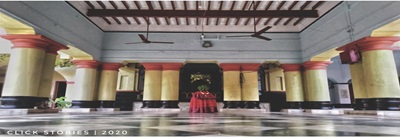
The pillared courtyard (mandapa)
of Jhanja Pita Matha
Practical Information for Pilgrims
Objective 4: To provide practical details regarding the site’s location, accessibility, presiding deities, and relevance for modern pilgrims.
| Address | The Jhanja Pita Matha Backside of Dolamandap Sahi (near Labanikhia Square), Patra Sahi, Balagandi, Puri – 752001. |
| Location | Jhanja Pita Matha is situated in the sacred pilgrim town of Puri, Odisha, within the network of traditional Mathas surrounding the Jagannath Temple, in the vicinity of the Dolamandap Sahi locality. |
| Nearest Railway Station | Puri Railway Station. |
| Nearest Airport | Biju Patnaik International Airport, Bhubaneswar (approximately 60 km from Puri). |
| Best Time to Visit | October to March, when the weather is pleasant and major Jagannath festivals—including Kartika Purnima and the winter festival calendar—are celebrated. |
| Presiding Deities | The Matha maintains worship according to traditional Gaudiya Vaishnava practice associated with Lord Jagannath and, as is customary in Gaudiya Mathas of Puri, the worship of Sri Radha-Krishna and portraits of past Acharyas. Detailed information regarding the present presiding Deities should be verified through local authorities and field visits. |
| Affiliated Sampradaya | Madhwa Gaudiya (Madhva-Gaudiya) sampradaya. |
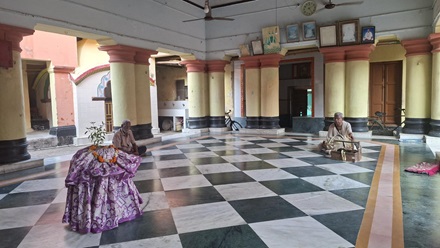
The inner courtyard of Jhanja Pita Matha, with resident Vaishnavas
seated near the covered Deity
A Glimpse of the Sanctum
Within the Matha’s inner shrine, the presiding Deities are kept in a richly decorated altar, framed by traditional Odishan wall paintings depicting attendant gopis bearing articles of worship—lamps, garlands, and ceremonial vessels—in the style commonly found in the Vaishnava Mathas of Puri. Such painted door-frames and shrine walls are themselves part of the artistic heritage that these institutions have preserved alongside their ritual functions.
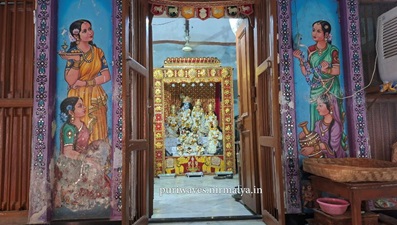
The decorated sanctum doorway leading to the Deity chamber
The Matha’s premises also include a marble-floored courtyard where daily devotional routines, festival observances, and the reception of visiting devotees take place, continuing a pattern of communal worship that has characterised Puri’s Mathas for centuries.
Conclusion
Jhanja Pita Matha represents an important, though modest, component of the sacred institutional framework that supports the worship of Lord Jagannath in Puri. Affiliated with the Madhwa Gaudiya sampradaya, it carries forward a distinctive ritual tradition centred on the offering of devotional music—the playing of jhanja cymbals and the recitation of sastra—during the early-morning awakening of the Deities.
Its historical association with temple rituals, preservation of the lineage of Acharyas and Mahantas, and continued contribution to the living culture of Jagannath worship make it a valuable part of Odisha’s spiritual heritage. Through its unwavering devotion and dedicated service, Jhanja Pita Matha continues to sustain the rich tradition of Sri Kshetra Puri and inspires pilgrims with the timeless ideals of Gaudiya Vaishnavism.
