
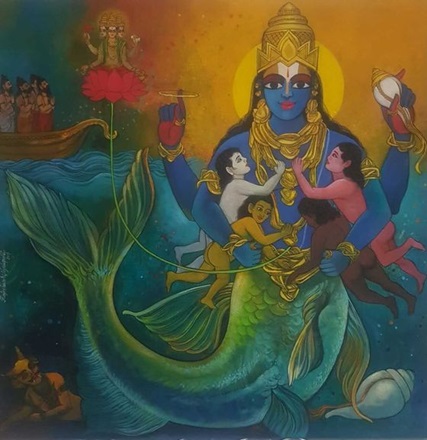
Objective 1: To explore the significance associated with Matsya Madhav Temple in Puri.
Objective 2: To know about the Devotees Associated with This Place.
Objective 3: To trace the historical development of the temple structure, including its original construction and structural architecture.
Objective 4: To describe the main Deity forms in the temple, their arrangement, historical origin, and the presence of other sacred Deities worshiped at the temple of Matsya Madhav Puri.
Objective 5: To describe the leelas and pastimes of the Lord with His devotees in Matsya Madhav Temple as mentioned in various scriptures.
Objective 6: To know how Lord Matsya Madhava’s temple was established on the banks of the Sweta Ganga Tank in Puri as a gift to King Shveta blessed by the Lord, and henceforth the establishment of the shrine.
Objective 7: To narrate the story behind the creation of Shankha Kshetra and to know the story of Matsya Madhava as referenced in various Puranas.
Objective 8: To understand the interpretation of the story from Srimad Bhagavatam.
Objective 9: To appreciate the history behind the end of the deluge by the divine Matsya, and the subsequent preservation of Vedic knowledge.
Objective 1: To explore the significance associated with Matsya Madhav Temple in Puri.
The Matsya Madhava Temple is a small but highly sacred shrine located on the southern banks of the Sweta Ganga Tank in Puri, Odisha, just a short walk south of the main Jagannath Temple. It houses an incarnation of Lord Vishnu and is a highly revered stop for Hindu pilgrims.
Key DetailsLocation: Southern bank of the Sweta Ganga Tank, near Bali Sahi Road, Puri.
Significance: One of the revered Pancha Tirthas (five sacred bathing sites) of Puri.
Landmark: Located on the banks of the Sweta Ganga Tank, directly opposite the Ganga Mata Math.
Historic Layout: The temple is structurally unique because it is situated about 18 feet below the city’s general ground level, showcasing its incredible antiquity.
Significance of the Temple and TankCleansing of Sins: According to Hindu scriptures, taking a holy dip in the Sweta Ganga Tank and having darshan of Matsya Madhava and Sweta Madhava absolves a devotee of all sins.
Relieving Prasad Offenses: Bathing here is particularly believed to cleanse a devotee of the specific spiritual offense of inadvertently stepping on or disrespecting Jagannath Mahaprasad.
Matsya Avatar: The deity worshipped here represents the Matsya (fish) incarnation of Lord Vishnu, symbolizing the preservation of the Vedas and the universe during the great deluge (Pralaya).
The Sweta Ganga LegendThe Sweta Ganga is one of the five ancient, sacred bathing ponds in Puri. It is named after the widow Swetaganga, who was such a devout worshipper that the river Ganga was said to personally manifest in the tank. Devotees often visit here after performing the final rites for departed ancestors, making it a critical hub of pilgrimage and purification rituals in Puri.
Objective 2: To know about the Devotees Associated with This Place.
Saints and Devotees of the TempleSaptarishi & Manu: Mythological lore dictates that the Saptarishis (seven sages) accompanied King Manu on a large boat tied to the Matsya Avatar’s horn during the cosmic deluge.
Ganga Mata Goswamini (Sachi Devi): A prominent historical saint and devotee, she spent her days performing bhajans and bathing in the holy Sweta Ganga, intimately linking her pastimes to this shrine.
Saintly Connections: The region is deeply associated with other great saints, such as Sri Chaitanya Mahaprabhu, who are recorded as having bathed in the Sweta Ganga Tank to purify themselves before visiting the main Jagannath Temple.
Architecture and Structural LayoutObjective 3: To trace the historical development of the temple structure, including its original construction and structural architecture.
The shrine features the traditional, multi-tiered Odishan temple layout, which is divided into the following principal structures aligned south of the Jagannath Temple.
Architectural FeaturesMaterial & Design: The structure is built utilizing regional materials like laterite and sandstone. The tower features the classic pyramidal roof rising in tiers, characteristic of Kalinga design.
Exterior Walls: Adorned with localized carvings and decorative elements, the structure exemplifies the regional Silpa-sastras (Vedic architectural texts).
Entrance: The doorway and jambs are meticulously carved, featuring detailed traditional Vaishnava motifs.
Objective 4: To describe the main Deity forms in the temple, their arrangement, historical origin, and the presence of other sacred Deities worshiped at the temple of Matsya Madhav Puri.
Presiding Deities of Matsya Madhava TempleThe presiding deities of the ancient Matsya Madhava Temple in Puri are Matsya Madhava (a form of Lord Vishnu manifesting His fish incarnation, or Matsyavatar) and Sweta Madhava.
The Shrines: On the banks of the sacred Sweta Ganga Tank (near the Jagannath Temple in Puri, Odisha), there are ancient shrines dedicated to both Sweta Madhava and Matsya Madhava.
Objective 5: To describe the leelas and pastimes of the Lord with His devotees in Matsya Madhava Temple as mentioned in various scriptures.
Scriptural References1. Brahma Purana and Matsya Purana and skanda Purana
2. Srimad Bhagavatam and Odia Folklore
Leelas Mentioned in the PuranasThe “leelas” (divine plays) and references to Matsya Madhava, as well as the Matsya Avatar, are detailed in a few significant contexts.
The Legend: Chapter 60 of the Brahma Purana explores the glory of Matsya Madhava and the sacred purificatory bathing rites at Varuna’s abode.
Objective 6: To know how Lord Matsya Madhava’s temple was established on the banks of the Sweta Ganga Tank in Puri as a gift to King Shveta blessed by the Lord, and henceforth the establishment of the shrine.
The Shveta Madhava ConnectionAccording to the Utkala-khanda of the Skanda Purana: The deity is intrinsically linked to King Shveta. Following his intense devotion and a divine vision of Goddess Lakshmi serving the Lord, Lord Jagannath granted him liberation (moksha) at a specific spot facing Matsya Madhava, which sits between the holy Akshaya Bata (banyan tree) and the ocean.
Objective 7: To narrate the story behind the creation of Shankha Kshetra. To know the story of Matsya Madhava as referenced in various Puranas.
According to the Brahma Purana and local Odia folklore, the history of the temple traces back to the end of a previous cosmic era (Kalpa).
1. The Theft of the Vedas: A fierce demon named Shankhasura (also known as Hayagriva in certain Puranic texts) stole the four sacred Vedas from Lord Brahma while he was sleeping. Without the Vedas, the light of knowledge vanished, plunging the universe into dark ignorance and threatening the cosmic order.
2. The Matsya Avatar Descends: To save creation, Lord Vishnu manifested as Matsya (the giant fish avatar). He tracked the demon down to the deepest, darkest depths of the ocean.
3. The Epic Battle: Lord Vishnu engaged Shankhasura in a ferocious aquatic battle. He successfully slew the demon and retrieved the stolen Vedas, returning them safely to Lord Brahma so that a new cycle of creation could begin.
4. The Panchajanya Conch and Shankha Kshetra: Following the defeat of the demon, Lord Vishnu took the demon’s shell-shaped body—which became the divine Panchajanya Shankha (conch shell)—and placed it at this very site. Because of this, the holy city of Puri is formally recognized in Hindu geography as Shankha Kshetra, because its coastal topography is shaped exactly like a right-handed conch shell.
5. Establishment of the Shrine: To commemorate this victory and protect the sacred territory, Lord Vishnu manifested there as Matsya Madhava. Across from Him sits the shrine of Sweta Madhava, dedicated to the legendary King Shveta, who was an ardent devotee.
Objective 8: An interpretation of the story from Srimad Bhagavatam.
The Story of King Satyavrata and Matsya AvatarAs referenced from Vedabase.io, Srimad Bhagavatam, Canto 8, Chapter 24, explains the incarnation of the Lord as a fish. Sukadeva Goswami explains to King Pariksit about the Lord’s incarnation as a fish. He spoke as follows: “During the end of the past millennium, at the end of Lord Brahma’s day, he fell asleep and annihilation took place. The three worlds were covered with water. The Vedas were emanating from his mouth. The demon Hayagriva stole the Vedas.”
The narrative is as follows.During the Caksusa manvantara there was a great King named Satyavrata. In the next millennium the king was born as the son of Vivasvan, the king of the sun planet and was called Sraddhadeva. By God’s mercy he was given the post of Manu. One day when Satyavrata, the King of Dravidadesa was meditating a fish appeared in front of him. To protect the small fish he dropped it in the river. To his surprise the fish began to grow bigger and bigger and was accommodated only in the ocean. Realising this as the play of none other than the Lord himself, the King asked the Lord what was the purpose of this visit. King Satyavrata asked the Lord why he took the form of a fish. The Lord who at the end of the yuga had taken the form of a fish to enjoy his pastimes with his devotees, in the water of inundation, spoke, “On the seventh day from today all the three worlds will merge into the water of inundation. I shall send a boat to you. You can all travel on it till the night of Lord Brahma is over. I shall protect the boat taking the form of a fish and by tying my horn with a serpent named Vasuki, until the night of Lord Brahma’s slumber is over”. Thus speaking the Lord disappeared and then the King began to meditate. As the particular day mentioned by the Lord began to approach, the ocean began to overflow and inundate the entire world. The sages and the king boarded the boat that appeared and began to meditate. A golden fish, eight million miles long appeared. The king tied the fish’s horn to the serpent Vasuki as instructed. The Lord in the form of fish, while moving in the water of inundation began to explain Absolute Truth of spiritual science which was the essence of Vedas. These instructions of self-realization were in the form of the Vedic literature. Hence the sages and the King had no doubt about the Absolute Truth, which is the Vedas. At the end of the last inundation, during the period of Svaymbhuva Manu, the Lord killed the demon Hayagriva and delivered the Vedic literature to Brahma awakening him from sleep. King Satyavrata enlightened by the Vedic knowledge and in this period has taken birth as Vaivasvata Manu, the son of Sun God. The story of the great King Satyavrata and the fish is a transcendental narration. I offer my respectful obeisances unto the Lord who took the form of a gigantic fish and restored the Vedic literature to Lord Brahma when Lord Brahma awakened from sleep and who explained the essence of Vedic literature to King Satyavrata and sages.
The above mentioned passage is a narrative of the epic conversation between SukaDeva Goswami and King Pariksit.
Objective 9: To appreciate the history behind the end of the deluge by the divine Matsya, and the subsequent preservation of Vedic knowledge.
Matsya Avatar symbolizes the divine principle of preservation and the importance of safeguarding knowledge and life in the face of imminent destruction. It is also a reminder of the cyclical nature of time in Hindu cosmology, with each yuga (age) having its own unique set of challenges and divine interventions.
Spiritual Significance & RitualsThe Matsya Madhava Temple is highly revered by pilgrims. It holds a unique spot in the daily spiritual ecosystem of Puri.
The Swetaganga Connection: The temple sits right next to the Swetaganga Tank, which the Mahabharata states was created directly from Lord Vishnu’s nail. It is believed that Ganga Devi permanently resides in this tank so she can continuously view and serve Lord Jagannath.
Absolution of Sins: According to the Brahma Purana, taking a holy bath in the Swetaganga and visiting Matsya Madhava grants the same spiritual merit (Punya) as performing a massive Ashwamedha Yajna.
The Pancha Tirtha Pilgrimage: Matsya Madhava is explicitly counted as part of the Pancha Tirtha (Five Sacred Water Bodies) that pilgrims must visit to complete their full pilgrimage to Puri.
Darshan Timings: Morning : 6:00 AM to 12:00 PM Evening : 5:00 PM to 8:30 PM