
Objectives:
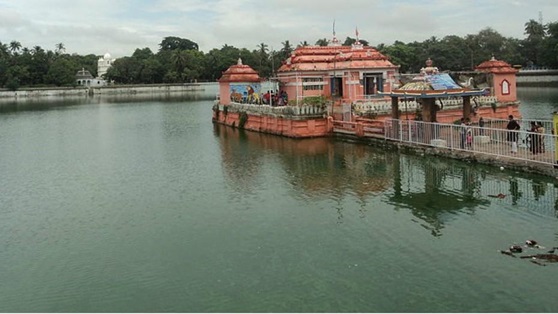
Objective 1. To introduce the Chakra Tirtha Temple by detailing its location in Puri and outlining its key architectural features.
Objective 2. To identify the presiding deities and describe the temple’s daily rituals, festivals, and historic connection to the Jagannath Temple.
Objective 3. To explore the foundational legends and mythological narratives associated with the origins of Chakra Tirtha.
Objective 4. To explain the site’s overall religious importance, spiritual significance, and the pilgrimage benefits for visitors.
Objective 1: To introduce the Chakra Tirtha Temple by detailing its location in Puri and outlining its key architectural features.
1. Overview & Identity:
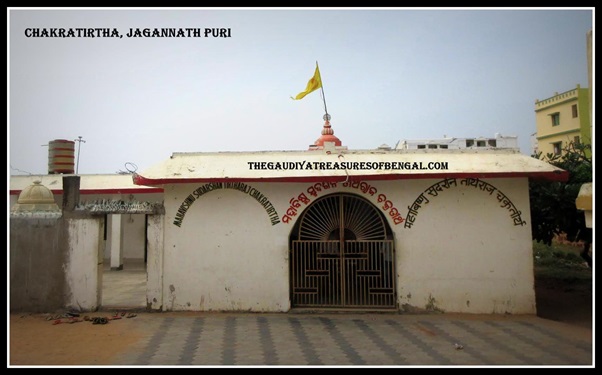
Chakra Tirtha Temple, located 3 km from the Jagannath Temple on the northern end of Puri, is an important pilgrimage destination. It is also referred to as the Chakra Narayana Temple, Chakra Narasimha Temple, or Chakra Nrusingha Temple. The temple is also called Chakra Theertha or Chakra Narasimha Deula.
2. Leela associated with Chakra Tirtha
Chakra Tirtha is identified in Puranic literature as the spot where the wooden logs (Daru) of Jagannath, Balabhadra, and Subhadra first floated ashore in Puri — the location being marked by a Chakra or discus mark.
Puri is regarded as Purushottama Kshetra and a Moksha Kshetra. Within this sacred geography, Chakra Tirtha holds a distinct place separate from the Pancha Tirtha (the five sacred bathing tanks). The Pancha Tirtha — the five sacred bathing spots essential for completing a Puri pilgrimage — are the Indradyumna Tank, Markandeya Tank, Swetaganga, the Sea, and the Rohini Kunda. Chakra Tirtha is a distinct sacred site beyond the Pancha Tirtha, associated specifically with the origin of the Daru and the Neelachakra.
Objective 2: To identify the presiding deities and describe the temple’s daily rituals, festivals, and historic connection to the Jagannath Temple.
3. The Presiding Deities
There are three main deities in this temple — Narasimha, Chakra Narayana, and Adi Narayana. There is also a small temple devoted to Varuna Deva, who is the father of Lakshmi Devi and father-in-law of Lord Jagannath. Deities of Jagannath, Baladeva, and Subhadra are also worshipped in this temple.
The temple has three images of Lord Nrusingha — Chakra Nrusingha, Laxmi Nrusingha, and Abhaya Nrusingha. The form of Chakra Nrusingha represents Goddess Subhadra, the form of Abhaya Nrusingha represents Sri Balabhadra, and the form of Laxmi Nrusingha represents Lord Jagannath.
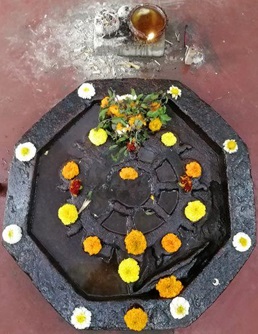
In the sanctum sanctorum, a large wheel carved from black granite — representing Lord Jagannath’s divine weapon — is worshipped in water, with a statue of Lord Narayan at the centre, known as Chakra Narayana.
Objective 3: To explore the foundational legends and mythological narratives associated with the origins of Chakra Tirtha.
4. Legends & Mythology
4.1 The Sacred Daru (Divine Log)
It is believed that the Daru — the divine log of wood employed for carving the deities of Lord Jagannath during Navakalevara — touched the ground for the very first time here at Chakratirtha. The tree was not ordinary: it emanated a sweet fragrance and an unusual luster, and bore the four symbols of Lord Vishnu upon it. These logs of wood came floating through the sea and were subsequently used by King Indradyumna to sculpt the deities of Jagannath, Baladeva, and Subhadra in Satya Yuga.
The sacred Daru is believed to be the wood for the construction of the first idols of Jagannath, Balabhadra, Subhadra, and Sudarshana Chakra — which touched down here after floating in the sea and was finally taken by Indradyumna Maharaja.
4.2 The Neelachakra Legend
It is believed by local people that once there was a cyclone in Puri and the Neelachakra — the wheel at the top of the Jagannath Temple — was displaced from its location, flew across the sky, and finally fell at Chakratirtha.
4.3 Varuna Deva & Lakshmi’s Father
Chakratirtha has another spiritual significance: the abode of Goddess Mahalaxmi’s father (Varuna Deva) is situated here. The presence of a shrine to Varuna at Chakra Tirtha is understood in the context of Jagannath being regarded as the son-in-law of Varuna.
Objective 4: To explain the site’s overall religious importance, spiritual significance, and the pilgrimage benefits for visitors
5. Architecture & Temple Structure
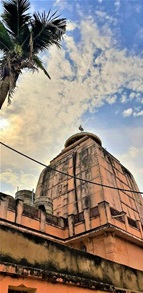
The temple was built in the 14th century CE by the Ganga Kings. The temple faces north and is square in plan, Panchangabada in elevation, consisting of a Pidha Vimana and a frontal porch of the Kalingan order. The Parsvadevata niches house recently installed idols. The Dvarapala niches contain four-armed Vaishnavite Dvarapalas standing on plain pedestals with outstretched legs. The architrave above the doorjambs is carved with Navagrahas seated in Padmasana within semicircular niches flanked by two Ganas.
6. Festivals & Ritual Connections to Jagannath Temple
Chakratirtha temple has close association with Lord Jagannath, and every year the Agnyamala (garland of fire/command) from Lord Jagannath comes to Lord Nrusingha. Narasimha Janma festival is observed in this temple with great devotion.
7. Spiritual Significance for Pilgrims
Chakra Tirtha Temple is deeply connected to Lord Vishnu’s Sudarshana Chakra. Located near the serene seashore, it is believed that prayers and a holy dip here can cleanse sins and bring divine blessings.
Pilgrims observe that the Kartik month is a particularly important time for local devotees to undertake Tirtha Yatra to Chakra Tirtha.
8. Location
Address:
Chakra Tirtha Road,
Badasirei, Puri,
Odisha 752002.
(It is situated on the eastern side of the Jagannath Temple, right along the Puri beach)
The Chakratirtha Sea Beach is situated 3 km from the Jagannath Temple on the right side of Chakratirtha Road. The beach offers a calm and serene atmosphere ideal for meditation.
The best time to visit is November to June (winter and early summer). The site opens at 5:00 AM daily. It is located about 1.5 km from Puri Railway Station, and 3 km from Puri Bus Stand, situated towards the northern end of Puri town, on the right side of Chakra Tirtha Road leading from Subhas Bose Chowk to Penthakota, the fisherman village.
The nearest railway station is Puri (about 2 km), and the nearest major airport is Biju Patnaik International Airport, Bhubaneswar (~60 km).
