
Objectives:
Objective 7: To learn the important pastimes that took place in Gambhira.
Objective 8: To understand the confidential ecstatic symptoms and night discussions in Gambhira.
Objective 9: To understand the spiritual significance of Gambhira pastimes.
Objective 11: To learn about the structure of Gambhira, the articles preserved there.
Objective12: To understand the importance of Gambhira in Gauḍiya Vaiṣṇava philosophy.
Objective 13: To understand the main presiding Deity of Sri Gambhira and its spiritual significance.
Objective 1: To understand the location and historical background of Gambhira (Kasi Misra Bhavan) in Jagannatha Puri, including the role of King Prataparudra, Kasi Misra, and Sarvabhauma Bhattacarya.
Gambhira, also known as Kasi Misra Bhavan, is located in Jagannatha Puri, Odisha, near the Jagannatha Temple. After accepting sannyasa, Sri Caitanya Mahaprabhu travelled to many holy places but later stayed in Puri. By the arrangement of King Prataparudra Maharaja, Mahaprabhu was given residence in the house of Kasi Misra, the royal guru and a great devotee of Lord Jagannatha. This arrangement was suggested through Sarvabhauma Bhattacarya, and thus Mahaprabhu stayed in Kasi Misra’s house.
Objective 2: To learn why Sri Caitanya Mahaprabhu stayed in Gambhira for the last eighteen years and to know about the small secluded room.
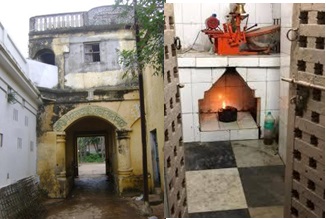
Entrance to Gambhira (Kashi Mishra’s House)
In Kasi Misra’s house, Mahaprabhu chose a very small and secluded room, which later became famous as Gambhira. He stayed there for the last eighteen years of His manifest pastimes. Even though the house was large, He preferred this simple room for deep absorption in devotion.
Objective 3: To understand the deep internal mood of Mahaprabhu in Gambhira and the spiritual significance of this place.
The word Gambhira means deep, grave, or profound. This name describes Mahaprabhu’s internal condition during this time. In Gambhira, He was constantly absorbed in the highest love of God in the mood of Srimati Radharaṇi, especially in the feeling of separation from Krishna(vipralambha-bhava). These pastimes reveal the inner purpose of Mahaprabhu’s appearance — to taste and distribute the highest prema-bhakti. Therefore, Gambhira is considered one of the most sacred places in the Gauḍiya Vaiṣṇava tradition.
Objective 4: To identify the main devotees associated with Gambhira and understand their relationship with Sri Caitanya Mahaprabhu and the services performed by the intimate associates.
Many exalted devotees were connected with Gambhira during the Antya-lila of Sri Caitanya Mahaprabhu in Jagannatha Puri. Below are the main devotees connected with this sacred place according to Caitanya-caritamṛta, Caitanya-bhagavata, and Gauḍiya Vaiṣṇava tradition. However, only a few intimate associates were allowed to enter Gambhira, because Mahaprabhu’s internal mood was extremely confidential.
i. Kasi Misra – Owner of the house
Kasi Misra was a respected brahmaṇa and servant of Lord Jagannatha.
· He offered his residence to Mahaprabhu.
· Mahaprabhu accepted a small room in his house, which became Gambhira.
· He was closely connected with King Prataparudra.
Because of his devotion, his house became one of the holiest places in Gauḍiya Vaiṣṇava history.
ii. Svarupa Damodara Gosvami – Mahaprabhu’s constant companion
He was the most intimate associate in Gambhira.
Identity in Krishna-lila: Lalita-sakhi
Service in Gambhira:
· Stayed with Mahaprabhu constantly
· Understood His internal mood
· Sang suitable verses to pacify Him
· Protected Him during ecstasy
Mahaprabhu would not allow anyone to come to Him without Svarupa Damodara’s permission.
iii. Ramananda Raya – Confidential associate
Identity in Krishna-lila: Visakha-Sakhi
He would come to Gambhira at night.
Service:
· Discussed highest rasa-tattva
· Spoke about Radha-Krishna pastimes
· Recited verses from Bhagavatam and Gita-govinda
Mahaprabhu especially relished discussions with Ramananda Raya during Gambhira years.
iv. Govinda
Personal servant of Mahaprabhu. He served Him day and night and stayed near Gambhira.
Govinda was the personal sevaka of Mahaprabhu.
Service:
· Massaging Mahaprabhu
· Bringing prasada
· Guarding the door
v. Jagadananda Paṇḍita
Very intimate devotee, known for his intense loving mood.
Identity in Krishna-lila: Satyabhama
Service:
· Brought sandalwood oil
· Cooked for Mahaprabhu
· Showed intense loving mood
He often visited Gambhira but Mahaprabhu kept strict renunciation.
His loving quarrels with Mahaprabhu are described in Antya-lila.
vi. Paramesvara Puri
Senior Vaiṣṇava and disciple of Madhavendra Puri.
Senior sannyasi and disciple of Madhavendra Puri.
· Stayed in Jagannatha Puri
· Frequently met Mahaprabhu
· Highly respected by Him
He was allowed to visit Gambhira because of his seniority.
vii. Sikhi Mahiti
One of the few who understood Mahaprabhu’s internal mood. One of the most confidential devotees in Puri. He, along with Madhavi Devi and Murari Mahiti were considered very advanced devotees.
Mahaprabhu allowed only three and a half persons to understand His internal mood:
· Svarupa Damodara
· Ramananda Raya
· Sikhi Mahiti
· Madhavi Devi (half)
This statement is mentioned in Gauḍiya tradition.
viii. Madhavi Devi
Highly advanced devotee, respected by Mahaprabhu.
A very exalted devotee.
· Elderly lady devotee in Puri
· Highly advanced in prema-bhakti
· Mahaprabhu respected her greatly
She was one of the few who could understand His Gambhira mood.
ix. King Prataparudra Maharaja
Arranged residence and protection for Mahaprabhu in Puri.
King of Orissa and great devotee of Mahaprabhu.
· Arranged residence for Mahaprabhu
· Gave protection
· Ensured no disturbance
Although the king did not freely enter Gambhira, he played an important role in maintaining the place.
x. Gopinatha Acarya
Relative of Sarvabhauma Bhattacarya.
· Devotee in Puri
· Helped arrange Mahaprabhu’s stay
· Associated with Gambhira period
xi. Sarvabhauma Bhattacarya (connected to the period in Puri)
Although not staying in Gambhira, he was one of the main devotees in Puri.
· Met Mahaprabhu after sannyasa
· Became great devotee
· Frequently associated during Puri pastimes
xii. Devotees who guarded Mahaprabhu at night
During the Gambhira years, devotees stayed nearby because Mahaprabhu would enter ecstasy.
Often present:
· Svarupa Damodara
· Govinda
· Ramananda Raya (sometimes)
· Jagadananda Paṇḍita
They ensured He would not run out in divine madness.
Objective 5: To understand why only a few confidential devotees were allowed in Gambhira and the deep spiritual significance of their association.
Mahaprabhu’s mood in Gambhira was extremely confidential, as He was experiencing the highest love of Srimati Radharaṇi in separation from Kṛṣṇa.
Therefore only very intimate devotees like Svarupa Damodara, Ramananda Raya, and Sikhi Mahiti, along with Madhavi Devi, could fully understand His internal state.
Gauḍiya tradition says that only three and a half persons could understand His mood.
This shows that Gambhira is one of the most sacred places, where Mahaprabhu performed His deepest and most confidential pastimes with His closest associates.
Objective 6: To understand the main purpose of Mahaprabhu’s stay in Gambhira, especially His tasting of Radha-bhava and vipralambha-prema.
In Gambhira, Sri Caitanya Mahaprabhu stayed during the last years of His manifest pastimes to taste the mood of Srimati Radharaṇi in separation from Kṛṣṇa.
He constantly cried, calling out “Where is Kṛiṣhṇa? Where is Vṛindavana? Where is Yamuna?”
He recited verses from Srimad-Bhagavatam, Gopi-gita, and Sikṣaṣtakam, showing the highest stage of love called vipralambha-bhava.
This fulfills the inner purpose of His incarnation — to taste and distribute the highest prema.
Objective 7: To learn the important pastimes that took place in Gambhira.
Many confidential pastimes of Sri Caitanya Mahaprabhu in Gambhira are described in Caitanya-caritamṛta Antya-lila, showing His deep absorption in Kṛṣṇa-prema.
One night, although the doors of His room were locked from outside, Mahaprabhu disappeared and was later found unconscious near Siṁha-dvara (Lion Gate) of the Jagannatha temple. His body had become unusually long and the joints were loosened due to divine ecstasy. The devotees chanted the Hare Krishna maha-mantra and gradually brought Him back to external consciousness.
On another occasion, while walking near the seashore, He mistook the ocean for the Yamuna River and jumped into it in the mood of Vṛindavana pastimes. A fisherman caught Him in his net, and later Svarupa Damodara and the devotees found Him and brought Him back to Gambhira.
In intense separation from Kṛiṣhṇa, Mahaprabhu sometimes rubbed His face against the walls at night, causing bleeding and wounds. This showed the highest symptoms of maha-bhava and vipralambha-prema. To protect Him, devotees like Svarupa Damodara arranged for someone to stay with Him at night.
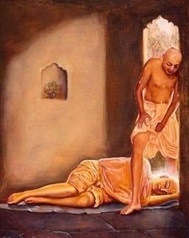
There is also the pastime of Govinda, His servant. One day Mahaprabhu lay across the doorway, and Govinda crossed over Him only to perform service, but refused to cross again for his own eating or rest, showing the ideal mood of pure service.
Another loving pastime is with Jagadananda Paṇḍita, who brought scented sandalwood oil for Mahaprabhu, but Mahaprabhu refused to use it because He was a sannyasi. Jagadananda became upset in loving anger, and later Mahaprabhu pacified him. This shows the intimate loving relationship between the Lord and His devotee.
All these pastimes reveal the deep and confidential mood of Mahaprabhu in Gambhira.
Objective 8: To understand the confidential ecstatic symptoms and night discussions in Gambhira.
In Gambhira, Mahaprabhu showed rare symptoms of maha-bhava, such as fainting, tears flowing, body becoming long, joints loosening, and divine madness.
At night, Svarupa Damodara and Ramananda Raya stayed with Him and recited verses from Srimad-Bhagavatam, Gita-govinda, Kṛiṣhṇa-karṇamṛta, Vidyapati and Caṇḍidasa songs. Hearing these, Mahaprabhu entered deep ecstasy. He often recited the mood of separation like “yugayitaṁ nimeṣeṇa… govinda-viraheṇa me”, expressing intense longing for Kṛṣṇa.
Objective 9: To understand the spiritual significance of Gambhira pastimes.
Gambhira represents the highest stage of Kṛṣṇa-prema. In Navadvipa Mahaprabhu taught saṅkirtana, in South India He preached, in Vṛindavana He revealed holy places, but in Puri — especially in Gambhira — He showed the deepest separation from Kṛiṣhṇa. During His final years He stayed mostly in Gambhira, associating only with intimate devotees. These pastimes reveal the deepest purpose of His appearance — to taste the love of Radharaṇi and show that the ultimate goal of bhakti is pure prema.
Objective 10: To understand the location of Sri Gambhira (KaSi MiSra Bhavan) and the important holy places nearby in Jagannatha Puri.
Sri Gambhira, also known as Kasi Misra Bhavan, is situated in Jagannatha Puri, Odisha, near the Jagannatha Temple. It is one of the most sacred places in Gauḍiya Vaiṣṇava tradition because Sri Caitanya Mahaprabhu stayed here during His final years.
Several important holy places are located near Gambhira, such as Jagannatha Temple, Siṁha-dvara (Lion Gate), Narendra Sarovara, Tota Gopinatha temple, Siddha Bakula (Haridasa Thakura’s place), and the sea shore (Svargadvara).
Therefore, pilgrims visiting Puri usually include Gambhira darsana along with these holy places.
Objective 11: To learn about the structure of Gambhira, the articles preserved there,
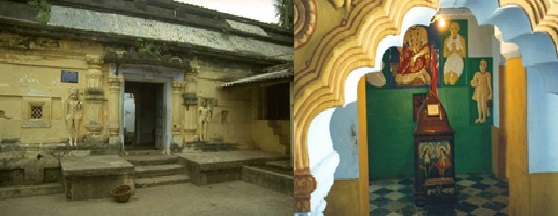
Gambhira is a very small, simple, enclosed room, not a large temple hall.
It has thick walls, a narrow space, a small doorway, and a quiet, dark interior with no luxury.
Mahaprabhu chose this small room intentionally so that He could remain absorbed in deep meditation and separation from Kṛiṣhṇa.
Inside Gambhira, sacred articles connected with Mahaprabhu are preserved, such as His wooden sandals (paduka), water pot (kamaṇḍalu), kaupina cloth, quilt, sitting place, and stone slab marked during His ecstasy. These are worshiped with great respect by devotees.
Acaryas explain that the small room represents the inner chamber of the heart, renunciation, and deep internal devotion. Although a big house was available, Mahaprabhu stayed in the smallest room to show that real spiritual life is internal, not external.
Objective 12: To understand the importance of Gambhira in Gauḍiya Vaiṣṇava philosophy.
Gambhira is very important because Mahaprabhu stayed here for about eighteen years and experienced the highest stage of love of God. Most of the confidential pastimes of His Antya-lila, described in Caitanya-caritamṛta, took place here. In Gambhira He tasted Radha-bhava, vipralambha (separation), and mahabhava, which are the highest stages of bhakti.
This place also shows the final goal of chanting:
Hare Krishna→ Bhakti → Prema → Separation → Mahabhava.
Only very intimate devotees like Svarupa Damodara, Ramananda Raya, Govinda, Jagadananda, Sikhi Mahiti, and Madhavi Devi were allowed to enter, showing the confidential nature of the pastimes.
Thus, Gambhira represents the heart of Sri Caitanya Mahaprabhu, the highest stage of devotion, and the ultimate goal of pure love for Kṛiṣhṇa.
Objective 13: To understand the main presiding Deity of Sri Gambhira and its spiritual significance.
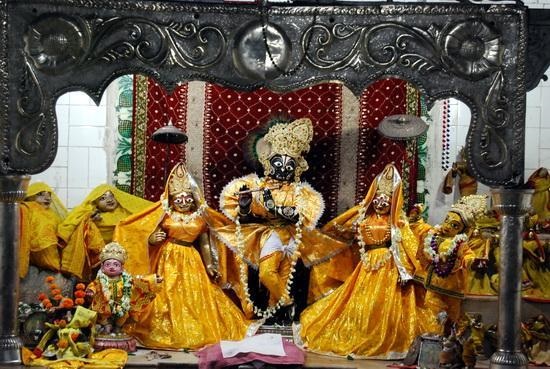
Sri Sri Radha Kanta at Kashi Mishra’s House
Sri Radha Kanta is worshipped in Kashi Mishra’s house. King Prataparudra’s father, Sri Purusottama Deva, conquered the king of Kanchipura in battle and returned with three deities – Radha kanta, Sakshi Gopala, and bhada Ganesha. Bhada Ganesha is still worshipped in an inner courtyard just behind Jagannatha temple. It is said Radha Kanta was also worshipped inside the Jagannatha Mandir for some time. But in dream Lord Jagannatha informed the King Prataparudra to remove Radha Kanta deity Because He is taking all nice items from his bhoga plate and so king requested to his Gurudev Kashi Mishra to take the Radha Kanta to his house.
During the Kashi Mishra’s time only Sri Radha Kanta was worshipped here. Later, when Gopala Guru became the Mahanta of the Matha, he installed a deity of Srimati Radharani on the left side of Sri Radha Kanta and a deity of Sri Lalita Devi on the right side. He also established the deities of dancing Gauranga and Nityananda on the left and right side of Radha Kanta.
When Mahaprabhu lived there, He regularly took darsana of this Deity, and the worship has continued till today.
The name Radha-Kanta means Kṛiṣhṇa, the beloved of Srimati Radharaṇi. Since Mahaprabhu in Gambhira was tasting the mood of Radha-bhava, the presence of Radha-Kanta is very significant. Therefore, Sri Sri Radha-Kanta is accepted as the main presiding Deity of Gambhira.
Objective 14: To understand the worship of Sri Caitanya Mahaprabhu in Gambhira through His personal articles and His presence as the presiding Lord of the place.
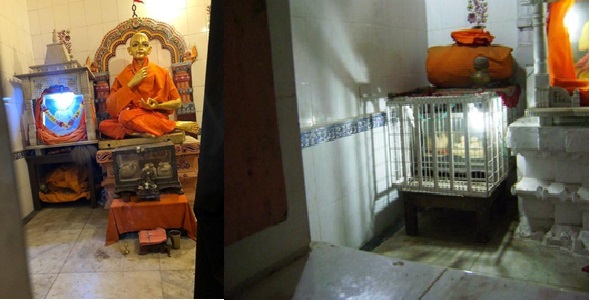
Kamandalu, Paduka and Quilt of Mahaprabhu inside the Cage
Gambhira is very special because along with the Deity of Radha-Kanta, the personal articles of Sri Caitanya Mahaprabhu are also worshiped with great reverence.
These include His wooden sandals (paduka), kamaṇḍalu (water pot), kaupina cloth, quilt, sitting place, and stone slab marked during His ecstasy.
In Gauḍiya Vaiṣṇava tradition, items used by the Lord are considered non-different from Him, so devotees offer obeisances to them.
Although there is no large Deity of Mahaprabhu inside the original room, the whole Gambhira is understood as His personal residence, so He Himself is the main presiding personality of the place. Thus, the worship in Gambhira is centered on Radha-Kanta Deity, Mahaprabhu’s personal presence, and His sacred articles.
Objective 15: To know the location of Sri Gambhira in Jagannatha Puri and how to reach the place from Jagannatha Temple.
Sri Gambhira (KaSi MiSra Bhavan) is located in Jagannatha Puri, Odisha, near the Jagannatha Temple. The location can be found in Google Maps by searching “Gambhira Puri”, “Kashi Mishra Bhavan Puri”, or “Gambhira Gaudiya Math Puri”.
The distance from Jagannatha Temple to Gambhira is about 500–700 meters.
From the temple, one should go towards the Balisahi / Radhakanta Math side, and locals can easily guide the way if asked for Gambhira Math or Kashi Mishra Bhavan.
Because of its importance, this place is commonly included in the Puri pilgrimage darsana.
