
Objectives:
Objective 2: To know about the Devotees Associated with This Place.
Introduction
Objective 1. To explore the location and significance associated with Kṣīra-Chora Gopīnātha Temple in Remuṇā.
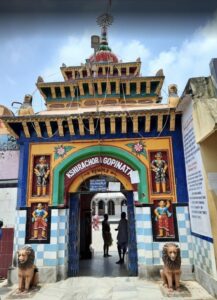
Kṣīra-Chora Gopīnātha Temple is located in Remuna, Odisha, about 9 km from Balasore railway station, between Puri and Kolkata.
The name Remuna comes from the word “Ramaniya,” meaning very beautiful. The name Kṣīra-Chora Gopīnātha means “Gopīnātha, the Lord of the Gopis who stole sweet rice milk preparation”. This name comes from a famous incident about 600 years ago, when the Deity of Gopīnātha stole a pot of sweet rice (kṣīra) for the great Vaiṣṇava saint Mādhavendra Purī.
Because of this divine pastime, the Deity became well known as Kṣīra-Chora Gopīnātha. The temple is also revered as one of the 108 Abhimāna Kṣethrams in the Vaiṣṇava tradition.
Devotees Associated with This Place
Objective 2. To know about the Devotees Associated with This Place.
Several great devotees are connected with Kṣīra-Chora Gopīnātha Temple:
● King Langula Narasiṁha Deva of Utkal – The king who brought the Deity and established worship at Remuna.
● Śrī Chaitanya Mahāprabhu – Visited the temple while travelling to Jagannātha Purī; His lotus footprints can be seen near the Garuda-stambha. This pastime was narrated by Sri Chaitanya Mahaprabhu. It is recorded in Chaitanya Charitamrita (Madhya-lila).
● Śrī Rasikānanda – A great devotee in the disciplic succession of Śrī Chaitanya Mahāprabhu; his samādhi is located within the temple premises.
● Chaitanya Dāsa Bābājī – Brought the Deities of Śrī Govinda and Śrī Madana Mohana from Vṛndāvana to the temple.
Leelas (Pastimes)
Objective 3. To appreciate the historical journey of Mādhavendra Purī, the divine incident of Kṣīra-Chora Gopīnātha, and the continuing spiritual traditions at Remuṇā.
Over 500 years ago, the great devotee Mādhavendra Purī was travelling to Jagannātha Purī to bring sandalwood for his Deity Śrī Gopāla in Vṛndāvana. On the way he stopped at Remuna, where the beautiful Deity Gopīnātha is worshipped.
While taking darśana, Mādhavendra Purī learned from the temple priest that in the evening Gopīnātha is offered a special sweet rice milk preparation called Amṛta-keli (Gopīnātha-kṣīra). Seeing the offering, he briefly desired to taste it so he could prepare the same for his Lord Gopāla. Immediately realizing this desire was improper, he felt ashamed and left the temple to chant in a nearby marketplace.
That night Lord Gopīnātha appeared in the priest’s dream and told him that He had hidden a pot of kṣīra for Mādhavendra Purī. The priest found it and gave it to him, saying that the Lord had stolen the sweet rice for him. From that time the Deity became famous as Kṣīra-Chora Gopīnātha (“Gopīnātha who stole sweet rice milk”).
Later, after collecting sandalwood from Puri, Mādhavendra Purī again came to Remuna. In a dream Lord Gopāla instructed him to apply the sandalwood paste to Gopīnātha, explaining that the two Deities are non-different. This tradition continues even today during the Chandana-yātrā festival, and devotees still receive the famous Amṛta-keli kṣīra prasādam at the Remuna temple.
Kṣīra-Chora Gopīnātha reveals that the Lord Srikrishna personally serves His devotee and fulfills even their unspoken desires.
Deities
Objective 4. To describe the main Deity forms in the temple, their arrangement, historical origin, and the presence of other sacred Deities worshiped at Remuṇā.
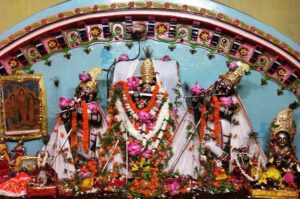
The main Deity in the temple is Lord Gopīnātha (Kṣīra-Chora Gopīnātha), who stands between Śrī Govinda on the right and Śrī Madana Mohana on the left. All the Deities are carved from black stone.
Govinda and Madana Mohana Deities were brought from Vṛndāvana around 1938 by a devotee named Chaitanya Dāsa Bābājī.
The temple also houses Deities of Śrī Rādhā-Rāsabihārī, Lord Jagannātha, Śrī Chaitanya Mahāprabhu, and many Śālagrāma śilās.
Origin of the Deity
Objective 5. To gain insight into the traditional origin of the Gopīnātha Deity carved by Lord Rāma, its divine significance, and its continued worship through the different yugas.
According to local tradition, the Deity of Gopīnātha was originally carved by Lord Rāma during Treta-yuga while He was living in exile at Chitrakūṭa with Sītā and Lakṣmaṇa.
One day, after heavy rains had turned the surroundings green and beautiful, Lord Rāma saw cows grazing in the hermitages and smiled. When Sītā asked the reason, Rāma explained that this reminded Him of His future incarnation as Lord Sri Krishna, the cowherd boy in Dvāpara-yuga. Curious to see that form, Sītā expressed her desire.
To fulfill her wish, Rāma took a piece of stone and engraved the Tribhaṅgī form of Lord Sri Krishna playing the flute (Murali) using the tip of His arrow. Around Him He also carved eight sakhīs (gopīs)—Lalitā, Viśākhā, Chitrā, and Indulekhā on the left, and Champakalatā, Sudevī, Tuṅgavidyā, and Raṅgadevī on the right.
Near His feet He carved His dear companions Subala, Madhumaṅgala, Sanandana, and Vidagdha, along with scenes of Sri Krishna’s cowherding pastimes and the defeat of the wrestlers Chāṇūra and Muṣṭika.
Sītā touched the image and asked how it was created. Lord Rāma touched the stone again with His arrow. It is said that the stone began to bleed, indicating that the Deity had become spiritually alive by the Lord’s divine touch. From then on, Sītā personally worshipped the Deity, and later Lord Brahmā continued the worship.
After defeating Rāvaṇa, while returning to Ayodhyā, Lord Rāma stopped at a beautiful place now known as Remuna. When Sītā wished to bathe, Lord Rāma shot seven arrows into the ground, creating a river known as Saptasārā.
The Deity originally carved at Chitrakūṭa continued to be worshipped by Brahmā through Treta-yuga, Dvāpara-yuga, and into Kali-yuga.
Installation of Śrī Kṣīra-Chora Gopīnātha at Remuṇā
Objective 6. To analyse how the Deity of Madanagopāla came to Remuṇā through King Langula Narasiṁha Deva and how His worship was established there.
During Kali-yuga, the famous king of Odisha Langula Narasiṁha Deva, a great Vaiṣṇava and generous ruler, visited Chitrakūṭa during his pilgrimage. There he saw the ancient Deity worshipped by Brahmā. That night the Lord appeared to him in a dream and told him that His name was Madanagopāla, instructing the king to take the Deity with him.
The next day the king respectfully carried the Deity with him toward Śrīkṣetra (Jagannātha Purī). On the way, he stopped at Remuna. There the Lord expressed His desire to remain in that place because the area was filled with many milk-giving cows.
The king accepted the Lord’s wish and installed the Deity at Remuna. Since the Deity was surrounded by the eight sakhīs and companions, the queen named Him Śrī Gopīnātha.
The king also arranged for the excavation of two large sacred tanks called Brajapokharī and Kuṭapokharī, and after completing these works he returned to Purī.
Thus, the sacred Deity of Śrī Kṣīra-Chora Gopīnātha came to be worshipped at Remuna, where He remains a beloved Deity for devotees even today.
Temple Structure
Objective 7. To trace the historical development of the temple structure, including its original construction, destruction during invasions, and later restoration.
Historical traditions say that King Langula Narasimha Deva of Odisha installed the deity at Remuna around the 13th century.
The original temple suffered damage during Muslim invasions but was later renovated by the great devotee Sri Rasikananda. The deity had been hidden in a pond for protection during that period and was later recovered.
