
Objectives:
Objective 5: To explore the major festivals celebrated at the Lingaraj Temple.
Objective 6: To plan a convenient route to reach the Lingaraj Temple.
Introduction
Objective 1: To understand the spiritual importance of the Lingaraj Temple as a major sacred shrine in Bhubaneswar.
Lingaraj Temple, the largest and most sacred shrine in Bhubaneswar, is dedicated to Lord Harihara (a combined form of Vishnu and Shiva). Built in the 11th century by Jajati Keshari, who was a Somvanshi king. This temple has both Lord Shiva and Vishnu. Even the temple on the top has got no trishul (which is considered to be the weapon of Shiva) and even Chakra (which belongs to Lord Vishnu). It has only Lord Rama’s arrow symbol.
The temple remains an active place of worship with strict rules on entry—only Hindus are allowed inside, and purity norms are maintained. Non-Hindus can view the temple from an external platform.
History of Lingaraj Temple, Bhubaneswar
Objective 2: To learn how Lord Kṛṣṇa granted Ekāmra Kānanam (Bhubaneswar) to Lord Śiva as His residence.
Lord Siva Obtains Sri Bhubaneswar Dhama from Lord Krsna. In Skanda Purana it is mentioned that, “Once in Kasi, there was a king who was a great devotee of Lord Siva, but his desires were unfulfilled.
That king underwent very severe penances to conquer Krsna. He was in tapasya trying to satisfy Lord Siva as he had that desire that he would conquer Krsna. One cannot understand the behavior of a vaisnava. Even the demigods cannot understand, what to speak of the human beings. Siva became satisfied and pleased with his tapasya. At that time Siva told him, “Alright you go and fight against Krsna, I’m following you, I’ll support you, I’ll help you.”
So that king then started for battle and Siva with all his followers followed behind the raja, king. Then Krsna, Vasudeva, Devaki-nandana, Son of Devaki, could understand these things, so He released His Sudarsana Cakra. That Sudarsana Cakra cut off the head of the king.
After that Sudarsana Cakra cut off the heads of all the Siva bhaktas in Kasi. This Varnasi became a crematorium ground – all were dead. So Siva became very angry and released his Pasupatastra. But what he’ll do, Pasupatastra is no match in front of Sundarsana Cakra. It could not do anything.
So at last, Siva also became very terrified, frightened and tried to run away, but where will He go? Then Siva could understand except for Krsna nobody can save me now. So He surrendered unto the lotus feet of Krsna, Govinda. He offered many prayers.
Siva says, “O Lord of my heart, I have one prayer. I am always very puffed up. I have great false ego, but now I understand I can not leave You, I can not stay anywhere else, please tell me where I shall stay.” This is described in the Skanda Purana.
So Vasudeva said, “My ksetra is there, Sri Purosottama Ksetra. So in the North of that ksetra is Ekamra Kanana. That place, Ekamra Kanana is very auspicious and will give bhukti and mukti, a very beautiful place. So you’ll stay there and you’ll be known as “Bhubaneswar.” “So I give you that Ekamra Kanana. You go and stay there and become the guard of that ksetra, ‘ksetra pala’”.
So this is Bhubaneswar. It is also known as ‘Hemacala’ and ‘Svarnadi Ksetra.’ In this ksetra crores, crores, koti lingum crores of Sivas are here. It is also known as asta-tirtha, the famous eight tirthas reside here. Bhubaneswar is superior to Varnasi and is more dear to Siva than Varnasi. This place is more pleasing than Kailash.
The Ekamra Purana states that the deity appeared as a lingam only from Dvapara and Kali yugas. The present lingam is a natural Swayambhu (self-manifested) stone resting on a Shakti base.
Deities of Lingaraj Temple
Objective 3: To list the deities worshipped in the Lingaraj Temple, including Lord Lingaraj in the Harihara form.
Lord Lingaraj (Main Deity – Harihara Form) Lord Lingaraj is worshipped as a Swayambhu Shivalinga representing Harihara (Shiva + Vishnu). Devotees believe worshipping Him gives the combined blessings of both deities. The self-manifested (Swayambhu) Shivalinga measuring about 8 feet in diameter. Lord Lingaraj is worshipped with elaborate daily rituals including abhisheka, arati, and food offerings, which are also offered to Goddess Parvati (Annapurneswari).
Lord Vishnu (Saligram Presence) Lord Vishnu is present as a Saligram, signifying His presence within the Linga and reinforcing the unity of Shaivism and Vaishnavism.
Goddess Parvati (Annapurneswari) Goddess Parvati is worshipped in a separate shrine, and all offerings to Lingaraj are also offered to Her, symbolizing divine unity.
Nandi Nandi, the vehicle of Lord Shiva, faces the sanctum and is believed to convey devotees’ prayers to the Lord.
Other Deities The complex houses more than 100 small shrines of various deities including Ganesha, Kartikeya, Gauri, and other forms of Shiva and Vishnu, making it a complete spiritual center.
Architecture & Features
Objective 4: To explain the architectural features of the Lingaraj Temple as an example of Kalinga style.
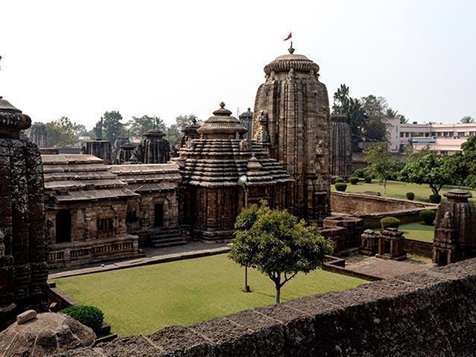
The Lingaraj Temple is a fine example of Kalinga architecture, enclosed within a large laterite wall covering about 22,720 sq. m. The main tower (Vimana) rises to about 180 feet, dominating the skyline and visible from a distance, while the spacious courtyard houses around 150 smaller shrines.
Built using red sandstone and laterite, the temple has a dark appearance and is richly decorated with sculptures of gods, goddesses, humans, animals, birds, and floral designs, showcasing the peak of Hindu temple art.
The high walls of Lingaraja temple, that have been made by using solid red sandstones, lend it the look of a fortress, when viewed from outside.
The temple complex measures approximately 520 × 465 feet and has its main entrance in the east, with additional gates on the north and south. The temple’s main gates have Lord Shiva, Trishul on one side and Lord Vishnu, Chakra on the other side.
The structure consists of four main parts aligned on a single axis: the Vimana (sanctum tower), Jagamohana (assembly hall), Nata Mandira (festival hall), and Bhoga Mandapa (offering hall), each increasing in height towards the sanctum.
Nearby, the sacred Bindusagar Tank is believed to be filled by an underground water source from the temple, and its water is considered spiritually and physically purifying.
Festivals
Objective 5: To explore the major festivals celebrated at the Lingaraj Temple.
The main festivals celebrated at Lingaraja Temple
● Maha Shivaratri – The most important festival; devotees fast, offer bel leaves, and worship all night.
● Rukuna Ratha Yatra (Ashokashtami) – Annual chariot festival where Lingaraja is taken to Rameshwar Temple. Legend goes as when Rama was returning from Lanka after victory over Ravana, Goddess Sita asked to worship Shiva here. So Ramachandra built a Linga for that purpose.[citation needed] Traditionally during Ashokashtami, which falls one day before to Rama Navami in Chaitra, Lord Lingaraja comes to this temple by a large chariot called Rukuna Rath and stays for four days.
● Chandan Yatra – 22-day sandalwood festival with boat processions in Bindusagar Tank.
The other festivals of Lord Lingaraja include Prathamastami, Pravarana Sasthi, Pusyabhiseka, Ghrtakambala Ceremony, Magha Saptami, Damanabhanjika, Parasuramastami, Sayana Chaturdasi, Pavitraropana, Yama Dvitiya, and Utthapana Chaturdasi.
These festivals are celebrated with great devotion and large gatherings of pilgrims.
Location & Accessibility
Objective 6: To plan a convenient route to reach the Lingaraj Temple.
Located in Old Bhubaneswar (Old Town area)
About 3 km from the airport
About 5 km from Bhubaneswar Railway Station
Around 0.5 km from Bhubaneswar–Puri main road
About 5 km from the main bus stand
Well connected by town buses.
Easily accessible by autorickshaws from all parts of the city.
