
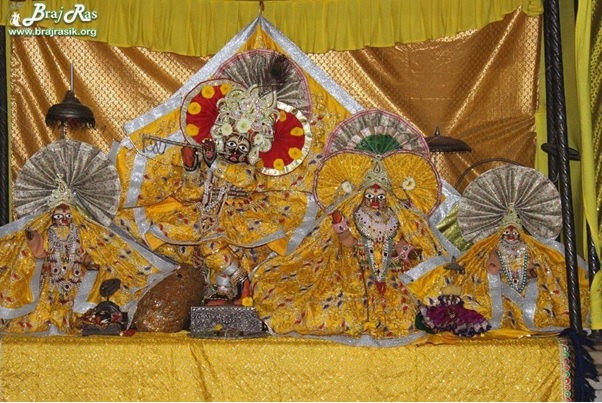
Objectives:
Objective 3: To understand the appearance of Govardhana sila
Objective 4: To understand the significance of the deity Madan Mohan in Vrindavan.
Objective 5: To highlight the key features and architecture of the Madan Mohan Temple.
Objective 1: To describe the historical timeline and development of the Radha Madan Mohan Temple in Vrindavan
Significance:
One of the three main deities of Vrindavan (Madana Mohan, Govinda, and Gopinath). Worship of Madana Mohan establishes sambandha, one’s relationship with Krishna.
Madan Mohan Temple is one of the oldest temples in Vrindavan and is located near the Kaliya Ghat. Established by Sanatana Goswami, the deity of Madan Mohan was originally known as Madana Gopala. Worshiped along with Madana Mohan are Radharani and Lalita Sakhi. Krishna Dasa took care of the temple after Sanatana Goswami. The original Deity of Madan Mohan was discovered at the base of an old banyan tree by Advaita Acharya, when he visited Vrindavan. He entrusted the worship of Madana Mohana to his disciple, Damodara Chaube, who then gave the deity to Sanatana Goswami who spent 43 years in Vrindavan. Radharani and Lalita are worshipped along with Madan Mohan.
The original deity of Lord Madan Gopala was shifted from the shrine to Jaipur for safe keeping during Mughal emperor Aurangzeb’s rule. The original deity of Madan Mohan is said to exactly resemble Krishna from the waist down.
Historical Development
Year & Event
1534 – First temple with a single shikhara erected with help of Ramadas Kapoor
1580 – Current temple structure completed
1670 – Deity moved from Vrindavan to Radhakund, Kamyavan, then Jaipur due to Aurangzeb’s attacks
Later Deity moved to Karauli, Rajasthan by royal marriage
In 1748 AD, a replica of Madan Mohan was established here.
In 1819 AD, Sri Nandalal Vasu constructed the present temple at the foot of the hill
Objective 2: To highlight the lineage of guardians, devotees, and spiritual leaders associated with the worship and preservation of the Madan Mohan deity in Vrindavan.
Lineage of Worship (Chronology of the Deity)
1. Ambarisa Maharaja – Worshipped during his vow in Madhuvana
Sri Suka describes the king’s Deity worship there. Srimad’Bhagavalam does not mention Madana-gopala by name, but oral tradition confirms that when Vajranabha was developing Vraja, Madana-gopala was one of the eight Deities he excavated
2. Kubja – Krishna fulfilled His promise to her via this deity
3. Advaita Acharya – Found the deity beneath a banyan tree
Advaita Acarya discovered Madana-gopala in his parikrama marga in vrindavan & worshipped him. Before Advaita Acarya left for Bengal, concerned for the Deity’s safety, He took Madana-gopala to Mathura and placed Him in the care of a brahmana by the name of Damodara Chaube.
4. Damodara Chaube – Entrusted by Advaita to protect the deity
5. Sanatana Goswami – Worshipped Madana Mohana for 43 years.
Sanatana Gosvami took Madana-gopala back to Dvadasaditya-tila where at first he worshipped the Lord beneath a tree, and then sometime later in a thatched hut next to his bhajana-dullra . Transfer of deity from Damodara Chaube to Sanatan Gosvami(Ref NVM, NVM = Nectar of Vraja-mandala)
Upon seeing the form of Madana-gopala in the Chaubes’ house while doing madhukari, Sanatana was enchanted. He left after a short time, but Sanatana continued to remember the Lord even after returning to Vrndavana.On one occasion Sanatana Gosvami humbly instructed Chaube’s wife in the proper etiquette of worshipping the Deity on the path of regulated service, a form of worship befitting the Supreme Lord.
The brahmani immediately accepted Sanatana Gosvami’s advice and inaugurated the rules of Deity worship the saint had given. She restricted her son Sadana to eat, play, or sleep with Madana gopala.That night Madana-gopala appeared in the dreams of both Sanatana Gosvami and Damodara Chaube. The Lord instructed each of them differently, but expressed to both His desire for a new arrangement.
To Sanatana, Madana gopala said, ‘Mother Chaube loved Me and her son equally, but on your advice she now distinguishes between the two of us, worshipping Me with rituals and keeping Me at a distance.’
To Chaube, Madana gopala said, ‘I have been with you for a long time, but now I want to live with Sanatana Gosvami. You have Sadana, but Sanatana has none. Please give Me to him right away.’
The next day Sanatana went to apologise to Chaube, but he was greeted with the news that Madana-gopala wanted to accept the service of Sanatana in Vrndavana. The Gosvami’s bliss was boundless.
The pastime of Madan Gopal arranging salt and a temple for himself is described in NVM.
But Madana-gopala was used to a different kind of fare; Mother Chaube would cook with ghee and fine spices and give Gopala many preparations complemented by the best quality rice available.
One day the Lord asked, ‘Every day you are offering Me these tasteless meals. Can’t you at least add a little salt?’ Sanatana was pained to hear these words, but he was also reluctant to comply.
‘I am Your eternal servant,’ he answered, ‘but if I get You salt today, tomorrow You may ask for ghee. If I spend my days begging for food and cooking Your meals, how will I fulfill the orders of Mahaprabhu?’
Taking another capali ball and placing it into Madana-gopala’s outstretched hand, Sanatana concluded, ‘Please accept what I have. And if You want more, please make your own arrangements.’
Madana-gopala accepted Sanatana Gosvami’s decision, but He still wanted salt and better accommodation, and so He arranged for those things without compromising His devotee’s primary services.
One day, a merchant named Rama Dasa Kapoor was taking three boatloads of merchandise — including salt — down the Yamuna to Agra when his boats got stuck on the sand flats of Kaliya-ghata.Despite all efforts made by Rama Dasa and his sailors, the boats would not move. At that time Madana-gopala was playing nearby with some Vraja-vasi boys. In the form of a gopa, the Lord advised Kapoor.
Madana-gopala said, ‘On top of that hill lives a great saint. He will surely help you.’ Hearing this, Rama Dasa Kapoor climbed to the top of Dvadasaditya-tlla and explained his plight to Sanatana Gosvami.Always sympathetic to the distress of others, Sanatana Gosvami guided the merchant to Madana-gopala, who had again assumed His Deity form. Sanatana said, ‘Pray to the Lord and He will help you.’
Rama Dasa Kapoor replied, ‘If the Lord frees my boat, and I can get to Agra without being attacked by thieves, I will be extremely grateful. From my profits I will build Him a beautiful temple here.’
Soon after Rama Dasa spoke these words, a heavy rainstorm broke out and raised the water level high enough to free the boats. The overjoyed merchant reiterated his pledge and headed for Agra.Rama Dasa Kapoor left a supply of salt for Madana-gopala’s meals. And, after selling all his wares in Agra, true to his word, he returned to construct the first temple in Vrndavana.
In 1573 Emperor Akbar himself had given Jiva Gosvami permission to construct four temples in Vrndavana: one for Madana-gopala, the others for GovindajI, Gopinatha, and Yugala- kisora.
Rama Dasa Kapoor completed Madana-gopala’s temple in approximately 1580 and also donated a sizable agricultural plot to provide the temple and its pujaris with sufficient produce.
6. Later hidden during Mughal attacks and relocated through:
Radhakund → Kamyavan → Jaipur → Karauli (current location)
Hidden in Radhakund: In the year 1670, just prior to the attack on Vrindavana by the soldiers of the Mughal tyrant Emperor Aurangzeb, the deity of Lord Madana-mohana, along with the other important Gaudiya Goswami deities including Govindaji and Gopinathaji, were secretly taken out of Vrindavana for safety and hidden at Radha-kunda.
Objective 3: To understand the appearance of Govardhana sila
Sri Madana Mohana appeared one day and said, ‘Baba! you are too old. Don’t take so much trouble to walk around Govardhana Hill every day.’
Sanatana replied, ‘This is one of the daily activities of my bhajana: I must maintain it.’ ‘Since you are old,’ said Madana Mohana, ‘you may now give up this vow.’
Starting to walk again, Sanatana replied, ‘I will never give up my religious principles.’
Sanatana Gosvami’s firm determination to complete his daily devotional vow pleased Sri Madana Mohana (Krishna). But in the loving dealings between the Lord and His pure devotee, Krishna’s desire to please His devotee often defeats the devotee’s desire to please Him. So out of loving compassion for His devotee, Sri Krishna stood on a large flat stone (Govardhana sila) taken from Giriraja. He played His irresistable flute. The Govardhana sila melted in ecstasy, capturing the impression of Krishna’s lotus feet.
Objective 4: To understand the significance of the deity Madan Mohan in Vrindavan.
Spiritual Significance
Meaning of Name: Madana Mohana = “He who even enchants Cupid.”
Madana Mohana’ means Krishna who is so indescribably beautiful that He even attracts Cupid, Kamadeva. Sanatana Gosvami is the sambandha acarya who gives us knowledge of our proper relationship with Krishna, And his Deity, Madana Mohana, helps us overcome our attraction for material sense gratification (Cupid) and fix our minds on devotional service. The temple of Madana-
mohana was the first temple built in Vrindavana since the time of Vajranabha Maharaja five thousand years earlier
Role in Devotion: Helps neophyte devotees overcome material desires and establish relationships with Krishna.
Sanatana Goswami: Known as the sambandha-acharya, his service and dedication to the deity exemplify the ideal Vaishnava lifestyle.
Objective 5: To highlight the key features and architecture of the Madan Mohan Temple.
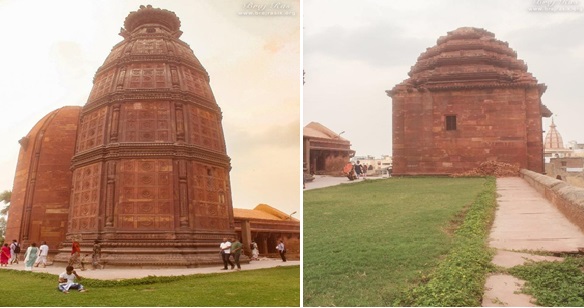
Temple Architecture
Material: Red sandstone
Shape: Oval tower (shikhara) rising ~20 meters
Location: On Dwadashaditya Tila near Yamuna River
Built by: Ramadasa Kapoor
Features: Bhajan kutir & samadhi of Sanatana Goswami, and manuscript repository (Granth Samagra)
Key Darshans and Deities
Deities: Radha, Madana Mohan, and Lalita Sakhi
Original deity: Now in Karauli, Rajasthan
Vrindavan replica: Installed in 1748 AD for darshan
Govardhan Shila: Given to Sanatana Goswami by Madan Mohan, bears Krishna’s footprints
Objective 6: To describe important pastimes and devotional stories associated with Madan Mohan and his devotees.
Important Pastimes
Transfer of Deity to Sanatana Goswami
Madana Mohana appeared in dreams to both Damodara Chaube and Sanatana requesting transfer of service.
Highlight: Shows Lord’s personal involvement in choosing His devotee.
Salt & Temple Pastime
Madan Mohan requested salt from Sanatana Goswami.
Later arranged Rama Dasa Kapoor’s boats to get stuck near Yamuna, leading to the construction of the temple and donation of salt.
Gopi Milk Pastime (Karauli)
Old milk-seller accidentally offers fish-tainted milk; Lord reassures her through a mystical visit and accepts her devotion.
Some years later, during the reign of Maharaja Harikaspal, an old devotee woman lived in a village near Karauli. Her sole source of income was selling milk from her small herd of cows.
Every day she would go to Karauli. On the way she would thin her milk with water from a creek she had to ford. At Karauli, before going to market, she would offer a cup of milk to Madana mohana.Once, as she was thinning the milk with creek water, a small fish swam unnoticed into her pot, and from there into the cup of milk she gave to Madana-mohana’s pujari to offer to the Lord.
Just as the pujari was about to make the offering, he noticed the tiny fish. He at once rejected the milk, scolded the woman, and forbade her to make any further offerings to the Deities.The old gopi was heartbroken that her only service to Madana” mohana had been taken away from her. She returned home, where she cried and fasted, continually praying to the Lord for forgiveness.
Determined to somehow regain her service to the Lord, she prayed and prayed to Madana- mohana for guidance, hoping to find out how she could rectify herself and regain His favour.Madana-mohana took pity on the old gopi. In the guise of a mendicant He came knocking on her door late that night and requested a place to stay until the following morning.
The gopi asked, ‘Boy! Where do you come from? I have not seen you in these parts before.’ The mendicant answered, ‘Mother! I live in Vraja and have come to take darsana of Madana- mohana.‘Please allow me to stay the night. Tomorrow I will go to Karauli.’ The old lady felt obliged to accommodate the saint, who was not only young but also had a compellingly familiar countenance.Bdbaji!‛ the elderly cowherd woman replied. ‘My house is yours. Tell me, what can I offer you to eat?’ The sage replied, ‘I only drink milk. If you can offer me a little, then I will accept that.’
The old woman only had the milk in which the fish had been trapped, and so she offered to go and milk her cow. But the young mendicant said, ‘No! I can’t wait! Give me what you have
The gopi explained that there had been a fish in the milk, but the young man replied, ‘In the future you should sieve your milk when diluting it, but for now I am too hungry to wait, please give it as it is.’Unable to change the young mendicant’s mind, the old woman gave him the milk. After drinking it with obvious satisfaction, he said, ‘Mother! You know your milk is very tasty — the best I have drunk.’
The young man then lay down on a cot and fell asleep, but the old woman, still tormented by her offence to Madana-mohana, was unable to sleep. She stayed awake most of the night.
The air became chilly after midnight, and so the gopi covered her guest with an old quilt. Finally, she went to her room to rest. Towards the end of night she drifted off and dreamt of Madana-mohana.In her dream the Lord smiled kindly and said, ‘Why are you still fasting, thinking that I have refused your milk? Don’t you know that I have come to your house and taken milk directly from your hands?
‘Continue your service,’ Madana-mohana concluded. ‘The pujari will not object any further. Now get up and eat.’ The gopis dream broke and she rose to find that the young sadhu had disappeared.
She approached his cot and saw that her old quilt had been exchanged for Madana-mohana’s fine yellow silk shawl. At once she understood that the young sadhu had been none other than the Lord.Overwhelmed with various symptoms of ecstasy, it took the old woman time to compose herself. She then followed Madana-mohana’s orders, ate a little, bathed, milked her cows and left for Karauli.
Meanwhile, the pujarl had gone to wake Radha-Madana-mohana and found the Lord wearing a torn quilt instead of His opulent shawl. The brahmana could not understand what had happened.
Indeed, none of the Deities’ servants could account for the absence of Madana-mohana’s shawl, or the presence of the quilt, until the old gopi arrived with the yellow shawl the Lord had worn the day before.The old woman handed the shawl to the pujarl and said, ‘Madana- mohana came to my house last night to drink milk. It was dark when He left. He must have mistaken my quilt for His shawl.’
Madana-mohana’s servants were at a loss for words, but they could not contest the evidence of the shawl and the quilt. They concluded that, no matter what, the Lord would accept the old gopis milk.
Objective 7: To outline the worship tradition, prayers, and lasting legacy of Madan Mohan’s Gaudiya Vaishnav influence.
Worship Tradition
Food Offering (Anga Kadi): Wheat flour balls mixed with water and horse gram—same as offered by Sanatana Goswami.
Daily Bhoga: Continues the tradition of simplicity and devotion in offering
Glorification and Prayers
Srila Prabhupada: Emphasized Madana Mohana’s role in helping devotees establish their relationship with Krishna.
Raghunatha Dasa Goswami: Authored deep prayers expressing divine love for Madan Gopal.
Quote: “In Krishna consciousness, our first business is to know Krishna and our relationship with Him. That we can learn by worshipping the Madana Mohana vigraha.”
Samadhi and Legacy
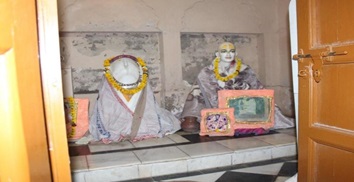
Samadhi of Sanatana Goswami: Adjacent to the temple
Inscription: “Param vijayate Sri Krishna Sankirtanam” from Sri Chaitanya Mahaprabhu’s Shikshashtakam
