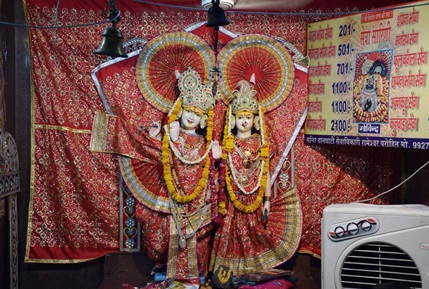
Objectives:
Objective 1: To understand the historical and devotional significance of Mukhāravinda.
Objective 2: To describe the associated temples and practices.
Objective 3: To highlight devotional practices at Mukhāravinda.
Objective 4: To know the symbolic representation of the lotus face (Mukhāravinda).
Objective 5: To understand scriptural references about the lotus form.
Objective 6: To describe the form of Govardhan as represented in the temple.
Objective 7: To highlight the sacred places around Mukhāravinda.
Objective 8: To understand the historical background of Jatipura.
Objective 9: To know the legends associated with Mukhāravinda.
Mukhāravinda: A testimonial of divinity
Objective 1: To understand the historical and devotional significance of Mukhāravinda.
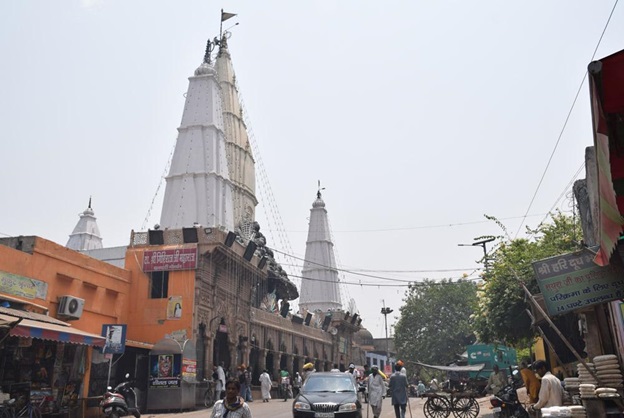
Mukhāravinda is a temple located in the village Jatipura in Govardhan that lies at a distance of around 28 km from Mathura. In Govardhan, the sacred hill called Shri Giriraj is worshipped and this temple is being taken care of by the Vallabha Sampradaya (from Gujarat).
Mukhāravinda temple is situated at the base of Girirajji Govardhan hill popularly known as the place of appearance of Lord Giriraj that is His Pragatya. It is believed that from this place Bhagavan had consumed all the Prasadam offerings done by the Vrindavan Vasis during the Govardhan Pooja as per Vallabha Sampradaya. Mukhāravinda also known as Mukhārabind temple as in Vraj bhasha ‘V’ is pronounced as ‘B’ and vice a versa, like Brindavan and Vrindavan, Vraj and Braj).
Objective 2: To describe the associated temples and practices
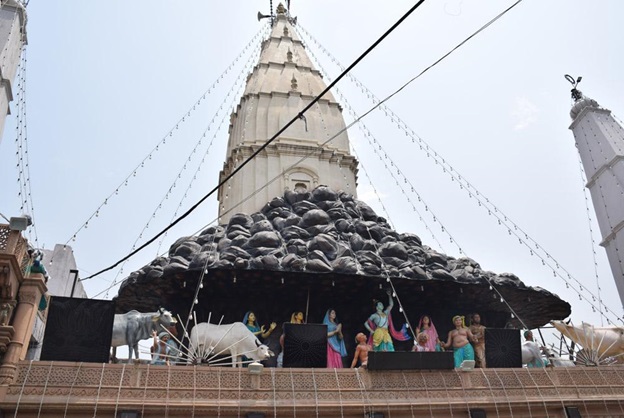
This is another temple called the Jihva Mandir: This is the tongue of Govardhan and on the eve of annakut (Govardhan Puja), it is from here that Giriraj Ji eats the food offered by Vraja Vasis.
Annakut is a special offering to God just a day after Dipawali (the actual day when the Govardhan Leela had taken place).
Objective 3: To highlight devotional practices at Mukhāravinda.
Mukhāravinda temple is one of the important locations during the Govardhan Parikrama. Many begin their parikrama, of Giriraj Ji from Mukhāravinda Govardhan. Some people do parikrama walking with a pitcher of milk, with the milk flowing slowly through the pitcher in a stream. This is known as the doodh dhaar parikrama
An Aesthetic face of faith and devotion:
Objective 4: To know the symbolic representation of the lotus face (Mukhāravinda).
The temple is located on the northern bank of Mansi-Ganga. It is the lotus face (Mukhāravinda) of Govardhan. Mukha means face (more specifically also mouth) and Aravind means lotus. It is also stated in the sloka 4 of Gita Mahatmyam, that the Srimad Bhagavad Gita emanated from the lotus mukha (mouth/lips) of Bhagavan himself. Here also the mouth of Bhagavan Govardhan Giri Raj is called the lotus mouth. Not only His mouth, but Bhagavan’s face is also like a lotus. so are his lotus feet.
Objective 5: To understand scriptural references about the lotus form.
gītā sugītā kartavyā kim anyaiḥ śāstra-vistaraiḥ
yā svayaḿ padmanābhasya mukha-padmād viniḥsṛtā
Meaning : Bhagavad Gita should be cheerfully sung, of what avail is the study of the elaborate scriptures, for Geeta has emanated from the lotus lips of the Lord Himself.
Not only Bhagavan’s face and mouth, lotus is often associated with Bhagavan’s divine feet, eyes are also, as stated by Kunti Maharani in sloka no. 1.8.22 of Srimad Bhagavatam when she pays obeisances to Bhagavan as below :
namaḥ paṅkaja-nābhāya namaḥ paṅkaja-māline
namaḥ paṅkaja-netrāya namas te paṅkajāṅghraye
Meaning : My respectful obeisances are unto You, O Lord, whose abdomen is marked with a depression like a lotus flower, who are always decorated with garlands of lotus flowers, whose glance is as cool as the lotus and whose feet are engraved with lotuses.
Mukhāravinda Temple located in Govardhan’s Form
Objective 6: To describe the form of Govardhan as represented in the temple.
Govardhan’s form is that of a sitting cow. His hind part is puchari or the puchari ka lota. He has turned his neck to place his lotus face near his stomach, which is the town of Govardhan. His two eyes are Radha-kund and Shyam-kund. This is a beautiful temple of Giriraj’s lotus face at jatipura called Mukhāravinda.
Mukhāravinda Temple:
Objective 7: To highlight the sacred places around Mukhāravinda.
Shreeji lives in Vraj at Mathura on Giriraj Govardhan.
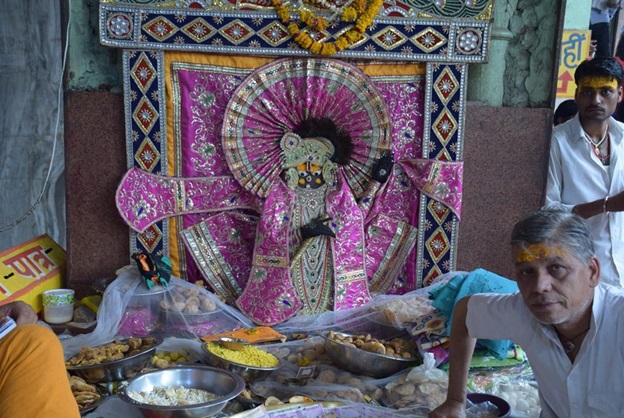
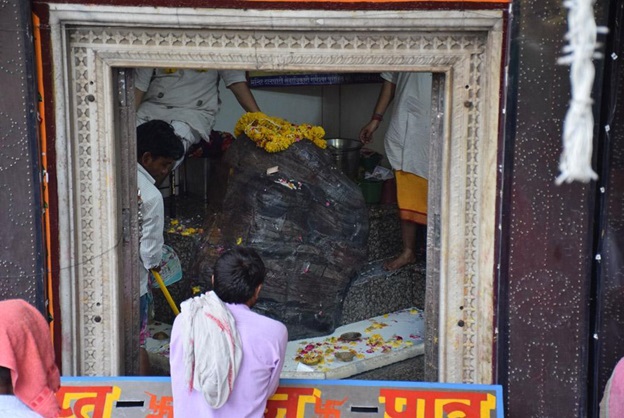
Mukhāravinda temple houses a big rock located at the base of Govardhan hill. This sacred place is also known as shringar sthali. The place is divine and witnesses several other sacred places of Saints nearby. To name a few are Shri Gusainji’s tulsi kiyara, Mahaprabhuji’s tulsi kiyara, Shri Gusainji’s baithakji, Shri Girdharji baithakji, Gokulnath ji’s temple, Shri Madanmohanji’s temple, Shri Mahaprabhuji’s baithak, Shri Chandramaji’s temple, Dandvati Shila and many others. Every place has its own sacred relevance. Many famous Saints did worship these places and even now these places are full of Divine vibrations and energy.
About the village Jatipura
Objective 8: To understand the historical background of Jatipura.
Jatipura located on the West of Giriraj Govardhan, was originally known as Yatipura. Though it was an uninhabited side, Shri Vallabha Acharya liked to live on this side of Girirajji as he found it easier to climb up for Shreeji’s seva.
Another name for a sadhu or sant is ‘Yati’, and anyone looking for Shri Vallabha was directed here. People soon began calling it the place where the ‘Yati’ resides; hence the name Jatipura. In Vraj bhasha ‘Y’ is pronounced as ‘J’.
The14th Pushti marg Baithakji is located in front of the Mukhāravinda. It is from here that Shri Vallabha narrated Bhagwadji to Girirajji.
Madhavendra Puri Samadhi Madhavendra Puri is the Guru Maharaj of Iswara Puri, who is the Diksha Guru of Chaitanya Mahaprabhu. Madhavendra Puri did his bhajan here at Govardhan.
Story behind Lord’s presence:
Objective 9: To know the legends associated with Mukhāravinda.
Dandvati shila is believed to have been six feet tall when ShreeNathji went to Mewar. Due to the curse given by Pulastya Muni to Giriraj Govardhan it reduces in size each day. This Dandvati shila is already on the earth and so the land around it has been dug so that the darshans are visible to the devotees.
According to legends, Shri Krishna left Braj dham and went to Nathdwara for further duties. On request of Gopis and Brijwasis, Shri Krishna decided to come to sleep here for six months. It is considered that Shri Krishna comes to rest here for six months every year, from Vasant Panchmi to Dassehra. After the Sandhya Aarti at his Nathdwara temple, he comes to the Mukhāravinda Mandir in Shri Govardhan to give Shayan Darshans. During this period, his presence can be felt by the receptive devotees.
The main offering to the divine deity is milk. People across the world come to worship. Abhishek, a special pooja offered to Bhagavan to please him, can be done here by the devotee. During the festival period, a huge crowd is witnessed. Hundreds of devotees visit daily and offer milk and flowers to the deity etc.
Darshan Timings:
Morning:- 05:30 AM to 11:00 AM
Evening:- 04:00 PM to 10:00 PM