
Objectives:
Objective 2: To learn the location and physical features of the kundas.
Objective 3: To describe the sacred features, groves, and devotees connected to the kundas.
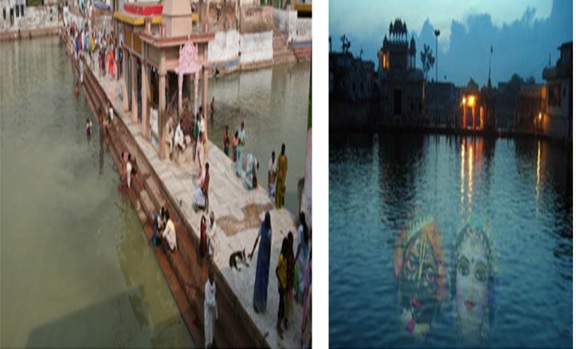 The Sacred Ponds of Divine Love
Objective 1: To know the sacred significance of Radha Kunda and Shyama Kunda as the holiest places of Vraja.
Radha Kunda and Shyama Kunda hold a revered place in the hearts of millions of devotees of Sri Krishna and Srimati Radharani. These sacred ponds are not only sites of immense religious significance but also a symbol of divine love, eternal devotion, and spiritual transcendence. They are considered holiest places within the three worlds, because these two ponds were the most confidential bathing places of both Srimati Radharani and Sri Krishna. Radha-Kunda was one of the principal sites of the ashta-kāliya-nitya-lila (eight-fold daily pastimes) that take place between Srimati Radharani and Sri Krishna and also one of the places where they performed the rāsa-lila. There are six rasa-mandalas at Radha Kunda established by Narayana Bhatta that commemorate the rasa-lila pastimes. The Puranas also say that Radha Kunda is one of the important upavanas or sub-forests of Vraja and is known as Shri-vana. The name Shri is another name of Srimati Radharani.
Objective 2: To learn the location and physical features of the kundas.
Location:
Radha Kunda and Shyama Kunda are around 26 km (16 miles) west of Mathura.
Description of the Kundas
Each kunda covers about two hundred square feet. Radha Kunda is separated from Shyama Kunda by a retaining wall rising just above the water. This wall is topped with ornate columns. A chatra shades the marble footprints of Srimati Radharani and Sri Krishna molded according to scriptural descriptions installed by Srila Bhaktisiddhanta Saraswati Thakura.
Objective 3: To describe the sacred features, groves, and devotees connected to the kundas.
Sacred Features of Radha Kunda and Shyama Kunda
In the center of Radha Kunda, there is a small, enclosed area known as Kāncana Kunda. This kunda marks the exact spot where Srimati Radharani and Her friends dug the original sacred pond using their bangles.
To honor the spot where Sri Krishna killed the demon Aristasura, Krishna’s great-grandson Vajranābha later constructed a bathing tank at Shyama Kunda. When Shyama Kunda is filled with water, this ancient tank is hidden from view. But during times when the water level drops, one can see a small, deeper walled section in the center—this is called Vajranābha Kunda.
Shyama Kunda is also traditionally known as Arista Kunda. Around it are the groves of Sri Krishna’s most intimate and trusted cowherd friends, like Madhumangala, Subala, and Ujjvala. These boys have lovingly offered their forest groves to Krishna’s dearmost gopi companions for His pastimes with them.
In the northwestern corner of Shyama Kunda, there is Subala’s grove, known as Manasa Pavana Ghata. This is a very sacred place where Srimati Radharani and Her girlfriends bathe every day with deep devotion. The water here is considered spiritually extraordinary—it contains the sweet nectar flowing from Sri Krishna’s lotus feet, and for this reason, it is as dear to Srimati Radharani as Sri Krishna Himself.
Surrounding Radha Kunda in the eight directions are the beautiful forest groves of Srimati Radharani’s eight chief companions—Lalita, Vishakha, Chitra, Indulekha, Campakalata, Ranga Devi, Tungavidya, and Sudevi. In the very center of Radha Kunda is the sacred grove of Sri Ananga Manjari, who is Srimati Radharani’s younger sister and an expert assistant in Her divine pastimes.
Objective 4: To understand the spiritual significance and divine pastimes associated with the formation of the kundas.
Spiritual Significance
According to ancient scriptures and devotional traditions, Radha Kunda was formed by Srimati Radha Rani herself during the Dvapara Yuga, following a divine pastime (lila) involving Sri Krishna.
As the story goes; after Sri Krishna killed the demon Aristasura (who took the form of a bull), Srimati Radharani and her sakhis (friends) playfully refused to associate with Sri Krishna, claiming that he had committed the sin of killing a bull, considered sacred.
To purify himself, Sri Krishna dug a kunda (pond) with his heel and filled it with the waters of all holy rivers. Srimati Radharani, not to be outdone, and to assert her divine position, created her own kunda nearby, with the help of her friends, which was later filled with water from Sri Krishna’s kunda — symbolizing the inseparable love between Srimati Radharani and Sri Krishna.
It is said that a single drop from Radha Kunda grants the highest spiritual benediction.
Objective 5: To highlight the historical role of the kundas in protecting deities during Aurangzeb’s time.
Historical Significance
Murtis at Radha-kunda:
In the year 1670, the Mughal tyrant Aurangzeb was planning an attack on Vrindavan to destroy all the temples and desecrate all the deities. Fortunately, having received an advance warning through spies employed in Aurangzeb’s court by the Rajput princes, all the important deities of the Gaudiya Goswamis were smuggled out of Vrindavan in bullock carts and taken to Radha Kunda. It has been said that the deities were actually hidden in the kunda until the initial danger had passed. The deities spent a number of days at Radha-kunda, where they were worshiped daily by the local residents before being taken to Kamyavana, and then finally to Jaipur in Rajasthan. After the Gaudiya Goswami’s deities left Radha Kunda, the local Vrajavasis and Vaishnavas felt great separation from them and therefore it was decided to establish replica temples containing the pratibhu-murtis or empowered expansions of the original Goswami deities. This also meant that residents of Radha-kunda could have darshan of the ‘Seven Goswami Temples of Vrindavan’, without having to leave Radha Kunda.
Objective 6: To know the rediscovery and renovation efforts by Chaitanya Mahaprabhu and the Goswamis.
Rediscovery and Renovation of the Kundas
Vajranābha Maharaja, who was at that time the King of Mathura, excavated the sacred kundas and built stone ghalas around both Radha Kunda and Shyama Kunda. Unfortunately, due to the long passage of time and the ever changing socio-political climate in India during the course of the following fifty centuries, these two sacred kundas were eventually forgotten and within time became covered over and completely disappeared.
In the early 16th Century, ‘Golden Avatara’ Sri Chaitanya Mahaprabhu, during His historic parikrama around the twelve sacred forests of Vrindavan in the year 1515, accompanied by His assistant Balabhadra Bhattacharya, rediscovered a number of important holy places. His most important discovery was the sacred ponds known as Radha Kunda and Shyama Kunda, the most confidential bathing places of Srimati Radharani.
Recognizing their sacredness, Sri Chaitanya Mahaprabhu later sent His senior-most disciples in the form of the Six Goswamis to excavate and renovate Radha-kunda and all the other holy places connected to Sri Krishna’s transcendental pastimes in Vraja Mandala that had taken place five thousand years earlier.
Based on the above instructions Srila Raghunatha Dasa Goswami stayed at Radha Kunda. At that time, Radha Kunda and Shyama Kunda were only 12 feet by 12 feet in size.
One rich man named Sampanna went to Badrinath to offer Lord Narayana a large donation. In a dream, Lord Krishna told him to go to Radha Kunda and give the money to Srila Raghunatha Dasa Goswami to renovate the kundas, which he did.
Srila Raghunatha Dasa Gosvami and Srila Jiva Gosvami supervised the expansion of the kundas around the year 1554.
Bahulāṣṭamī – Appearance Day of Radha Kunda and Shyama Kunda
The day on which Radha Kunda appeared in this world is known as Bahulāṣṭamī, which falls on the eighth day (aṣṭamī) of the dark fortnight (kṛṣṇa-pakṣa) in the month of Kārtika (October–November). Since Radha Kunda manifested at midnight, thousands of devotees gather on this sacred night to take their ritual bath exactly at midnight, known as the ardha-rātri-snāna. This midnight bath is unique and is considered one of the most spiritually powerful in the entire world.
Objective 8 : To understand the spiritual practices and proper etiquette followed at Radha Kunda and Shyama Kunda.
Spiritual Practices and Etiquette
Devotees perform parikrama of both kundas, barefoot and chanting Krishna’s names.
Bathing in the kunda purifies the soul and brings one closer to experiencing prema bhakti—the pure, selfless love exemplified by Srimati Radha Rani. Radha-kunda is considered to be the liquid form of Radharani; therefore, one must observe the proper etiquette in accordance with the Vaishnava scriptures.
Bathing is done with the utmost reverence—one should first touch the water with the right hand, then enter, emulating Srila Raghunatha Dasa Goswami’s humility.
Some even crawl into the kundas on their knees, while others pour the water over their heads without entering, to avoid offense.
Objective 9: To highlight the glorification of these kundas by great saints, acharyas, and scriptures.
Glorification of Radha and Shyama Kunda
Many saints and spiritual leaders, including Sri Chaitanya Mahaprabhu, Srila Rupa Goswami, and Srila Raghunatha Dasa Goswami, have visited and glorified Radha Kunda. In fact, Srila Raghunatha Dasa Goswami spent his final years in intense bhajan (devotional meditation) on the banks of this sacred kunda.
1.Teachings of Srila Raghunatha Dasa Goswami
“One can immediately attain pure love for God just by bathing once in Radha Kunda.”
“Radha Kunda is the place of Radha’s joyful pastimes. Anyone who bathes there can attain loving devotion to God.”
2.Teachings of Srila Krishnadasa Kaviraja Goswami
From Chaitanya Charitamrita, the biography of Lord Chaitanya:
“Anyone who even once bathes in Radha Kunda will receive love for Krishna similar to Radharani’s love.”
3.Teachings of Srila Prabhupada
In his commentary to The Nectar of Instruction (Verse 11), Srila Prabhupada writes:
“A devotee will at once develop pure love for Krishna in the mood of the gopis (Krishna’s dearest devotees) simply by bathing once in Radha Kunda.”
4.Teachings of Vishwanatha Chakravarti Thakur
“Radha Kunda and Shyama Kunda are direct forms of Radha and Krishna’s divine love. Bathing in these ponds is like bathing in Their love itself. Those who bathe here are the most fortunate.”
5.From the Padma Purana (Scripture)
“If someone bathes in Radha Kunda on the day of Bahulastami in the month of Kartik (October–November), they become extremely dear to Krishna.”
Radha Kunda and Shyama Kunda are not just a geographical location; they are spiritual gateways. They offer a unique glimpse into the transcendental love of Srimati Radharani and Sri Krishna — a love that is selfless, divine, and eternal.
For those on a spiritual path, visiting these Kundas are not merely a pilgrimage; it is a profound journey inward, into the heart of devotion itself.
