
Objectives :
Objective 1: To learn about the significance of Jantar Mantar as an astronomical observatory and highlight Maharaja Jai Singh’s efforts in advancing scientific knowledge through the integration of Indian and foreign research.
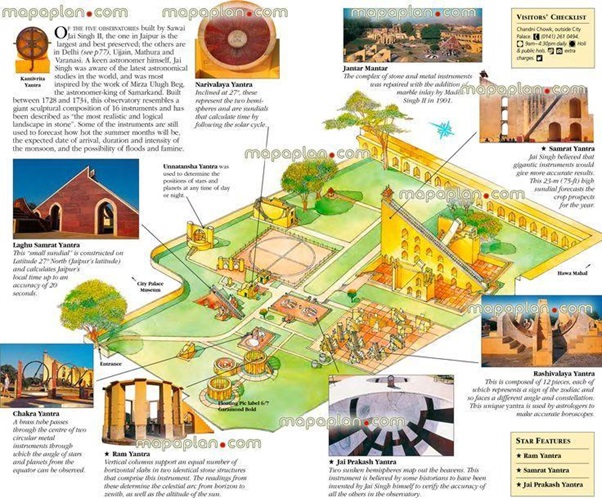
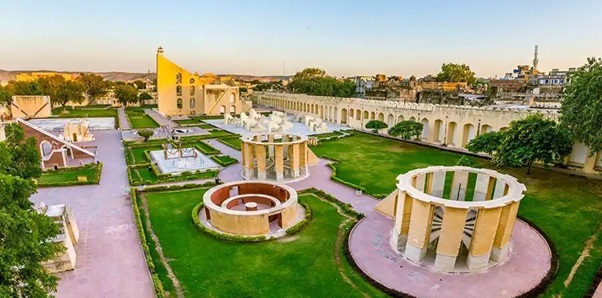
East of the Chandra Mahal is the Jantar Mantar. It is an open-air observatory, which was designed by Maharaja Jai Singh in 1728. Before commencing the observatory, he sent scholars abroad to study other foreign observatories so that he would have one that would satisfy his passion for astronomy. In order to achieve accuracy, the instruments were made from stone and marble. Each of these curious sculptures has a specific purpose such as measuring the positions of stars, altitudes, and azimuths and calculating the times of eclipses. The most striking instrument is the sundial with its 27m-high gnomon (the rod of the sundial). At Jantar Mantar the visitor gets a glimpse of the scientific temperament of Sawai Jai Singh. His passion for astronomical studies grew with the years and he made a careful study of the work of Hindu Islamic and Western scholars. He even invited astronomers from abroad who brought details of the latest astronomical research being done in Europe.
Jai Singh was unhappy with the results he was getting from the regular brass instruments and decided to build this giant observatory to get the precision that he demanded. While building these instruments in stone and marble he was helped by Pandit Jagannath, Kewal Ram and Vidyadhar Bhattacharya. The instruments were accurate to a remarkable degree.
The Samrat Yantra is a huge sundial and Jaipur’s solar time was read here. It is said, “from reading the position of the dot of light, the altitude declination, zenith and distance of the sun can be seen. The variation in the sun’s diameter can also be accurately measured and even the sun spots could be clearly observed. The Jai Prakash Yantra measures the rotation of the sun and it is used in finding out longitude and latitude and the sign of the zodiac in which it is placed. The movement of the stars can be traced with remarkable accuracy with the Ram Yantra. The Reshvalayas Yantra has twelve small sundials for each of the signs of the zodiac and the Yantra Raj is a brass disc that is the largest astrolabe in the world. Calculations for the Hindu calendar, festivals and other religious times are made with this instrument.
Objective 2: To know about the meaning and origin of the name Jantar Mantar and its connection to the Sanskrit words for instrument and calculation.
The name jantar is derived from “yantra” a Sanskrit word, meaning “instrument, machine”, and mantar from “mantrana” also a Sanskrit word meaning “consult, calculate”). Therefore, Jantar Mantar literally means ‘calculating instrument’
Objective 3: To learn about the life and contributions of Maharaja Sawai Jai Singh, explain his role in founding astronomical observatories in India, and highlight his dedication to the advancement of scientific and cultural knowledge.
Sawai Jai Singh The Founder of Observatories in India
Maharaja Sawai Jai Singh was born on 3rd November, 1688 at Amber, the erstwhile capital of Kachhawas. His father Maharaja Bishan Singh was told by astrologers that Jai Singh would earn glory and fame beyond anybody’s imagination. Bishan Singh made arrangements to provide his son the best possible education in all the field. But his untimely death in 1699 A.D. forced young Jai Singh to ascend to the throne at the age of 11.
Young Jai Singh was much wiser and wittier than most people of his age. He was an equally brave soldier. Mughal emperor Aurangzeb bestowed upon him the title of Sawai which meant one and a quarter times superior to his contemporaries. This title adorns his descendants even to this date.
Sawai Jai Singh continued his pursuit for knowledge and education even after he was enthroned. He learnt religion, philosophy, art, architecture, astronomy and astrology. He acquainted himself thoroughly with the Hindu, Greek, Muslim and European Schools of Astronomy. He studied Ptolemy’s Syntaxis De La Hire’s Tabulae Astronomical, Flamsteed’s Historia Coelestis Britannica, Newton’s Principia, Euclid’s Clements, Mirza Ulugh Beg’s Astronomical Tables besides the Master works of Aryaa Bhatta, Varahmihira, Brahma gupta and Bhaskaracharya.
In 1719 A.D. he witnessed a noisy discussion in the court of Mughal emperor Mohammed Shah. The heated debate was regarding ascertaining certain astronomical calculations for finding out an auspicious date when the emperor could start a journey. This discussion made Jai Singh think that the nation needed to be educated on the subject of astronomy. He decided to construct Astronomical observatories for this purpose.
By 1724 A.D., he completed the first such observatory at Delhi. During this time Jai Singh was also busy with the ambitious project of shifting his capital from Amber to Jaipur, a city to be named after him. He executed this plan in 1727 A.D., by laying the foundation stone of Jaipur and simultaneously the construction of an observatory at Jaipur also began.
In the next few years Sawai Jai Singh constructed three more observatories at Varanasi, Ujjain and Mathura. These observatories came to be known as JANTAR MANTARS. The astronomical devices in these observatories are of Hindu origin but the construction technique and masonry is Islamic. On hearing about these observatories being constructed in Jaipur, a number of Europeans came to see it in the 18th century.
A glorious chapter ended on 21st September 1743 when Maharaja Sawai Jai Singh left for his heavenly abode. But he made himself immortal with the grandiose constructions called Jantar Mantar besides founding the Pink City of Jaipur. He was cremated at the Royal Crematorium at Gatore in the north of Jaipur.
Bhairav Temple – located within the Jantar Mantar Complex
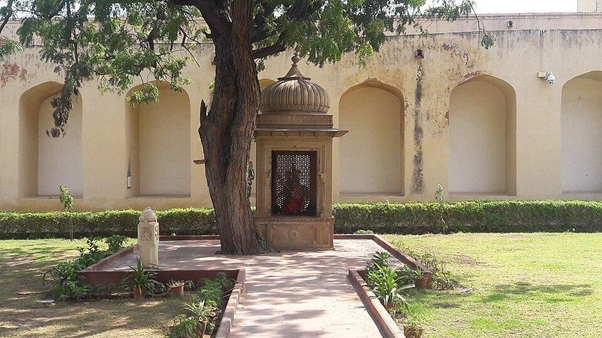
This is a small temple structure located within the Jantar Mantar complex with the words “Bhairav temple” written on a stone plaque. It is supposed to have been constructed at a later time period when the use of the observatory died down.
Objective 4: To know about the key astronomical instruments (Yantras) at Jantar Mantar and explain their functions, significance, and contributions to the advancement of ancient Indian astronomy.
Some of the Key Yantras in Jantar Mantar
Jai Prakash Yantra
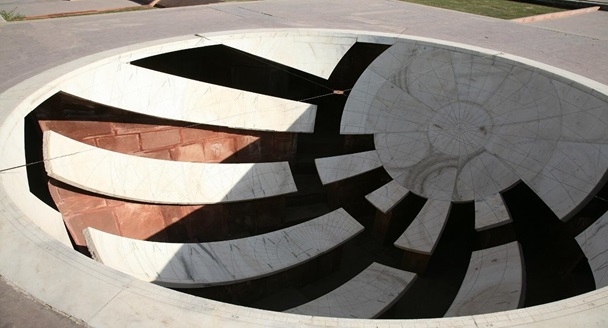
The Jai Prakash Yantra consists of two complementary hemispherical bowls, partially embedded in the ground, with engraved coordinate systems on their inner surfaces. These instruments project an inverted image of the sky, enabling observers to determine the position of celestial bodies using both azimuth-altitude and equatorial coordinates. Invented by Jai Singh II, it is considered one of his most complex and ingenious creations, allowing for continuous observation by switching between the twin hemispheres.
Narivalaya Yantra
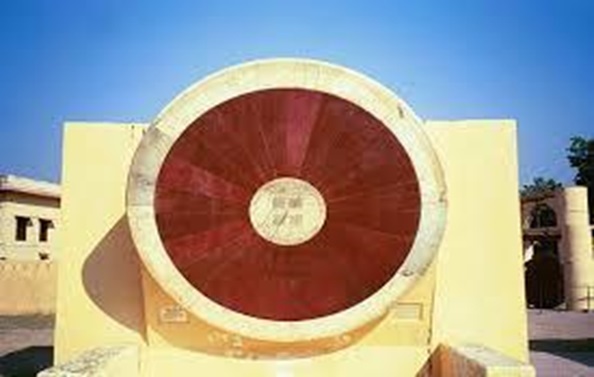
The Narivalaya Yantra is an equatorial sundial composed of two circular plates—one facing north and the other south—each used for six months of the year depending on the Sun’s position relative to the equator. These dials measure local solar time by tracking the shadow cast by a central rod aligned with the Earth’s axis. This instrument exemplifies the precision with which ancient Indian astronomers accounted for seasonal solar movement and timekeeping throughout the year.
Chakra Yantra
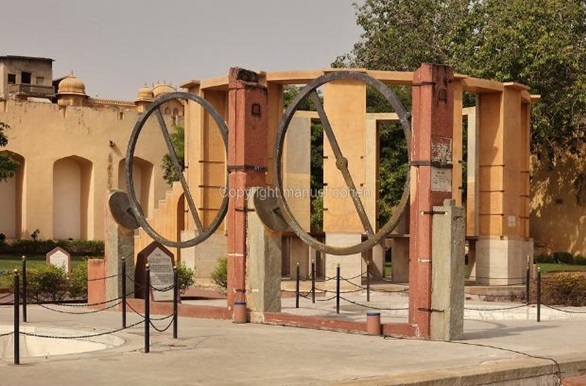
The Chakra Yantra is a ring-shaped instrument used to measure the declination and hour angle of celestial bodies. Though less visually imposing than the Samrat or Jai Prakash Yantras, it plays a crucial role in determining the coordinates of stars and planets. Its design allows astronomers to track the daily motion of celestial objects across the sky, contributing to accurate astrological and astronomical calculations.
Rama Yantra
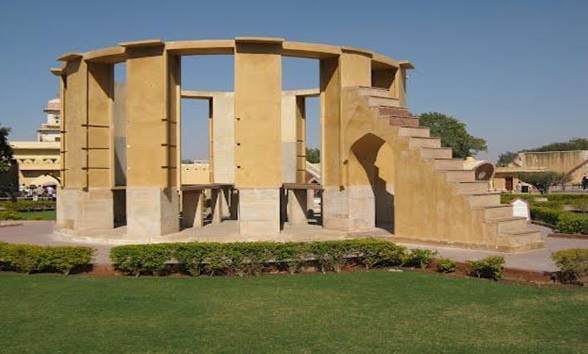
The Rama Yantra comprises two open cylindrical structures with a central vertical pillar and walls marked with angular scales. It is used to measure the altitude and azimuth of celestial objects by aligning the object with the top of the central pillar and the corresponding point on the floor or wall. This instrument allows for direct observation of the sky both day and night and is particularly accurate near 45° altitude, making it a vital tool for positional astronomy.
Yatraraj Yantra (Shree Yantra)
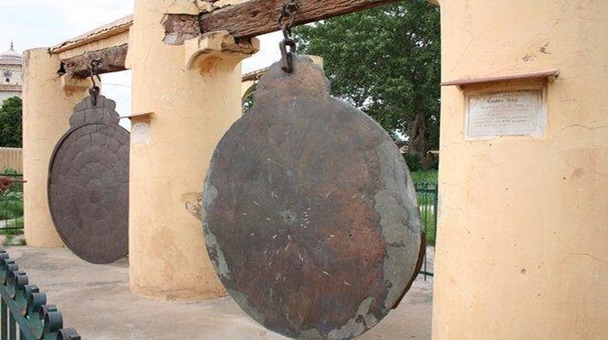
The Yatraraj Yantra, also known as the Shree Yantra or Yantra Raj, is revered as the king of all Yantras in Vedic and Tantric traditions. Composed of nine interlocking triangles radiating from a central bindu (point), it symbolizes the union of Shiva and Shakti, the masculine and feminine cosmic principles. Though not a physical astronomical instrument like the others at Jantar Mantar, it represents the metaphysical foundation of all energy and cosmic order. Its intricate geometry is believed to encapsulate the entire universe, making it a powerful tool for meditation, spiritual awakening, and invoking divine blessings.
Small Samrat Yantra (Laghu Samrat Yantra)
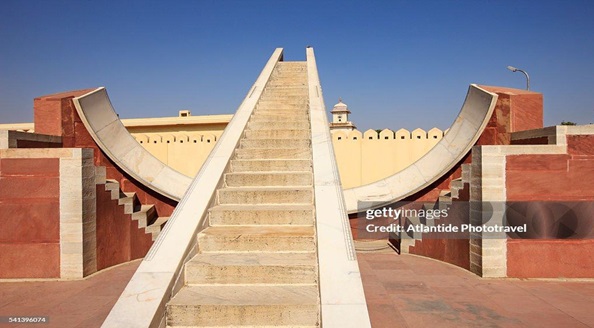
The Small Samrat Yantra, or Laghu Samrat Yantra, is a scaled-down version of the Great Samrat Yantra and serves as a precise equinoctial sundial. Though smaller in size, it is capable of measuring local solar time with an accuracy of up to 20 seconds. Its triangular gnomon is aligned with the Earth’s axis, and the shadow it casts on the calibrated quadrants allows observers to determine the time of day. This instrument was likely used for quick, practical readings and educational demonstrations, reflecting the observatory’s blend of scientific rigor and accessibility.
Great Samrat Yantra (Vrihat Samrat Yantra)
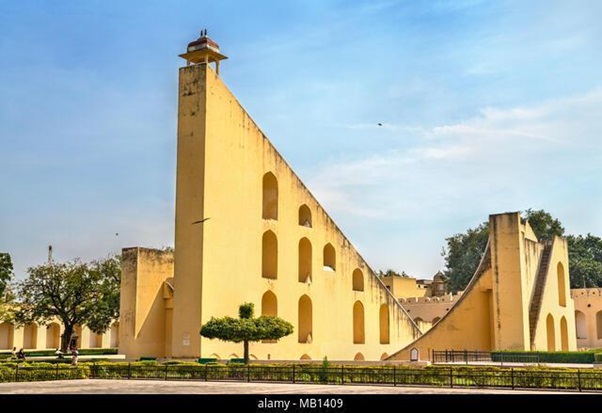
The Great Samrat Yantra, or Vrihat Samrat Yantra, is the most iconic and monumental instrument at Jantar Mantar, Jaipur. Standing 27 meters tall, it is the world’s largest stone sundial and can measure time with an astonishing precision of up to two seconds. Its massive triangular gnomon is aligned precisely with the Earth’s axis, and its flanking quadrants are marked with fine time divisions. This instrument not only demonstrated the advanced astronomical knowledge of Maharaja Jai Singh II but also served as a symbol of India’s scientific heritage and architectural brilliance.
Ancient Roots of Indian Astronomy
Although the Vedas mention time, calendars, and celestial movements, they don’t describe physical instruments. The earliest references to astronomical tools like the gnomon (śaṅku) and water clocks appear in the Vedangas—ancient Sanskrit texts that laid the foundation for Indian astronomy. Over time, scholars like Aryabhata, Brahmagupta, Varahamihira, and Bhaskara developed detailed theories and instruments such as the chakra-yantra, kapala-yantra, and nadivalaya-yantra. These ideas were preserved and expanded in Hindu, Buddhist, and Jain texts, forming a rich legacy of observational science that inspired later innovations like those at Jantar Mantar.
Jantar Mantar: A Monument of Science and Symbolism
Built in the early 18th century by Maharaja Sawai Jai Singh II, Jantar Mantar in Jaipur is the largest and best-preserved of five observatories he constructed across India. It houses 19 massive stone instruments designed for naked-eye observation of celestial bodies. These instruments measure time, track planetary positions, and predict eclipses with remarkable precision. Jai Singh’s goal was to refine existing astronomical tables and improve calendar accuracy. While the observatory’s instruments are scientifically impressive, there’s limited evidence of a formal research program, suggesting that Jantar Mantar also served symbolic, educational, and cultural purposes.
The Zij Muhammad-Shahi: A Fusion of Traditions
Jai Singh’s astronomical handbook, the *Zij Muhammad-Shahi*, was compiled under his patronage but relied more on existing Persian and European tables—like those of Ulugh Beg and Philippe de la Hire—than on fresh data from his observatories. He adapted these sources by correcting for the precession of the equinoxes and adjusting for India’s longitude. This shows that while the instruments at Jantar Mantar were capable of precise measurements, the observatory also functioned as a bridge between traditional Indian astronomy and global scientific knowledge.
