Objectives:
Objective 1: To know where the Amber fort is situated.
Objective 2 : To understand the historical significance of the Amber Fort.
Objective 3: To know about the Architectural features of the Fort.
Objective 4: To Know about its heritage importance.
Objective 1: To know where the Amber fort is situated.
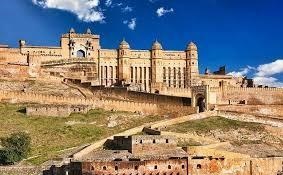
Amber Fort is situated in the valley of the Aravalli ranges just below Jaigarh Fort. Prior to shifting their capital to Jaipur, Amber was the capital of the Kachhwaha Rajputs. Amer Fort or Amber Fort is a fort located in Amer, Rajasthan, India. Amer is a town with an area of 4 square kilometres (1.5 sq mi) located 11 kilometres (6.8 mi) from Jaipur, the capital of Rajasthan. Located high on a hill, it is the principal tourist attraction in Jaipur.
Objective 2: To understand the historical significance of the Amber Fort.
Amber was initially under the domain of the Susawat Meena tribe. In the 11th century, Dulahrai (Dhola), the son of Sodhadeva laid the foundation of the Kachhwaha dynasty in the Dhundhar region. His son, Kakil Dev took over the reign of Amber from the Meenas.
Raja Man Singh I started the construction of the new palace complex in the end of the 16th century. After Raja Man Singh I, Mirza Raja Jai Singh I and Sawai Jai Singh II made modifications and changes as per the needs from time to time. They also changed the interior decoration as per their own interests. The entire fort was constructed in four stages.
Amer Fort is known for its artistic style elements. With its large ramparts and series of gates and cobbled paths, the fort overlooks Maota Lake, which is the main source of water for the Amer Palace.
Objective 3: To know about the Architectural features of the Fort.
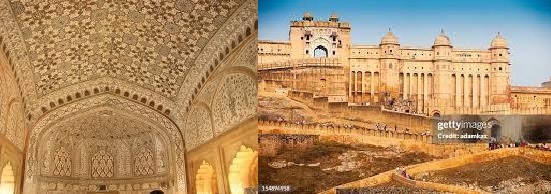
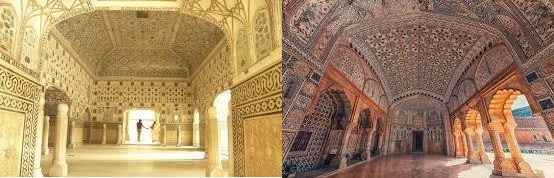
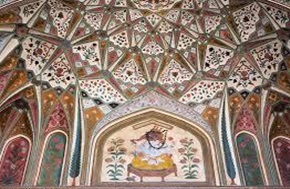
Amer Palace is great example of Rajput architecture. Some of its buildings and work have influence of Mughal architecture. Constructed of red sandstone and marble, the attractive, opulent palace is laid out on four levels, each with a courtyard. It consists of the Diwan-e-Aam, or “Hall of Public Audience”, the Diwan-e-Khas, or “Hall of Private Audience”, the Sheesh Mahal (mirror palace), or Jai Mandir, and the Sukh Niwas where a cool climate is artificially created by winds that blow over a water cascade within the palace. Hence, the Amer Fort is also popularly known as the Amer Palace. The palace was the residence of the Rajput Maharajas and their families.
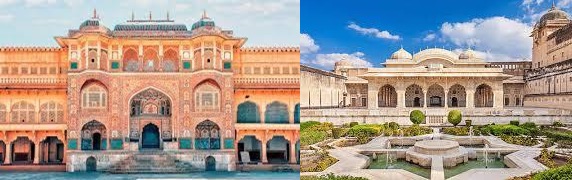
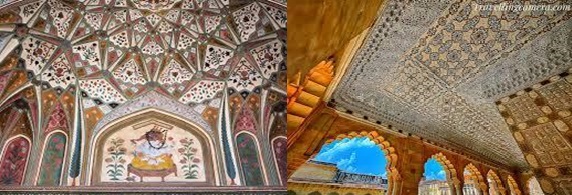
At the entrance to the palace near the fort’s Ganesh Gate, there is a temple dedicated to Shila Devi, a Goddess of the Chaitanya cult, which was given to Raja Man Singh when he defeated the Raja of Jessore, Bengal in 1604. (Jessore is now in Bangladesh).
Raja Man Singh had 12 queens so he made 12 rooms, one for each Queen. Each room had a staircase connected to the King’s room but the Queens were not to go upstairs. Raja Jai Singh had only one queen so he built one room equal to three old queen’s rooms.
This palace, along with Jaigarh Fort, is located immediately above on the Cheel ka Teela (Hill of Eagles) of the same Aravalli range of hills. The palace and Jaigarh Fort are considered one complex, as the two are connected by a subterranean passage. This passage was meant as an escape route in times of war to enable the royal family members and others in the Amer Fort to shift to the more redoubtable Jaigarh Fort.
Objective 4: To Know about its heritage importance
At the 37th session of the World Heritage Committee held in Phnom Penh, Cambodia, in 2013, Amer Fort, along with five other forts of Rajasthan, was declared a UNESCO World Heritage Site as part of the group Hill Forts of Rajasthan.