Objectives:
Objective 1: To learn about the origin and establishment of Govind Dev Ji Temple by Maharaja Sawai Jai Singh II.
History of Govind Dev Ji Temple
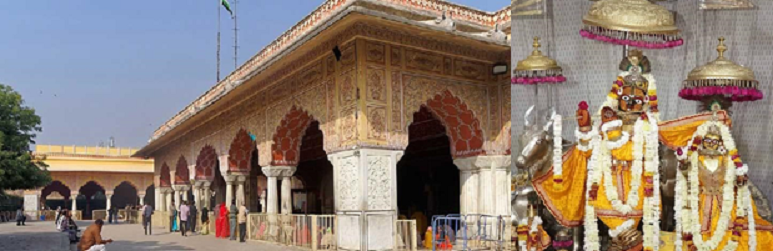
The Govind Dev Ji Temple in Jaipur is a historically significant temple dedicated to Lord Krishna, specifically in his form as Govinda. The temple, located within the City Palace complex, was established in the 18th century by Maharaja Sawai Jai Singh II. The deity, Govind Dev Ji, was brought from Vrindavan and has been a central part of Jaipur’s cultural and spiritual landscape since then.
Key Historical Points:
Establishment:
The temple was built by Maharaja Sawai Jai Singh II in the 18th century, according to a Jaipur Tourism website.
Deity:
The main deity, Govind Dev Ji, is a form of Lord Krishna, and the temple is also dedicated to his consort, Radha.
Location:
It’s situated within the City Palace complex, specifically between Badal Mahal and Chandra Mahal.
Significance:
The temple is a major place of worship for those following the Gaudiya Vaishnavism tradition.
Architectural Style:
The temple’s architecture blends Hindu Rajput and Islamic Mughal styles.
The Satsang Hall, with its widest single-span RCC flat roof, is recognized by the Guinness Book of World Records.
Royal Patronage:
The temple held special significance for the royal family, according to the Inc#ff0000ible India website and Sawai Jai Singh II even built his palace to face the temple.
In summary:
The Govind Dev Ji Temple in Jaipur is a historically important temple, established in the 18th century by Maharaja Sawai Jai Singh II, dedicated to Lord Krishna and his consort Radha. It’s located within the City Palace complex and has a unique blend of architectural styles, with the Satsang Hall being a noteworthy feature.
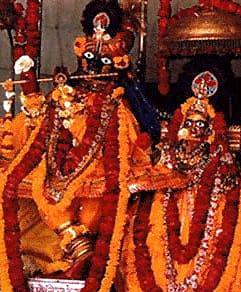
Objective 2: To understand the significance of Govind Dev Ji as a manifestation of Krishna’s original face form, as crafted by Vajranabha.
The deity of Govind Dev Ji was originally created by Vajranabha, the great-grandson of Krishna based on the descriptions of Krishna given by Uttara, the mother of King Parikshith. According to legend, Vajranabha created three deities of Krishna: one representing the exact form of Krishna from his hip to feet (Madan Mohan Ji deity), one representing the exact form of Krishna from his hip to neck (Gopinath Ji deity), and one his face (Govind Dev Ji deity). The temple is historically significant as the site where Baladeva Vidyabhushana, an important philosopher of the Gaudiya Vaishnavism tradition, composed the Govinda Bhashya, a commentary on the Brahma Sutras (Vedanta sutras), after receiving guidance in a dream from the Govind Dev Ji deity.
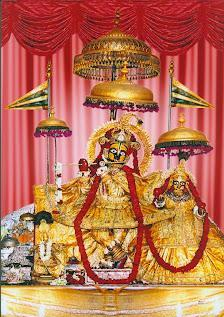
Objective 3: To understand the historical journey of the deity from Vrindavan to Jaipur and explore the significance of Mughal invasions in influencing the relocation and protection of Krishna temples
Srila Rupa Gosvami originally established this temple under the instruction of Sri Chaitanya Mahaprabhu, being orde#ff0000 to excavate all the lost holy places of Vrindavan. Five thousand years earlier, Lord Krishna’s grandson, Vajranaba, installed a number of important Deities in Vrindavana; Govindaji was one of these Deities. Rupa Gosvami searched all over Vrindavan to locate the Yogapith, the resting place of the original Deity of Govindaji, but after months of searching, the Deity could not be found.
Feeling disappointed, Rupa Gosvami came and sat by the bank of the Yamuna river and shedding tears, he began to call out the name of Lord Caitanya. Suddenly, Lord Krishna appea#ff0000 in the guise of a beautiful brijabasi boy. He informed Rupa Gosvami that there was a cow that came every day to a nearby hillock, and the cow emptied its milk into a hole on the hilltop. He asked Rupa to accompany him to the place to see what might be contained in the hole. Rupa Gosvami followed the boy and upon reaching the spot, the boy disappeared.
Looking within the milk drenched hole, Rupa Gosvami immediately fell unconscious in a wave of ecstatic emotions. When he recovered, he summoned the local people who then excavated the hole and found the beautiful Deity of Lord Govinda. The loud cries of “Hey Govinda, Hey Krishna” suddenly reverberated throughout the sky.
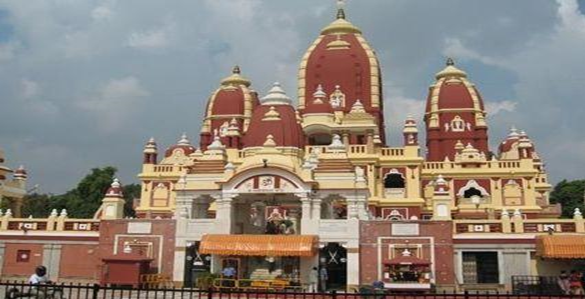
The construction of the temple of Radha Govinda began under the guidance of Raghunatha Bhatta Gosvami and his disciples headed by Raja Man Singh of Jaipur sometime after 1570. It was the most impressive edifice that Hindu art had ever produced in the whole of Northern India. This temple was originally seven stories tall with a marble altar, silver and gold. A sculptured lotus flower weighing several tons decorates the main hall. At the request of Rupa Goswami, Man Singh of Jaipur, a general in Emperor Akbar’s army, built this magnificent temple.
Less than one hundred years later, Emperor Aurangzeb, the Muslim zealot, was standing on the ramparts of his fort at Agra, and noticed a bright light burning in the far distance. Upon being informed that this was a large ghee lamp kept atop the Radha Govinda temple in Vrindavan, he became furious that a Hindu shrine was taller than any Muslim building and immediately ordered its destruction. By the time the soldiers of Aurangzeb arrived, Lord Govindadeva and all the important Deities of Vrindavana had been moved to safer places. The soldiers of Aurangzeb dismantled the top floors of the Govindaji temple and desecrated the sanctum sanctorum as well as mutilated all the stone carvings within the temple. At that time, suddenly the ground began to shake violently and Aurangzeb’s men panicked and ran for their lives, never to return. Because the soldiers of Aurangzeb desecrated the main temple, it is believed that worship cannot continue in that temple. Therefore the present temple was established behind the original Govindaji temple and it contains the pratibhu deities of Radha Govinda. The original Deities of Govinda were brought to Jaipur. The pratibhu deities are considered to be the same as the originals.
The deities on the altar in this temple are Govindaji in the middle, to His left is Lord Chaitanya, and to His right is Lord Nityananda. Below are small Radha and Krishna Deities. Below Them are Lord Jagannath and a Govardhana-shila.
Before its destruction the temple stood seven stories high. Just two stories remain. Still, the Radha Govinda Temple remains a towering monument to Lord Govinda and a place where one can feel a connection to the great saints of the past and the history of Krishna devotion in Vrindavan.
History of Govind Dev Ji Temple Jaipur
Govind Ji was taken care of by Sri Shiv Ram Goswami in Vrindavan. In pursuit of saving the deities, he kept transferring the deities from Vrindavan to Kama in Bharatpur to Radhakund to Govindpura in Sanganer.
Since Lord Govind Dev Ji was the principal deity of the ruling dynasty, the then ruler of Amer, Maharaja Sawai Jai Singh took the responsibility of providing protection to the deity and placed it in Amer Valley which was later named as Kanak Vrindavan in 1714 AD. However, they could worship openly because the king served the Mughal court during that time and could not afford to have a stand-off with the Mughals.
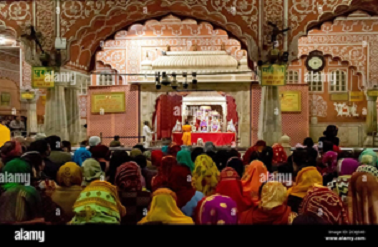
The deity of Govind Ji was placed at the Surya Mahal in 1735 AD, by Maharaja Sawai Jai Singh after he received instructions in his dreams from the Lord himself to do so. The Maharaja enshrined the deity at Suraj Mahal as he thought the palace belonged to Lord Govind Ji and he himself moved his residence to a new palace and named it Chandra Mahal. The Chandra Mahal was built in such a fashion that the deity of Govind Ji would be in his direct sight from the palace.
The Suraj Mahal was later renamed and is known by its present name, Govind Ji Temple.
Objective 4: To understand the unique architectural blend of Rajput, Mughal, and traditional Hindu styles in the temple.
Architecture and Layout of Govind Dev Ji Temple Jaipur
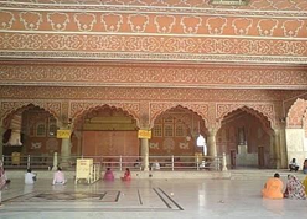
The Govind Ji Temple is built in sandstone and marble with ceilings covered with gold. The architecture of the temple building has a mix of Rajasthani, Muslim as well as Classical Indian elements to it. Since it was built beside a royal residence, the walls are adorned with chandeliers as well as paintings. The temple is also surrounded by a lush #008000 garden and the garden is known by the name, ‘Talkatora’
Additional Information about Govind Dev Ji Temple Jaipur
The Satsang hall of Govind Ji Temple is a separate hall to conduct religious and cultural activities. The concept of a separate hall was conceived by Late Shri Pradhyuman Kumar Goswami Ji and was overlooked and completed by his son, Shri Anjan Kumar Goswami and his grandson, Shri Manas Kumar Goswami Ji.
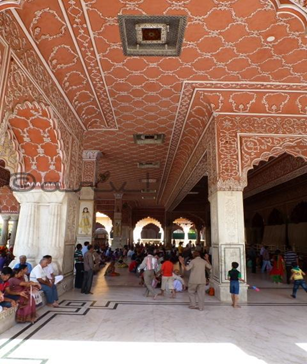
As a matter of fact, the Satsang hall of Govind Ji Temple of Jaipur found its place in the Guinness Book of World Records for being World’s widest single span R.C.C flat roof construction. The span measu#ff0000 118 feet and took 383 days for the construction to be completed with 290 tons of steel and 2000 cubic metres of concrete used.
The holy prasad of the temple is the laddoo, and visitors can purchase the prasad from the temple complex itself.
The daily footfall of devotees at the Govind Ji Temple is around thousands in numbers and goes up to lakhs during festivities.
Mangala Arti is conside#ff0000 to be the most important Arti by devotees. The temple is so aligned that in the older times, the first thing Maharani did in the morning was to bow before the Lord from her window.
There are two temples inside the main temple premises, first one is Gopeshwar Mahadev. Another one is the Giriraj Ji temple. The temple has its own kitchen where they produce prasadam.
This roof only has peripheral pillars and no pillars inside the hall. The temple has Jai Nivas Udyan, the fountain in the Udyan is turned on occasionally.
Objective 5: To recognize the importance of the temple in preserving and promoting Gaudiya Vaishnava philosophy, especially through Govinda Bhashya by Baladeva Vidyabhushana.
Govinda is a Sanskrit name for Krishna, the Supreme Personality of Godhead. Prabhupada tells us that “GO” can indicate cows, senses, or land. Thus the name Govinda conjures images of Krishna in His original form as a rustic cowherd who gives the highest pleasure to the transcendental senses of His devotees as He tends the cows in the land of Vrindavan.
Additionally, vinda means “to give pleasure,” which has subtle implications that speak to the most profound aspects of Gaudiya Vaishnava philosophy. This is so because Govinda is the deity who embodies “the path” – abhidheya tattva – to divine love (prema), or the techniques used to “find” the ultimate goal of life. This contrasts with Madana-mohana and Gopinatha, the other two prominent Vrindavan deities in the Gaudiya tradition, who respectively represent sambandha tattva (the truth that initially establishes one’s relationship with Krishna) and prayojana tattva (the goal of that relationship).