
Objectives:
Objective 1: To learn the historical and spiritual significance of Kāliya Ghat in Vrindavan.
Objective 2: To understand why Kāliya resided in the Yamunā and how his presence affected Vṛndāvana.
Objective 3: To know the details of Sri Krishna’s Kāliya Daman līlā.
Objective 4: To describe how Sri Krishna subdued Kāliya by dancing on his hoods.
Objective 5: To know the prayers offered by the Nāgapatiṇīs and Kṛṣṇa’s response.
Objective 6: To understand the symbolic meaning of Kāliya as representing envy and pride.
Objective 8: To know scriptural references glorifying Kāliya Ghat from Purāṇic texts.
Objective 9: To describe the current state of Kāliya Ghat and its nearby sacred landmarks.
Objective 10: To know about the nearby sacred sites.
Objective 1: To learn the historical and spiritual significance of Kāliya Ghat in Vrindavan.
HISTORICAL SIGNIFICANCE
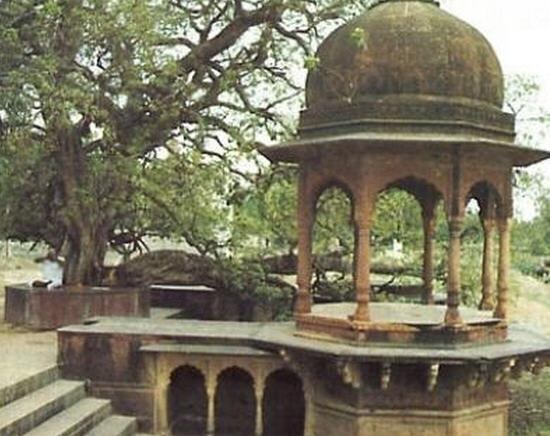
Kāliya Ghat, located near the Madanmohan Temple in Vrindavan, marks the divine site where Lord Śrī Kṛṣṇa subdued the venomous serpent Kāliya by ecstatically dancing on his many hoods. This episode, known as Kāliya Daman Līlā, is one of the most graphic and powerful expressions of Kṛṣṇa’s divine play (līlā) and His mercy upon even the most envious beings.
In ancient times, the River Yamunā flowed adjacent to the ghat, but its course has since shifted. The sacred Kadamba tree, from which Kṛṣṇa leapt into the Yamunā to confront Kāliya, still stands as a witness to the līlā. Pilgrims visit this holy tree, offering prayers and honoring its timeless connection to the Lord’s pastime.
DESCRIPTION OF THE SITE
Exalted Vaiṣṇavas describe this spot as miraculous. East of Kāliya-hrada (Kāliya’s pool) stands a splendid white Kadamba tree, said to remain in bloom throughout the year. Filled with sweet fragrance and vibrant blossoms, it radiates divine splendor in all directions. This tree survived the poison of Kāliya’s lake only due to the nectar previously sprinkled by Garuḍa, the divine carrier of Lord Viṣṇu.
The bhajan-kuṭir and samādhi of Śrīla Prabodhānanda Sarasvatī, as well as the bhajan place of Bilvamaṅgal Ṭhākura, are located nearby, adding to the spiritual aura of the area.
Objective 2: To understand why Kāliya resided in the Yamunā and how his presence affected Vṛndāvana.
KALIYA
Kāliya, a thousand-hooded serpent (with 101 prominent hoods), took refuge in a deep pool within the Yamunā called Kāliya Daha, after offending Garuḍa. Due to the curse of the sage Śaubhari Muni, Garuḍa avoided this spot, and Kāliya, seeking safety, made it his home.
However, Kāliya’s venom boiled the Yamunā, darkened the skies with toxic smoke, and poisoned the surrounding area for miles. Birds fell mid-air, trees withered, and no life could survive except Kāliya, his wives, and sons.
Objective 3: To know the details of Sri Krishna Kāliya Daman līlā.
Kṛṣṇa’s Arrival and Divine Intervention
One day, while herding cows, SriKrishna and the cowherd boys came to this spot to quench their thirst. Upon drinking the poisonous water, the boys and cows fell unconscious. Sri Krishna , moved by their plight, revived them with a glance, a divine act described in the Śrīmad-Bhāgavatam.
Determined to purify the Yamunā and protect Vraja, Kṛṣṇa climbed the Kadamba tree, tied His hair and belt like a wrestler, and dramatically leaped into the poisoned waters. His playful splashing infuriated Kāliya, who emerged to attack.
Kāliya struck and coiled around Sri Krishna , squeezing with all his strength. For hours, the cowherd boys and Vrajavāsīs wept in despair. Then, smiling compassionately, sri Krishna expanded His divine form, effortlessly breaking free.
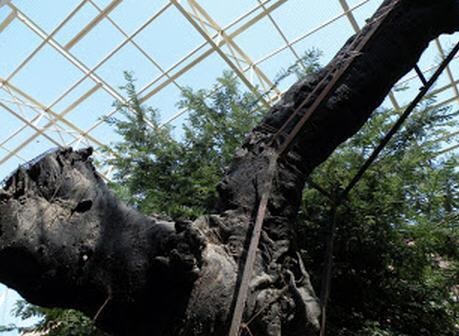
The tree which Krishna jumped off to fight the Kaliya serpent
Objective 4: To describe how Sri Krishna subdued Kāliya by dancing on his hoods.
Kāliya raised his thousand hoods to attack again, but Sri Krishna began to dance gracefully atop them. Each step of His lotus feet—softer than lotus petals for the Gopīs—fell like thunderbolts on Kāliya’s heads.
As Sri Krishna danced, the demigods played celestial instruments, and His rhythm captivated all three worlds. Blood and venom spewed from Kāliya’s mouths; his strength drained. Eventually, crushed and humiliated, Kāliya surrendered.
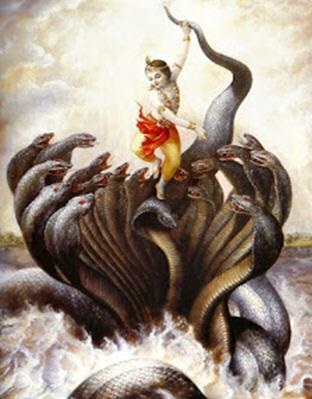
Sri Krishna is dancing on the heads of the snake Kaliya
Objective 5: To know the prayers offered by the Nāgapatiṇīs and Sri Krishna ‘s response.
Kāliya’s wives, the Nāgapatiṇīs, renowned for their devotion, approached Sri Krishna with folded hands and prayers of surrender. Pleased, Sri Krishna forgave Kāliya, instructing him to return peacefully to Ramaṇaka Island, his rightful home in the ocean, and never trouble Vrindavan again.
Objective 6: To understand the symbolic meaning of Kāliya as representing envy and pride.
PHILOSOPHICAL & DEVOTIONAL MEANING
This līlā reflects how envy and pride, symbolized by Kāliya, poison the heart. The only remedy is Sri Krishna’s mercy, received through bhakti and surrender. His dancing upon Kāliya is symbolic of the Lord subduing anarthas (unwanted traits) like lust, anger, pride, and jealousy.
Objective 7: To understand the role of the Holy Name in purifying the heart, as illustrated in this pastime.
The tongue, like Kāliya, can spew venom in the form of harsh words. But when it chants the Holy Name:
HARE Krishna HARE Krishna Krishna Krishna HARE HARE
HARE RĀMA HARE RĀMA RĀMA RĀMA HARE HARE
…the poison is neutralized, and the heart becomes purified.
Objective 8: To know scriptural references glorifying Kāliya Ghat from Purāṇic texts.
SCRIPTURAL GLORIES OF KĀLIYA-GHAT
Ādi-Varāha Purāṇa:
Offering pinda at Keśi-tīrtha (nearby) is 100x more auspicious than at Gayā. Bathing at Kāliya-ghat removes all sins.
Varāha Purāṇa:
“Sacred Kāliya-hrada, where I eternally sport in the Yamunā’s pure waters, is My secret divine abode.”
Saura Purāṇa:
A person who bathes here and worships Lord Vāsudeva attains Krishna-sāyujya-mukti, rarely achieved even after many births.
Even a carpenter’s son who fasts and bathes here is glorified in the Sri Krishna’s eternal abode.
Objective 9: To describe the current state of Kāliya Ghat and its nearby sacred landmarks.
MODERN CONTEXT
Although the Yamunā now flows about 50 yards from the original site, devotees still experience the same spiritual potency by touching the dust of Kaliya Ghat, which is considered as meritorious as bathing in the Yamunā itself.
Objective 10: To know about the nearby sacred sites.
NEARBY SACRED SITES
Madanmohan Temple – Samādhi of Śrīla Sanātana Goswāmī.
Bhajan-kuṭir of Śrīla Prabodhānanda Sarasvatī.
Bhajan-sthali of Bilvamaṅgal Ṭhākura.
