
Objectives:
Objective 1: To learn how Śrīla Prabhupāda’s surrender to his guru in Vṛndāvana sowed the seeds of a global mission rooted in devotion and spiritual purpose.
A devotee’s journey doesn’t begin with personal ambition—it begins with surrender. Surrender to the desire and guidance of the spiritual master. In the story of the Kṛṣṇa consciousness movement, one of the most special parts is the deep connection between His Divine Grace A. C. Bhaktivedanta Swami Prabhupāda and his guru, Śrīla Bhaktisiddhānta Sarasvatī Ṭhākura. Some of their most meaningful moments happened in Vṛndāvana, especially near the sacred waters of Śrī Rādhā Kuṇḍa. These were not ordinary talks—they were spiritual exchanges that helped plant the seeds for a mission that would touch the whole world.
The First Encounter – Calcutta, 1922
“Preach Lord Caitanya’s message to the whole world.”
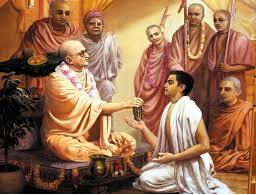
In 1922, a young and intellectually inclined Abhay Charan De, guided by a friend, met Śrīla Bhaktisiddhānta Sarasvatī Ṭhākura for the very first time in Calcutta. The moment was transformative. After offering humble obeisances, Abhay was immediately given a profound instruction:
“You are an educated young man. Why don’t you preach Lord Caitanya’s message throughout the whole world?”
This direct command from a pure devotee was unexpected. With a logical mindset, Abhay respectfully questioned the feasibility—he expressed that India’s political freedom must come first.
But the reply from the ācārya pierced his heart:
“Kṛṣṇa consciousness is so important that it cannot wait. Even if India is under British rule, our real need is spiritual independence.”
That day, a seed of spiritual destiny was planted. Though Abhay continued in family life for many more years, he never forgot those divine words. A true disciple never forgets the instruction of his guru, even if the fulfillment comes decades later.
Vṛndāvana was not just a holy place for Śrīla Prabhupāda—it became the nurturing ground where the seed of his guru’s instruction began to sprout. He made frequent visits to this dhāma, seeking inspiration and internal preparation.
But it was at Rādhā-Kuṇḍa, the most sacred of all places, that a second historic meeting took place.
The Confidential Exchange – Rādhā-Kuṇḍa, Circa 1935
“If I could sell the marble of all these temples and print books, I would do it.”
During this meeting, Śrīla Bhaktisiddhānta Sarasvatī revealed his deep concern about the internal dissensions within the Gauḍīya Maṭha. He was not impressed by institutional opulence or temple construction for prestige. Instead, he revealed the essence of the preaching mission:
“If I could sell the marble of all these temples and print books, I would do it.”
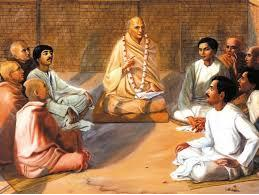
Śrīla Prabhupāda later reflected on this moment with gravity:
“He was very grave… his instruction was clear. If I ever got money, I should print books.”
This was not a casual conversation—it was a sacred empowerment, delivered in the heart of Rādhārāṇī’s transcendental abode. For a sincere disciple, such words are not taken lightly—they become life and soul.
Why Rādhā-Kuṇḍa?
Meeting the spiritual master here signifies a deeply confidential relationship. It’s not an accident—it’s divine arrangement. The instruction received at Rādhā-Kuṇḍa was not merely spoken; it was etched onto Śrīla Prabhupāda’s heart.
Objective 2: To understand how Śrīla Prabhupāda’s years at Radha Damodar Temple became the devotional and literary foundation for his global mission to spread Kṛṣṇa consciousness
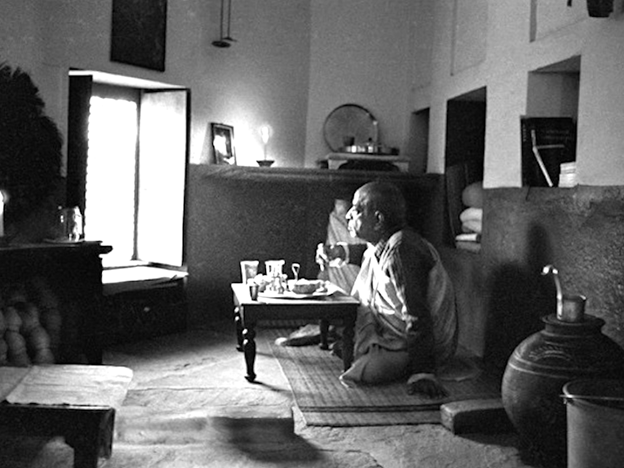
After accepting sannyāsa in 1959, Srila Prabhupāda moved into two modest rooms at the Radha Damodar Temple in Vṛndāvana—one for cooking and one for writing. This sacred temple, home to the samādhis of Śrīla Rūpa Gosvāmī and Śrīla Jīva Gosvāmī, became his spiritual base. He spent his mornings chanting japa, writing, and circumambulating the samādhis. Later in the day, he would visit other temples, shop for vegetables, and cook simple meals using a kerosene stove.
During his six years there, he wrote
Easy Journey to Other Planets
The first volumes of Śrīmad Bhāgavatam
Articles for Back to Godhead and Bhāgavat Darśan
He referred to his rooms as his “eternal residence”, saying they were the hub of the spiritual world due to the deep devotional energy and legacy of the Gosvāmīs. It was here that he received inspiration—sometimes even in dreams—from Rūpa and Jīva Gosvāmīs to spread Kṛṣṇa consciousness globally.
Then came the historic step:
1965: Boards the Jaladuta, carrying boxes of Bhāgavatam volumes, bound for America.
1966: Establishes the International Society for Krishna Consciousness (ISKCON) in New York City.
1970s: Establishes the Bhaktivedanta Book Trust (BBT)—launching massive global book distribution.
1977: Over 500 million books and magazines printed in over 50 languages, inspiring millions worldwide.
Objective 3: To know how Śrīla Prabhupāda built ISKCON temple in Vṛndāvana that became the center of his spiritual work and resting place.
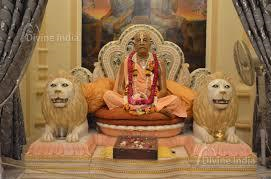
Prabhupāda established ISKCON in Vṛndāvana with the inauguration of the Krishna-Balarāma Mandir on April 20, 1975—a temple he personally envisioned as a spiritual powerhouse rooted in the sacred land of Kṛṣṇa’s pastimes. He oversaw every detail of its design and construction, ensuring it would serve as a beacon of devotion and strength for his followers worldwide. The temple houses the deities of Krishna–Balarāma, Rādhā–Śyāmasundar with Lalitā and Viśākhā, and Gaura–Nitāi, and includes his white-marble samādhi shrine, marking the place where his earthly journey concluded in 1977. Today, ISKCON Vṛndāvana stands as a vibrant spiritual center, fulfilling his mission to spread Kṛṣṇa consciousness from the heart of Vraja
Beneath those same rafters lies his white-marble samādhi shrine, where his body was laid to rest on November 14, 1977—a fitting end to his earthly journey in the place he both loved and preached for decades
Objective 4: To understand Śrīla Prabhupāda’s vision for New Vrindaban as a model village reflecting the devotional life and values of original Vṛndāvana.
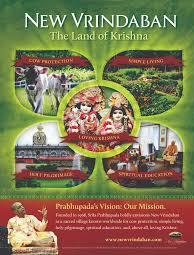
Srila Prabhupāda envisioned New Vrindaban as more than just a farm community—it was meant to be a living example of spiritual life modeled after the original Vrindavan in India. One of his most quoted statements captures this beautifully:
“We will establish a local self-governing village and show all the world a practical example of spiritual life as Krishna Himself exhibited in Vrindavan.” — Letter to Kīrtanānanda Swami, July 27, 1973
He emphasized five pillars for New Vrindaban:
Cow protection
Simple living
Spiritual education
Holy pilgrimage
Loving Krishna
Prabhupāda also said:
“America has got good potency. We have got so much land here. We can have hundreds of New Vrindabans or farms like that. And people will be happy. Invite all the world, ‘Please come and live with us. Why you are suffering congestion, overpopulation? Welcome here. Chant Hare Krishna.’ Make that.”
His vision was not limited to one location—it was about establishing the mood and lifestyle of Vrindavan wherever devotees live, through devotion, simplicity, and community centered on Krishna.
Objective 5:To feel how Śrīla Prabhupāda’s bhajan kutīr in Vṛndāvana became the sacred starting point of his global mission and lifelong devotion
From the moment Śrīla Bhaktivedanta Swami Prabhupāda acquired his bhajan kutīr near the samādhis of Rūpa-Jīva Gosvāmī (1960), Vṛndāvana became not just a city but his spiritual heartland. In the quiet sanctity of Radha-Damodar Temple, he engaged in ceaseless japa, bhajana, and translation work, seeing it as God’s personal blessing to hasten his global mission
His deep affection for Vṛndāvana is reflected in his often-quoted sentiment:
“Better to die in Vṛndāvana.” (Krishna.org – Real Krishna Consciousness)
Objective 6: To reflect on how Śrīla Prabhupāda’s final days in Vṛndāvana embodied his devotion, teachings, and lasting legacy.
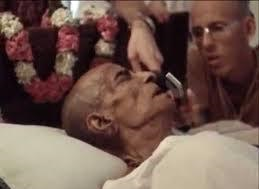
During his final months (1977), Vṛndāvana served as his spiritual workshop:
Hṛṣikeśa to Vṛndāvana:
He insisted on ending his journey in Vrindavan, calling it providential for departure
Arrival at dawn: Carried in a rocking chair at ~4 a.m., he soaked in darśana of Gaurā-Nitāi, Krishna–Balarāma, and Radha–Śyāmasundar, shedding
His final address:
Once seated in his room, he told devotees:
“Whatever I have to speak, I have spoken… Now you try to understand it and continue your endeavour… One who has served the Lord lives eternally.”
Last organizational counsel :He guided the GBC on leadership and succession, appointing ritvik initiators to uphold ISKCON after his departure
Objective 7:To cherish Śrīla Prabhupāda’s vision of Vṛndāvana as a place of eternal bhāva, where inner devotion and yukta-vairāgya guide true spiritual life.
Śrīla Prabhupāda often highlighted that Vṛndāvana is more than geography—it’s eternal bhāva:
In 1972, while standing near Rūpa Gosvāmī’s bhajana kutīr, he defined yukta-vairāgya—balanced renunciation and engagement—as the highest perfect life, inspiring the Vrindavan Chandrodaya Mandir project
He emphasized that true preaching begins in the inner spiritual atmosphere; physical temples are mere vessels for bhakti.
Let us remember Śrīla Prabhupāda not just for his achievements, but for his devotion-filled heart anchored in Vṛndāvana. May we aspire to mirror his love for the dham—where service, scripture, and sacred connection become our life’s offering.
