
Objectives:
Objective 1: To understand the significance that Talavana is one of the twelve sacred forests of Vraja Mandala despite the forest’s physical decline.
Overview
Talavana is one of the twelve sacred forests (Dvadasha Kanana) of Vraja Mandala (Braja), known for the divine pastimes of Lord Balarama, the elder brother of Lord Krishna. Today, the forest no longer exists in its original lush form, but the glories of Talavana live on in scriptures, sacred festivals, and the hearts of devotees.
Objective 2: To describe the historical and spiritual importance of Talavana, including its association with the killing of the demon Dhenukasura by Lord Balarama.
Historical Significance
Talavana is historically significant for its fruit-bearing palm trees, which were considered to be divine nectar, but now only some palm trees remain and are not as extensive as they once were.
It was here that Lord Balarama killed the demon Dhenukasura, a powerful ass-demon who was guarding the forest’s palm fruits.
Dhenukasura was cursed by Durvasa Muni in a previous life and was later liberated by the touch of Balarama.
Presently, this area is known as Tarsi (or Tarasi), a village approximately 6 miles south-west of Mathura. It is a place where devotees visit a Balarama temple, Dauji Mandira, that reflects the pastimes of Krishna and Balarama.
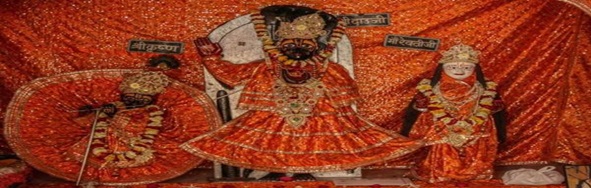 3-foot-tall deity of Lord Balarama, along with His consort,
Srimati Revati, and Lord Krishna.
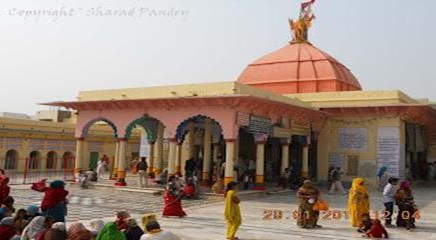 Dauji Mandir
Objective 3: To identify and describe the major sacred sites in Talavana and explore how these locations commemorate the pastimes of Lord Balarama and continue to attract devotional activities.
Sites to Visit in Talavana (Tarsi)
| Site | Description |
|---|---|
| Dauji Mandir (Temple of Balarama) | A prominent temple dedicated to Lord Balarama, also known as Dauji. It commemorates His divine victory over Dhenukasura. |
| Sankarshana-kunda | A sacred water body associated with Lord Balarama, where pilgrims often take a dip and offer prayers. |
| Festival Site (Bhadra Month) | An annual festival is celebrated here on the 11th day of bright Bhadra (July–August), recalling Balarama’s glorious pastime. |
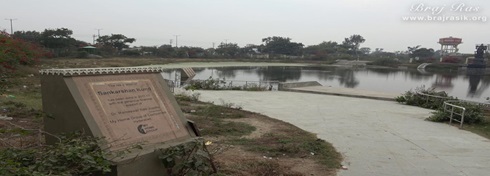
Sankarshan Kund – Holy Dip in this Kund relieves one from all the past sins incurred in this material world.
Objective 4: To narrate the divine pastime of Lord Balarama and Lord Krishna defeating Dhenukasura in Talavana as described in the scriptures.
Pastimes: Dhenukasura Vadha (Slaying of the Demon)
As narrated in Bhagavata Purana and elaborated in Ananda Vrindavan Champu:
One day, while herding the cows, Lord Krishna and Balarama together with the cowherd boys wandered near Talavana. Some of the intimate cowherd friends, Shridama, Subal, Stoka-Krishna approached Krishna-Balarama, “Oh Balaramji, whose arms are very strong, please relieve us of the demon of hunger. We can smell fresh, juicy, ripened Taal fruits growing in the nearby forest and are very much eager to taste these fruits. However, this forest has been usurped by a big ass demon of the name “Dhenukasura” who is so wicked and cruel that he does not allow anyone, not even a bird or insect, to enter the forest and enjoy the fruits. You being the princes of Vrindavan should teach this demon a good lesson and feed us these fruits.”
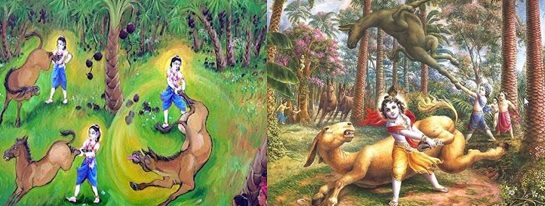
Balaram and Krishna in order to please their friends ventured into this forest. Lord Balarama saw big big Taal trees and shook one of them so hard that all the big Taal fruits began to fall to the ground. The boys began jumping and dancing seeing this. Meanwhile, Dhenukasura heard his Taal fruits falling. Being outraged he galloped straight to that place, went right up to Balaramji, turned around his hind legs as asses do and kicked Him as hard as he could right in the chest. Shri Balaramaji very patiently stood there, undisturbed by the kick of the demon as if nothing had happened. Dhenukasura feeling insulted by this, turned again and kicked Him right in the chest. Finally Balaramaji effortlessly took both of the hind legs of Dhenukasura in one hand and whirled him around over His head like a toy. Just by the centrifugal force of that skyride Dhenukasura was dead. Then Balaramaji threw the huge dead body of Dhenukasura into the tallest of the Taal trees. That Taal tree fell down upon another Taal tree which fell down upon another, creating a kind of Domino effect. When the ass-opiates of Dhenukasura charged at Krishna Balarama for avenging their master’s death, They grabbed each of the asses by their hind legs, whirled them around to death and threw them over the Taal trees thus creating a nice panoramic scene. The multi-coloured asses looked like big coloured clouds floating on the trees. Then Krishna Balaram along with the cowherd boys enjoyed the feast of ripened juicy Taal fruits. Later the animals started coming to Talavana to eat the fresh grasses and the birds started coming to eat seeds and the fruits on the trees, and again Talavana became a very pleasurable forest for Krishna and Balarama’s pastimes.
Following in the footsteps of the cowherd boys, one should pray to Guru and Krishna to mercifully enter our hearts which have been currently encroached upon by the demons of lust, anger, envy, false pride, illusion and greed. So that They may slay these demons and consequently the fruits of loving devotional service may be offered to Krishna Balarama, within our hearts.
Objective 5: To appreciate scriptural references that glorify the spiritual significance of Talavana by explaining the spiritual benefits.
Scriptural Glorification of Talavana
The glories of Talavana are mentioned in the Adi-varaha Purana, Mathura Mahatmya (MM), and other sacred texts:
“The second forest is the transcendental Talavana. Anyone who bathes here attains all success.” (Adi-varaha Purana, MM-332)
“The clear-water lake here is decorated with blue lotuses. Bathing or giving charity here fulfills all desires.” (MM-333)
“This sacred forest is where the demon was killed to help the Lord’s pastimes and benefit the Yadavas.” (MM-334)
“One who bathes in these waters becomes a Yadava and attains the vision of the Lord.” (MM-335)
Spiritual Insight
Talavana represents the deep spiritual symbolism in Vraja’s forests. Balarama’s slaying of Dhenukasura emphasizes the necessity of removing arrogance and ignorance before tasting the true sweetness of devotion. Visiting this sacred land with reverence brings purification, divine inspiration, and a stronger connection to the Lord’s eternal pastimes.
Objective 6: To locate Talavana on a map by identifying its modern equivalent—Tarsi village—in relation to Mathura and surrounding areas.
Location of Talavana (Tarsi, Mathura)
Talavana corresponds to the modern village of Tarsi (sometimes spelled Tarasi) in Mathura district, Uttar Pradesh, India
It is situated about 6 miles (10 km) southwest of Mathura city and 2½ miles southwest of Madhuvana
A detailed village map of Tarsi shows its geographic area (~4.79 km²) and administrative links to Mathura tehsil and district headquarters approximately 6–10 km away
