
Objectives:
Objective 4: To know Mahaprabhu’s ecstatic darshan of Yamuna during His Vrindavan visit.
Objective 1: To understand why Sri Chaitanya Mahaprabhu longed to visit Vrindavan and how it reflects His deep love for Krishna’s pastimes and the mood of prema-bhakti
When Sri Krishna appeared as Sri Chaitanya Mahaprabhu, He came to spread the chanting of the Hare Krishna maha-mantra and to taste the sweet mood of Srimati Radharani’s love for Krishna. One of His cherished desires was to visit Vrindavan, the eternal playground of Krishna.
For a devotee, Vrindavan is not just a land of temples and forests — it is Krishna’s eternal home. Mahaprabhu wanted to:
- See the places where Krishna performed His childhood leelas,
- Absorb Himself in loving remembrance (smarana),
- And inspire the world to take shelter of Krishna in the mood of prema-bhakti.
“He wanted to go to Mathurā and Vṛndāvana to see the land where Lord Kṛṣṇa had enjoyed His pastimes.”
— — Chaitanya Charitamrita Madhya-līlā 17.2-3
Objective 2: To explore Sri Chaitanya Mahaprabhu’s first attempt to reach Vrindavan, and how this journey reveals the depth of His humility and the affectionate care of His devotees (Madhya 1.159–167)
Before His legendary South India tour, Sri Chaitanya Mahaprabhu resolved to go to Vrindavan. The longing to see Krishna’s playground surged in His heart. But the journey would not begin as planned.
Mahaprabhu, freshly initiated into sannyasa, wandered in divine ecstasy. His heart was flooded with remembrance of Krishna’s leelas, and His feet moved with urgency toward Vrindavan. But His associates in Navadvipa—Nityananda Prabhu, Chandrasekhara Acharya, and Jagadananda Pandita—were deeply concerned. The roads through Bengal were perilous, and Mahaprabhu, immersed in bhava, was vulnerable.
They devised a gentle plan.
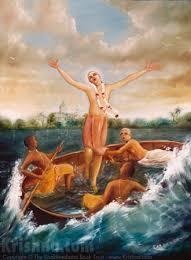
As Mahaprabhu walked north, Nityananda Prabhu led Him toward the Ganges, telling Him it was the Yamuna. Mahaprabhu, absorbed in Krishna’s mood, believed it. With tears in His eyes, He stepped into the river, thinking He had reached Vrindavan.
But just then, Advaita Acharya appeared in a boat nearby.
Seeing Advaita, Mahaprabhu realized the truth: this was not Vrindavan. He had been lovingly tricked. Yet He did not protest. Instead, He smiled, recognizing the care behind the deception.
Advaita Acharya brought Him to Shantipur, where Śacī-mātā awaited. She had one request:
“If You must leave, then reside in Jagannath Puri. There, I will still hear news of You.”
Mahaprabhu, ever obedient to His mother’s wish and the love of His devotees, accepted. He canceled His journey to Vrindavan and turned toward Puri.
“Caitanya Mahāprabhu canceled His journey to Vṛndāvana and decided to go to Jagannātha Puri instead.” (CC Madhya 1.167)
Thus, the first attempt to reach Vrindavan ended not in disappointment, but in a deeper revelation: that even the Lord bows before the love of His devotees and the gentle wish of His mother.
Lesson: The Lord, although independent, accepts the love and guidance of His devotees. This mood teaches us humility and cooperative service.
Objective 3: To learn about Mahaprabhu’s second, successful journey to Vrindavan and how it fulfilled His deep desire to visit Krishna’s sacred playground
(Madhya 17–18)
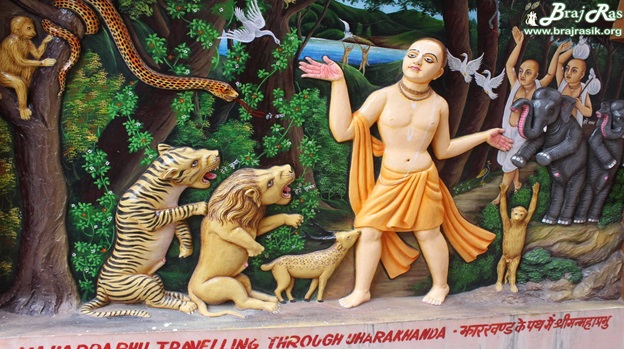
After staying in Puri and traveling through South India, Mahaprabhu finally set out for Vrindavan with Balabhadra Bhattacharya.
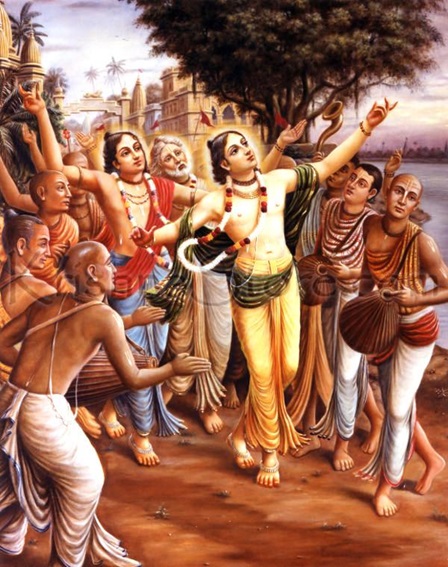
He avoided the main roads and took a quiet forest route, not wanting to attract crowds. But His golden form and divine kirtan melted the hearts of villagers everywhere.
“People ran to Him as if drawn by a magnet. They danced and cried, following Him with love.” (CC Madhya 17.27–36)
Objective 4: To know Mahaprabhu’s ecstatic darshan of Yamuna during His Vrindavan visit.
Darshan of Yamuna (Madhya 18.73–81)
Upon seeing Yamuna Devi, Mahaprabhu lost external consciousness in Krishna-prema. He cried out “Krishna! Krishna!” and rushed to jump into her waters, but was stopped by Balabhadra.
Upon seeing the river Yamunā, Śrī Caitanya Mahāprabhu immediately became overwhelmed with ecstatic love.” (CC Madhya 19.78)
Objective 5: To know about Mahaprabhu’s Govardhan Parikrama and how it expresses His devotion to Krishna’s sacred land (Madhya 18.34–38)
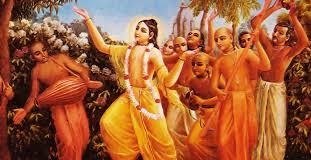
Mahaprabhu circumambulated Govardhan Hill, offering full dandavats repeatedly. He glorified Govardhan as:
“Haridāsa-varya – the best of Krishna’s servants.” (SB 10.21).
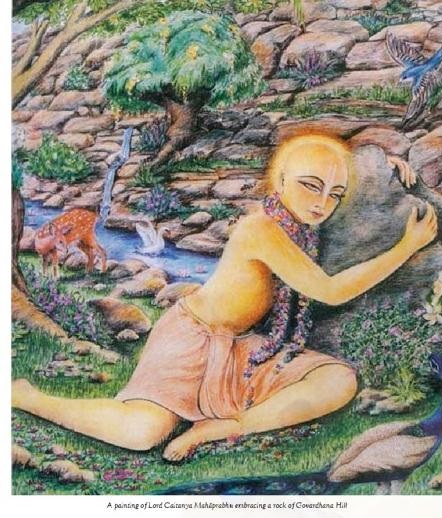
Mahaprabhu saw every stone of Govardhan Hill as non-different from Krishna Himself, embracing the mood of hari-dāsa-varya—the best servant of the Lord. His circumambulation was not merely ritualistic but an expression of ecstatic love, humility, and surrender. By walking barefoot around the hill, Mahaprabhu demonstrated how Govardhan is both a divine embodiment and a cherished servant of Krishna, inspiring devotees to honor the land of Vrindavan as sacred and spiritually transformative.
Objective 6: To know how Mahaprabhu identified Radha-Kunda and Shyama-Kunda, and how this moment reveals His deep connection to Krishna’s sacred pastimes. (Madhya 18.13–15, 18.25)
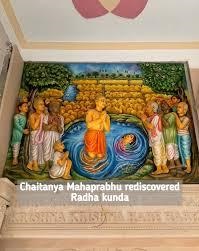
Sri Chaitanya Mahaprabhu’s identification of Radha-Kunda and Shyama-Kunda was a moment of deep spiritual revelation, rooted in His divine intuition and ecstatic love for Krishna. When He arrived at Arita-grama near Govardhan, Mahaprabhu saw two small ponds in a paddy field and immediately recognized them as the sacred kundas created by Radha and Krishna after the slaying of the demon Arishta. Overwhelmed with devotion, “Here is Rādhā-kuṇḍa! Here is Śyāma-kuṇḍa!” He bathed in them with deep reverence and applied the clay from Radha-Kunda as tilaka, declaring it the holiest place in creation. According to ISKCON’s Gaudiya Vaishnava teachings, this act revealed Mahaprabhu’s intimate connection to the mood of Srimati Radharani and affirmed Radha-Kunda as the embodiment of Her love, inspiring devotees to approach it with reverence and longing for pure prema-bhakti.
These sacred spots were later excavated and glorified by Rupa and Raghunatha Dasa Goswamis under His direction.
Objective 7: To know how Mahaprabhu performed kirtan in Vrindavan’s twelve forests, expressing His ecstatic love for Krishna through song and sacred travel.
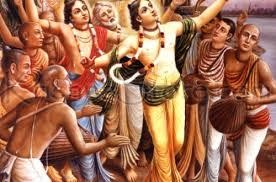
When Śrī Chaitanya Mahāprabhu visited Vṛndāvana, He ecstatically traversed its twelve sacred forests—such as Madhuvana, Bhāṇḍīravana, and Vṛndāvana—singing kirtan and immersing Himself in divine remembrance of Krishna’s pastimes. Accompanied by devotees, He embraced trees, bathed in holy rivers, and awakened bhakti even in animals and tribal people, revealing the all-enchanting power of the holy name. His journey, detailed in Chaitanya Charitamrita (Madhya 17.192 onward), exemplifies how sankirtana can sanctify both nature and hearts, turning every forest path into a sacred stage of transcendental love.
Objective 8: To recognize the spiritual significance of places visited by Śrī Caitanya Mahāprabhu and understand how His presence sanctified them through kīrtan, devotion, and divine remembrance.
Yamuna
As Mahaprabhu arrived in Mathura, He bathed in the sacred Yamuna at Vishram Ghat. The river’s gentle currents stirred His heart with remembrance of Krishna’s water pastimes — the playful splashing with the gopīs, the boat leelas, and the divine rasa of the Yamuna’s embrace. Immersed in bhava, Mahaprabhu saw not just water, but Krishna’s smile reflected in every ripple.
Govardhan
When Mahaprabhu beheld Govardhan Hill, He fell flat like a rod in full obeisance. Embracing a stone from the hill, He wept in ecstasy, glorifying Govardhan as Haridāsa-varya — the best of Krishna’s servants. He performed parikrama with reverence, remembering how Krishna lifted the hill to protect His devotees. Every step was a prayer, every breath a glorification.
Radha-Kunda
In Arishta-grama, Mahaprabhu searched for the sacred lakes of Radha and Krishna. Though nearly lost to time, He discovered two paddy fields — Kali Badi and Gauri Badi — and recognized them as Syama-Kunda and Radha-Kunda. With tears of joy, He bathed in their waters, smeared their mud on His forehead, and declared Radha-Kunda the topmost holy place. Even Brahma, He said, could not describe the ecstasy He felt there.
Vamsi Vat
At Vamsi Vat, Mahaprabhu sat beneath the ancient tree where Krishna once played His flute, summoning the gopīs for the rasa-lila. Mahaprabhu’s heart echoed with the melody of Krishna’s flute, and He entered a trance of divine longing, reliving the rasa dance in the mood of a devotee.
Objective 9: To understand the key instructions given by Śrī Caitanya Mahāprabhu to the Goswamis, focusing on their mission to establish Vrindavan’s sacred sites, write devotional literature
After visiting the holy land of Vrindavan, Sri Chaitanya Mahaprabhu gave very special responsibilities to two of His dear followers, Rupa Goswami and Sanatana Goswami. These instructions helped preserve and share the path of pure devotion for generations to come.
To Rupa Goswami — in Prayag (Dashashwamedh Ghat – Ganga River)
Mahaprabhu met Rupa Goswami and lovingly explained how to write spiritual books. He taught him about the different moods of devotion — how Krishna feels, how His devotees feel, and how to express that love in writing.
He said, “I’m giving you a small drop of the ocean of devotion — now you spread it far and wide.”
Rupa Goswami later wrote beautiful books like Bhakti-rasāmṛta-sindhu, which teach us how to worship Krishna with love from the heart.
To Sanatana Goswami — in Varanasi (the city of knowledge)
Mahaprabhu instructed Sanatana Goswami to:
Find and restore the hidden holy places in Vrindavan
Write Vaishnava scriptures to help people learn about bhakti
Teach how to worship Krishna properly with love and respect
“Go to Vrindavan and, with great humility, find the lost sacred places and write about true devotional service.” (CC Madhya 20.106)
Sanatana Goswami later discovered many sacred sites, wrote practical guides for devotees, and helped establish worship of deities like Madana-Mohan.
Both lived simple lives, full of devotion
Rupa and Sanatana Goswamis lived in Vrindavan as humble saints — sleeping under trees, chanting the holy name, and writing books that continue to inspire devotees today. They followed Mahaprabhu’s instructions with deep love and faith.
Objective 10: To feel how Śrī Chaitanya Mahāprabhu revealed Radha’s longing for Krishna through His deep chanting, tears, and verses of separation in Vrindavan and Puri.
In Vrindavan and later in Puri, Śrī Chaitanya Mahāprabhu entered profound absorption in Śrīmatī Rādhārāṇī’s mood of separation from Krishna—viraha-bhāva. His chanting became intensely emotional, often accompanied by tears, trembling, and ecstatic symptoms that mirrored Rādhā’s longing. He would cry out, “Where is Krishna, the enchanter of My soul?” and mistake sand dunes for Govardhana Hill, revealing the depth of His divine madness. These episodes, recorded by Svarūpa Dāmodara and Raghunātha dāsa Gosvāmī, show how Mahaprabhu embodied the pinnacle of devotional love, where remembrance of Krishna becomes inseparable from the pain of separation
Objective 11: To cultivate a prayerful and humble mood during yatra to Vrindavan, learning from Mahaprabhu and the Goswamis how heartfelt devotion transforms pilgrimage into a living experience of Krishna’s presence.
Vrindavan isn’t just a holy town—it’s Krishna’s home. When we plan to go there, it’s easy to get caught up in logistics and sightseeing. But deep down, Vrindavan invites something gentler from us: a mood of prayer, humility, and longing.
Let’s try to enter with that attitude. Not rushing around, but walking slowly. Not just clicking pictures, but letting the atmosphere touch us. In every temple bell, in every dust-laden path, Krishna lives.
Think about Mahaprabhu’s visit. He didn’t go with a tour group—He walked, chanted, and cried for Krishna with such intensity that the whole dham responded. Vrindavan awakened again through His tears. That wasn’t drama—it was love. Real, raw, and divine.
We may not have the same depth, but we can try. While standing in line at a temple, or watching the Yamuna flow, we can chant. We can close our eyes for a minute, whisper Krishna’s name, and offer a soft prayer.
The Goswamis didn’t just live in Vrindavan—they became part of its rhythm. No fancy homes, no big schedules—just devotion, deep study, and care for the dham. We can take that inspiration home with us and build a little Vrindavan in our hearts.
When We Remember Mahaprabhu…
His time in Vrindavan was brief but powerful. He wasn’t just passing through; He reignited the spirit of the place. His visit became the foundation for Gaudiya Vaishnavism’s love for the dham.
Our Personal Prayer should be
“O Gauranga, please awaken the Vrindavan within me.
Let me chant with sincerity. Let me cry with feeling.
And let me love Krishna the way You showed us.”
When we travel with this mood—even if only in thought—Vrindavan stays with us. That’s what makes the journey truly spiritual.
