
Objectives:
Objective 2: To recognize the symbolic and historical features of Chaurasi Khamba Temple in Gokul
Objective 4: To know about the presiding deity and other deities associated with the temple
Objective 5: To learn about the pastimes at Chaurasi Khamba.
Objective 1: To identify Nand Bhawan as Krishna and Balram’s childhood home in Gokul, and to recognize its spiritual importance and unique structure of 84 pillars.
About the Temple
Nand Bhawan, also well known as Chaurasi Khambha Temple is one of the most famous pilgrimage attraction of Gokul, at just 16 km from Mathura, Uttar Pradesh. This is the home of Nand Baba where Shri Krishna and Balram had spent his childhood time and did lots of attractive pastimes. Lord Krishan had stolen lots hearts with full of love and devotion here in Gokul with his devine activities. As Nand Bhavan is rested on 84 Pillars it is famed as Chaurasi Khambha, one of the most attractive and notable structure of Old Gukul Mahaban. It is believed that Nand Bhavan is the birth place of Lord Balramji and Goddess Yogmaya and also the naming ceremony for Sri Krishna and Balram took place here.
Objective 2: To recognize the symbolic and historical features of Chaurasi Khamba Temple in Gokul
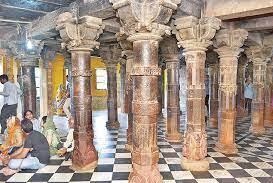
The word ‘Chaurasi’ means eighty-four in Hindi, and ‘Khamba’ refers to pillar. So “Chaurasi Khamba” signifies the 84-pillared structure of Nand Bhavan.
The number 84 is said to symbolize the 84 lakh (8.4 million) species of life in the universe.
It is believed that Lord Viswakarma, the divine architect, built Nand Bhavan over 5,000 years ago.
Over time, the palace was destroyed by invaders, but later rebuilt using the same original pillars.
Temple premise has huge courtyard and wide open spaces along with huge Gaushala where hundreds of cow are served. In the courtyard of the temple, there is huge banyan tree where devotees tie up colorful ribbons on its branches for good luck and prosperity.
Under the banyan tree, there is a temple of Kali Maa also. In temple you can blessed with the beautiful darshan of Goddess Yogmaya. There are lots of pastimes of Lord Krishna and Balramji here in Gokul
It is believed that the original Nand Bhawan was built by architect of the Gods Shri Vishwakarma more than 5000 years ago. But it was invaded by Mughal king Aurangzeb during his reign as a part of temple destruction activities across the nation. Then Nand Mahal was re-built later on using the same pillars from the original. Even today you can see the ash on wall and slab of Mahal as it is believed that Yashoda maiya prepare the food and Makhan for Kanha here. The pillars are so smooth and oily like you can fee the Makhan and small hands of Krishna which were touched on pillar. The pradakshina marg or the circumambulation path of the Chaurasi Khamba temple leads you several important places where Bal Krishna did famous pastimes. The Brahmand Ghat is the place where baby Krishna showed the entire Universe in his mouth to Yashoda Mata. Yamala-Arjuna kunda is the place where Krishna uprooted the two ashoka trees on which he was tied for his mischief. Also there are place where Krishna had killed the demons Putana and Trinavarta. Several other popular places with similar kind of history and name are located in Gokul (believed as newly developed Gokul) where Lord Krishna was brought up along with his brother Balram. There may be some confusion or difference for the exact site of Nand Bhavan but let’s not get into that other side and complete visit fo as many place with full of devotion towards Lord Krishna, during your visit to Gokul. The best time to visit Nand Bhavan is between October and March when weather is pleasant and during festival like Holi and Janmashtami which are celebrated with great zeal.
Objective 3: To describe key architectural and devotional features of the temple, including its elevation, carvings, Gaushala, and the Yogamaya shrine beneath the sacred banyan tree.
Situated atop a small hill, reached via a flight of steps.
Walls adorned with paintings depicting Krishna’s childhood pastimes.
Majestic stone pillars with intricate carvings add to the aesthetic beauty.
Contains a large courtyard, open spaces, and a Gaushala housing hundreds of cows.
A huge banyan tree stands in the courtyard where devotees tie colorful ribbons for luck
Beneath the banyan tree lies a small temple of Yogamaya Devi, honoring Her as the deity who was exchanged for Krishna and carried to Mathura.
Objective 4: To know about the presiding deity and other deities associated with the temple
Deities Worshipped Inside
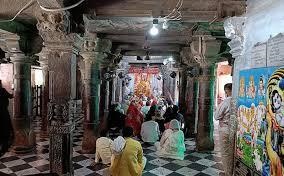
- Nanda Maharaja
- Mother Yashoda
- Lord Balarama,
- And a small deity of Gopala (Krishna).
Nand Bhavan in Mahavan – The Eighth Forest of Vraja Mandala
Nand Bhavan is located within Mahavan, which is the eighth sacred forest of Vraja Mandala.
The Adi Varaha Purana glorifies Mahavan with the following verse:
“Maha vanam castamam tu sadaiva hi mama priyam
Tasmin gatva tu manuja indraloke mahiyate”
Translation:
“The eighth forest of Mahavan is very dear to Me. One who goes there is worshiped on Indra’s planet.”
Sri Chaitanya Mahaprabhu visited Mahavan during His pilgrimage in Vraja Mandala, and deeply relished Krishna’s pastimes here.
At this sacred spot, He also manifested His ecstatic bhakti-lilas.
Objective 5: To learn about the pastimes at Chaurasi Khamba
Below are some of the significant pastimes that have taken place at Nand Bhavan in Gokul Mahavan:
1. Lord Shiva visited to see Bal Krishna
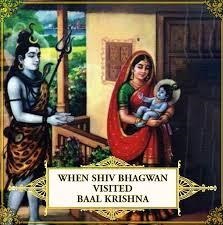
One of the interesting event happened when Lord Shiva wanted to see Bal Krishna, the eight incarnation of supreme lord Vishnu and for this reason went to Gokul. But Yashoda Maiya did not recognize him and refused to show Krishna. Lord Shiva did not want to miss the chance to see the Bal roop of lord and told Yashoda maiya that he would take a Samadhi there if he was not allowed to see Krishna. Once Krishna came to know that Lord Shiva himself reach here at Nand Bhavan so he started crying a lot. Then at last Yashoda mata agree with lord Shiva and brought baal Krishna outside. This is how the milan of Hari and Har happened at Gokul, the meeting of protector and destroyer of world. Just imagine how the seen was while Hari meets Har at Nand Bhavan Gokul.
2. Krishna and Balarama’s Name-Giving Ceremony
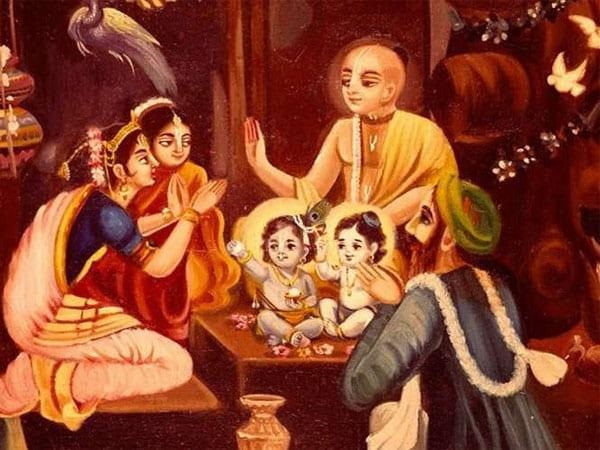
Garga Muni, the priest of the Yadus, was requested by Vasudeva to visit the residence of Nanda Maharaja in Gokul to complete the astrological calculations for Krishna and Balarama.Nanda Maharaja welcomed the sage warmly, unaware of the full truth about Krishna’s birth. Garga Muni understood: Krishna was the son of Vasudeva and Devaki Balarama was also Devaki’s son, later transferred to Rohini’s womb—thus, both were brothers
Garga Muni cautioned Nanda: If a public name-giving ceremony were held, Kamsa might suspect their divine identity According to astrological signs, Devaki couldn’t have given birth to a girl The girl who appeared (Yogamaya/Durga) had warned Kamsa that the child destined to kill him was already born. Therefore, if Kamsa discovered Krishna and Balarama’s true lineage, he might try to kill them both After hearing the sage’s apprehensions, Nanda Maharaja decided to perform Krishna’s name-giving ceremony without grandeur and as discreetly as possible. It was conducted in Nanda Maharaja’s cowshed, right here in Nand Bhavan, where Garga Muni chanted the Vedic hymns and completed the purificatory process.
Garga Muni first described Balarama’s qualities: He would bring joy to His friends and family, hence named Balarama. His future strength would earn Him the name Baladeva, and due to His connection with both the Yadu and Nanda dynasties, He would also be called Sankarshana.
Turning to Krishna, Garga Muni explained that Krishna would be the source of immense good fortune for the community. Though He’d face many challenges, He would overcome them and become beloved in Vrindavan. Garga Muni noted Krishna’s incarnations in various colors through different yugas—white, red, yellow, and now black. Since Krishna was formerly the son of Vasudeva, He was to be named Vasudeva and Krishna. His divine strength would rival that of Lord Narayana, and Nanda Maharaja was warned to protect Him diligently from demon attacks.
3. Krishna Kills Putana
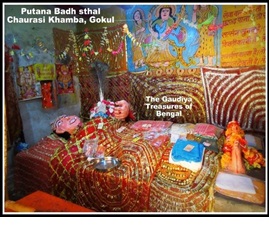
Kamsa feared the child destined to kill him had already taken birth. So he instructed Putana, a powerful witch, to slay all newborn children nearby. According to the Brahma Vaivarta Purana, Putana was actually Kamsa’s sister. Skilled in black magic and infamous for infanticide, she belonged to the category of witches called Khechari, known for their ability to fly in the sky.
Putana entered Nand Bhavan, appearing dazzling and charming, easily blending in with the women of Gokul. She approached baby Krishna—only a few days old—with poisoned breasts, intending to kill Him while offering milk.
But Krishna, knowing her intentions, began to suck not just her milk, but her very life air. Overcome with agony, Putana collapsed and died. As she fell, the earth trembled, and her body expanded into a terrifying form over twelve miles long.
Despite her evil intent, Krishna accepted her act as motherly affection. Because of this, Putana was purified and attained liberation from material existence.
Such a vivid and spiritually layered pastime! Would you like help distilling this into Tamil learning objectives, comparison prompts, or character-based worksheets for your students? It could make for a powerful lesson on Krishna’s mercy and protective nature.
In her previous life, Putana was Ratnamala, one of the daughters of Bali Maharaj. On seeing Lord Vamanadeva, she desired to become His mother. The Supreme Lord who knows everyone’s mind obliged her request. Later, she became enraged and bitter toward Lord Vamanadeva when He tied up Bali Maharaj. Hence she was born as Putana, where she could act as Krishna’s mother as well as harbor sinful desires of killing the Lord.
Putana represents a bogus Guru (spiritual master) who teaches beyond his realizations or teaches beyond the realization of his disciple. Such a Guru is a bad spiritual guide who offers the suck of the poisoned breast that kills the purified cognition of the soul. The real Guru is self-realized. The polluted mind also acts as a pseudo-Guru by proposing all kinds of false arguments that hinder one’s spiritual realization.
4. Krishna kills Sakatasura
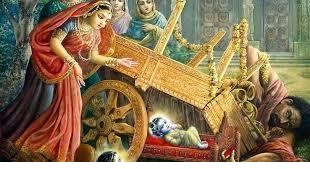
Sakatasura was a ghost having no gross material body. He appeared in the form of a handcart and was looking for an opportunity to kill Krishna. It was the occasion of Krishna’s first birthday ceremony and His parents were busy receiving guests and making arrangements. Krishna was left beneath the handcart that was piled with dishes, utensils, and other metals. As Krishna was not being fed with milk, He turned angry. He lifted up His legs and began kicking just like a small child. His legs touched the wheel of the cart, which separated from the axle causing it to collapse. As the cart broke into pieces, Satakasura died and attained liberation from material existence. This pastime had occurred here at Nand Bhavan.
Sakatasura represents pridefulness, laxity, bad habits, and bad philosophy that includes following the scriptures in their literal sense without due regard to their meaning. This offense needs to be dealt with early on in one’s spiritual life in order to realize natural love for Krishna.
5. Krishna kills Trinavarta
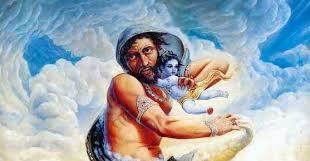
One day shortly after His first birthday, mother Yashoda was patting little Krishna on her lap. Finding Krishna heavy, she unwillingly placed Him on the floor. She gradually became engaged in her household work. At that time, a demon named Trinavarta, who was acting on the instructions of Kansa, arrived to steal Krishna away. He appeared as a whirlwind and picked Krishna up on his shoulders. He created a dust storm all over Vrindavan and carried Krishna about 800,000 miles above the ground. Not seeing Krishna, Yashoda began crying piteously. Meanwhile, as the demon carried Krishna high into the sky, Krishna made Himself very heavy. Trinavarta began to feel as if he was carrying a big mountain upon his back. Trinavarta tried in vain to escape from Krishna’s clutches, who was holding tightly onto the demon’s neck. Unable to bear Krishna’s weight, the demon fell down dead with his eyes popping out. The Gopis discovered Krishna playing upon the demon’s dead body and picked Him up with great affection
Trinavarta represents false arguments, dry speculation, and useless controversy that hinders one’s spiritual progress. These can be compared to the dust that conceals the vision of Krishna. The demon Trinavarta, who is the embodiment of disloyal controversy, must be vanquished for the lotus of spirituality to blossom in one’s heart
6. Damodar Lila
The pradakshina marg or the circumambulation path of the Chaurasi Khamba temple leads you several important places where Bal Krishna did famous pastimes. The Brahmand Ghat is the place where baby Krishna showed the entire Universe in his mouth to Yashoda Mata. Yamala-Arjuna kunda is the place where Krishna uprooted the two ashoka trees on which he was tied for his mischief.
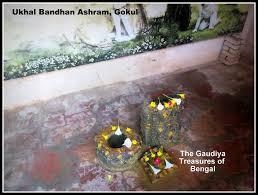
The sweet pastime of baby Krishna stealing butter and subsequently being tied to a mortar by His dear mother Yashoda is also known as Damodara Lila. In Sanskrit, dama means rope and udara means belly. Damodara refers to Krishna who was bound by ropes of affection by His mother Yashoda. It is also known as the Ukhal Bandhan pastime as during the course of this pastime Krishna was tied with ropes to a ukhal or grinding mortar. Little Krishna was only 2 years and 3 months old at this time. During Damodar Lila, Krishna had delivered the two sons of Kuvera, Nalakuvara and Manigriva, who were cursed to become trees in Nanda Maharaja’s courtyard.
