
Objectives:
Objective 1: To describe the spiritual significance and pastimes of Krishna and the gopis at Seva Kunja (Rasa Sthali).
At A Glance
Rasa sthali or Rasa-mandala – site of Krishna’s most ecstatic rasa-lila pastimes with the beautiful gopis of Vraja.
Sites to Visit
- Sites to Visit
- Lalita-kunda, that was created by Krishna just to please Lalita-sakhi
- A deity of Vrinda devi at Rupa-Sanatana Gaudiya Math Mandir.
DESCRIPTION
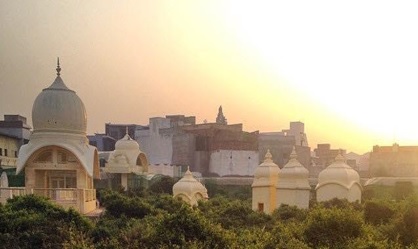
In this particular forest grove also called Nikunjavana, Krishna massaged Radharani’s lotus feet and decorated them with kunkuma. Krishna also massaged Her delicate limbs with perfumed oil, combed Her long black hair into braids, and applied cosmetics to Her moon-like face, and dressed Her with silken garments and gem-encrusted ornaments. After the rasa-dance was over the gopis would prepare a soft bed made of flower petals and invite Radha and Krishna to lie down together so they might spend the night entwined in each other’s arms. At Seva Kunja, one can see the actual place known as the Rang Mahal Mandira, where Krishna served the lotus feet of Radharani. One can also see Lalita-kunda that was created by Krishna just to please Lalita-sakhi, and also the rasa-mandala platform commemorating the rasa-lila pastimes that took place here. Seva Kunja is also referred to as Rasa-sthali, because it was the site of Krishna’s most ecstatic rasa-lila pastimes with the beautiful gopis of Vraja. The rasa lila or rasa-dance is considered to be the high-point of the nocturnal pastimes between Krishna and the gopis, during which every gopi has the opportunity to dance directly with Krishna. When the rasa-dance begins, Krishna stands alone in the middle as the gopis dance around Him in a circular motion, while singing songs in chorus and clapping their hands to the ecstatic beat of the drums. The most enchanting sound was created by the jingling of the gopis ankle-bells, as they dance in perfect unison around the rasa-mandala. Each gopi was thinking that Krishna was looking directly at her while she performed her dance of love before Him. Then by His mystical potency, Krishna expanded Himself into hundreds of identical forms to dance next to each individual gopi, who could then personally enjoy His loving embraces and taste His nectar-like kisses.
Objective 2: To highlight the worship and significance of Vrinda Devi at Seva Kunja and associated locations.
Until recently in Vrndavana, Vrinda-devi was worshipped in two places: Kamyavana and Vrinda-kunda. A third deity has appeared to receive wonderful service from the sincere devotees at the Rupa-Sanatana Gaudiya Math Mandir in SevaKunja, Vrindavana. Whenever one takes the auspicious darsan of Vrinda-devi, he should beg for the mercy to eternally reside in Sri Vraja-dhama as a servant of the servants of Srimati Radhika- Krsnacandra.
A painting of ŚrīmatīRādhikā with Śrī Krsna massaging Her feet is worshipped here in a small temple. The Vrajavāsīs say that even today ŚrīRādhā-Krsna Yugala perform Their pastimes here every night. Everyone therefore leaves this kuñja at dusk. Even the impudent monkeys independently leave this kuñja as the evening falls. From time to time it happens that someone stubbornly tries to remain here during the night, and in the morning is found dead. Others have by some means escaped death, but have become completely insane.
Objective 3: To recount experiences and poetry describing Krishna’s loving service to Radha at Seva Kunja.
Bhakta Rasakhān searched for Krsna all over Vraja but without success. Finally, he had darśana of rasika Śrī Krsna at this very place. He has revealed this in his beautiful poetry as follows:
‘Standing in the doorway of the kuñja, I watch Krsna as He sits massaging Rädhikä’s feet submissively.’ [ Krsna is massaging in the mood, ‘I will not go to Candrävalī’s kuñja again.’]
In Sevā-kuñja, we also find Lalitā-kuṇďa. When Lalitā was feeling thirsty during rāsa, Krsna manifested this beautiful kuṇďa.
Objective 4:To provide the present-day condition and historical extent of Seva Kunja within the broader Vrindavan forest.
Present condition of sevakunja:
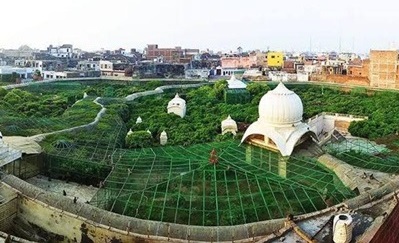
Today SevaKunj appears like a small park encircled by a protective wall. But during Lord Krishna’s time, it encompassed a vast area. When RupaGoswami came to this part of Vrindavan forest, he sat down in the middle of SevaKunj in order to serve Radha and Krishna and write books to benefit others.
Geographical Details
This place is also called Nikuñjavana. It lies just near the temple of ŚrīRādhā-Dāmodara, to the south-west.
The place which is presently called Seva Kunja was formerly called Nikunja vana, and was one of twelve small forest groves of Vrindavana also called upavanas. Sometimes when the Puranas refer to Seva Kunja, it refers to all twelve of the sub-forests that form the inner-most core of the vast and expansive forest of Vrindavana.
According to the Puranas, the whole area bordered by the River Yamuna, from Mohana Ter Ghata to Adi-Badri Ghata was referred to as being Sevakunja. Therefore, such places as Kaliya-Ghata, Madana-mohana, ImliTala, Radha Damodara, Shringara Vata, Govinda Ghata, Chehana Ghata, Keshi Ghata, Nidhuvana,]hulanavana, Gopinatha, Dira Samira, VamsiVata, Gopishwara, Brahma-kunda, Govinda-kunda and Govindaji Yogapitha, are also considered to be different lila-slhanas within SevaKunja. The Puranas also refer to these twelve small upavanas or sub-forests that surround the Govindaji Yoga-pith like petals of a lotus, as the ‘Garden of Vrindavana’.
The twelve upavanas of Vrindavan and their approximate locations are as follows:
- Viharavana- surrounding Krishna BalaramaMandira and RadhaKupa
- Gocharanavana- surrounding VarahaGhata and Go Ghata
- Kaliyadamanavana- surrounding KaliyaGhata
- Gopalavana – surrounding Gopala Ghata (KarauliGhata)
- Nikunjavana – surrounding SevaKunja
- Nidhuvana – next to the RadharamanaMandira
- Radhavana – between 64 Samadhi Pitha and PaniGhata
- jhulanavana – between RagajiBhagaGarden and PanighataVillage
- Gaharavana – surrounding PaniGhata
- Papadavana – surrounding Adi-BadriGhata
- Atalavana – where the Vrindavana paridramapath crosses the Mathura Road
- Kevarivana – surrounding Davanala-kunda
The Puranas say that the forest of Vrindavana encompassed a vast area stretching from Seva Kunja to Nanda grama and included Govardhana, Radha-kunda! Varsana, and the entire region on the western bank of the Yamuna as far north as Kelanvana. In the Brihad- gaulamiyalanlra it says. “The forest of Vrindavana consists of five yojanas.” Five yojanas is equal to forty miles which is the distance from Vrindavana to Nandagrama and the whole on the western bank of the Yamuna as far as Nandagrama is included in the forest of Vrindavana. Therefore when considering this vast area of Vrindavana forest, the twelve small forests or adhivanas are collectively known as SevaKunja.
Objective 5: : To recount the historical details and association of Rupa Goswami and other Goswamis with Seva Kunja.
Historical Details
Rupa goswami’s stay and activities at SevaKunj: There were no temples, only dense forests when the Goswamis first settled in Vrindavan. RupaGoswami didn’t take any land or any deed. He just lived under a different tree each night. Jiva and Rupa used to live together in the middle of Seva Kunj. Of course, then Seva Kunj was a large area. But there were no temples, no buildings, no construction. The emperor’s landlord, who owned this area, was thinking, ‘I am so fortunate that Rupa Goswami is living here on my land.’
Many Vaishnavas gathered at Seva Kunj to hear Sri Rupa Goswami explain the philosophy of Krishna consciousness. Living alongside the Goswamis were such famous personalities as LokanathGoswami, Subuddhi Raya, RaghavaPandit, Uddhava das and Gopal das.
With Sanatana Goswami’s disappearance in 1558, Jiva Goswami officially purchased the land to preserve Seva Kunj for the Gaudiya Vaishnavas. Seva Kunj was a special sacred place for many reasons. Here, Sanatana Goswami worshiped his beloved Deity of Madanmohan and he later entered samadhi. The Supreme Lord Damodara appeared here to accept service from Sri Rupa and Sri Jiva Goswamis. Many famous Vaishnavas lived here doing bhajan, and they attended Rupa Goswami’s realized discourses on prema bhakti. And most significantly, within Seva Kunj, Sri Shyamasundar eternally enjoys super excellent pleasure pastimes with Srimati Radharani and the gopis. For thirty rupees Jiva Goswami bought the plot from Ali Kant Chaudhari, Emperor Akbar’s local landlord. The original deed kept at the Vrindavan Research Institute, mentions that the tract encompassed SevaKunj, Dan Gulli, ImliTala, SringharSthali, and Rasa Sthali. Its boundaries were marked by four trees; tamarind, banyan, pipal and kadamba.
