Objectives:
Objective 1 : To learn about Sri Rangji Temple’s Architecture.
Objective 2 : To know the historical background of Sri Rangji Temple.
Objective 3 : To understand the layout of the temple.
Objective 4 : To understand the function of different Sannidhis & Events.
Objective 1 : To learn about Sri Rangji Temple’s Architecture.
Lord Ranganath’s temple resembles famous temple in Sri Rangam in Tamil Nadu. Rangaji is a form of Lord Visnu lying on the Sesa Naga.
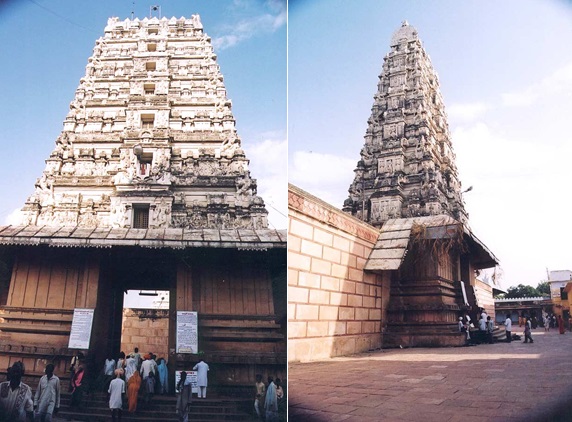
It is constructed in the South Indian Dravidian style and has an impressive gopuram tower over the main entrance. It is the biggest temple in Vrindavan. It was built in 1851 by Laksmicanda Seha at the expense of 4.5 million rupees.
Objective 2 : To know the historical background of Sri Rangji Temple.
Sri Rangji Mandir is dedicated to Lord Sri GodaRangamannar. Goda or Andal as she is popularly known in South India was a famous 8th century Vaishnava saint and Alwar who composed “Tiruppuvai” which centers around her love for her beloved Lord Krishna and his leela bhoomi Vrindavan. She pines for him, fasts for him, sings songs in his praise and wants to attain him by marrying him. Lord Ranganatha who is none other than Krishna answers her prayers by becoming her bridegroom.In SriRanganath Mandir, Lord Krishna is present as the bridegroom with a walking stick in his hand as is the custom in a traditional south Indian marriage. To his right is Andal and to his left Garuda, the vahana of Lord Krishna.
Andal had expressed three wishes in her “NachiyarTirumozhi”(143 verses composed in praise of Lord Krishna). Her first wish was to spend her life at the feet of Lord Krishna in Vrindavan. Her second wish was that Lord Krishna must accept her as his bride fulfilled by Lord Ranganatha. The third wish that the Lord be offered “Ksheeranna”(dessert made of rice and milk) in a hundred pots was fulfilled by the eleventh century vaishnava saint Sri Ramanujacharya. Her first wish was fulfilled by Sri Rangadeshik Swamiji by constructing this temple where Sri Goda-Rangamannar reside as divya dampathi (divine couple). Once when Sri Rangadeshik Swamiji was explaining about the greatness of the South Indian temples to his disciples, then the brothers Seth Sri Radhakrishnaji and Sri Govind Dasji of Mathura expressed their wish for establishing Sri GodaRangamannar at Vrindavan. Swamiji had always thought about this unfulfilled wish of Andal. Taking the wish of brothers as divine indication, Swamiji immediately went to Sri Rangam and expressed this desire to the divine couple Sri GodaRangamannar and sought their permission for starting the construction of the temple. Skilled labourers were hired from Sri Rangam and brought to Vrindavan and the construction work for the temple commenced in the year 1845. The brothers contributed wholeheartedly and with their effort and Sri Goda Rangamnaar’s grace the temple was completed in the year 1851 A.D. Thus manifested the magnificent GodaRangamannar Mandir in Vrindavan.
The structure of the Mandir is based on the famous Sri Ranganatha Swami temple of Sri Rangam. Keeping in mind the local craftsmanship; changes in the architecture were done though. Sri Ranganath Mandir is a rare and exquisite mixture of south and north Indian temple architecture. It is built in the traditional south Indian style with five concentric rectangular enclosures around the sanctum sanctorum and two beautiful stone gates carved in Jaipur style on the eastern and the western side.
The structure of the Mandir is based on the famous Sri Ranganatha Swami temple of Sri Rangam. Keeping in mind the local craftsmanship; changes in the architecture were done though. Sri Ranganath Mandir is a rare and exquisite mixture of south and north Indian temple architecture. It is built in the traditional south Indian style with five concentric rectangular enclosures around the sanctum sanctorum and two beautiful stone gates carved in Jaipur style on the eastern and the western side.
Objective 3 : To understand the layout of the temple.
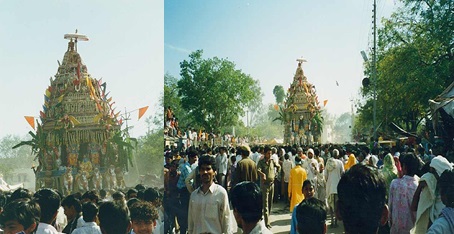
On the western side of the temple just outside the gate is present a 50 feet high wooden chariot which is taken out only once in a year during Brahmotsav.
Once you enter through the stone carved western gate you see a huge seven storeyed gopuram.
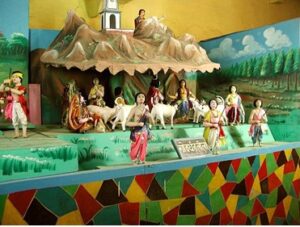
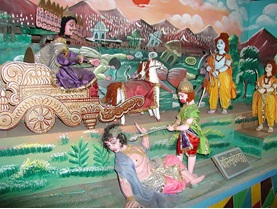
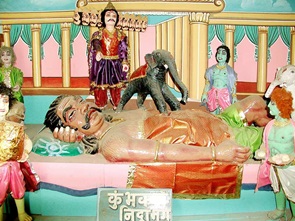
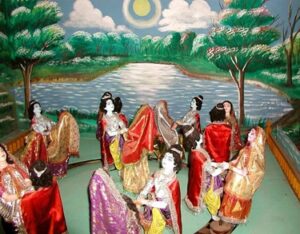
To its left and right are electrically operated leelas depicting the stories of Lord Rama and Lord Krishna.
On the eastern side is another gopuram which is five storeyed. Between the two gopurams in the outer concentric enclosure there is a big pond known as the “Pushkarni”.
Symmetrical in position to the pond on the other side is a small garden where Andal is taken out every Friday evening. The garden has beautiful stone fountains which operate on special occasions.
In between the garden and the pond straight in front of the eastern gopuram is “barahdwari” and a small temple of Sri Hanumanji.
Adjacent to the garden as you move along the periphery, is located the seat of the Goverdhan Peeth, residence of Sri Goverdhan Rangacharyaji Maharaj who is the current Goverdhan peethadeesh and the head of the Sri Rangji Mandir Trust Board and the residential quarters of other priests and employees in a row.
The temple is surrounded by high walls. It has traditional gates.
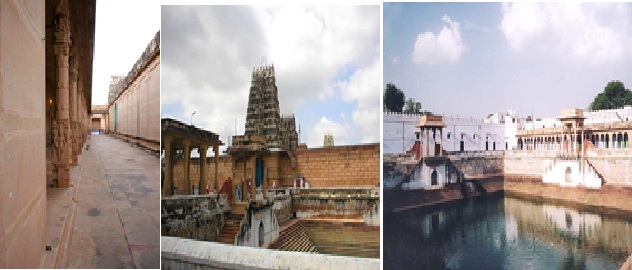
Mandapam provides shade for rest and of course temple-sarovar (pond) and as any temple built in South Indian style should have.
Objective 4 : To understand the function of different Sannidhis & Events.
Entry into the temple can be made from both the gates but the eastern gate is called the main gate. Inside, in a clockwise direction is located the cookhouse, the temples of Sri Raghunathji (Lord Ram) and Sri Paudanathji (Lord Ranganath), Vaikunth Dwar (it opens once in a year on Vaikunth Ekadashi) the “Vahan Ghar”(where all the divine mounts are kept, which are taken out during temple festivals),the store, and the clock tower. Crossing the clock tower through another gate you come across the 50 feet high gold plated “Dhwaja Stambha”. As you again start moving in the clockwise direction you first see the Sri Sheesh Mahal (during Jhoola Utsav Lord Goda Rangamannar reside here) and then come across the following sannidhis:-
- Sri Sudarshanji
- Sri Narsimhaji
- Lord Venkateshawra (Tirupati Balaji)
- Sri VenuGopalji
- Sri Alwar Sannidhis
- Sri Ramanujacharya Swamiji with Sri Nammalwar(Sri Shathkop Swamiji), Sri Nathmuni Swamiji, Sri Madhurkavi Alwaar
- Sri Rangadeshik Swamiji(Temple Founder), Sri Yamunacharya Swamiji(Alwandar), Sri Kanchipurna Swamiji
At the end to the left of the Dhwaja Stambha is the Yagyashala where “Pavitrostava” is held in the month of August/September. At the centre of the temple is located the sannidhi of the main deity Sri Goda-Rangamannar. As you enter the sannidhi of Sri Goda Rangamannar you can see “Sri Jaya-Vijaya” guarding the divine abode. Sri Goda-Rangamannar is present as the “mool-vigraha” with Sri Goda Devi to his right and Sri Garudaji. Seated in the front is the “utsav-vigraha” of Sri Goda-Rangamannar with Sri Sudarshanji, Sri Garudaji, Sri NityaGopalji(Sri Laddu Gopalji), Bhog Moorti and the Shayan Moorti.
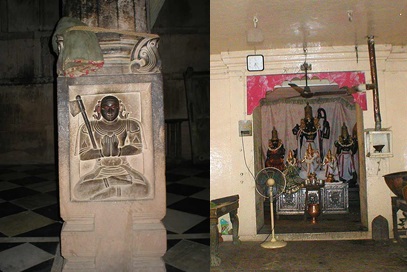
Near the Western door is a chariot, upon which Sri Rangaji rides on special occasions. Once a year, a Ratha-yatra for Lord Ranganath is held. The Lord’s cart is pulled to nearby Rangaji garden.The carts are smaller than in Puri, but the sentiments of devotees can be the same.
Objective 5 : To highlight the spiritual and cultural value of dioramas depicting various lilas of the Lord.
Killing of Ravana
Waking up of Kumbhakarna from Rama-lila
Rasa-lila
 Govardhan-lila and others from Krishna-lila