
Objectives:
Objective 7: To know the appearance and worship of Gaura-Govinda in the temple complex.
Objective 8: To understand the pratibhu deity worship tradition and the current altar arrangement.
Objective 9: To learn the major chronological events that shaped the temple’s legacy.
Objective 1: To know the ancient origins and installations of Govindaji at the Yoga‑Pitha
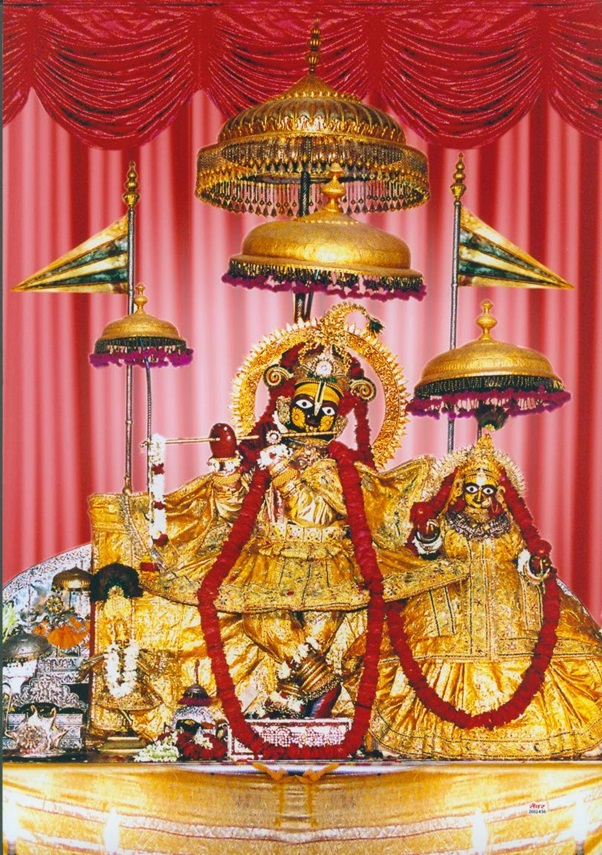
- Govindaji was first installed by Lord Krishna’s great-grandson,Vajranabha Maharaja around 3000 BCE(5,000 years ago) at the sacred Govinda Yoga‑Pitha, a transcendental meeting place of the Lord with His eternal associates.
- The deity of Govind Dev Ji was originally created by Vajranabha, the great-grandson of Krishna based on the descriptions of Krishna given by Uttara, the mother of King Parikshith. According to legend, Vajranabha created three deities of Krishna: one representing the exact form of Krishna from his hip to feet (Madan Mohan Ji deity), one representing the exact form of Krishna from his hip to neck (Gopinath Ji deity), and one his face (Govind Dev Ji deity).
- Uttara, mother of King Parikshit, confirmed that His face resembled the original Krishna.
Objective 2: To know the ancient origins and installations of Govindaji at the Yoga‑Pitha
- Ordered by Sri Caitanya Mahaprabhu to rediscover Vrindavan’s lost holy places and establish proper deity worship, as part of the abhidheya-tattva (the process of devotional service).
- Rupa Gosvami performed intense bhajana in Vrindavan and searched tirelessly for the original deity of Govinda but after months of searching, the Deity could not be found.
- When he became overwhelmed with despair, Rupa Gosvami came and sat by the bank of the Yamuna river and shedding tears, he began to call out the name of Lord Caitanya. Suddenly, Lord Krishna appeared in the guise of a beautiful brijabasi boy. He informed Rupa Gosvami that there was a cow that came every day to a nearby hillock, and the cow emptied its milk into a hole on the hilltop. He asked Rupa to accompany him to the place to see what might be contained in the hole. Rupa Gosvami followed the boy and upon reaching the spot, the boy disappeared.
- Looking within the milk drenched hole, Rupa Gosvami immediately fell unconscious in a wave of ecstatic emotions. When he recovered, he summoned the local people who then excavated the hole and found the beautiful Deity of Lord Govinda. The loud cries of “Hey Govinda, Hey Krishna” suddenly reverberated throughout the sky.
Objective 3: To learn about the architectural patronage and Mughal influences in the Radha Govindaji Temple’s construction
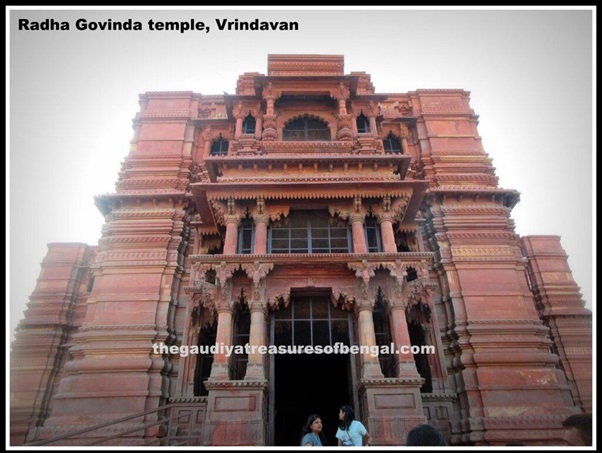
The construction of the Śrī Rādhā-Govindajī Temple stands as a glorious offering of devotion, blending regal patronage with transcendental purpose. Between 1570 and 1590 AD, under the inspired leadership of Rāja Mān Siṅgh of Jaipur, a devoted general in the court of Emperor Akbar, the temple rose as a seven-story marvel of North Indian temple architecture. After Śrī Rūpa Gosvāmī entered nitya-līlā, the responsibility of manifesting this sacred structure was lovingly taken up by Śrī Raghunātha Bhaṭṭa Gosvāmī, who, guided by the Gosvāmīs’ vision, ensured that every stone reflected the mood of abhidheya-tattva—devotional service in action.
Crafted from Mughal red sandstone, the temple’s construction even received material support from Emperor Akbar, whose admiration for the spiritual culture of Vrindavan led him to contribute generously. The altar, adorned with marble, gold, and silver, became the heart of the temple, where Śrī Rādhā-Govinda would receive offerings from surrendered souls. Above the main hall, a massive sculpted lotus bloomed across the ceiling, symbolizing the unfolding of divine love. It is said that the temple cost ten million rupees and took many years to complete—yet every rupee, every moment, was an offering of bhakti. The Govindajī Temple remains not only an architectural wonder but a living monument of devotion, where royal resources were transformed into eternal service to the Divine Couple.
Objective 4: To describe the Mughal attack on the temple and the preservation of the original deities.
In 1670 AD, the majestic Govindaji Temple in Vṛndāvana became the target of imperial aggression when Emperor Aurangzeb, disturbed by the radiant glow of the temple’s ghee lamps, visible even from Agra, ordered its destruction. But the Lord is never abandoned by His devotees, nor does He ever forsake them. In a spirit of deep surrender and urgency, the Vaiṣṇavas lovingly and secretly relocated the original deities of Śrī Rādhā-Govinda to Jaipur, ensuring Their worship continued unbroken. Though the upper stories of the temple were demolished, a miraculous earthquake intervened, halting the complete destruction—an unmistakable sign of divine protection. Today, the lower structure still stands, weathered yet glorious, as a testament to the resilience of bhakti and the Lord’s eternal presence amidst adversity. This episode reminds us that when Krishna is served with love and devotion, no force can extinguish His glory, and His devotees are always under His shelter.
Objective 5: To highlight the theological significance of Sri Govindaji as the presiding deity of Vrindavan.
- Govindaji is known as Vrindavaneshvara, the Lord of Vrindavan.
- Described by Rupa Gosvami as more beautiful than millions of Cupids.
- In the Puranas, He is referred to as Raja-Rajeshvara—the King of Vrindavan.
Objective 6: To describe the historical installation of Srimati Radharani’s deity and Her first formal worship with Krishna.
The external worship of Śrīmatī Rādhārāṇī alongside Śrī Krishna marks a profound moment in the unfolding of Gaudiya Vaishnava siddhānta. Historically, Her deity was first worshipped in Jagannātha Purī, where She was revered in the form of Lakṣmī-devī. However, in a divine dream, She revealed Her true identity as Śrī Rādhikā to King Purushottam Jana, awakening his heart to the deeper truths of prema-bhakti. This revelation paved the way for a historic transition: Śrī Jāhnavā Ṭhākurāṇī, the spiritual consort of Lord Nityānanda, later carried Rādhārāṇī’s deity to Vṛndāvana, where She was lovingly placed beside Govindajī. This sacred act was not merely ceremonial—it was the first public manifestation of Radha-Krishna’s eternal unity in deity worship within the Gaudiya tradition. Through this, the internal principle that Rādhā and Krishna are one soul in two bodies was externally expressed, allowing devotees to engage in worship that reflects the highest truths of divine love. Thus, the altar of Govindajī became a radiant symbol of mādhurya-rasa, where the sweetness of Their loving pastimes could be accessed through pure devotional service.
Objective 7: To know the appearance and worship of Gaura-Govinda in the temple complex.
- Sri Caitanya Mahaprabhu, the combined form of Radha and Krishna, sent His Gaura-Govinda deity to Vrindavan through Kashishvara Brahmacari.
- The deity is worshipped in the southern wing of the temple complex, affirming Mahaprabhu’s central place in Gaudiya theology.
Objective 8: To understand the pratibhu deity worship tradition and the current altar arrangement.
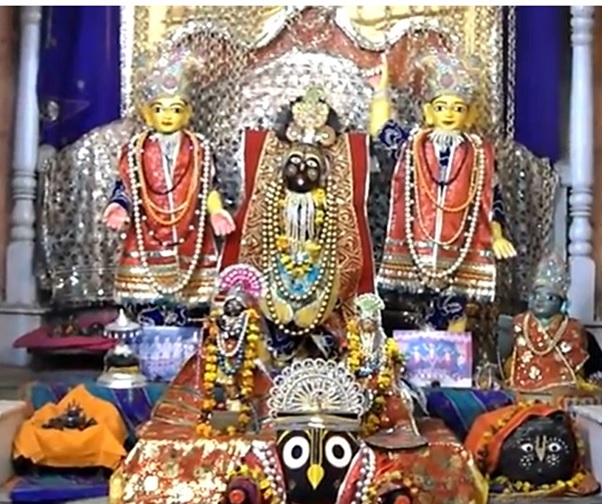 After the original deities were relocated, a new temple was built behind the ruined structure, where the pratibhu-murtis (replica deities) of Sri Sri Radha Govinda are worshipped today.
Current altar:
Center: Sri Govindaji
Left: Sri Caitanya Mahaprabhu
Right: Lord Nityananda
Below: Small Radha-Krishna deities
Base: Sri Jagannath and Govardhana-shila
Gaudiya siddhanta confirms no difference between original and pratibhu forms when worshipped with devotion.
Objective 9: To learn the major chronological events that shaped the temple’s legacy.
BCE~3000
The sacred journey of Govindaji begins in the era of Vajranabha Maharaja, the great-grandson of Lord Krishna. With deep devotion, he installs the original deity of Govindaji in Vrindavan, marking one of the earliest acts of divine worship in the region. This installation preserves the memory of Krishna’s pastimes and establishes Vrindavan as a sacred center of devotion.
1510s
After centuries of obscurity, the buried deity of Govindaji is rediscovered by Śrī Rūpa Gosvāmī, one of the foremost disciples of Lord Chaitanya Mahaprabhu. Guided by divine inspiration and scriptural insight, Rūpa Gosvāmī revives the worship of Govindaji, reconnecting the Vaishnava community with its ancient spiritual heritage.
AD 1570
1570 AD
Recognizing the spiritual significance of Govindaji, Raja Man Singh of Amber initiates the construction of a magnificent temple in Vrindavan. This royal patronage reflects the growing influence of Gaudiya Vaishnavism and the desire to honor Krishna’s eternal presence through architectural grandeur.
AD 1590
After two decades of dedicated effort, the Govindaji Temple is completed. Worship begins with great enthusiasm, and the temple becomes a vibrant center for devotional life, attracting pilgrims, scholars, and saints from across the land.
AD 1670
During the reign of Mughal emperor Aurangzeb, the temple faces destruction as part of a broader campaign against Hindu places of worship. To protect the sacred deity, devotees secretly move Govindaji to safety, preserving the divine presence despite political turmoil.
AD 1748
In Vrindavan, a pratibhu-mūrti (replica deity) of Govindaji is ceremonially installed, allowing worship to continue in the original temple space. This act symbolizes the resilience of devotion and the community’s unwavering commitment to honoring the Lord.
AD 1819
To restore the sanctity and beauty of the temple, Nandakumar Vasu constructs a new altar for Govindaji. This renewal breathes fresh life into the temple, enabling devotees to once again offer their prayers and services in a spiritually uplifting environment.
Objective 10: To highlight the Gaudiya-siddhanta realized through sambandha, abhidheya, and prayojana in relation to Govindaji worship.
The worship of Śrī Govindadeva in Vrindavan beautifully illustrates the progression of Gaudiya-siddhānta, guiding the soul from relationship to practice to ultimate perfection. Just as Madana-mohana represents sambandha-tattva, the foundational truth of our eternal relationship with Krishna, Govindaji’s presence reaffirms that the jīva is intrinsically connected to the Lord as His servant. This sambandha is not theoretical—it is the beginning of spiritual life, awakening the soul’s identity in relation to the Supreme.
Govindaji, manifest as Śrī Rādhā-Govinda, embodies abhidheya-tattva, the path of bhakti-yoga. Through regulated devotional service—hearing, chanting, and worship—one engages in loving reciprocation with the Lord. The Govindaji Temple, established by the Gosvāmīs and supported by royal patronage, became a living center of abhidheya, where sādhakas could cultivate devotion under the shelter of the deity’s merciful glance.
The culmination of this journey is prayojana-tattva, the attainment of pure love of Godhead. Just as Śrī Rādhā-Gopīnātha represent the goal of prema-bhakti, Govindaji’s worship draws the devotee toward the highest aspiration—unalloyed love, free from material motivation. In this mood, the soul no longer seeks liberation or knowledge, but simply desires to serve and please Krishna eternally.
Installed by Śrī Rūpa Gosvāmī, the rasācārya of the Gaudiya tradition, Govindaji also reveals the richness of rasa-tattva—the Lord as the enjoyer of unlimited transcendental moods. Rūpa Gosvāmī’s realization infused the deity with the sweetness of mādhurya-rasa, allowing devotees to enter the intimate pastimes of Rādhā and Krishna through pure devotional absorption.
All of this is made possible by the mercy of Śrī Caitanya Mahāprabhu, who empowered Rūpa Gosvāmī and Jāhnavā Māta to manifest both the internal essence and external expression of Radha-Krishna worship. Through their guidance, the worship of Govindaji became not just ritual, but a gateway to spiritual transformation—where sambandha leads to abhidheya, and abhidheya blossoms into prayojana.
Objective 11: To understand the poetic warning of Srila Rupa Gosvami regarding Govindaji’s captivating form.
“If you have even the slightest desire to enjoy material life, do not go to see Govindaji at Keshi Ghat, Vrindavan.
His threefold-bending form, crooked glance, and flute-playing will steal your heart and ruin all worldly attachments.”
– Srila Rupa Gosvami
This poetic warning is a loving reminder of Govindaji’s power to captivate the soul and cut through material illusions.
Objective 12: To describe the temple as a living symbol of Vaishnava history, divine mercy, and spiritual resilience.
The Radha Govindaji Temple is a living embodiment of devotional perseverance, Mughal adversity, royal patronage, and divine protection. Though partly in ruins, the current worship of pratibhu deities continues with full Gaudiya siddhanta, inviting every pilgrim to rekindle their eternal bond with Sri Sri Radha-Govinda.
