
Objectives:
Objective 1: To understand the historical importance of the Radha Gopinath Temple in Vrindavan.
Objective 1: To understand the historical importance of the Radha Gopinath Temple in Vrindavan.
Overview
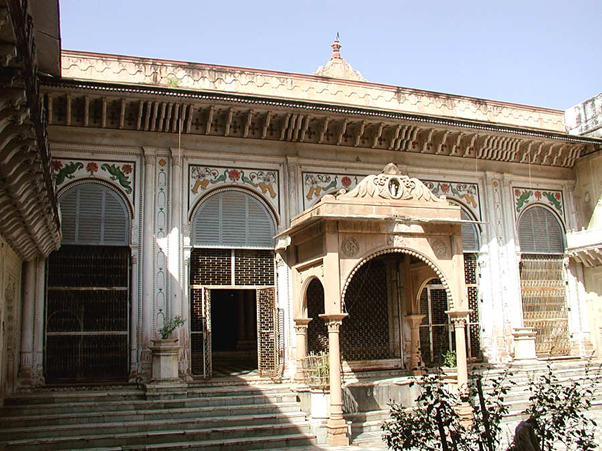
Radha Gopinath temple is considered to be one among the oldest temple in Vrindavan located at the Parikrama Marg, Keshi Ghat, on the banks of River Yamuna. It was founded by Madhu Pandit Goswami and its marvelous construction reveals a glorious past.
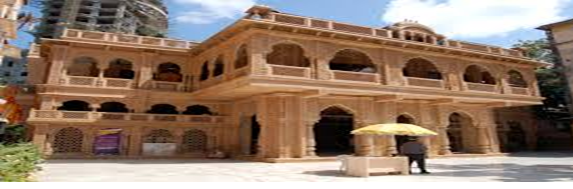
 New temple entrance
Objective 2: To explain the historical significance of the original deity of Lord Gopinath and how the deity was rediscovered during the time of the Six Goswamis.
Appearance of the Original Deity – The deity of Lord Gopinatha was originally established by Vajranabha Maharaja, Lord Krishna’s great-grandson at Vamsi Vata five thousand years earlier. Then during the period of the Six Goswamis, the deity of Lord Gopinatha was rediscovered at Vamsi Vata lying buried in the ground near the famous banyan tree. Madhu Pandita Goswami, a disciple of Sri Gadadhar Pandit, came to Vrindavana and was searching everywhere for the deity of Lord Gopinatha. Not finding the deity anywhere and feeling great sorrow, Madhu Pandita gave up eating food and sat at Vamsi Vata shedding a constant stream of tears. As it was the monsoon season, there was a great flood in Vrindavana and the River Yamuna overflowed her banks. The force of the flood waters apparently swept away the old banyan tree that stood at Vamsi Vata and when the flood waters receded, the deity was seen half-buried in the ground by Madhu Pandita’s close friend and companion named Paramananda Bhattacharya, just beneath where the old banyan tree had once stood. Paramananda immediately called his friend Madhu Pandita who retrieved and worshipped the Gopinath deity. The deity was then moved to the spot where the present Gopinatha temple now stands.
Objective 3: To know the unique features of the Shri Radha Gopinath temple and understand the symbolic significance of Ananga Manjari being placed on Krishna’s left, and Radharani on the right.
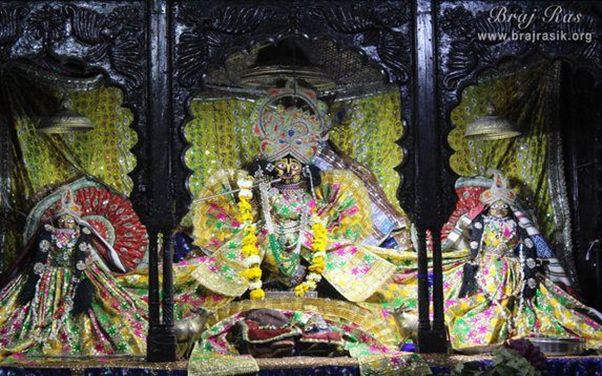 Darshan of Radha Gopinath, Vrindavan
Uniqueness of Deities –
The Gopinath temple stands out from other temples because it has the unique distinction of featuring the Deity of Ananga Manjri on the altar. Ananga Manjri who is the younger sister of Radharani stands on the left-hand side of Lord Gopinath, while Radharani stands on the right. This is different from all other temples where Radharani is depicted standing on the left-hand side of Krishna.
Objective 4: To explore the divine intervention and dreams received by Jahnava Devi that led to the installation of the deity of Ananga Manjari.
Jahnava Devi, the wife of Lord Nityananda, once visited the Radha Gopinath temple in Vrindavan and felt that the deity of Radharani could look more beautiful if it were slightly taller. However, she did not express the thoughts to anyone. That night Shri Radharani and Gopinath appeared in her dream and expressed their desire to have a new deity of RadhaRani installed beside them. The next morning Jahnava Devi instructed the sculptor Nayana to design a new deity of RadhaRani.
The new deity was then sent to Vrindavan and immediately installed beside Sri Gopinath. When the devotees saw the new deity, they felt that it looked just like Jahnava Devi. It turned out that the sculptor, being the disciple of Jahnava Devi, had modelled the deity on Jahnava Devi’s own beautiful features. After consulting with senior Vaishnavas, it was determined that the deity was actually Ananga Manjri, who appeared as Jahnava Devi in Chaithanya Lila. Since the deity of Ananga Manjri had already been installed on the left side of lord Gopinath, it was felt that it must have been pre-arranged by Lord Gopinath Himself. The smaller deity of Radharani was then placed on the right side of Lord Gopinath, where she remains to this day. The devotees believed that, out of love and compassion for her younger sister, Radharani elevated Ananga Manjri to her own position on the left side of Krishna.
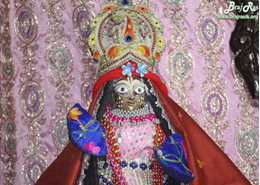 Shri Jahnava Thakurani, Sri Sri Radha Gopinatha Temple
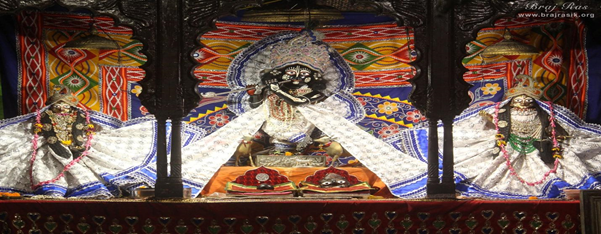 Close deity darshan in white attire – Shri Radha Gopinathji
Objective 5: To learn about the Mughal invasion and the resulting relocation of the original deities of Radha-Gopinath to Jaipur.
Original Deities Shifted To Jaipur –
During Mughal invasion, the original deities of Lord Gopinath, Radhika and Jahnava was proceeded to Jaipur together with other deities.
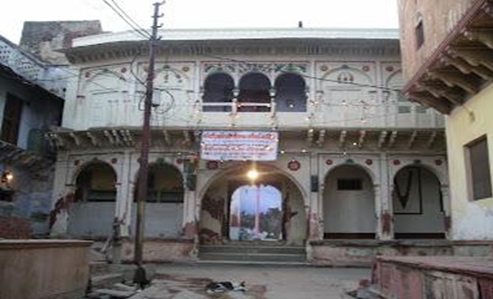
In the hall leading to Radha-Gopinath´s current altar there is a doorway on the right leading down a step into a small temple room. This is the old temple where the original deities of Radha-Gopinath lived before the Mughal invasion when they were moved to Jaipur.
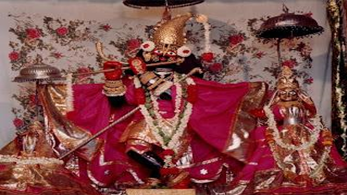 Radha Gopinath, original Deities (Jaipur)
Ananga-manjari (Nityananda Shakti Ma Jahnava) is at the left side of Gopinath. The small deity on Gopinath’s right side is Radharani, and on the far left and right are Lalita and Visakha.
Objective 6: To know the current worship practices in the temple, including the installation of the deity Muralidhar Mahaprabhu and the significance of his form.
Present Deities – Now the deity being worshipped here is ¨Muralidhar Mahaprabhu,¨ a form of Goursundar playing the flute. The temple Gosvami says that, ¨This deity was installed after the Mughal invasion. Mahaprabhu holds the flute, for the sake of the general populace who don’t know about Mahaprabhu´s svarup. His color is golden like Radharani, but he holds the flute to show that he is also Krishna; He is Radha and Krishna in one form.¨ Today, the pratibhu or non different replacement deities of Radha-Gopinath reside in a new temple connected to the old one. According to the direct order of Nityananda-shakti Sri Jahnava Thakurani, Gopinath stands with Ananga-manjari to his left, and Radharani to his right. Lalita and Visakha flank them on both sides. The deity of Mahaprabhu SriGaurasundara is in a separate chamber.
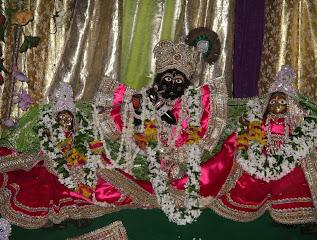 Sri Sri Radha Gopinath, pratibhu vigrahas
Objective 7: To understand the deep emotional connection between Nityananda Prabhu and Lord Krishna, and its expression in Gaudiya Vaishnava theology.
Pastimes Here
Nityanand Prabhu’s Visit :
Lord Nityananda Prabhu in the mood of Balarama had desperately searched all over Vraja for His younger brother Krishna, calling out Kanhaiya Kanhaiya and falling at the feet of the Vrajavasis, He would beg them to tell Him where His younger brother was; everyone had concluded that this avadhuta was totally mad. In utter desperation Nityananda was sitting here with tears streaming from His eyes, calling out Kanhaiya when a voice from the sky informed Him that His younger brother was in Navadwip. Nityananda went to Navadwip, where He met Caitanya Mahaprabhu in Nandan Acarya’s house.
Objective 8: To know the location of the samadhi of Madhu Pandita Goswami in relation to the Radha Gopinath temple.
Samadhi
The samadhi of Madhu Pandita Goswami can be seen near the eastern gate of the temple.
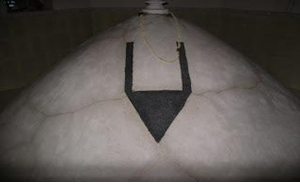 Samadhi of Madhu Pandit Goswami
Objective 9: To know the role of Srila Raghunatha das Gosvami as the prayojana acharya and his connection to the Radha-Gopinatha Deity.
Glories
Object Of Ultimate Perfection of Prema – Vrindavana’s Gopinatha Deity is Krishna, the Lord of the gopis. The Gopinatha Deity represents the prayojana tattva (truth about life’s ultimate goal—pure love of Krsna). Srila Raghunatha das Gosvami, acclaimed as the ‘prayojana acarya accepts the lotus feet of Srila Rupa Gosvami as his highest aspiration. He thus reveals the way to attain the perfection of one’s loving relationship with Sri Krishna is through humble prayers and service to the Radha-Gopinatha Deity, and by imbibing the teachings and mercy of Srila Raghunatha das Gosvami, a devotee can quickly advance in devotional service and ultimately attain the goal of life, prema bhakti.
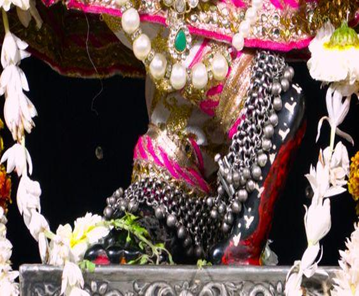 Lotus feet of Shri Radha Gopinath, Vrindavan
Objective 10: To explain the special spiritual benefit of seeing the three Deities—Madana-mohana, Gopinatha, and Govinda—within one day..
According to Gaudiya Vaishnava tradition, from teachings, we understand that one who receives darshan of Sri Madan Mohan in Karoli, Sri Gopinath, and Sri Govind Dev in Jaipur within a single day before sunset, it is believed that they can receive the divine blessings equivalent to having the sacred vision of Lord Krishna Himself.
