
Objectives :
Objective 4: To know the legacy of the Deities in this Mandir and their origin
Objective 6: To Preserve and understand the legacy history of Visvanatha Cakravarti Takura.
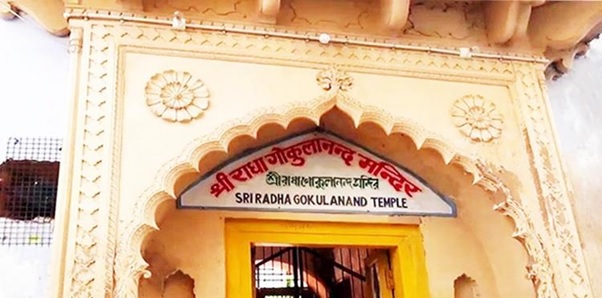
Objective 1: To highlight the historical and spiritual significance of Sri Sri Radha Gokulananda Mandir.
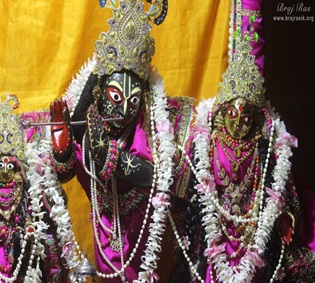
Radha Gokulananda temple is an ancient shrine, located at Vrindavan, in Uttar Pradesh and was established by Lokanatha Goswami
This Temple is located at the Bank of Yamuna River – in between Keshi Ghat and the Radha-Raman temple
This Temple is most famous as one among ‘Seven Goswami Temples’
This Temple includes Samadhis of eminent Vaishnava Acharyas
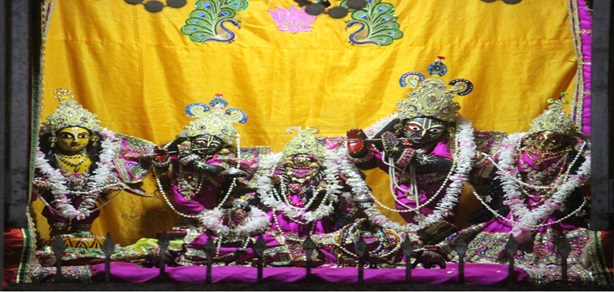
In this temple, there are the small Radha-Vinoda Deities of Lokanatha Gosvami, the larger Deities of Vijaya Govinda of Baladeva Vidyabhusana, and the Radha Gokulananda Deities of Viswanath Chakravarti. The small Deity of Krishna in front of Gokulananda and the Deity of Chaitanya Mahaprabhu were worshiped by Narottama Dasa Thakur. Viswanath Chakravarti arranged to have this temple built. Formerly, all the Deities in this temple were worshiped alone, in their own temples.
One brahmachari from Mathura had a dream in which the Lord appeared to him and asked him to give his small Gokulananda Deity to Viswanath. He did so, but Viswanath refused to take the Deity because he could not afford proper worship. That night the Lord appeared to Viswanath and told him that He would arrange everything necessary for the offerings. The brahmacari had another dream and this time, Viswanath accepted.
Originally, Viswanath Chakravarti worshiped the Deity of Gokulananda at Radha Kunda. He then moved to Vrindavana and stayed with Lokanatha Gosvami. Where this temple is located is where Lokanatha Gosvami would do his bhajana. When the original temple of Radha-Vinoda fell apart, Viswanath Cakravarti had another temple built and called it the Gokulananda Temple. Both his Deity of Gokulananda and Radha-Vinoda were worshiped here.
Objective 2: To highlight the contributions of prominent Gaudiya Vaishnava Acharyas associated with the temple.
The temple established by Lokanatha Goswami is known as Radha Gokulananda, but he himself worshipped the deity named Radha Vinoda, which he discovered in Kishori-kunda at Umraya. In the centre of the temple is the small deity of Radha Gokulananda which was worshipped by Visvanatha Cakravarti Thakura. Also on the altar are Śrī Śrī Rādhā-Vijaya Govinda, the Deities of Baladeva Vidyābhūṣaṇa; Śrī Chaitanya Mahāprabhu, as worshiped by Śrīla Narottama dāsa Ṭhākura; and the Govardhana-śilā worshiped by Śrī Chaitanya Mahāprabhu and later gifted to Śrīla Raghunātha dāsa Gosvāmī.
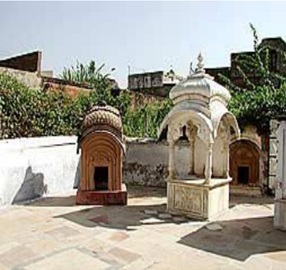
Located in the courtyard are the samadhis of Lokanatha Goswami, his only disciple Narottama dasa Thakura, his disciple Srila Ganganarayana Cakravarti, and Srila Visvanatha Cakravarti Thakura who came in their disciplic succession.
Objective 3: To Safeguard and highlight the spiritual significance of sacred Artifacts like the Govardhana Shila of Lord Chaitanya, housed in the temple.
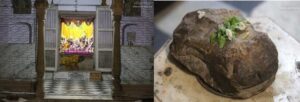
A small cube-like Govardhana-sila given to Raghunatha Dasa Gosvami by Chaitanya Mahaprabhu. This Govardhana-shila was worshiped by Lord Chaitanya Mahaprabhu who gave it as a gift to Raghunatha Dasa Goswami. The original shila which bears the thumb impression of Lord Chaitanya is presently being worshiped at Bhagawata Nivasa in the Ramana Reti area of Vrindavana.
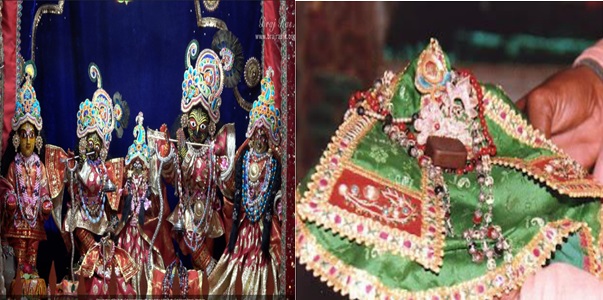 Sri Sri Radha Shyamasundar &
Small cube-Govardhana-sila
In this temple, Lokanatha Goswami performed bhajana in his later years of life. Though he was not one of the Six Goswamis, he was one of the renowned Gaudiya Goswamis and his temple is included amongst the famous ‘Seven Goswami Temples’. Lokanatha is often referred to as being the ‘Seventh Goswami’ of Vrindavana. Though he founded the Radha Gokulananda Temple, he himself worshiped the deity named Shri Shri Radha Vinoda, which he discovered in Kishori-kunda at Umraya. Later, the temple was named as Radha Gokulananda.
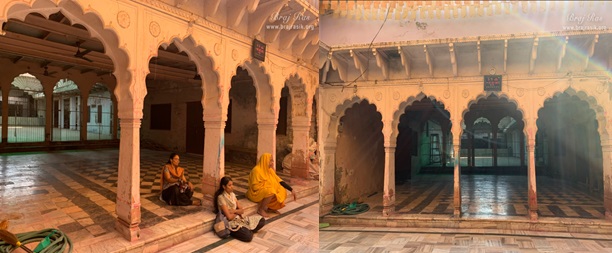
Geographical Details:
Just south of Radha-Vallabha’s temple is a block of six terraced houses that represent the Radha-Gokulananda temple. It is across the street from the Vamsi-Gopala Temple. Now let us hear about each terraced house, beginning with the northernmost one, Radha- Gokulananda’s temple, and proceeding one by one to the southernmost.
“With deep love, I worship Sri Manjulali Manjari, whose enchanting body is the color of molten gold, who wears a red dress and beautiful ornaments, and who serves the lotus feet of Sri Radhika”-as revealed in Vilāpa-kusumāñjali by Śrī Lokanātha Gosvāmi
(https://www.vrindavanforest.com/sri-sri-radha-gokulananda)
There is a Govardhana-shila in this temple that was given by Lord Chaitanya to Raghunath Dasa Gosvami. This shila bears the thumb print of Lord Chaitanya. He used to chant while holding the shila, pressing it to His heart or eyes. The shila was always moist with Lord Chaitanya’s tears. He would place it on His head or smell it. Lord Chaitanya kept this shila for three years and then gave it to Raghunatha dasa. This shila can be seen if you give a small donation. Krishna Priya Thakurani, the daughter of Ganganarayan Chakravarti (the disciple of Narottama dasa), got the service of worshiping Giridhara, the Govardhana shila of Raghunatha dasa Gosvami.
Historical Details:
The deity of Radha Vinoda was taken out of Vrindavana during the attack on the holy city by the tyrant Aurangzeb, and is now being worshiped in Jaipur. It was around a hundred years later when the deity worshiped by Shrila Vishvanatha Chakravarti named Shri Shri Radha Gokulananda was installed in the temple. Therefore it is believed that during the time of Vishvanatha Chakravarti and his disciple Baladeva Vidyabhushana, the concept of the ‘Seven Goswami Temples’ came.
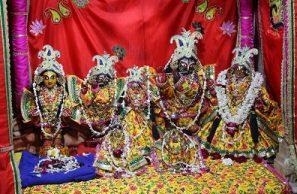
Deities:
Radha Gokulananda -Gaura-Nitai -Radha Vinoda -Radha Vijaya-Govinda
Radha Gokulananda: Gokulananda was the Deity of Visvanatha ChakravartI Thakura, who came to Vrindavana one hundred years after Lokanatha Gosvami’s disappearance; thus the name of the temple must have been changed. On the altar of this temple are the small Gokulananda Deity that ChakravartI Thakura kept in his bead bag
Gaura-Nitai: The altar is also graced by the Deity of Lord Caitanya worshipped by Narottama Dasa Thakura.
The deity of Radha Vinoda was discovered in Kishori-kunda at Umraya and it was taken out of Vrindavana during the attack on the holy city by the tyrant Aurangzeb, and is now being worshiped in Jaipura.
The Deity Radha Vijaya-Govinda was worshipped by Baladeva Vidyabhushana.
Objective 4: To know the legacy of the Deities in this Mandir and their origin
The rich spiritual legacy of names of Deities, details of worship by the Gaudiya Vaishnava Parambara, and the origin of the deity is given in the following table:
| Names of Deities | Worshipped By | Origin of deity | Original Deity in |
|---|---|---|---|
| Radha Gokulananda | Vishvanath Chakravarty Thakur | — | Jaipur, Rajasthan |
| Gaura-Nitai | Narottama Dasa | Partibhu murti | |
| Radha Vinoda | Lokanatha Goswami | discovered in Kishori-kunda at Umraya |
Jaipur, Rajasthan |
| Radha Vijaya- Govinda | Baladeva Vidyabhushana | Partibhu murti | |
| Mahaprabhu’s famous Govardhana-shila | Raghunatha Dasa Goswami | Given by Mahaprabhu | Original Sila worshiped at Bhagawata Nivasa in the Ramana Reti area of Vrindavana |
Objective 5: To Preserve and Promote Gaudiya Vaishnava Heritage and create awareness and to conserve the temple complex
The rich spiritual legacy of Radha Gokulananda temple need to be preserved and promoted as the Samadhis of Famous Vaishnava Acharyas Lokanatha Goswami, Narottama Dasa Thakura, Vishvanatha Chakravarti Thakura and Ganga-Narayana Cakravarti are housed in the Temple premises. This rich heritage should not only be conserved but also promoted among the devotees.
Radha-Gokulananda’s temple and samadhi courtyard have a charming and intimate atmosphere conducive to feeling the transcendental presence of the Lord and His exalted devotees. Narottama Dasa was born into a royal family of East Bengal in 1531, while Caitanya Mahaprabhu was still physically present. He displayed all the features and symptoms of a great person, Mahapurusha
A well-behaved child, Narottama astonished everyone with his sharp memory and intellect. His parents, however, worried about his detachment from worldly things and his strong devotional impulses.
It is said that on His visit to East Bengal Lord Chaitanya had called out Narottama’s name while bathing in the Padma River and placed the wealth of divine love in the river for Narottama to receive later.
The book Prema-vilasa tells that when the river Padma asked the Lord how she would recognise Narottama, the Lord replied that by His touch Narottama would cause her waters to swell onto her banks.
At the age of twelve, Narottama had a dream in which Lord Nityananda directed him to collect the gift of love that Lord Caitanya Mahaprabhu had left for him in the Padma river.
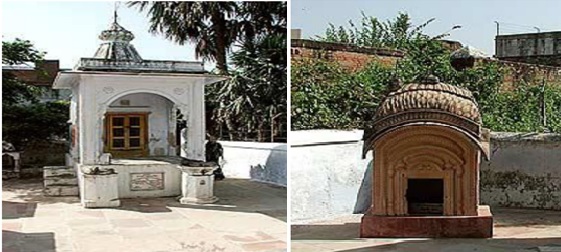
Puspa Samadhi Narottama Dasa Thakura: Next to Radha-Gokulananda Mandira is the pushpa-samadhi of Narottama Dasa Thakura, the sole initiated disciple of Lokanatha Gosvami and an empowered representative of Lord Nityananda.
Lokanatha Gosvami: Lokanatha was the son of Padmanabha Chakravarti of the village Talakhadi in Jessore district, who was a disciple of Advaita Acharya. Lokanatha had taken the mantra from Advaita Acharya and studied Bhagavata at Santipur with Gadadhara Pandita. Shortly before Lord Chaitanya Mahaprabhu took sannyasa, He ordered Lokanatha to go to Vrindavana accompanied by Bhugarba Gosvami, who was a disciple of Gadadhara Pandita. Later Lokanatha gave diksha to Narottama Dasa Thakura .
Lokanatha Gosvami set the example of perfect renunciation. He was the incarnation of Manjulali Manjari.
Ganga-Narayana Chakravarti: Sri Lokanatha Gosvami was the disciple of Sri Gauranga & his disciple was Sri Narottama Dasa Thakura, and his disciple is Shri Ganga Naranayana Chakravarti
The worship of such great souls makes this area spiritually potent.
Objective 6: To Preserve and understand the legacy history of Visvanatha Cakravarti Takura
Visvanatha Chakravarti wrote many important books, giving the essence of devotional service and was the siksha-guru of the wonderful Baladeva Vidyabhusana and Narahari Chakravarti. Visvanatha Chakravarti was born most probably in the Saka era 1586 In the famous village of Devagrama in the district of Nadia. He belonged to the Radhi brahmana sect. Shri Ramabhadra and Shri Raghunatha Chakravarti were his two brothers.
Shri Visvanatha took his initiation from Shri Krsna Charana Chakravarti of Saidavada in the Mursidabad district. He lived there for a considerable time and wrote many books. Because he lived there for so long, Visvanatha introduced himself as an inhabitant of Saidavada. He studied grammar, poetry and rhetoric when he lived in Nadia. It is said that when he was a student he defeated a world famous scholar in an argument. From his early boyhood days he was completely indifferent to the materialistic world. In order to get him involved in worldly life, his father arranged his marriage at a very early age. Shri Chakravarti lived for sometime in his house and then left to become a resident of Vrindavana. His relatives tried to bring him back, without success. When he came to Vrindavana, Sri Chakravarti Thakura stayed with Mukunda Dasa, a disciple of Srila Krshna Dasa Kaviraja Gosvami, in Radha-kunda and studied the Gosvami’s books.
.
Shri Chakravarti Thakura used to worship the Deity of Shri Gokulananda as well as the Govardhana sila of Raghunatha Dasa Gosvami. Amongst the Mahanta society, he was famous as Sri Harivallabha Dasa. The title Chakravarti was given to him by his disciples. Sri Lokanatha Gosvami was the disciple of Sri Gauranga & his disciple was Sri Narottama Dasa Thakura, and his disciple is Shri Ganga Naranayana Chakravarti. Shri Ganga Narayana Chakravarti’s disciple was Sri Krishna-charana Chakravarti, whose disciple was Sri Radha Ramana Chakravarti. Shri Visvanatha Chakravarti was the disciple of Sri Radha-Ramana Chakravarti. In the month of Magha (January – February), on the fifth day of the bright fortnight, 1755 he departed from this world. (Ref MD
Śrīla Narottama Dāsa Ṭhākura’s Prayers to Lokanatha Gosvami
“shrimad-radha-vinodaika seva-sampat-samanvitam
padmanabhatmajam shrimalal lokanatha prabhum bhaje”
I worship the lotus feet of Srila Lokanatha Prabhu, the son of Sri Padmanabha. He is a storehouse of single-minded service to the lotus feet of Shri Shri Radha-Vinoda. (Ref Sri Krishna Kathamrita Bindu)
Objective 7: To Preserve and understand the legacy history ofPrabhupada’s Connection with Radha Gokulanand Mandir:
Srila Prabhupada, the founder-acharya of ISKCON, was closely connected to the Radha Gokulananda deities and he installed Radha Gokulananda deities at “Bhaktivedanta Manor”, his first temple in the United Kingdom.
Prabhupada personally supervised the installation of the deities, ensuring every detail was attended to, from dressing the deities to their placement on the altar. The installation of Sri Sri Radha Gokulananda at “Bhaktivedanta Manor” was a remarkable event in the establishment of ISKCON as a global movement. It allowed the movement to spread Krishna consciousness throughout the world from that base.
Prabhupada’s focus during the installation ceremony was entirely on the pleasure of Sri Sri Radha Gokulananda, highlighting the importance of the deities in the devotional service that he was teaching. The entire event, from the installation to the ecstatic dancing of the devotees, was a demonstration of love and devotion to Sri Sri Radha Gokulananda, and a testament to Prabhupada’s commitment to spreading Krishna consciousness.
Timings of the Temple
- Mangal Darshan 8:00 am to 12 noon: Mangal Darshan 5:20 pm to 8:00 pm
Radha Raman Temple to Radha Gokulanand temple
Winter-Managala Aarti : 6 am
Radha Raman Temple to Radha Gokulanand temple
