
Objectives:
Objective 1: To know the historical significance of Nanda Bhavan .
Objective 2: To learn about the sacred places within the Nanda Bhavan.
Objective 3: To understand the structure and divine atmosphere of Nanda Bhavan.
Objective 4: To describe the present-day Krishna-Balaram temple .
Objective 5: To highlight the secret meeting place of Rādhā and Krishna.
Objective 6 : To describe different pastimes.
Objective 8: To describe the daily childhood activities of Krishna and Balarama.
Objective 9 : To highlight the glories of Nanda Mahārāja.
Objective 1: To know the historical significance of Nanda Bhavan
The site of Nanda Maharaja’s palatial residence
The place of residence for Krishna Balarama
The very spot where the present KrishnaBalaram Temple is built
The deities of Nanda, Yashoda and Krishna, are said to be the same deities found by Lord Caitanya in the caves of Nandisvara Hill
Objective 2: To learn about the sacred places within the Nanda Bhavan.
KåishnaBalaram Temple
Radhikas Resting Place
The Path to the Forest
The Path to go cow grazing
The Place where Radhika was bidden farewell
The place where yoghurt was churned
Pürṇamäsī’s arrival path
Objective 3: To understand the structure and divine atmosphere of Nanda Bhavan
Nand Bhavan:
This was the site of Nanda Maharaja’s residence known as Nanda Bhavan where Krishna and Balarama lived; the word ‘bhavan’ means a palatial residence. (VMP).
Nanda’s residence here was extensive, with separate bedrooms for everyone including Nanda Bābā, Mother Yaśodā, Mother Rohiṇī, Kṛṣṇa and Baladeva. Ita kitchen, store-room and dining hall, as well as resting-rooms and other rooms for Rādhikā and Kṛṣṇa.
The compound of Nanda-bhavana is immense and holds many delightful pastime places as follows.
Objective 4: To describe the present-day Krishna-Balaram temple .
KrishnaBalaram Temple:
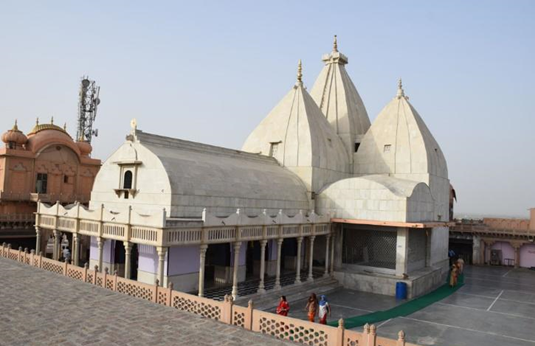
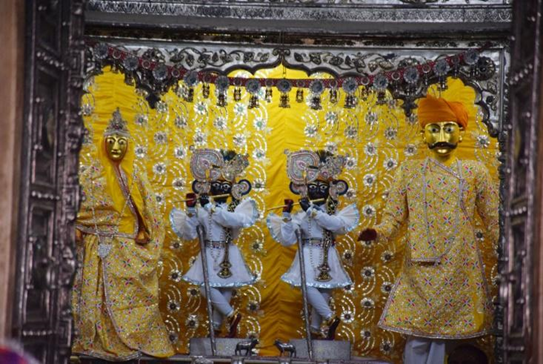
The present temple of KrishnaBalarama has been built on the spot where Nanda’s residence once stood. Within this temple one can see the large deities ofYasoda Mayi and Nanda Maharaja with Krishna and Balarama standing in between them. On the right side of Nanda are Krishna’s friends Shridama and Madhumangala. On the left of Yashoda one can see Radharani, and then Rohini and Revati, the mother and the consort respectively of Balarama. These deities of Nanda, Yashoda and Krishna, are said to be the same deities found by Lord Chaitanya in a cave on Nandishwara Hill. The other deities were added at a later time after. The present KrishnaBalarama temple at Nandagrama was reportedly built by the wealthy landowner Rupa Rama Singh of Barsana in the 19th Century.
Objective 5: To highlight the secret meeting place of Rādhā and Krishna
Rādhikā’s resting place:
This is Śrīmatī Rädhikä’s resting place. After completing Her cooking, Śrīmatī Rādhikā would, on the request of Mother Yaśodā, take prasàda mixed with the remnants of Kṛṣṇa that Dhani??hā Sakhī would bring. Mother Yaśodā then invited Her to take rest in this garden. At that time, the sadhìs used to arrange for Her secret meeting with Kå?ṇa. This place is called Rādhā-bäga, Rädhä’s garden.
Objective 6 : To describe different pastimes.
The path to the forest:
Every day, Mother Yaśodā used to decorate Balaram and Krishna Rāma and Kṛṣṇa in different ways, thus preparing Them to go to the forest to graze the cows. She would send Them and the sadhàs off from here with a heavy heart.
The path to go cow grazing:
Rāma and Kṛṣṇa, the best of dancers, traversed this path alongwith Their friends to go cow grazing.
The place where Srimati Radharani was bidden farewell:
Here, Mother Yaśodā used to put Śrīmatī Radharani on her lap before seeing Her off to Jāvata with tearful eyes.
The place where yoghurt was churned:
Every day in the early morning, Mother Yaśodā used to churn yoghurt at this place. To this day, one can see an enormous yoghurt pot here.
Pūrṇamāsī’s arrival path:
Yogamāyā Pūrṇamāsī used to arrive at Nanda-bhavana along this path to have darshan of baby Kṛṣṇa.
 DEITY
DEITY
Objective 7 : To understand how Lord Caitanya’s mission led the Six Gosvāmīs to excavate Krishna’s pastime places and revive devotional culture.
During Lord Chaitanya’s departure from Vrindavana, He sent the Six Goswarnis to the holy Dhama for the purpose of excavating all the lost places of Krishna’s pastimes as well as establish temples of Radha-Krishna, write books on the science of devotion, and in general revitalize the cult of Krishna-bhahli amongst the population. Within a short time, temples were built at all the important pastime places like Vrindavana, Govardhana, Nandagrama and Varsana.
Objective 8: To describe the daily childhood activities of Krishna and Balarama.
Krishna and Balaram’s childhood pastimes:
Here, Kå?ṇa and Baladeva performed many of Their childhood, boyhood and youth pastimes. Daily, at forenoon, Śrīmatī Rādhikā used to come here from Jāva?a with Her sadhìs on the zealous and loving requests of Mother Yaśodā, and with great delight, She would prepare many tasty foodstuffs for Kå?ṇa together with Mother Rohiṇī. Kå?ṇa used to eat with His sadhàs in the adjacent large dining-hall and then rest in the bedroom situated one hundred steps from the dining-hall.
Objective 9 : To highlight the glories of Nanda Mahārāja’s palace.
Śrī Raghupati Upādhyāya glorifies NandaBābā and this compound in very sweet words:
– Padyàvalì (126)
‘Those who are afraid of the perplexities of worldly life worship the Śrutis and Småtis, and others may worship the Mahàbhàrala. Let them do so. I myself will always worship Nanda Bābā, in whose courtyard the Supreme Absolute Truth is crawling here and there on His knees.’
