
Objectives:
Objective4: To know about the temple darshan timings and important festivals.
Objective6: To understand the spiritual and scriptural references to Māna-Garh in Adī-Varāha Purāṇa.
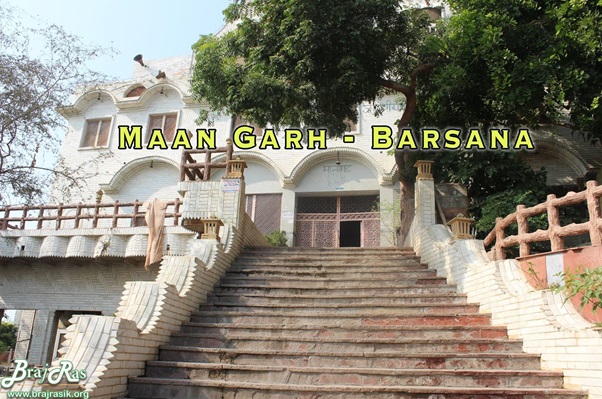
Objective1: To understand the significance of Māna-Garh as the site of Śrīmatī Rādhikā’s divine māna-līlā.
Śrī Māna-Garh and the Divine Māna-Līlā
Situated atop one of the four peaks of Brahmāgiri Parvata in Gehvar-Van, Barsana, Māna-Garh is where Śrīmatī Rādhikā enacted the sacred māna (lover’s pique) against Śrī Kṛṣṇa and was sweetly consoled by Him in disguise .
In this divine līlā:
- Krishna planned to meet Rādhikā through Subala and Vṛndādevī, but got diverted to comfort a distressed Chandravālī at her request.
- Mindful of Chandravālī’s plea, Kṛṣṇa lost track of time and missed the appointment, unknowingly hurting Rādhikā’s heart. A trained parrot then delivered the details of His diversion, intensifying Her māna .
- When He finally arrived and begged Her forgiveness through various respectful means, She remained unmoved.
- Desperate, Kṛṣṇa sought help from Viśākhā, who advised Him to disguise as “Śyāma-Sakhī,” a gifted vina-playing sakhi. In this form, He soothed Rādhikā through music and praise.
- Enchanted, She embraced Śyāma-Sakhī—and upon recognizing Kṛṣṇa by touch, Her māna dissolved instantly, and they resumed their blissful union in full joy and harmony .
- அந்த வேடத்தில், கிருஷ்ணர் இனிமையான இசை மற்றும் புகழ்ச்சி மூலம் ராதாராணியை சமாதானப்படுத்தினார்.
Objective2: To know the importance of the Māna-Mandira and nearby features such as the rāsa-maṇḍala and Ratnākara-sarovara.
Temples, Features & Key Attractions
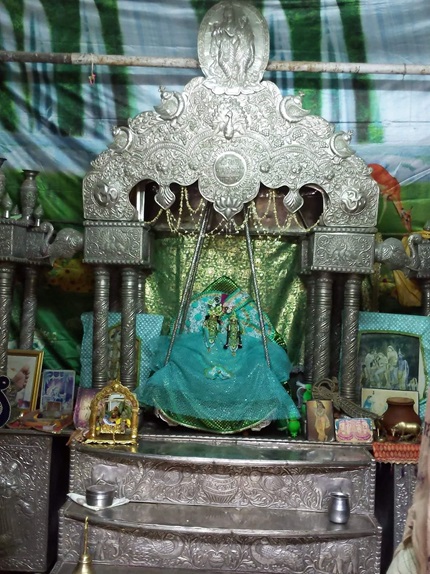
A small Māna-Mandira or shrine marks the place of this līlā. Nearby are a swing, a beautiful rāsa-maṇḍala, and the Ratnākara‐sarovara (jewel-like pond) symbolizing the transcendental setting of divine union .
According to Padma-Purāṇa, Brahmā performed austerities to witness these pastimes. Krishna pleased him by manifesting the hills of Brahmagiri as four peaks—Māna-Garh, Dāna-Garh, Vilas-Garh, and Bhaṅga-Garh, each commemorating different līlā-sthalas .
Objective3: To describe the preservation efforts of Māna Mandir Seva Sansthān under Śrī Ramesh Baba Ji Maharaj.
Māna Mandir Seva & Preservation Efforts
The temple is administered by the Māna Mandir Seva Sansthān under the guidance of Śrī Ramesh Baba Ji Maharaj, dedicated to preserving Braj’s spiritual legacy, restoring kunds, protecting sacred forests, and conducting Radha-Rāni Braj Yātrā (84-koś Parikrama) among many services to Braj-dham.
Objective4: To know about the temple darshan timings and important festivals.
Festivals & Darśan Timings
Darśan Hours:
Open daily from 7:00 AM to 9:00 PM .
Major Celebrations:
Rādhā‑Rāni Braj Yātrā (84‑Koś Parikrama) around Rādhā’s birth anniversary
Holi, Janmashtamī, and Rādhāshtamī draw thousands of devotees .
Objective5: To know the geographical location and various travel options to reach Vrinda Kund from nearby areas.
How to Reach
Located about 50 km northwest of Mathura (approx. 42 km from Vrindavan), and roughly 10 km from Nandgaon, this sacred hill temple is well‑signposted via Barsana–Govardhan route
Many pilgrims visit as part of the Barsana Parikrama (2‑kosi / 7 km circuit) that passes through principal sites—Radha‑Sarovar, Morkuṭī, Dāna‑Garh, Māna‑Mandir, and Vilas‑Garh.
Objective6: To understand the spiritual and scriptural references to Māna-Garh in Adī-Varāha Purāṇa.
*Excerpt from Adī-Varāha Purāṇa
deva-gandharvara-ramyāya rādhā-mān-vidhāyine
māna-mandir saṃjñāya namaṃste ratna-bhūmaye
Translation:
“obeisance to the gem-adorned site where divinities and gandharvas delight in Rādhā’s māna līlā”.
