
Objectives:
Objective 1: To know about the glories of Gopeshwar Mahadev.
Objective 2: To understand the relationship between Lord Siva and Lord Vishnu.
Objective 3: To know the confidential relationship between Srimathi Radharani and Sri Krishna.
Objective 4: To know about the story of Gopeshwar Mahadev.
Objective 5: To know about the relishing history of Vrindavan dham.
Objective 6: To know Gopeshwara at Hungry.
Objective 1: To know about the glories of Gopeshwara Mahadev.
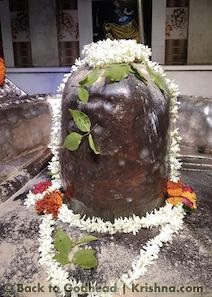
Though followers of Lord Shiva and Lord Krishna may appear to walk distinct spiritual paths, the deeper truth reveals a beautiful harmony. In Vrindavan, Lord Shiva assumes a most exalted role—as Gopeshwara Mahadeva, the divine guardian of the rasa-lila and the sacred abode of Sri Sri Radha-Krishna.
Gopeshwara Mahadeva: The Protector of Vrindavan
Srila Krishnadasa Kaviraja Goswami, the author of Sri Chaitanya-charitamrita, composed the revered bhajana Sri Vraja-dhama Mahimamrita, in which he sings:
“jaya jaya gopishwara vrindavana-majh”
“All glories, all glories to Gopeshwara Shiva, who resides in Vrindavan to protect the holy dhama.”
This verse encapsulates the deep reverence that Gaudiya Vaishnavas hold for Lord Shiva in his form as Gopeshwara. He is not merely a witness to the divine pastimes—he is their protector, ensuring that only those with pure devotion may enter the confidential realm of rasa-seva.
The Temple and Its Significance
The ancient Gopeshwara Mahadeva temple in Vrindavan is a sacred pilgrimage site, glorified in the writings of Srila Prabhupada and other Vaishnava acharyas. Devotees understand that before one can truly enter the spiritual mood of Vrindavan, one must first seek the blessings and permission of Gopeshwara Mahadeva. His presence reminds us that humility, purity, and sincere longing are prerequisites for tasting the nectar of Radha-Krishna’s lila.
A Lesson in Devotional Unity
Far from being separate, the worship of Lord Shiva and Lord Krishna converge in Vrindavan’s spiritual landscape.
Gopeshwara Mahadeva exemplifies the ideal devotee—renounced, surrendered, and fully dedicated to serving the Divine Couple.
Objective 2: To understand the relationship between Lord Siva and Lord Vishnu
Shiva Mahadeva is undoubtedly a very mysterious devotee of the Supreme Lord. Understanding and appreciating the intimate relationship between Lord Krishna and Lord Shiva is difficult but very important. Krishna advises us in the Bhagavad-gita not to worship the demigods for material profit, and this would include Lord Shiva, known as Mahadeva, the most prominent of all the devatas. However, the author of Chaitanya-charitamrita relates how Lord Chaitanya, appreciating Lord Shiva as the ideal Vaishnava, regularly visited the Shiva temple of Vishveshvara while staying in Varanasi. Kaviraja Goswami also tells of how Chaitanya Mahaprabhu visited all the prominent temples of Shiva on His journey to South India.
Objective 3: To know about Confidential Relationship with Srimathi Radha and Sri Krishna
One of the best ways to understand this perplexing relationship between Krishna and Shiva is by delving into the mysteries of Gopishwara. This specific manifestation of Lord Shiva has a particularly intimate and confidential relationship with Radha-Krishna. As a five-thousand-year-old shiva-linga deity, Gopishwara has long resided at the very heart of Vrindavan, pulsating with his mysterious energies. Gopishwara is still relevant today and will continue to be so for all future generations of Gaudiya Vaishnavas.
To appreciate Gopishwara Shiva is to recognize that Krishna consciousness is about the development of sacred love. The five chapters describing the dance of divine love known as the rasa-lila are the very cynosure of Srimad-Bhagavatam. Lord Krishna expands Himself into innumerable forms to dance with Srimati Radhika, the quintessential goddess of divine love. And Radharani expands Herself into countless gopis with varieties of personalities, all for the sake of fulfilling the Lord’s endless desire to enjoy loving exchanges.
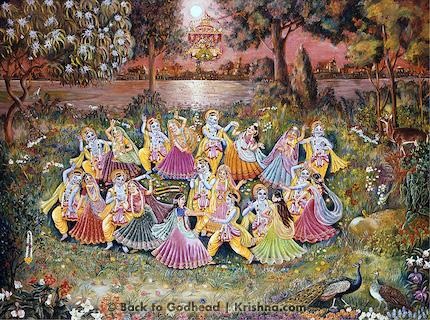
When arriving at the Los Angeles temple in May 1973, Srila Prabhupada said, “Unlimited happiness can be achieved when you go back home, back to Krishna. Krishna is eternal, and His pastimes are also eternal. Just join with Krishna, His rasa dance, His play with the cowherd boys, His dealing with His father and mother in Vrindavan. So, our, this movement is to join Krishna’s pastimes.”
The Hare Krishna movement embodies a tradition that deeply delves into the various aspects of a personal loving relationship with God. There is no other theology in the world that comes close to explaining the various nuances and subtleties of love for God. A devotee who through the standard practices of bhakti-yoga develops an inclination to go back to the eternal spiritual sky of Goloka Vrindavana to join Krishna and His associates must also appreciate that entrance into this exclusive transcendental realm of divine love requires complete purity of heart. Gopishwara Shiva, as the designated protector of Vrindavan, has the unique service of assisting all sincere devotees in their individual purification.
Objective 4: To know about the story of Gopeshwara Mahadev
The story of Gopeshwara comes from the Vaishnava text Garga-samhita and is very instructive for all Krishna bhaktas. It is told as follows.Once upon a time Lord Shiva, in deep meditation while on Mount Kailasa, heard the sweet melody of Lord Krishna’s flute. Absorbed in this extraordinary sound, Lord Shiva went into an even deeper samadhi and was transported to the transcendental abode of Vrindavan.When Lord Shiva entered that sacred realm, he observed Krishna as Gopinatha preparing for His rasa-lila dance. Shiva, with great excitement, desired to enter that unparalleled event. When he tried to enter the arena of the dance (rasa-mandala) near Vamsivata, however, he was stopped by Yogamaya, an expansion of Srimati Radharani.“If you want to take part in the rasa-lila,” Yogamaya informed him, “you have to first take permission from Vrinda-devi.”Yogamaya then took Lord Shiva to see Vrinda (also known as Tulasi), who then instructed him that because he was in a male form, he could not take part in the rasa dance. She explained that only females – gopis – are allowed to participate in this most exclusive pastime. Lord Krishna is the supreme enjoyer, or purusha, and He alone enjoys the rasa dance with the female (prakriti) gopi expansions of Srimati Radharani. Being in a male form, Lord Shiva naturally had the attitude of an enjoyer, unlike the gopis, who maintain the pure devotional attitude of being perpetually enjoyed by the supreme enjoyer, Lord Krishna.Shiva asked Vrinda-devi, “What must I do to get the form and mood of a gopi?”Vrinda-devi, taking the role of Shiva’s provisional guru, knew exactly what was needed. She brought him to Mana-sarovara Lake, where she instructed him to bathe. Dipping into the sacred waters, Shiva mysteriously emerged in the form of a beautiful gopi adorned with jewelry and mascara and dressed in an attractive sari. Vrinda-devi then took Lord Shiva in that alluring gopi form to a corner of the rasa-lila arena, where he/she stood and sincerely prayed to Radha-Krishna for pure prema-bhakti. (This prayerful attitude exemplifies the mood of a sincere devotee when chanting the Hare Krishna maha-mantra.).
In Srimad-Bhagavatam the rasa-lila is the quintessential pastime of the Supreme Lord. A devotee under the mentorship of a qualified guru gradually comes to the Tenth Canto and learns of this exalted dance of divine love. Devotees are warned not to prematurely jump to the Tenth Canto and read about the loving affairs of Krishna and the gopis as if these pastimes were mundane love affairs. The gopis have no tinge of desire for exploitive personal sense gratification. Only a mood of selfless service to please Krishna is found in their hearts.
When Srimathi Radharani and Sri Krishna and the gopis are dancing in the alluring moonlit forest, an aesthetically pleasing devotional atmosphere is created. The mood of divine love needs such a provocative ambience. On this occasion, Shiva in his gopi form was able to sneak in seemingly undetected and blissfully danced with Lord Krishna just as the other gopis were doing. (The regulated chanting of the Lord’s holy names can be perceived as a kind of sound representation of that sacred dance of love.)
After some time, Krishna took a short break. While resting, He said that He was not getting as much enjoyment as before. He told the gopis it seemed a strange man was in their midst.
Krishna requested Lalita-devi, “Could you please look and see if any man is somehow here?”
During this particular enactment of the rasa dance (which goes on repeatedly, eternally), the Supreme Lord knew something was out of the ordinary.
Lalita-devi started checking every gopi, but she could not detect that any man was present. She went back to Krishna and told Him that as far as she could see, there was no man present but there was a new and very attractive gopi who had three eyes.
“Please bring that gopi to Me,” Krishna said.
Questioning Lord Shiva in his gopi form, Krishna asked, “O Bholenatha [“lord of simple people”], what are you doing here?”
Krishna was thoroughly delighted to see Shiva as a gopi and kept laughing at the sight of him – the epitome of masculinity – manifest as a female.
The Lord then calmed down and told Lord Shiva, “O Gopishwara [lord of the gopis], actually I am very happy to see you in the form of a gopi. I give you the blessing that all the other gopis will offer you their respect and worship.”
After hearing this, Srimati Radharani, whose contrary nature is most pleasing to Krishna, became angry and told Him, “Who is this strange new gopi? You have never before called Me Gopishwara! But now You are calling this unknown girl Gopishwara and offering her Your benedictions. This is a great insult! I now want to immediately leave You and the rasa dance!”
Lord Krishna caught Radharani’s hand and said to Her, “Don’t be upset. This new gopi is actually Shiva Mahadeva in disguise. He has entered the rasa-mandala to enjoy loving exchanges with us. I hereby offer Gopishwara the position of dik-pala, the sacred protector of Sri Vrindavan-dhama and the rasa-lila. All of you should daily worship Sri Gopishwara to achieve the highest perfection of pure prema-bhakti.”
Directing His attention to Lord Shiva, Lord Krishna told him, “Now that you have taken part in the rasa-lila, I have a very important service for you. As the dik-pala for Vrindavan, you will guide all aspiring devotees to become free from their false ego and their male/purusha enjoying spirit. Your unique service is to be stationed at the gateway of Vrindavan as a transcendental security guard for the rasa dance. Many unqualified yogis, pseudo devotees, and mental speculators will want to join the rasa-lila, but you must protect its purity and sanctity. Such ineligible persons may be able to physically enter the holy land of Vrindavan in India, but only on an external level. Your service will be to allow selfless pure devotees to mystically enter spiritual Vrindavan.”
Krishna further told Shiva, “Only devotees who have no tinge of personal enjoyment, who are completely free from false ego, and who are ready to serve in all circumstances can be allowed to enter the circle of the rasa-lila.”
Lord Shiva happily accepted this service and benediction. As the topmost Vaishnava, his desire is to perpetually assist all variety of devotees in achieving their particular eternal perfection in relation to Radha-Krishna.
Objective 5: To know about the Relishing history of Vrindavan-dhama
Following in the footsteps of a pure spiritual master, sincere devotees learn how to approach Gopishwara when traveling to Vrindavan. Devotees may be able to enter and stay in Vrindavan-dhama, but their ability to relish this transcendental realm will depend on how much they have conquered false ego. Shiva Mahadeva, being in charge of the mode of ignorance, specializes in all issues related to ahankara, or material ego. As the lord of destruction, he mysteriously helps devotees destroy the tendency towards illusory materialistic enjoyment. For a devotee to achieve the eternal, real ego identity in relation to Lord Krishna, annihilation of the false ego is necessary.
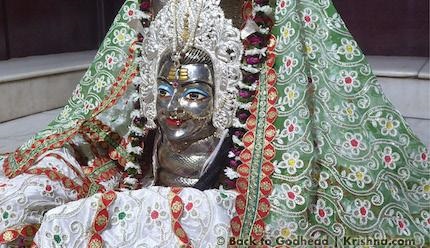
In modern Vrindavan, the ancient Gopishwara shiva-linga is worshiped as a male in the morning, and then in the afternoon and evening he is dressed in a sari and wears cosmetics and jewelry. This unique form of Shiva that is both male (Shiva) and female (Sakti) is known as Ardhanarishwara. Gopishwara teaches the metaphysical lesson that whether male or female, a devotee learns to be selfless and free from ahankara to develop pure love for Srila Rupa Goswami in his Mathura-mahatmya has advised a two-step procedure for entering the holy dhama. Before entering the town of Vrindavan, a sincere pilgrim seeking spiritual entrance should first offer prayers and respect to Bhuteshvara Mahadeva in the nearby town of Mathura. Along with Gopishwara, this ancient deity is said to have been established five thousand years ago by Vajranabha, the great-grandson of Lord Krishna.
For many centuries, Krishna devotees on pilgrimage to the sacred land of Vrindavan have followed Srila Rupa Goswami’s two-step procedure – a visit and prayers to Bhuteshwara in Mathura and then to Gopishwara in Vrindavan. All serious pilgrims to Sri Vrindavan-dhama are advised to follow this sagacious advice by Srila Rupa Goswami. Without the mercy of Lord Shiva, a devotee may be in the holy dhama but may experience it more like a tourist than a devotee-pilgrim seeking the intense sacred experiences that only Vrindavan can offer.
Objective 6: To know Gopeshwara in Hungary
At New Vraja Dhama, the ISKCON farm/temple in Hungary, Gopishwara has found a new manifestation. This flourishing community strives for the development of daiva-varnashrama, the Vedic cultural system based on cow protection, organic farming, simple living, high thinking, and self- sufficiency. In 2007, the community’s spiritual leader, His Holiness Shivarama Swami, established a marble outdoor shrine to Gopishwara that helps devotees deepen their appreciation for the gorgeous worship of Radha-Syamasundara, the resident deities. Gopishwara is not just a five-thousand-year-old shiva-linga situated in Vrindavan. He also embodies the transformative metaphysical principle of demolishing the negative qualities of false ego. For this reason the worship of Gopeshwara Mahadeva could be replicated in any devotee community that has consistent Radha-Krishna worship.
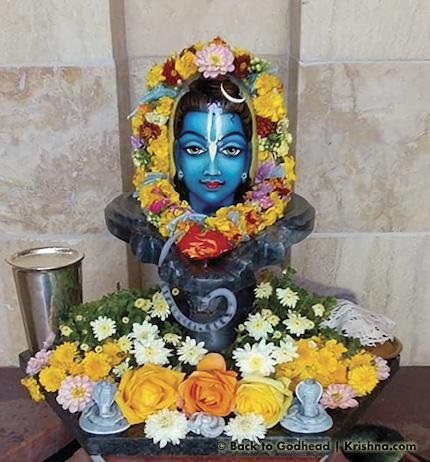
At New Vraja Dhama, Gopeshwara Shiva is venerated in a simple yet effective way using Ganges water. Lord Vamanadeva (Vishnu) accepted Mother Ganges on His feet, and that sacred water then fell on the head of Lord Shiva. Similarly, Gopishwara is lovingly worshiped and showered with Radha-Syamasundara’s bath water (charanaamrita)
