Objectives:
Objective 1: To learn about the historical and religious importance of Bhanke Bihariji .
Objective 4: To know the temple timings and rituals of the temple.
Objective 5: To understand various attractions of this place that makes it sacred.
Objective 6: To identify the main deity and observe key features of the temple exterior.
Objective 1: To learn about the historical and religious importance of Bhanke Bihariji
The story of Banke Bihari Temple is steeped in divine mysticism and devotion, primarily linked to Swami Haridas, a great saint, mystic, and musician of the 16th century, belonging to the Nimbarka Sampradaya. Swami Haridas was a contemporary of Tansen, the legendary musician in Emperor Akbar’s court, and was known for his unparalleled devotion to Lord Krishna and his consort, Radha.
Swami Haridas lived in Nidhivan, a dense grove in Vrindavan, where he spent his days in deep meditation and singing devotional songs (bhajans) in praise of the divine couple. It is said that his devotion was so pure and intense that Radha and Krishna would personally appear before him to listen to his kirtans.
One day, while Swami Haridas was performing his devotional practices in Nidhivan, his disciples requested him to reveal the divine vision he experienced. Upon their earnest plea, Swami Haridas sang a particular composition, and as he did, the divine couple, Radha and Krishna, appeared before them in their most enchanting form. This ethereal vision was so captivating that the disciples were mesmerized.
The divine couple, pleased with Swami Haridas’s devotion, merged into one, forming the captivating idol of Banke Bihari Ji. The word “Banke” means “bent in three places” (referring to Lord Krishna’s posture, bending at the neck, waist, and knee) and “Bihari” means “supreme enjoyer.” Thus, the idol embodies the combined charm of Radha and Krishna.
Initially, the idol was worshipped in Nidhivan itself. However, as the number of devotees grew, a need for a larger temple arose. The present temple was constructed in 1864 with the contributions of devotees, and the idol was moved from Nidhivan to its current location. The temple stands as a testament to Swami Haridas’s unwavering devotion and the divine grace of Lord Krishna.
Objective 2: To know about the presiding deities associated with Bhanke Bihariji temple and its architectural style .
The Temple Exterior:
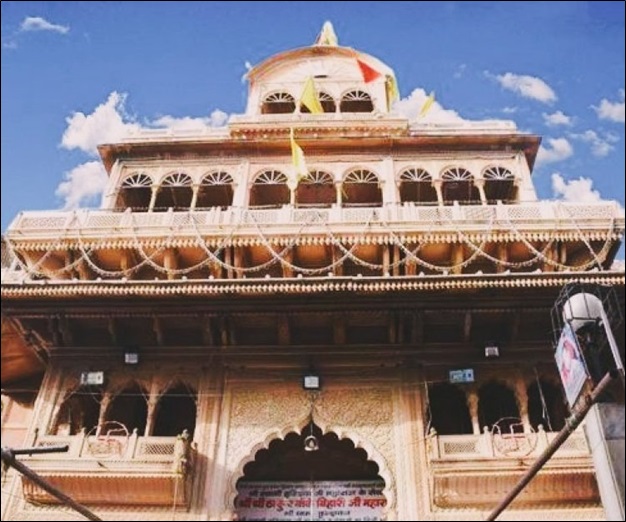
Notice the traditional Rajasthani architectural style, with its ornate carvings, arches, and a distinctive yellow-ochre color. The entrance is often bustling with devotees and vendors.
The Sanctum Sanctorum (Garbhagriha)
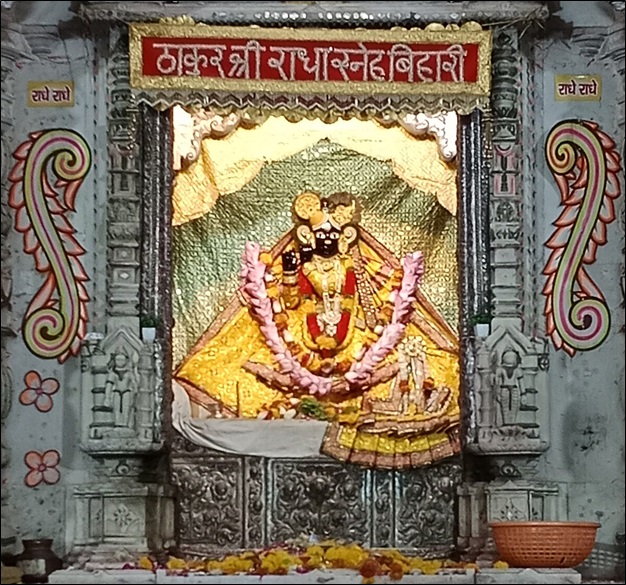
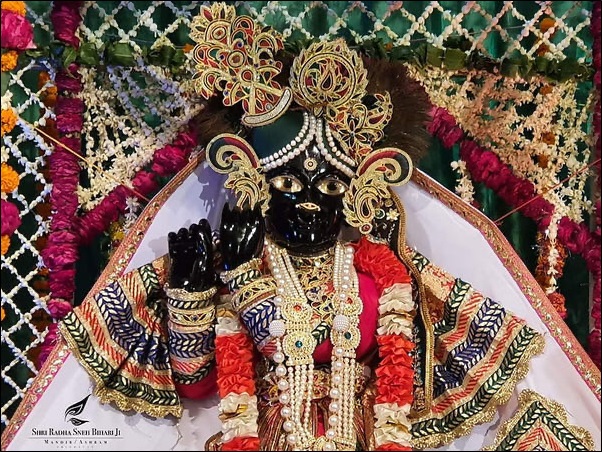
This is where the mesmerizing idol of Banke Bihari Ji resides. You’ll see images of the idol, often adorned with vibrant clothes, intricate jewelry, and fresh flowers. The idol’s unique “bent” posture is its most striking feature.
Devotees and Atmosphere:
Pictures will convey the vibrant atmosphere – the throngs of devotees, the sounds of bhajans, and the palpable sense of devotion.
Nidhivan:
Also look up images of Nidhivan, the original place where Banke Bihari Ji appeared. It’s a mystical grove with twisted trees, believed to be the site of Radha and Krishna’s divine pastimes.
Objective 3: To learn about the Pastime associated with Bhanke Bihariji temple ,unique style of the deity.
Banke Bihari Temple is unlike any other Krishna temple, offering a truly unique devotional experience:
The “Banke” Posture:
The idol of Banke Bihari Ji is a self-manifested (svayambhu) form, depicting Lord Krishna in a captivating Tribhanga (three-fold bent) posture. This unique stance, with its subtle smile and enchanting eyes, is believed to be so powerful that continuous gaze upon it can overwhelm a devotee with divine love.
The Curtain Darshan (Jhanki Darshan):
This is perhaps the most distinctive feature. The curtain in front of the deity is not kept open continuously. Instead, it is drawn shut and opened every few minutes. This tradition is said to be because the Lord’s beauty is so intense that if seen continuously, it could make a devotee lose consciousness or become completely absorbed, unable to return to worldly duties. It also signifies the fleeting nature of divine vision, urging devotees to cherish every glimpse.
Absence of Bells and Conch:
Unlike most Hindu temples, you will not hear the ringing of bells or the blowing of conch shells at Banke Bihari Temple. It is believed that the Lord dislikes the loud noise, as it might disturb his peaceful slumber. The devotees chant “Radhe Radhe” and other bhajans to express their devotion.
No Mangala Aarti:
The temple does not have the early morning Mangala Aarti (first aarti of the day) that is common in other temples. This is because it is believed that Banke Bihari Ji, like a child, should not be woken up too early. The first aarti, Shringar Aarti, happens later in the morning after the Lord has “woken up.”
Special Celebrations:
Holi: Vrindavan’s Holi is legendary, and Banke Bihari Temple is at its heart. The temple celebrates Holi with immense fervor, with devotees playing with colors and flowers. It’s an experience of pure joy and devotion.
Jhulan Yatra (Swing Festival): During the monsoon months, the temple celebrates Jhulan Yatra, where the deity is placed on a beautiful swing (jhula) and devotees take turns gently swinging the Lord, singing devotional songs.
Janmashtami: Lord Krishna’s birthday is celebrated with grand festivities, though the temple remains open only for a short period during the night for the actual birth celebration.
Atmosphere of Intimacy: The temple has a very intimate and personal feel. Devotees often feel a direct connection with the deity, as if interacting with a living child or friend. The energy is vibrant, filled with the chants of “Radhe Radhe” and the collective devotion of thousands.
Objective 4: To know the temple timings and rituals of the temple.
Best Time to Visit: Early morning (for Shringar Darshan) or late evening (for Shayan Darshan) can be less crowded, but the temple is always busy. Avoid peak festival times if you prefer less crowd, but if you want to experience the true spirit, festivals are the best.
Footwear: You will need to remove your shoes before entering the temple premises. There are hi shoe stands available.
Photography: Photography inside the main sanctum is generally restricted. Please respect the temple’s rules.
Personal Belongings: Be mindful of your belongings, especially in crowded areas.
Offerings: You can buy flowers, sweets, and other offerings from vendors outside the temple.
Embrace the Chants: Join in the chanting of “Radhe Radhe” – it’s an integral part of the experience.
Patience: Expect crowds, especially during festivals. Patience and a devotional mindset will enhance your experience.
Objective 5: To understand various attractions of this place that makes it sacred .
Deity: The temple is dedicated to Banke Bihari, a combined form of Radha and Krishna in a graceful Tribhanga(three‑bent) posture—Bent at the neck, waist, and knees—symbolizing playful divine beauty.
The idol is not just Krishna but the Yugala Roopa, meaning the combined form of Radha and Krishna.
Objective 6: Images of the deity and exterior of this temple
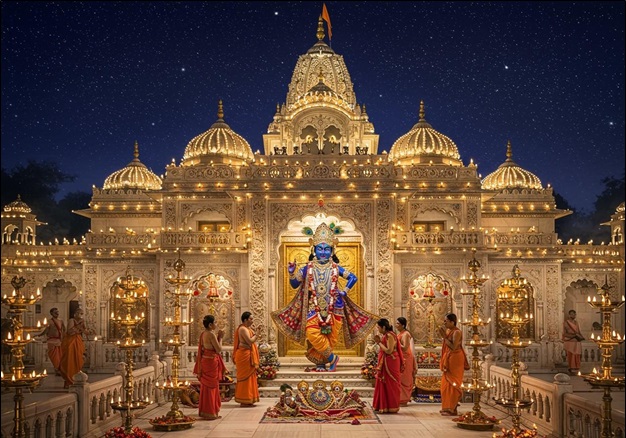
Here are beautifully varied images capturing the Sri Banke Bihari Mandir in Vrindavan:
The temple façade with its ornate Rajasthani‑style architecture
A night view illuminated and decorated for special observance
An aerial or wide-angle shot of the temple courtyard