
Objectives:
Objective 1: To highlight the spiritual significance and historical journey of the Amiya Nimai deity from Navadwip to Vrindavan.
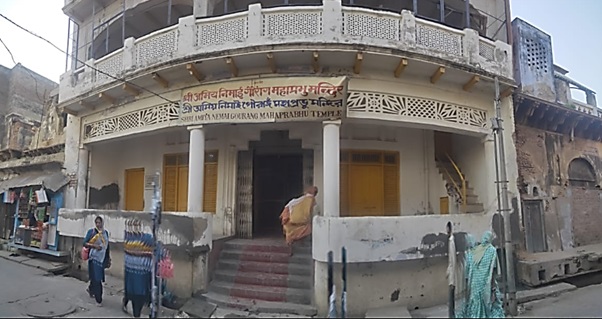
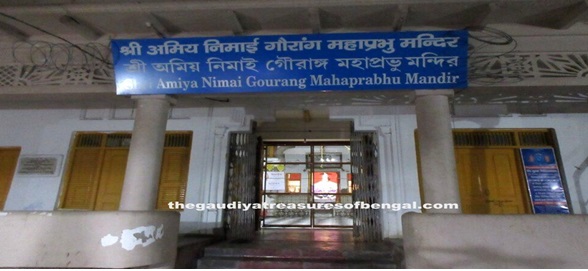
This Temple is located in Gopinath Bazar, Vrindavan.
The story of Amiya Nimai Mahaprabhu Temple in Gopinath Bazaar, Vrindavan begins with Shri Sarvabhauma Madhusudan Goswami, who was a devotee in the disciplic succession of Shrila Gopal Bhatta Goswami and a worshiper Radha Ramanai in Vrindavan.
Like Chaitanya Mahaprabhu, the deity of Amiya Nimai also came to Vrindavan on the Full Moon Day of Karthik (26 November 1926), Embracing the Sacred Aura and Mystical Charms.
Deity:
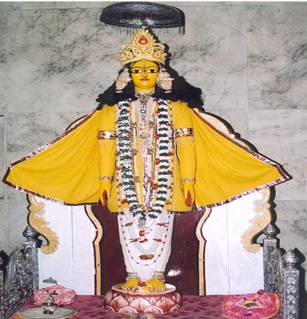
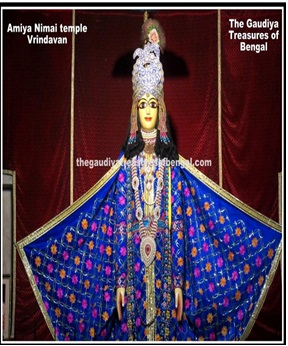
The temple houses a large, life-sized deity of Sri Chaitanya Mahaprabhu, also known as Amiya Nimai, which translates to “ambrosia” or “immortal”. Meaning of Amiya: “ambrosia” or “Immortal”
The Amiya Nimai Gauranga Mahaprabhu Temple in Vrindavan is dedicated to a large, life-sized deity of Sri Chaitanya Mahaprabhu, also known as Amiya Nimai, about 7 feet tall and is famous as “Bade Mahaprabhu Jee”. The temple is located in Gopinath Bazar and was established in 1956 after construction began around 1954. The deity was initially installed temporarily near the Radha Raman Temple before being moved to its current location.
History:
The deity was brought to Vrindavan on Kartik’s full moon day in 1926. It was initially housed temporarily near the Radha Raman Temple due to the lack of a dedicated temple. Later, it was moved to a location in Jugal Bagicha (Shah Ji’s temple garden).
பின்னர், ஜுகல் பாகிச்சா (ஷா ஜியின் ஆலய தோட்டம்) பகுதியில் மாற்றி வைக்கப்பட்டது.
This tall Deity of Sri Caitanya Mahaprabhu is well known throughout Vrindavan as Amiya Nimai. This Deity as installed by the priests from Radharaman Temple
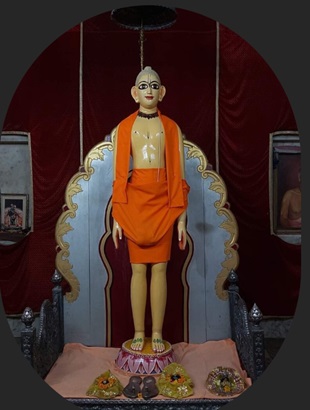
Mahaprabhu in Saffron robe
Objective 2: To highlight the spiritual significance of Sri Amiya Nimai (Sri Chaitanya Mahaprabhu) as worshiped in Vrindavan.
This Sri Amiya Nimai Temple is an important pilgrimage site for the followers of Chaitanya Mahaprabhu and Gaudiya Vaishnavism, celebrating the arrival of the deity in Vrindavan.
Temple Construction:
Around 1954, Sri Krishna Chaitanya Goswami, a devotee, initiated the construction of a dedicated temple for Amiya Nimai in Gopinath Bazar, Vrindavan.
Inauguration:
The temple was completed, and the deity ceremoniously installed in 1956.
In the disciple succession of Sri Gopal Bhatta Goswami, Sri Sarvabhauma Madhusudan Goswami got the privilege to worship the self-manifested deity of Sri Radha Ramanji in Vrindaban. He was a great scholar of nyaya (Sanskrit grammar),a preacher, a social reformer, and a great devotee.
During his life-time, he toured around various parts of India a number of times and thus spread the love of religion of Sri Mahaprabhu very vigorously.
In Navadwip, Sri Madhusudan obtained a very old life-sized deity of Sri Mahaprabhu, he has named “Sri Amiya Nimai Gauranga Mahaprabhu” to that deity. By Sri Madhusudan’s command and inspiration his great devotee and disciple, Sri Radha Govinda Goswami, got the same deity installed in Bag Bazar of Kolkata.
Objective 3: To preserve and disseminate the legacy of devotees like Sri Sarvabhauma Madhusudan Goswami and Sri Radha Govinda Goswami.
Sri Radha Govinda Goswami was born in a high class Brahmin family. His ancestors were great devotees of Sri Mahaprabhu. Sri Radha Govinda Goswami was highly skilled in music. The only means of his livelihood was the teaching of music. Whatever he earned by this work, he always spent in the service of Sri Mahaprabhu. All the Gaudiya devotees in Kolkata always honoured him. In the image of Sri Mahaprabhu, Sri Radha Govinda Goswami did not have the slightest feeling of a deity. He viewed and worshipped it as an actual manifestation of Sri Mahaprabhu.
When Sri Radha Govinda Goswami started growing older and older, he began to worry about the future worship of Sri Mahaprabhu. There was no successor in his family. Once in an infirm helpless condition, Sri Radha Govinda directly asked a question to Sri Mahaprabhu, “In the future, who and how will your service be performed ?” At night in the dream Mahaprabhu told him, “Stop worrying. Soon take me to Vrindaban where your Guru’s son lives”. Upon receiving this order in dream he wrote a letter to his Guru’s son Sri Krishna Chaitanya Goswami. He explained the order of Sri Mahaprabhu and requested him to arrange to take the deity of Sri Mahaprabhu to Vrindaban. Sri Krishna Chaitanya Goswami thought : “How will such a big deity be carried over to Vrindaban ? Where will it be seated ? In what way will its service and worship be arranged?” Therefore, he expressed some inability, but again Sri Radha Govinda Goswami wrote another letter and repeated his request. This way the exchange of letters continued between both for some time.
One day in the evening, while singing the “Geet Govinda” in front of Mahaprabhu’s deity Sri Radha Govinda Goswami left his body. For the local devotees it was a heart-rending tragedy. All began to worry, “How will the order of Sri Mahaprabhu of carrying away the deity to Vrindaban be executed ? Sri Radha Govinda Goswami had no successor. At once the police came along and sealed the place. Then the local devotees started doing the worship, mentally, and also offered Bhoga in front of the locked gate. Shortly afterwards, the police unlocked the gate and searched the whole place. The police found the exchange of correspondence between him and Sri Krishna Chaitanya Goswami concerning Sri Mahaprabhu’s deity and carrying him to Vrindaban and his will was in favor of Sri Krishna Chaitanya Goswami. On the basis of these documents the police wrote a letter to Sri Krishna Chaitanya Goswami requesting him to take off Mahaprabhu’ deity to Vrindaban. Now Goswamiji had no other alternative so he went to Kolkata. Over there he discussed this matter with his disciples, devotees, Sri Ramdas Babaji Maharaj and others.
In 1936, Sri Krishna Chaitanya Goswami, Sri Ramdas Babaji Maharaj and his followers, and the devotees of Sri Krishna Chaitanya Goswami as well as Sri Mrinal Kanti Ghosh, Sri Tushar Kanti Ghosh, Smt. Brij Bala Ghosh (Amrat Bazar Patrika Group, Kolkatta) accompanied the deity of Mahaprabu to Hathras by a reserved bogie of Toofan Train from Kolkata. At Hathras, the deity of Mahaprabhu was very profusely and heartily welcomed by the devotees. For four days, at Hathras, the deity was worshipped together with other devotional activities like Bhajan discourses etc. After that the deity was brought to Vrindaban by a truck.
About five hundred years ago, Sri Mahaprabhu himself arrived in Vrindaban on the full moon of Kartika. Exactly on the same day, 26th November 1926, on the full moon of Kartika, the deity of Sri Amiya Nimai Gauranga Mahaprabhu arrived in Vrindaban.
Objective 4: To create awareness about the temple’s cultural and devotional importance among the followers of Gaudiya Vaishnava community.
All the devotees and Vaishnavas extended unprecedented welcome by kirtan. Immediately no suitable spot over there was available for installing such a big deity of Sri Mahaprabhu. Outside the main gate of Sri Radha Raman Temple, in the room inside the “Raas Mandal” Mahaprabhu’s deity was seated, and the worship was performed. For about four or five years the worship of Mahaprabhu continued. Shortly afterwards, Sri Shah K.S. Gupta, (Present Servitor of Sri Shahji’s Temple, Vrindaban). His grandmother Smt. Ram Devi constructed two large rooms on the Yamuna bank which was then the garden of Shaji’s temple (also known as Jugal Bagicha). At this location, Mahaprabhu’s deity was seated, and for sixteen years Mahaprabhu remained at that spot.
Shri Chaitanya Mahaprabhu’s Appearance Day (Gaura Pumima)
This festival is celebrated for four days. On the first day, Vaishnavas perform adhivasa kirtan. On the second day, learned men recited Shri Chaitanya Charitamarta and other scriptures. On the third day, the pastime of Mahaprabhu’s birth is recited, and then an elaborate abhishek, bathing ceremony, of Mahaprabhu is conducted. Following that, prasadam is distributed amongst the devotees. Then on the last day there are feasts for the vaishnavas. In the evening there is a kirtan procession around the town carrying a painting of Mahaprabhu.
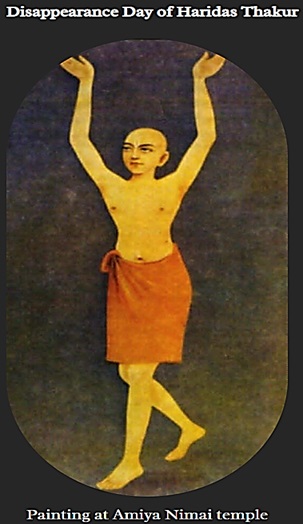
On this day, Mahaprabhu is dressed in the same mood He manifested on the occasion of Haridas Thakur’s disappearance. That day, Mahaprabhu went as a sannyasi beggar and collected alms and organized a feast for Haridas Thakur in Jagannath Puri. Thus, Amiya Nimai is dressed as a sannyasi on this day and carries a begging-bag in His hand. Special khichari bhoga is offered to Mahaprabhu and distributed among the devotees.
The program goes for four days. On the first day, adhivasa kirtan is performed by the followers of the late Ramdas Baba Ji Maharaha. These devotees come all the way from Nabadwip, Kolkata, and Puri to participate and extend their full cooperation for the festival. On the next day, learned scholars recite various scriptures aloud. On the third day, kirtans are performed telling the story of Akrura coming to Vrindavan. This particular subject is chosen because Mahaprabhu came to Akrura Ghat one day before his arrival in Vrindavan. After this, a feast is given to all of the vaishnavas. On the fourth day, which is the full moon day of Kartik month, Mahaprabhu’s pastimes of arriving in and touring Vrindavan are discussed. Then in the afternoon a kirtan procession goes out to the places in Vrindavan that Mahaprabhu visited on the day He first arrived. During this procession, various kirtans are performed that describe what Mahaprabhu felt when he saw the various pastime places of Shri Shri Radha Krishna. Then, after returning to the temple, full prasadam is distributed to all of the devotees.
Swing Festival
In the month of Sravana (July-August) from the day of Pavitraropani Ekadasi up to the full moon day, Amiya Nimai is daily pushed on a swing. Radharani Dress
The day after the full moon, Amiya Nimai is dressed up as Shrimati Radharani
Shree Amiya Nimai Gaurang Mahaprabhu Ki Jai!!!
Nearby Important Place to worship: Vilvamangala Thakur ji Samadhi
Objective 5: To create awareness to the devotees about ‘Bilvamangala Thakur’s Samadhi Mandir’ in Vrindavan near this temple.
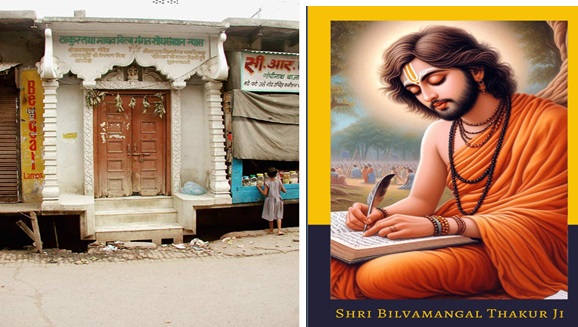
The Bilvamangala Thakur Samadhi Mandir is located in Vrindavan, specifically in Gopinath Bazar, near the Gopinath Temple. It is the final resting place of the 12th-century South Indian saint, Bilvamangala Thakur. He is also known as Vilvamangal Thakur. He is renowned for his devotion to Krishna and for writing the Krishna Karnamritam. His Samadhi (a shrine or tomb marking the place of cremation or burial of a holy person) is located in Gopinath Bazar, near the Gopinath Temple in Vrindavan
