Objectives :
Objective 1: To understand the cultural and religious role of Tadkeshwar Temple.
Objective 2: To know about the overall temple architecture.
Objective 3: To know about the symbolic significance of the brass Nandi statue at Tadkeshwar Temple.
Objective 1: To understand the cultural and religious role of Tadkeshwar Temple.
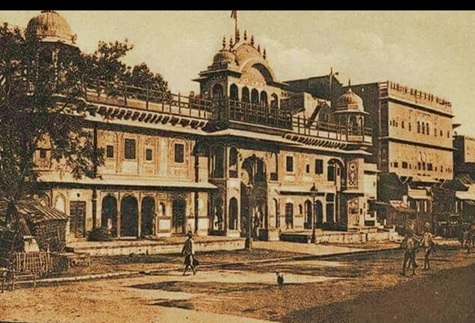
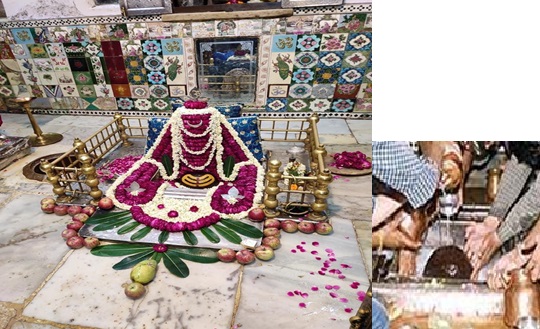
Tadkeshwar Temple is dedicated to Lord Shiva” and was built in 1784 A.D. As a focal point of local Shaivite worship, Tadkeshwar Temple is deeply woven into the ritual and festival life of the community. It is particularly revered during Mahashivaratri, when thousands of devotees come to offer prayers and perform abhishek to the ancient black stone Shivlinga, which measures 9 inches in diameter and is enshrined in the sanctum.
Objective 2: To know about the overall temple architecture.
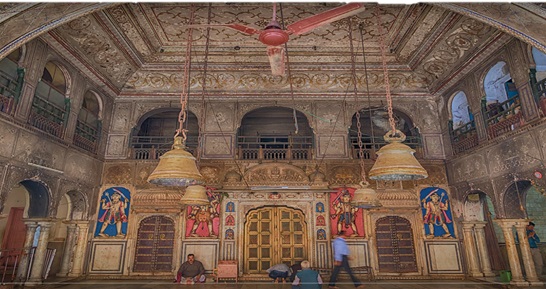
The Jagmohan hall at Tadkeshwar Temple plays a critical architectural and ritual role, functioning as the intermediate hall between the temple’s outer public spaces and the sacred garbhagriha (inner sanctum) where the Shivling is enshrined. Constructed with pillared supports and white marble flooring, the Jagmohan is designed to accommodate devotees during collective prayers, chanting, and ceremonies. Its central placement allows natural light and sound to flow harmoniously through the temple, enhancing the devotional ambiance without disrupting the inner sanctity of the garbhagriha.
Within the Jagmohan are installed four massive bronze gongs, each weighing around 125 kilograms, whose deep resonant tones during rituals enrich the acoustic environment and symbolically prepare worshippers for entering the divine presence of Lord Shiva.
Objective 3: To know about the symbolic significance of the brass Nandi statue at Tadkeshwar Temple.
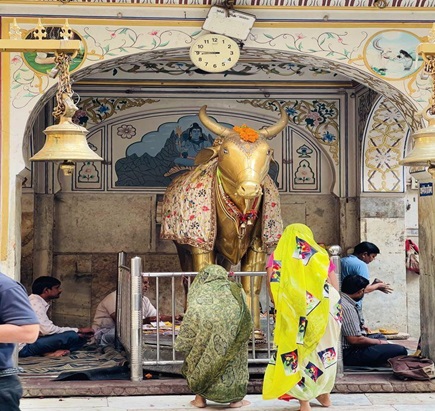
At the heart of the Tadkeshwar Temple courtyard sits a magnificent brass statue of Nandi, the vahana (divine vehicle) of Lord Shiva. Cloaked in decorative fabric and adorned with floral offerings, Nandi gazes directly toward the sanctum where the Shivalinga is installed. The shrine is beautifully decorated with painted flowers and traditional designs, combining Rajasthani art with holy symbols.
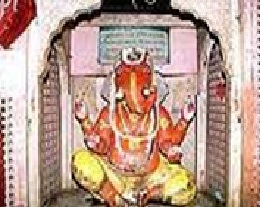
Objective 4: To learn about the spiritual significance of the Ganesh deity with a left-turned trunk .
This deity of Lord Ganesha is painted in vibrant orange-red and seated in a peaceful posture. A special feature of this deity is the left-curved trunk, which is considered highly auspicious.