
Objectives :
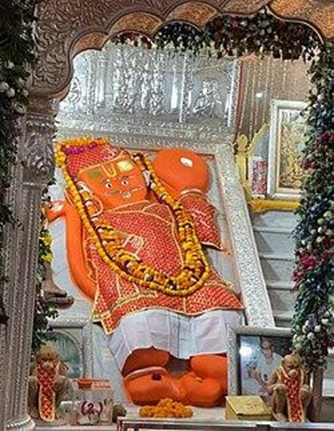 Shri Khole Ke Hanuman Ji Temple, Jaipur
Objective 1: To understand the rationale behind the name “Khole Ke Hanumanji” based on its geographical and historical context.
In the 60s, the city dwellers were not able to come here due to the fear of wild animals in the deserted place between the mountains and the rainy drain flowing in the cave of the eastern hills of the city. Then a courageous Brahmin went to this deserted place and discovered a huge statue of Hanumanji lying on the mountain. Seeing God in this deserted forest, the Brahmin started serving and worshipping Maruti Nandan Shri Hanuman ji here and did not leave that place till his death. Pandit Radhelal Choubey was the great devotee of Hanumanji of Khole. It is the result of Choubey ji’s tireless hard work throughout his life that this deserted place has become a picturesque tourist spot today. In 1961, Pandit Radhelal Choubey established Narwar Ashram Seva Samiti for the development of the temple. When this place was deserted, the rainwater used to flow here in the form of a cave from the cave of the mountains. That is why the temple was named Khole Ke Hanumanji.
Objective 2: To know the architectural style and structural design of the new temple edifice at Khole Ke Hanumanji.
This is a new building built in ancient fort style which has three floors in it. There is a big open square in front of the temple. Just to the right of the door, there is a marble mausoleum of Pandit Radhe Lal Choubey. In this grand three-storey temple, apart from Hanuman, there are separate and grand temples of Rama, Krishna, Ganesha, Gayatri and Valmiki. The paintings done on the walls and glass all around this temple are attractive.
In 2023, a rope way is also started here. Rajasthan state Governor Kalraj Mishra inaugurated it. This 436 meter long rope way from Annapurna Mata Temple to Vaishno Mata Temple situated on the hill has been built at a cost of Rs 18 crore. The height of this rope way, operated on five towers, is about 85 meters.
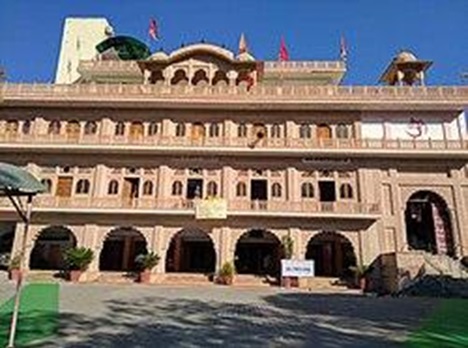
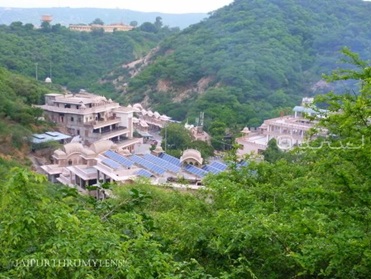
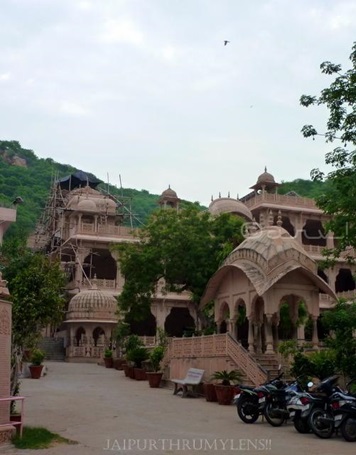
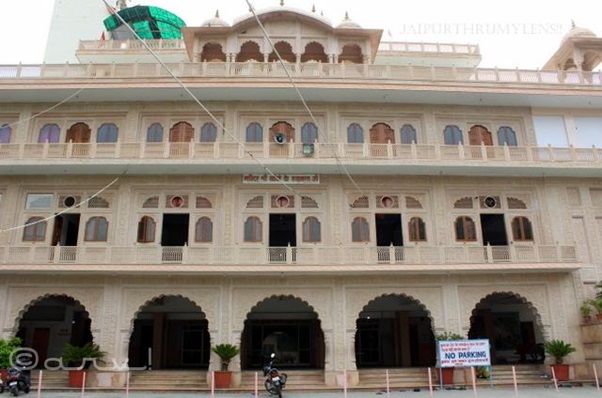 Made from Dholpur stone, a popular sandstone of Rajasthan,
it replicates the architecture of a bygone era.
Objective 3: To understand the cultural and spiritual significance of Sawamani Prasad as an offering at Hanuman temples.
Sawamani is an offering made in the Lord Hanuman temple by the devotees. Sawa means one and a quarter, Mani/Mun/Mann is an old Indian measurement system called Maund & equals 37.32 Kg. A Sawamani Prasad means 46.65 Kg of the offering. This is not usually followed strictly and is rounded off.
What is certain is the fact that Khole Ke Hanuman Ji Temple hosts a large number of “Sawamani” in Jaipur. The multiple kitchens here can serve thousands of visitors. Sawamani Prasaad is hosted in this Jaipur temple on a regular basis. This facility does make it very popular among devotees.
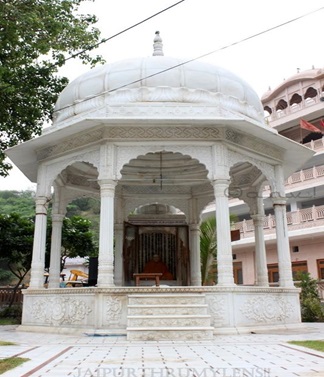 The marble Chhatri of the founder
– Pandit Radhey Lal Chaubey
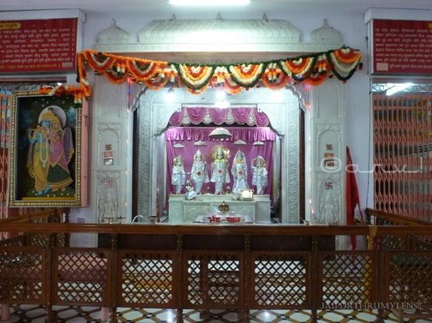 The Ram Darbar
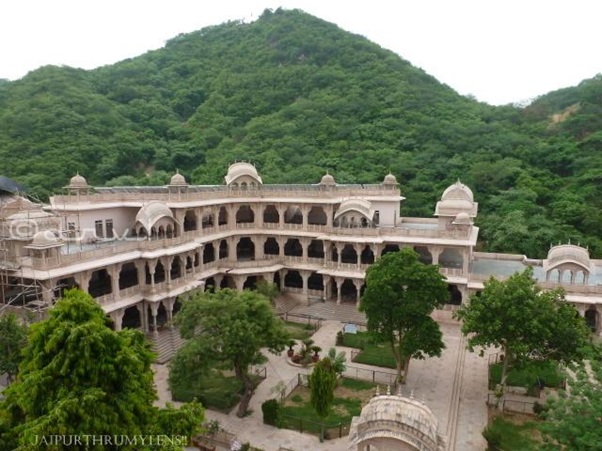 The Rasoi or kitchen section at
Khol Ke Hanuman Ji Temple
